
Most people meet their cholesterol numbers for the first time on a printout, with a doctor pointing at one line and saying "keep an eye on this." This guide is built around that moment: what counts as normal, borderline, and high for total cholesterol, LDL, HDL, and triglycerides, in both mg/dL and mmol/L, by age and sex, plus a worked example so you can calculate your own total cholesterol by hand. For what LDL and HDL actually are and how they work, see our LDL cholesterol and HDL cholesterol guides, or the full comparison — this post focuses entirely on the numbers.
What counts as a normal cholesterol level?
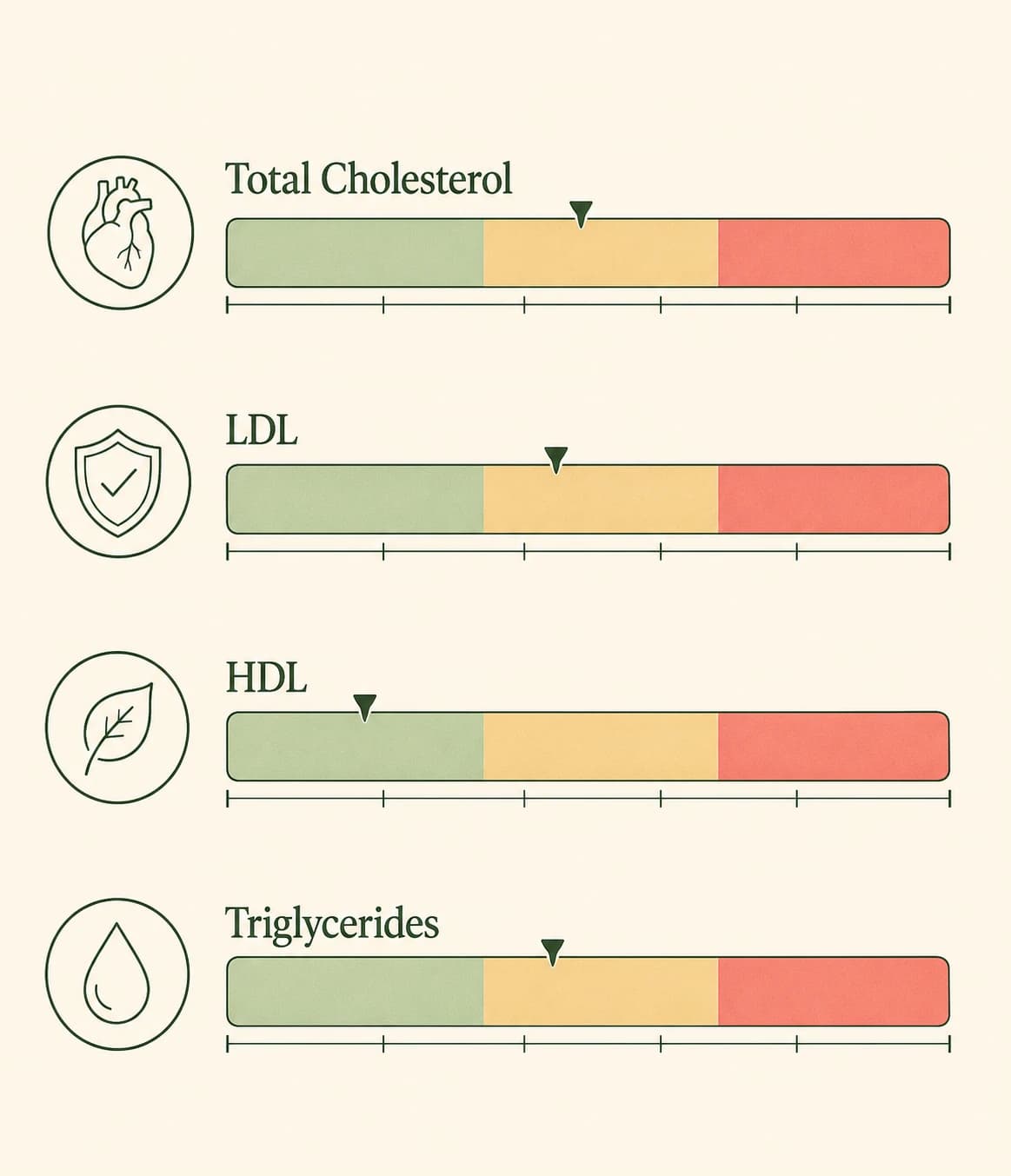
For most adults, total cholesterol under 200 mg/dL (5.2 mmol/L), LDL under 100 mg/dL (2.6 mmol/L), HDL of 60 mg/dL (1.6 mmol/L) or above, and triglycerides under 150 mg/dL (1.7 mmol/L) are the standard "desirable" screening categories used by MedlinePlus and Cleveland Clinic today (MedlinePlus; Cleveland Clinic).
Worth stating clearly before the chart: these are general-population screening categories, not personalized treatment targets. A newer guideline sets lower, risk-tiered LDL targets for people already being managed for cardiovascular risk — a distinction this post explains fully further down, so the two number sets don't get confused with each other.
Normal cholesterol levels: the full chart (mg/dL and mmol/L)
| Marker | Desirable | Borderline High | High | Very High |
|---|---|---|---|---|
| Total cholesterol | Below 200 mg/dL (5.17 mmol/L) | 200–239 mg/dL (5.17–6.18 mmol/L) | 240 mg/dL (6.21 mmol/L) or above | — |
| LDL cholesterol | Below 100 mg/dL (2.59 mmol/L) | 130–159 mg/dL (3.36–4.11 mmol/L) | 160–189 mg/dL (4.14–4.89 mmol/L) | 190 mg/dL (4.91 mmol/L) or above |
| Triglycerides | Below 150 mg/dL (1.69 mmol/L) | 150–199 mg/dL (1.69–2.25 mmol/L) | 200–499 mg/dL (2.26–5.63 mmol/L) | 500 mg/dL (5.65 mmol/L) or above |
| VLDL | Below 30 mg/dL (0.78 mmol/L) | — | 30 mg/dL (0.78 mmol/L) or above | — |
LDL and total cholesterol come from Cleveland Clinic's published cutpoints (LDL; total cholesterol and VLDL) — LDL also has a narrower "Elevated" band of 100–129 mg/dL (2.59–3.34 mmol/L) between Desirable and Borderline High that the summary table above simplifies out. Triglycerides come from NHLBI, which ties its "Very High" tier (500 mg/dL and above) specifically to a raised risk of acute pancreatitis, and lists a rare fifth "extremely high" tier above 1,500 mg/dL (16.93 mmol/L) tied instead to a separate condition called multifactorial chylomicronemia syndrome (NHLBI).
HDL runs the opposite direction, so it's shown separately: low is below 40 mg/dL (1.03 mmol/L) for men or below 50 mg/dL (1.29 mmol/L) for women; normal is 40–80 mg/dL (1.03–2.07 mmol/L) for men or 50–80 mg/dL (1.29–2.07 mmol/L) for women; and 60 mg/dL (1.55 mmol/L) or higher is generally considered the best range within normal (MedlinePlus; Cleveland Clinic).
You can verify every mmol/L figure yourself: divide a cholesterol number by 38.67, or a triglyceride number by 88.57 (NCBI Bookshelf, lipid conversion factors). For example, 200 ÷ 38.67 ≈ 5.17 mmol/L, and 150 ÷ 88.57 ≈ 1.69 mmol/L — exactly the figures in the table above.
Normal cholesterol levels by age (and why they're split by sex, not just age)
The biggest split isn't really by age within adulthood — it's by sex, and then separately by whether someone is under 19. For adults 20 and older, MedlinePlus gives men a total cholesterol target under 200 mg/dL, LDL under 100 mg/dL, non-HDL under 130 mg/dL, and HDL of 60 mg/dL or higher as best (below 40 mg/dL is low). Women share the same total, LDL, and non-HDL targets, but their HDL "low" cutoff is below 50 mg/dL rather than below 40 mg/dL. For anyone 19 or younger, every threshold drops: total cholesterol under 170 mg/dL, LDL under 110 mg/dL, non-HDL under 120 mg/dL, and HDL above 45 mg/dL (MedlinePlus).
Why the sex-specific HDL cutoff? Estrogen raises HDL cholesterol, an effect that's measurable enough that HDL levels in women fluctuate across the menstrual cycle, peaking around ovulation (NICHD) — which is part of why the "low HDL" threshold for women sits 10 mg/dL higher than the men's threshold rather than being identical.

On screening frequency: most children get a first cholesterol test between ages 9 and 11, most adults are retested roughly every 5 years, and testing typically becomes more frequent, around every 1–2 years, in the decades before and during menopause or andropause-adjacent ages, then annually after 65 or with existing risk factors (MedlinePlus). For the full walkthrough of what the test itself involves and current fasting guidance, see cholesterol test and lipid panel guide.
Triglycerides normal range, explained
Under 150 mg/dL (1.69 mmol/L) is normal for adults; 150–199 mg/dL is borderline high; 200–499 mg/dL is high; and 500 mg/dL (5.65 mmol/L) or above is very high. For children and teens (10–19), the normal cutoff is lower, under 90 mg/dL (NHLBI).
Triglycerides are more sensitive to your last meal than LDL or total cholesterol are, which is exactly why fasting has historically mattered more for this specific number. Triglyceride levels can shoot up 20–30% within hours of eating, enough to distort a reading taken shortly after a meal (Harvard Health Publishing). Triglycerides also carry their own cardiovascular weight rather than being a purely side number attached to the rest of the panel — NHLBI states plainly that elevated triglycerides "can raise your risk of heart disease and stroke" and, at very high levels, acute pancreatitis, which is why it's reported and managed as its own line on a lipid panel rather than folded into LDL or HDL (NHLBI).
What is a good total cholesterol level, exactly?
Under 200 mg/dL (5.17 mmol/L) is desirable; 200–239 mg/dL is borderline high; 240 mg/dL or higher is high (MedlinePlus; Cleveland Clinic).
One honesty note worth including rather than skipping: some sources describe a lower "floor" around 125 mg/dL as part of the normal range. We could not confirm this figure against MedlinePlus, NHLBI, Cleveland Clinic, or the American Heart Association — each of those states only a ceiling for total cholesterol ("below/under 200"), with no stated lower bound (WebMD, for the uncorroborated figure specifically). We're flagging this rather than silently repeating or silently dropping it, in keeping with this site's sourcing standard. Very low total cholesterol is its own separate topic, outside the scope of this guide, and isn't something to speculate about here.
How to calculate your total cholesterol
The standard formula, confirmed independently by the American Heart Association, StatPearls, and Harvard Health, is:
Total Cholesterol = LDL + HDL + (Triglycerides ÷ 5)
(The American Heart Association's own patient handout states it as "HDL + LDL + 20% Triglycerides," which is the identical relationship — 20% of a number is the same as dividing it by 5 (American Heart Association). The same underlying relationship, run in reverse to solve for LDL, is confirmed independently by StatPearls/NCBI Bookshelf and by Harvard Health Publishing.)
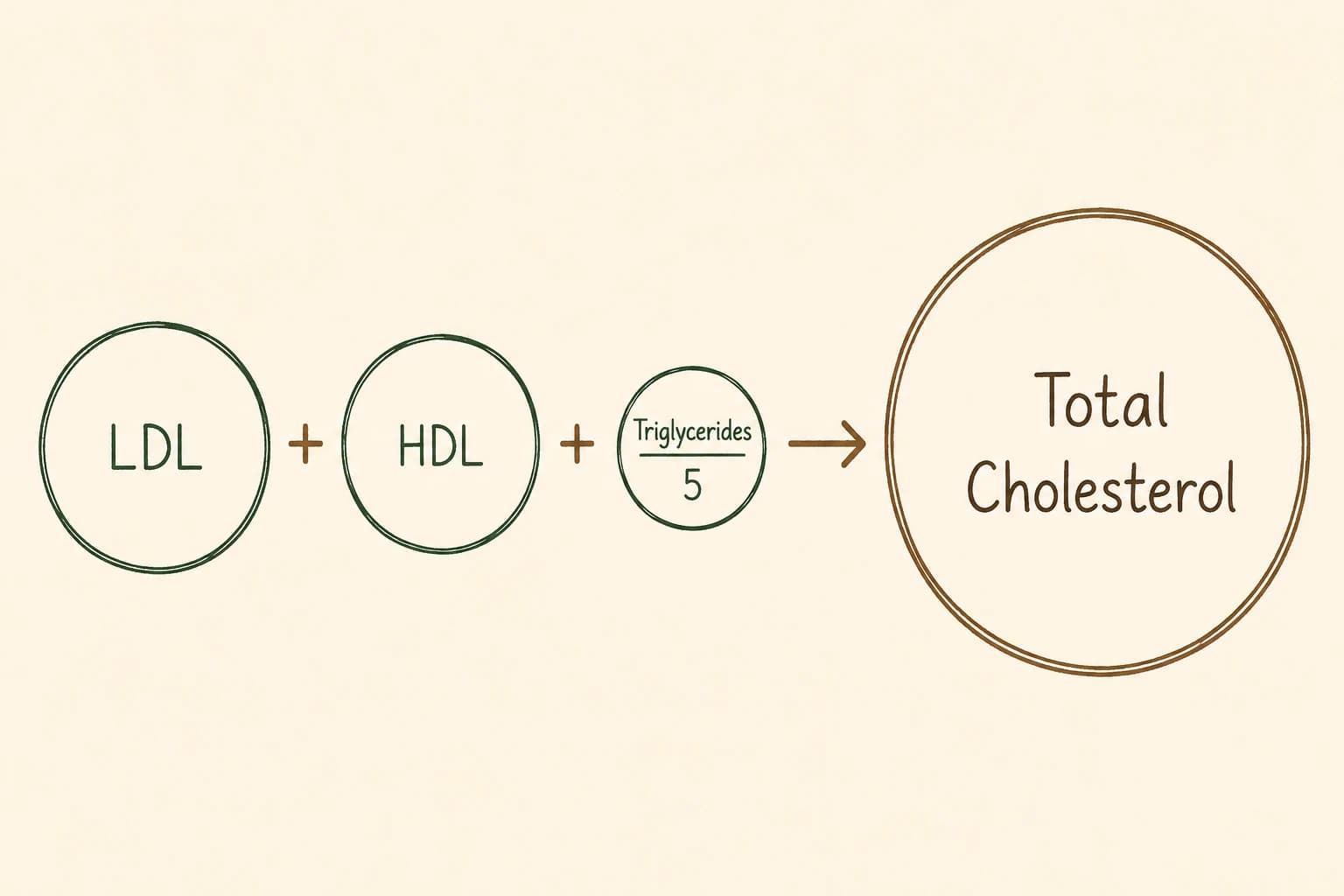
Here's a worked example with illustrative numbers. Say your results show LDL 110 mg/dL, HDL 55 mg/dL, and triglycerides 120 mg/dL:
- Triglycerides ÷ 5 = 120 ÷ 5 = 24
- Total = 110 + 55 + 24 = 189 mg/dL
189 mg/dL falls under the 200 mg/dL cutoff, so this example lands in the desirable category on the chart above.
One real limitation worth stating plainly: this formula is only accurate when triglycerides are below roughly 400 mg/dL and the sample is fasting or otherwise appropriately timed. Accuracy drops substantially at higher triglyceride levels, which is why very elevated triglycerides call for LDL to be measured directly rather than calculated this way (StatPearls/NCBI Bookshelf).
Non-HDL cholesterol: the number most people never hear about
Non-HDL cholesterol is your total cholesterol minus your HDL, and it captures LDL plus every other artery-affecting particle type, including VLDL, that LDL alone misses — especially useful when triglycerides run high. Cleveland Clinic gives the actual target numbers: below 130 mg/dL for an LDL goal under 100, below 100 mg/dL if the LDL goal is under 70, and below 120 mg/dL for children and teens (Cleveland Clinic). A further, even more precise marker called apoB, which counts artery-affecting particles directly, is described by Cleveland Clinic as "even more accurate at predicting risk than non-HDL" — worth knowing exists, though it's not part of a routine panel for most people.
The March 2026 guideline update: what actually changed
A March 13, 2026 guideline from the American College of Cardiology, the American Heart Association, and several partner societies retired the prior 2018 guideline on managing blood cholesterol (ACC.org). It's important not to conflate this with the desirable/borderline/high chart above: the new guideline sets risk-tiered LDL-C treatment goals for people already being managed for cardiovascular risk, not a replacement for the general-population screening categories. Under the new framework, the LDL target is below 100 mg/dL for people at borderline or intermediate risk, below 70 mg/dL for those at high risk, and below 55 mg/dL for people already living with cardiovascular disease or at very high risk. These are goals your clinician assigns based on your calculated risk, not numbers everyone should aim for by default, and reaching them often means weighing the cholesterol medications available alongside lifestyle changes.
Two more changes worth a one-line mention: the guideline moves toward Lp(a) — a separate, genetically-determined lipoprotein — being checked at least once in adulthood, and it states that a non-fasting lipid profile is now an acceptable baseline test for most people, with fasting reserved mainly for a nonfasting triglyceride result of 400 mg/dL or higher (Guideline Central, summarizing the 2026 ACC/AHA/Multisociety Dyslipidemia Guideline). For the full fasting and testing-day walkthrough, see cholesterol test and lipid panel guide.
When to get tested, and what to do with an abnormal number
Most adults are retested roughly every 5 years, more often with age or existing risk factors, as covered above. If a number comes back outside the desirable range, the next step is a conversation with your clinician about your broader risk profile, not a single fix based on one line of a printout — though our guide to lowering cholesterol covers the lifestyle and treatment approaches that conversation usually leads to. For symptoms, causes, and what an elevated result can mean day to day, see high cholesterol.
How this differs from your lipids and fat intake
This post is deliberately about the numbers on your report, not the biology of dietary fat. For the broader picture, saturated versus unsaturated fat, what triglycerides actually are as a class of lipid, and how your day-to-day eating pattern connects to these numbers, see our lipids explained guide.
Bottom line
Your printout gives you a number. This chart tells you which category that number falls into. What to actually do about it depends on your broader risk profile, family history, and existing health conditions, which is exactly what your clinician is there to calculate — no chart, including this one, replaces that conversation. For the fuller picture of what cholesterol is and does before any of these numbers, start with our cholesterol guide.
Frequently Asked Questions (FAQ)
What is a normal cholesterol level for my age? For most adults 20 and older, total cholesterol under 200 mg/dL (5.2 mmol/L), LDL under 100 mg/dL (2.6 mmol/L), and triglycerides under 150 mg/dL (1.7 mmol/L) are the standard desirable ranges; the biggest age-related difference is that ranges for people under 19 are lower across the board.
What is considered a good total cholesterol level? Under 200 mg/dL (5.2 mmol/L) is the desirable category; 200–239 mg/dL is borderline high, and 240 mg/dL or above is high, per MedlinePlus and Cleveland Clinic.
How do I calculate my total cholesterol from LDL, HDL, and triglycerides? Add your LDL and HDL, then add one-fifth of your triglycerides (triglycerides divided by 5) — for example, LDL 110 + HDL 55 + (120 ÷ 5 = 24) comes to a total cholesterol of 189 mg/dL.
What is a normal triglycerides range? Under 150 mg/dL (1.7 mmol/L) is normal for adults; 150–199 is borderline high, 200–499 is high, and 500 mg/dL or above is very high, per NHLBI.
Is 220 total cholesterol bad? A total cholesterol of 220 mg/dL falls in the borderline-high category (200–239 mg/dL), not the high category (240+) — worth discussing with a doctor, especially alongside your LDL and HDL numbers specifically, but not automatically alarming on its own.
Medical disclaimer: This article is for informational purposes only. Always consult a qualified healthcare provider before making changes to your health routine.
Sources
- MedlinePlus (National Library of Medicine, NIH). Cholesterol Levels: What You Need to Know. Updated May 5, 2025. https://medlineplus.gov/cholesterollevelswhatyouneedtoknow.html
- MedlinePlus (National Library of Medicine, NIH). Cholesterol Levels — Lab Test. Updated October 15, 2024. https://medlineplus.gov/lab-tests/cholesterol-levels/
- Cleveland Clinic. LDL Cholesterol — Health article. https://my.clevelandclinic.org/health/articles/24391-ldl-cholesterol
- Cleveland Clinic. HDL Cholesterol — Health article. https://my.clevelandclinic.org/health/articles/24395-hdl-cholesterol
- Cleveland Clinic. Cholesterol Numbers: What Do They Mean? — Health article. https://my.clevelandclinic.org/health/articles/11920-cholesterol-numbers-what-do-they-mean
- Cleveland Clinic. Lipid Panel — Diagnostics. https://my.clevelandclinic.org/health/diagnostics/17176-lipid-panel
- Cleveland Clinic. Non-HDL Cholesterol — Health article. https://my.clevelandclinic.org/health/articles/non-hdl-cholesterol
- National Heart, Lung, and Blood Institute (NIH). High Blood Triglycerides. Updated April 19, 2023. https://www.nhlbi.nih.gov/health/high-blood-triglycerides
- American Heart Association. Check. Change. Control. Cholesterol — Patient handout PDF. https://www.heart.org/-/media/Files/Health-Topics/Cholesterol/Cholesterol-Score-Explained-English.pdf
- StatPearls / NCBI Bookshelf (NIH). Cholesterol Levels. Last update July 24, 2023. https://www.ncbi.nlm.nih.gov/books/NBK542294/
- Harvard Health Publishing. Making Sense of Cholesterol Tests. Published May 14, 2022. https://www.health.harvard.edu/heart-health/making-sense-of-cholesterol-tests
- NCBI Bookshelf (AHRQ). Lipid Conversion Factors, Appendix A. https://www.ncbi.nlm.nih.gov/books/NBK83505/
- American College of Cardiology. ACC/AHA Release New Clinical Guideline for Managing Dyslipidemia — Journal scan, published March 13, 2026. https://www.acc.org/latest-in-cardiology/journal-scans/2026/03/13/15/20/acc-aha-release-new-clinical-guideline-for-managing-dyslipidemia
- Guideline Central. Summary of the 2026 ACC/AHA/Multisociety Dyslipidemia Guideline. https://www.guidelinecentral.com/guideline/5099440/
- WebMD. How to Interpret Cholesterol Numbers. Reviewed April 24, 2026. https://www.webmd.com/cholesterol-management/understanding-numbers
- Eunice Kennedy Shriver National Institute of Child Health and Human Development (NICHD, NIH). Women's Total Cholesterol Levels May Rise and Fall with Phases of Menstrual Cycle. Published August 10, 2010. https://www.nichd.nih.gov/news/releases/Pages/081010-womens-cholesterol-levels.aspx

Olivia Smith, RDN
A registered dietitian who has sat across from a lot of confusing lab printouts.