
A cholesterol test is a routine blood draw, but the instructions around it changed meaningfully in 2026, and most patient-facing pages haven't caught up yet. This guide covers what the test actually measures, whether you need to fast beforehand under the current guidance, how to read your results line by line, and how often to get tested. For what cholesterol is and what LDL and HDL do in your body, see our cholesterol guide — this post is about the test itself.
What a Cholesterol Test (Lipid Panel Test) Actually Measures
A cholesterol test, also called a lipid panel test or lipid profile, is a single blood draw that reports total cholesterol, LDL, HDL, triglycerides, and a calculated non-HDL figure, all from one sample run in one lab pass (MedlinePlus).
Do You Need to Fast Before Your Cholesterol Check? The New 2026 Guidance
For most people, no. A March 13, 2026 update from the American College of Cardiology, the American Heart Association, and several partner societies sets risk-tiered LDL-C treatment goals for people already being managed for cardiovascular risk (ACC.org) — and recommends "a standard nonfasting or fasting lipid profile" to document baseline lipid levels, reserving a fasting sample for people with a family history of dyslipidemia or premature ASCVD, a known or suspected disorder of triglyceride metabolism, or a non-fasting triglyceride result of 400 mg/dL or higher (Guideline Central, summarizing the 2026 ACC/AHA/Multisociety Dyslipidemia Guideline). A separate summary of the same guideline also describes fasting being retained for at-risk children with a strong family history — a detail we could not confirm against the Guideline Central summary, so treat it as less firmly established than the three criteria above (MedScriptum). The guideline's March 2026 date and its retirement of the prior 2018 guideline are independently confirmed by the National Lipid Association (NLA).
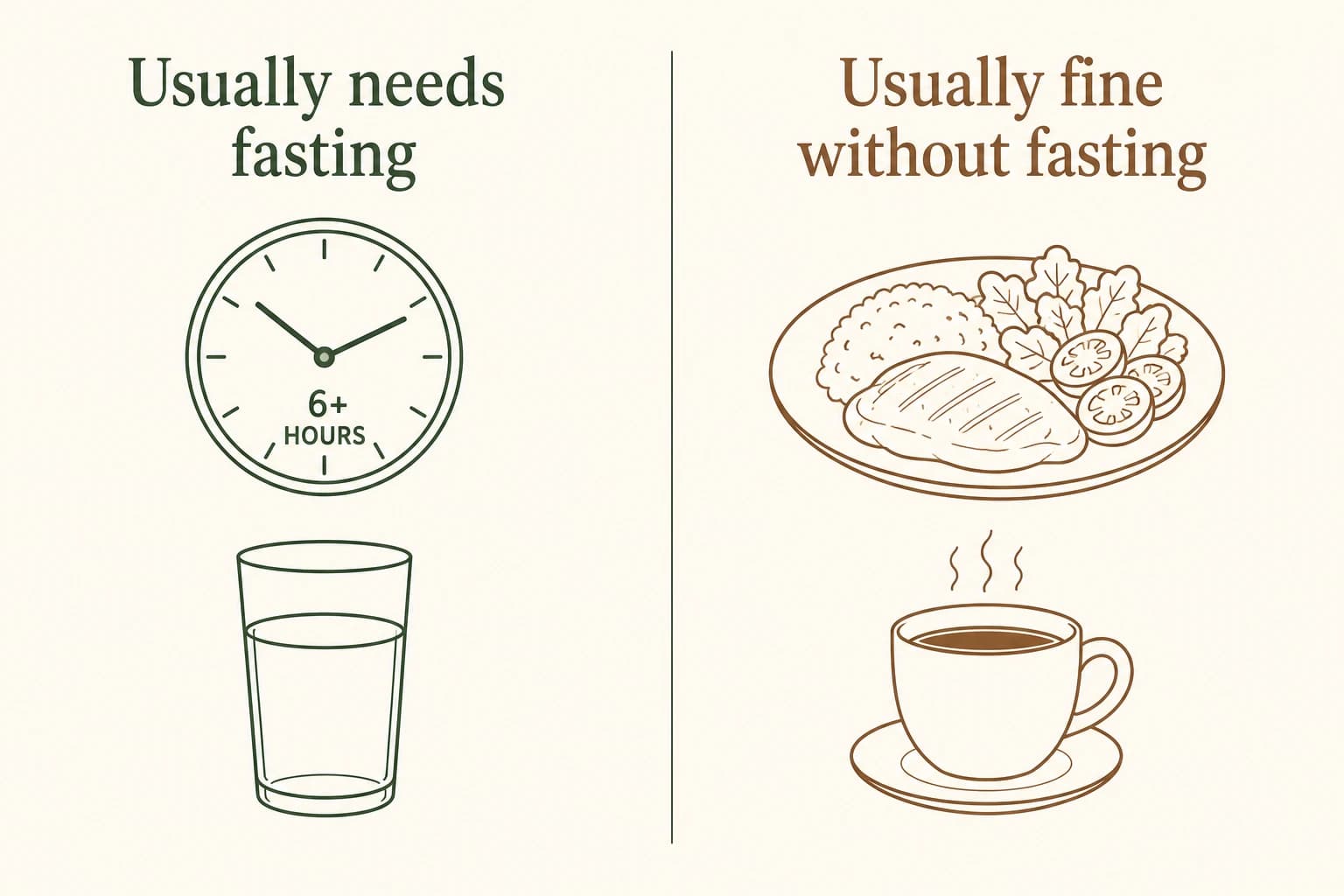
The old fasting rule wasn't arbitrary: triglycerides can spike 20–30% within hours of a meal, distorting a reading taken shortly afterward, and it's LDL's calculation, not a direct measurement, that gets thrown off by that spike (Harvard Health Publishing). LDL itself can also be measured directly on a non-fasting sample when needed.
Most patient-facing pages simply haven't caught up to the specifics yet. As of this writing, Cleveland Clinic's own lipid panel page still leads with a 10-to-12-hour fasting instruction as the default, only noting afterward that "in some cases, getting a lipid panel test without fasting is possible" and advising patients to ask their provider in advance rather than explaining when fasting genuinely is or isn't needed; MedlinePlus's lab-test page similarly only softly hedges that you "may need to fast" (Cleveland Clinic; MedlinePlus). In practice, confirm with your own clinician or lab before your appointment, since not every practice has updated its instructions to reflect the new guidance yet.
How to Read Your Lipid Panel Results, Line by Line
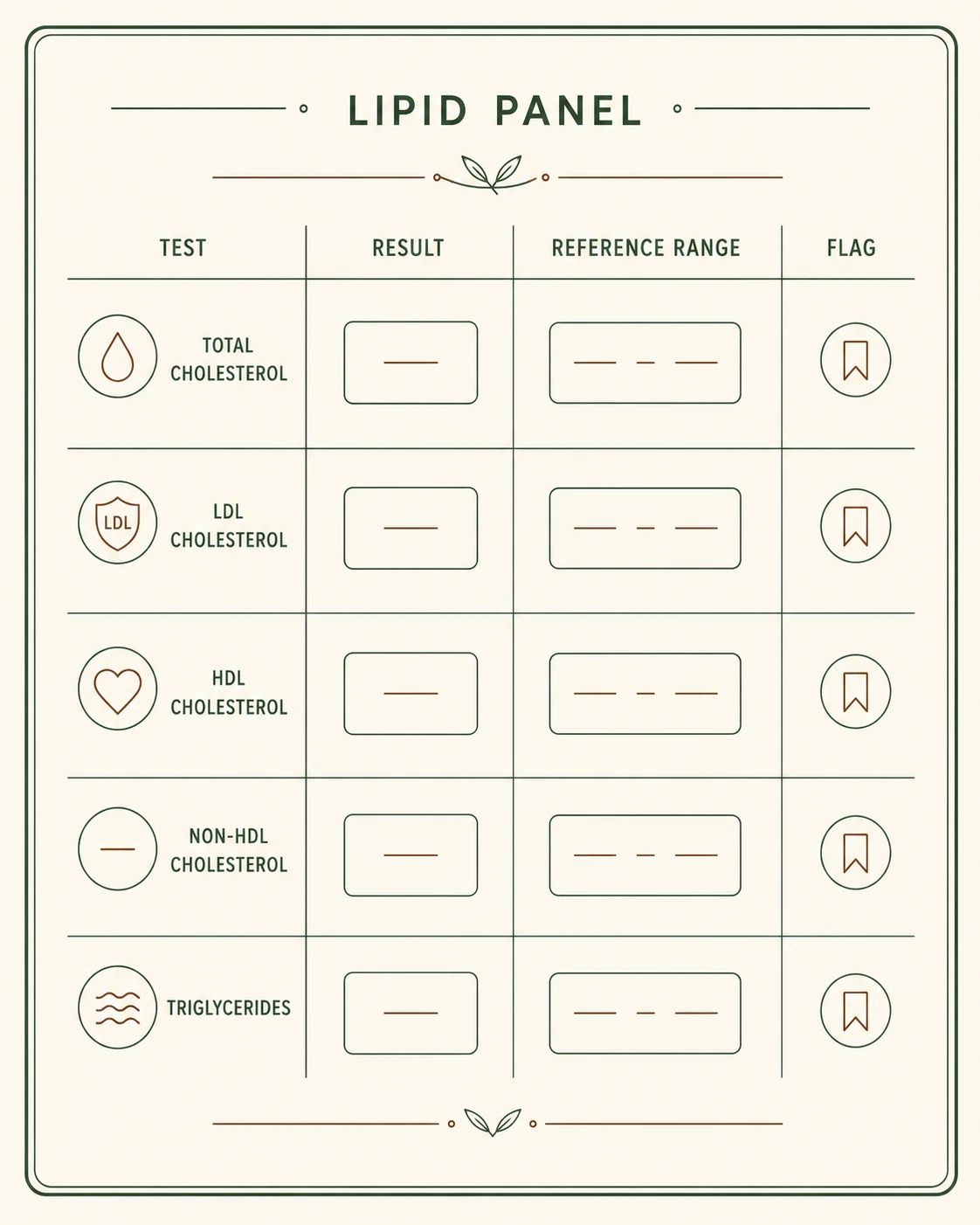
A lipid panel report lists each marker's name, your number, a reference range, and a flag showing whether you're high, low, or within range. Here are the adult screening categories for each line, in both mg/dL and mmol/L:
| Marker | Desirable / Normal | Borderline High | High |
|---|---|---|---|
| Total cholesterol | Below 200 mg/dL (5.17 mmol/L) | 200–239 mg/dL (5.17–6.18 mmol/L) | 240 mg/dL (6.21 mmol/L) or above |
| LDL cholesterol | Below 100 mg/dL (2.59 mmol/L) | 130–159 mg/dL (3.36–4.11 mmol/L) | 160 mg/dL (4.14 mmol/L) or above |
| HDL cholesterol | 60 mg/dL (1.55 mmol/L) or above is best | Below 40 mg/dL (1.03 mmol/L) men / below 50 mg/dL (1.29 mmol/L) women is low | — |
| Non-HDL cholesterol | Below 130 mg/dL (3.36 mmol/L) | — | 130 mg/dL (3.36 mmol/L) or above |
| Triglycerides | Below 150 mg/dL (1.69 mmol/L) | 150–199 mg/dL (1.69–2.25 mmol/L) | 200 mg/dL (2.26 mmol/L) or above |
The LDL, HDL, non-HDL, and desirable total-cholesterol figures come from MedlinePlus's adult reference tables (MedlinePlus) and Cleveland Clinic's non-HDL target (Cleveland Clinic); the total-cholesterol borderline-high and high tiers come from Cleveland Clinic's numbers overview (Cleveland Clinic). You can check the mmol/L column yourself: divide a cholesterol figure by 38.67, or a triglyceride figure by 88.57 (NCBI Bookshelf, lipid conversion factors).
Total cholesterol itself is a simple sum: HDL + LDL + 20% of triglycerides, per the American Heart Association's own patient handout (AHA). What most people don't realize is that the LDL line on a routine report usually isn't measured directly — it's calculated from your total cholesterol, HDL, and triglycerides using the Friedewald formula. That calculation is reliable under normal conditions, but it becomes unreliable once triglycerides run high, roughly 400 mg/dL or above, which is when a lab may switch to directly measuring LDL instead (StatPearls / NCBI Bookshelf).
One distinction worth keeping sharp: the risk-tiered LDL-C targets from the March 2026 guideline mentioned above (below 100, 70, or 55 mg/dL depending on cardiovascular risk category) are treatment goals for people already being managed for heart-disease risk — they are not a replacement for the general-population screening categories in the table above, and conflating the two number sets is a real, easy mistake to make given how close some of the figures are. For the full age-stratified breakdown of every marker, see normal cholesterol levels; for the broader lipid-panel and dietary-fat framing, see our lipids explained guide.
How Often Should You Get a Cholesterol Test?
Most people get a first test between ages 9 and 11, then repeat testing roughly every 5 years through most of adulthood (MedlinePlus). Cleveland Clinic's own age-and-sex breakdown narrows that further for midlife and older adults: men 45–65 and women 55–65 are generally tested every 1–2 years, and everyone 65 and older is tested annually (Cleveland Clinic). The two sources frame it slightly differently, which is worth knowing if you're comparing advice from different places rather than assuming one is wrong.

Who Should Get Tested More Often
People with a family history of early heart disease or high cholesterol, existing cardiovascular disease, diabetes, obesity, or who smoke are typically tested more often than the general schedule above, as are people already on cholesterol medication, since retesting is how a clinician checks whether it's actually working. Familial hypercholesterolemia is one specific reason for earlier and more frequent testing: it's more common than most people assume, with estimates ranging from roughly 1 in 250 to 1 in 311 depending on which population study is used (CDC Office of Genomics and Precision Health).
What to Expect During the Test and How to Prepare
The test itself is a standard arm blood draw, typically over in a few minutes. Preparation is minimal now that fasting is optional for most people, per the guidance above — beyond that, it carries the same ordinary, minor risks as any lab blood draw, like brief discomfort at the needle site or occasional light bruising.
What Happens Next If Your Results Are Abnormal
An abnormal flag on one line doesn't automatically mean medication. A clinician typically looks at your full risk picture, sometimes repeats the test to confirm, and discusses lifestyle or treatment options based on your personal risk category rather than reacting to a single flagged number in isolation (Cleveland Clinic). For what an elevated result can actually mean and what typically happens next, see high cholesterol; for the numbers-based lifestyle side of the picture, see the full lifestyle-changes breakdown.
Frequently Asked Questions (FAQ)
Do I really need to fast before a cholesterol test now that the guidelines have changed? For most people, no. A March 2026 guideline update states a non-fasting lipid profile is an acceptable baseline test for most people; fasting is still wanted mainly if triglycerides are already suspected to run very high, a genetic lipid disorder is suspected, or for at-risk children. Confirm with your own clinician or lab, since not every practice has updated its instructions yet.
Is there such a thing as total cholesterol being too low? Very low total cholesterol is its own separate topic that most major sources don't address with a specific numeric floor — the standard guidance states only an upper ceiling for "normal" (under 200 mg/dL), not a lower bound, so this isn't something to self-diagnose from a single numeric threshold.
Is a "lipid panel" a different test from a "cholesterol test"? No, they're the same blood draw — "lipid panel" and "lipid profile" are the clinical names for what's commonly called a cholesterol test, and both report the same set of markers.
Why does my report show a "calculated" LDL instead of a directly measured number? Most routine labs calculate LDL from your total cholesterol, HDL, and triglycerides using a formula rather than measuring it directly, because it's simpler and less costly — but that calculation becomes unreliable at high triglyceride levels, which is when a lab may switch to direct LDL measurement instead.
How often should I get tested if I have no known risk factors? Roughly every 5 years for most adults 20 to 65 without risk factors, shifting to about every 1–2 years for men 45–65 and women 55–65, and annually after 65.
Medical disclaimer: This article is for informational purposes only. Always consult a qualified healthcare provider before making changes to your health routine.
Sources
- MedlinePlus (National Library of Medicine, NIH). Cholesterol Levels — Lab Test. https://medlineplus.gov/lab-tests/cholesterol-levels/
- American College of Cardiology. ACC/AHA Release New Clinical Guideline for Managing Dyslipidemia — Journal scan, published March 13, 2026. https://www.acc.org/latest-in-cardiology/journal-scans/2026/03/13/15/20/acc-aha-release-new-clinical-guideline-for-managing-dyslipidemia
- Guideline Central. Summary of the 2026 ACC/AHA/Multisociety Dyslipidemia Guideline. https://www.guidelinecentral.com/guideline/5099440/
- MedScriptum. 2026 ACC/AHA Guideline for the Management of Dyslipidemia — Summary (secondary summary; used only for the at-risk-children detail, flagged in-body as unconfirmed). https://medscriptum.org/en/2026-acc-aha-guideline-for-the-management-of-dyslipidemia/
- National Lipid Association. 2026 ACC/AHA/Multisociety Dyslipidemia Guideline Released. https://www.lipid.org/nla/2026-accahamultisociety-dyslipidemia-guideline-released
- Harvard Health Publishing. Making Sense of Cholesterol Tests. https://www.health.harvard.edu/heart-health/making-sense-of-cholesterol-tests
- Cleveland Clinic. Lipid Panel — Diagnostics. https://my.clevelandclinic.org/health/diagnostics/17176-lipid-panel
- MedlinePlus (National Library of Medicine, NIH). Cholesterol Levels: What You Need to Know. https://medlineplus.gov/cholesterollevelswhatyouneedtoknow.html
- Cleveland Clinic. Non-HDL Cholesterol — Health article. https://my.clevelandclinic.org/health/articles/non-hdl-cholesterol
- American Heart Association. Check. Change. Control. Cholesterol — Patient handout PDF. https://www.heart.org/-/media/Files/Health-Topics/Cholesterol/Cholesterol-Score-Explained-English.pdf
- StatPearls / NCBI Bookshelf (NIH). Cholesterol Levels. https://www.ncbi.nlm.nih.gov/books/NBK542294/
- NCBI Bookshelf (AHRQ). Lipid Conversion Factors, Appendix A. https://www.ncbi.nlm.nih.gov/books/NBK83505/
- Cleveland Clinic. Cholesterol Numbers: What Do They Mean? — Health article. https://my.clevelandclinic.org/health/articles/11920-cholesterol-numbers-what-do-they-mean
- CDC Office of Genomics and Precision Health. How Common Is FH? — Genomics and Precision Health Blog, published January 25, 2021. https://blogs.cdc.gov/genomics/2021/01/25/how-common-is-fh/

Olivia Smith, RDN
A registered dietitian who spends a lot of visits translating lab printouts.