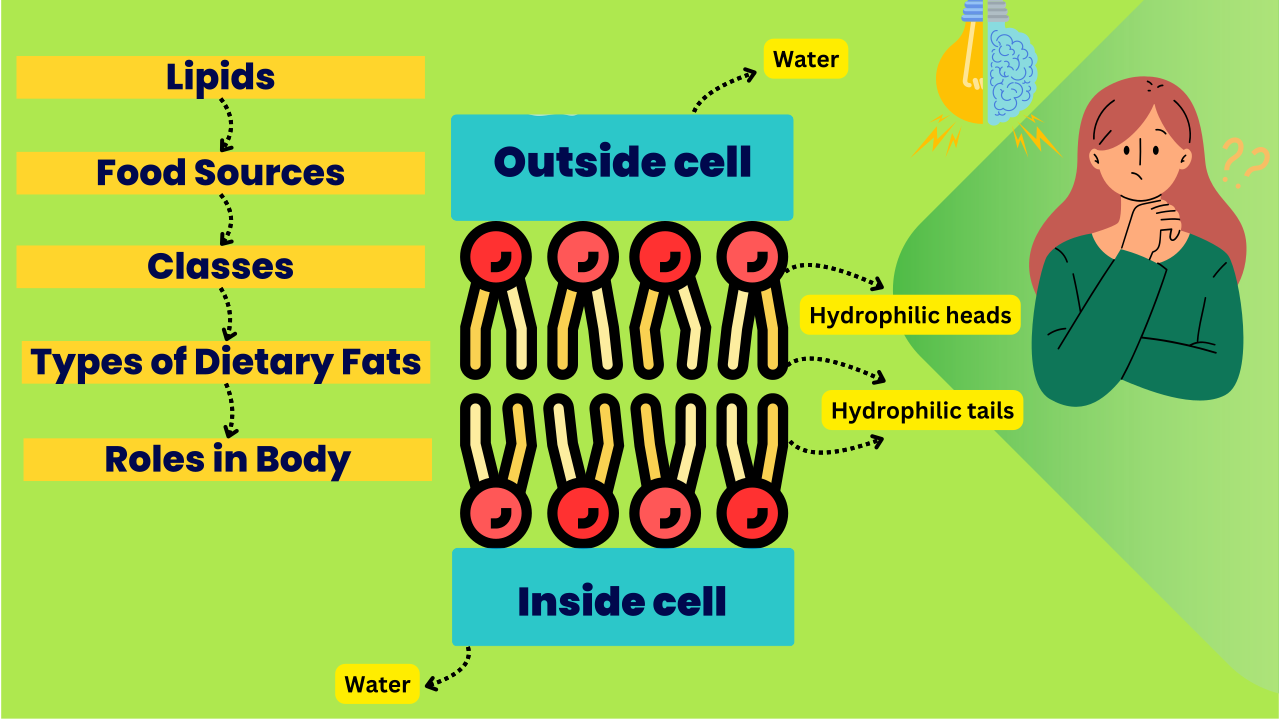
Lipids are the scientific name for fats, oils, and a few related compounds. They are one of the three main energy nutrients, alongside carbohydrate and protein, but they also build cell membranes, cushion organs, and carry certain vitamins. This guide explains what lipids are, the different kinds of dietary fat, what they do in your body, and which fats support your health.
What lipids are
Like carbohydrates, lipids are built mainly from carbon, hydrogen, and oxygen. Because they carry far more hydrogen relative to oxygen, they pack more energy per gram than carbohydrate does. Their defining feature is that they do not dissolve in water. The group also includes the fat-soluble vitamins (A, D, E, and K) and cholesterol.
In everyday terms, "fats" are lipids that are solid at room temperature, like butter, while "oils" are lipids that stay liquid, like olive oil. Both are concentrated energy: fat provides about 9 calories per gram, more than double carbohydrate or protein.
Where lipids come from in food
Dietary fat comes from animal sources (meat, milk, dairy) and plant sources (nuts, seeds, avocados, and the oils pressed from them). It's mainly the type of fat that drives heart-disease risk, not the total amount — which is why the classes below aren't interchangeable, and why the numbers further down matter more than a single "eat less fat" rule.
The main classes of lipids
- Fatty acids are chains of carbon with an acid group at one end. They are the building blocks of most other fats.
- Triglycerides are the main fat in food and the body's main storage fat. Each one is a glycerol backbone holding three fatty acids.
- Phospholipids form the membranes around every cell. They are like triglycerides but with one fatty acid swapped for a phosphorus-containing group.
- Sterols have a ringed structure. The best-known is cholesterol, which your cells need for their membranes and to make certain hormones.
The four types of dietary fat
- Saturated fat has no double bonds in its carbon chain, so it packs tightly and is usually solid at room temperature. Found in fatty meat, butter, cheese, and tropical oils like coconut and palm.
- Monounsaturated fat has one double bond, which kinks the chain and keeps it liquid. Found in olive oil, canola oil, avocados, and nuts.
- Polyunsaturated fat has two or more double bonds. Found in oily fish (salmon, mackerel), flaxseed, walnuts, and many vegetable oils. This group includes the essential omega-3 and omega-6 fats your body cannot make.
- Trans fat is made by adding hydrogen to liquid oils to harden them. Found in partially hydrogenated oils and some processed and fried foods. This is the one type to avoid.
What lipids do in the body
- Energy. Triglycerides store and release energy at about 9 calories per gram.
- Insulation. Fat under the skin retains body heat.
- Protection. Fat around organs like the kidneys cushions them.
- Cell structure. Phospholipids and cholesterol form the membranes that hold cells together.
Which fats are healthy?
The major health bodies agree on this practical guidance, even where they diverge on the treatment targets covered below.
Replace saturated fat with unsaturated fat. Swapping some saturated fat for unsaturated fat lowers blood cholesterol and reduces cardiovascular risk, which is the core advice of the American Heart Association and American College of Cardiology lifestyle guideline (Eckel et al., 2013). A World Health Organization review reached the same conclusion: replacing saturated fat with polyunsaturated fat improves blood-lipid profiles (Mensink, 2016). In practice, that means leaning on olive oil, nuts, seeds, avocado, and oily fish, and going easier on butter, fatty cuts of meat, and full-fat dairy. The American Heart Association's dietary fats guidance lays this out simply.
Avoid trans fat. Trans fat is the clearest villain. A major review concluded that trans fat raises the risk of heart disease more, per calorie, than any other nutrient (Mozaffarian et al., 2006). Many countries have now restricted it, but it can still appear in some processed and fried foods, so check labels for "partially hydrogenated oil."
Keep cholesterol in perspective. Dietary cholesterol matters less than once thought for most people; the bigger lever is the type of fat you eat (NHLBI). For the wider eating pattern that supports healthy fats, see our guide to anti-inflammatory foods.
What a healthy lipid panel looks like
A standard lipid panel reports four numbers. The categories below come from the NIH's National Cholesterol Education Program (NCEP) and are still the reference framework used to label results on a routine panel (NHLBI/NCEP, ATP III Guidelines At-A-Glance, NIH Publication No. 01-3305, May 2001); the triglyceride cutoffs are unchanged in NIH's current consumer guidance (MedlinePlus, reviewed August 2025).
| Marker | Category | Range (mg/dL) |
|---|---|---|
| LDL cholesterol | Optimal | Below 100 |
| Near/above optimal | 100–129 | |
| Borderline high | 130–159 | |
| High | 160–189 | |
| Very high | 190 and above | |
| HDL cholesterol | Low | Below 40 (below 50 for women, for metabolic-syndrome screening) |
| Desirable | 60 and above | |
| Triglycerides | Normal | Below 150 |
| Borderline high | 150–199 | |
| High | 200–499 | |
| Very high | 500 and above |
Non-HDL cholesterol is worth asking your lab for. It's calculated as total cholesterol minus HDL, and it captures LDL plus the other cholesterol-carrying particles that also drive artery plaque — including VLDL — a group LDL alone misses, especially when triglycerides are elevated. NCEP sets non-HDL goals about 30 mg/dL above the equivalent LDL goal for each risk category: below 130 mg/dL for people with existing heart disease or an equivalent risk, below 160 mg/dL for those with two or more risk factors, and below 190 mg/dL for everyone else (NHLBI/NCEP ATP III, 2001).
Where guidelines genuinely disagree isn't these screening categories — it's how aggressively to treat LDL once it's elevated, and that varies by country. The UK's NICE sets a single LDL target for secondary prevention, 2.0 mmol/L or below (about 77 mg/dL), or non-HDL of 2.6 mmol/L or below (about 100 mg/dL); for primary prevention it asks only for a greater-than-40% reduction in non-HDL cholesterol rather than an absolute number (NICE guideline NG238, 2023). Europe's ESC/EAS guideline instead sets absolute LDL targets that scale with calculated cardiovascular risk: below 70 mg/dL for high risk, below 55 mg/dL for very high risk (2019 ESC/EAS Guidelines for Dyslipidaemias). The newest US guideline, issued jointly by the ACC and AHA in March 2026, takes a similar risk-tiered approach: below 100 mg/dL at average risk, below 70 mg/dL at high risk, below 55 mg/dL for people with existing cardiovascular disease (AHA, March 2026). In short, the table above tells you which screening category a result falls into; the number your clinician actually treats you toward depends on your calculated risk and which guideline they follow.
The bottom line
Lipids are not the enemy. They fuel your body, build your cells, and carry key vitamins. What matters is the kind of fat: favor unsaturated fats from plants and fish, limit saturated fat, and avoid trans fat. Get that balance right and fat becomes one of the most useful parts of your diet. For related reading, see how fat fits into boosting metabolism naturally and eating avocado during intermittent fasting, or browse our nutrition guides.
Frequently Asked Questions (FAQ)
What are lipids? Lipids are a family of compounds that include fats, oils, certain vitamins, and cholesterol. They do not dissolve in water, store energy efficiently, and form part of every cell membrane.
What is the difference between fats and oils? Both are lipids. Fats are solid at room temperature and tend to be more saturated (like butter); oils are liquid and tend to be more unsaturated (like olive oil).
Which fats are healthiest? Unsaturated fats from olive oil, nuts, seeds, avocado, and oily fish. Health authorities recommend replacing saturated fat with these and avoiding trans fats.
Are all saturated fats bad? Saturated fat is not poison, but replacing some of it with unsaturated fat lowers cardiovascular risk. The bigger problem is trans fat, which should be avoided.
How much energy do lipids provide? About 9 calories per gram, more than double what carbohydrate or protein provides, which is why fat is the body's most energy-dense fuel.
What are healthy LDL, HDL, and triglyceride levels? Under NIH reference categories, LDL below 100 mg/dL, HDL of 60 mg/dL or higher, and triglycerides below 150 mg/dL are all classed "optimal" or "desirable." These are screening categories, not personalized treatment targets, which depend on your overall cardiovascular risk.
Why do cholesterol guidelines differ between countries? Health bodies use the same lab reference ranges but set different treatment targets. The UK's NICE sets one LDL target for secondary prevention, while Europe's ESC/EAS and the 2026 US ACC/AHA guideline set LDL targets that scale with calculated cardiovascular risk, from below 100 mg/dL down to below 55 mg/dL.
Medical disclaimer: This article is for informational purposes only. Always consult a qualified healthcare provider before making changes to your health routine.
Sources
- Eckel RH, et al. 2013 AHA/ACC guideline on lifestyle management to reduce cardiovascular risk. Journal of the American College of Cardiology, 2014 — PubMed. https://pubmed.ncbi.nlm.nih.gov/24239922/
- Mensink RP. Effects of saturated fatty acids on serum lipids and lipoproteins: a systematic review and regression analysis. World Health Organization, 2016. https://www.who.int/publications/i/item/9789241565349
- Mozaffarian D, et al. Trans fatty acids and cardiovascular disease. New England Journal of Medicine, 2006 — PubMed. https://pubmed.ncbi.nlm.nih.gov/16611951/
- American Heart Association. Dietary Fats. https://www.heart.org/en/healthy-living/healthy-eating/eat-smart/fats/dietary-fats
- National Heart, Lung, and Blood Institute. Blood Cholesterol. https://www.nhlbi.nih.gov/health/blood-cholesterol
- National Heart, Lung, and Blood Institute / National Cholesterol Education Program. ATP III Guidelines At-A-Glance Quick Desk Reference. NIH Publication No. 01-3305, May 2001. https://www.nhlbi.nih.gov/files/docs/guidelines/atglance.pdf
- MedlinePlus (National Library of Medicine, NIH). Triglycerides. Reviewed August 10, 2025. https://medlineplus.gov/triglycerides.html
- National Institute for Health and Care Excellence (NICE). Cardiovascular disease: risk assessment and reduction, including lipid modification. NG238, published December 14, 2023. https://www.nice.org.uk/guidance/ng238/chapter/Recommendations
- American College of Cardiology. 2019 ESC/EAS Guidelines for Dyslipidaemias — Ten Points to Remember (summarizing the European Heart Journal, 2019 guideline). https://www.acc.org/Latest-in-Cardiology/ten-points-to-remember/2019/09/12/15/13/2019-ESC-EAS-Guidelines-for-Dyslipidaemias
- American Heart Association Newsroom. ACC/AHA Issue Updated Guideline for Managing Lipids, Cholesterol. March 13, 2026. https://newsroom.heart.org/news/accaha-issue-updated-guideline-for-managing-lipids-cholesterol
All sources accessed 12 July 2026.

Sophia Martinez, MS, CNS
A wellness researcher focused on what the evidence actually says.