
Patients are often relieved, and sometimes a little unsettled, to learn there was truly no way they could have felt their cholesterol climbing before a lab test caught it. That reaction makes sense: it runs against how most health problems are supposed to work. This guide covers what actually happens with high cholesterol day to day — why it's usually silent, the narrow, specific physical signs that genuinely can show up, what those signs actually mean, and what to do next.
What Is High Cholesterol?
High cholesterol, clinically called hyperlipidemia or hypercholesterolemia, means more cholesterol is circulating in your blood than your body needs, most often driven by LDL. It's common: 11.3% of US adults have high total cholesterol (240 mg/dL or above), rising to 16.7% among adults 40 to 59 (NCHS Data Brief No. 515, via NCBI Bookshelf).
The two clinical terms get used loosely, but they're not identical: "hypercholesterolemia is a type of hyperlipidemia that focuses on high LDL-C. Hyperlipidemia includes various disorders that feature high levels of fat in your blood, not just LDL" (Cleveland Clinic). In everyday use, most people mean the same thing by either term. For the full biology of what cholesterol is and does, see our cholesterol guide — this post focuses on what "high" actually looks like day to day.
Does High Cholesterol Cause Symptoms?
No. High cholesterol on its own does not cause symptoms. Most people find out from a routine blood test, not from how they feel (NHLBI). Cleveland Clinic states it just as plainly: "High cholesterol doesn't cause symptoms directly" (Cleveland Clinic).
The reason is mechanical, not mysterious. Excess cholesterol builds up inside artery walls gradually, over years, before it narrows anything enough to actually be felt. There's no nerve ending inside an artery wall signaling "cholesterol here" the way a cut signals pain — the process is genuinely silent until it isn't.
The Physical Signs That Do Show Up — But Only With Very High or Familial Cholesterol
A small, specific set of physical signs can appear, but only with very high or genetically inherited cholesterol, familial hypercholesterolemia (FH), not ordinary high cholesterol. Three signs, each independently documented:
- Xanthomas and xanthelasma. Xanthomas are fatty bumps on the skin, "especially on the elbows, joints, knees, hands, ankles, or buttocks" (NHLBI); xanthelasmas are the same kind of deposit specifically around the eyelids (MedlinePlus).
- Corneal arcus. A grayish-white ring that appears around the cornea of the eye (NHLBI).
- Tendon xanthomas. Cholesterol deposits specifically in the Achilles tendons or the tendons of the hands or elbows, a detail the American Heart Association names precisely (AHA).
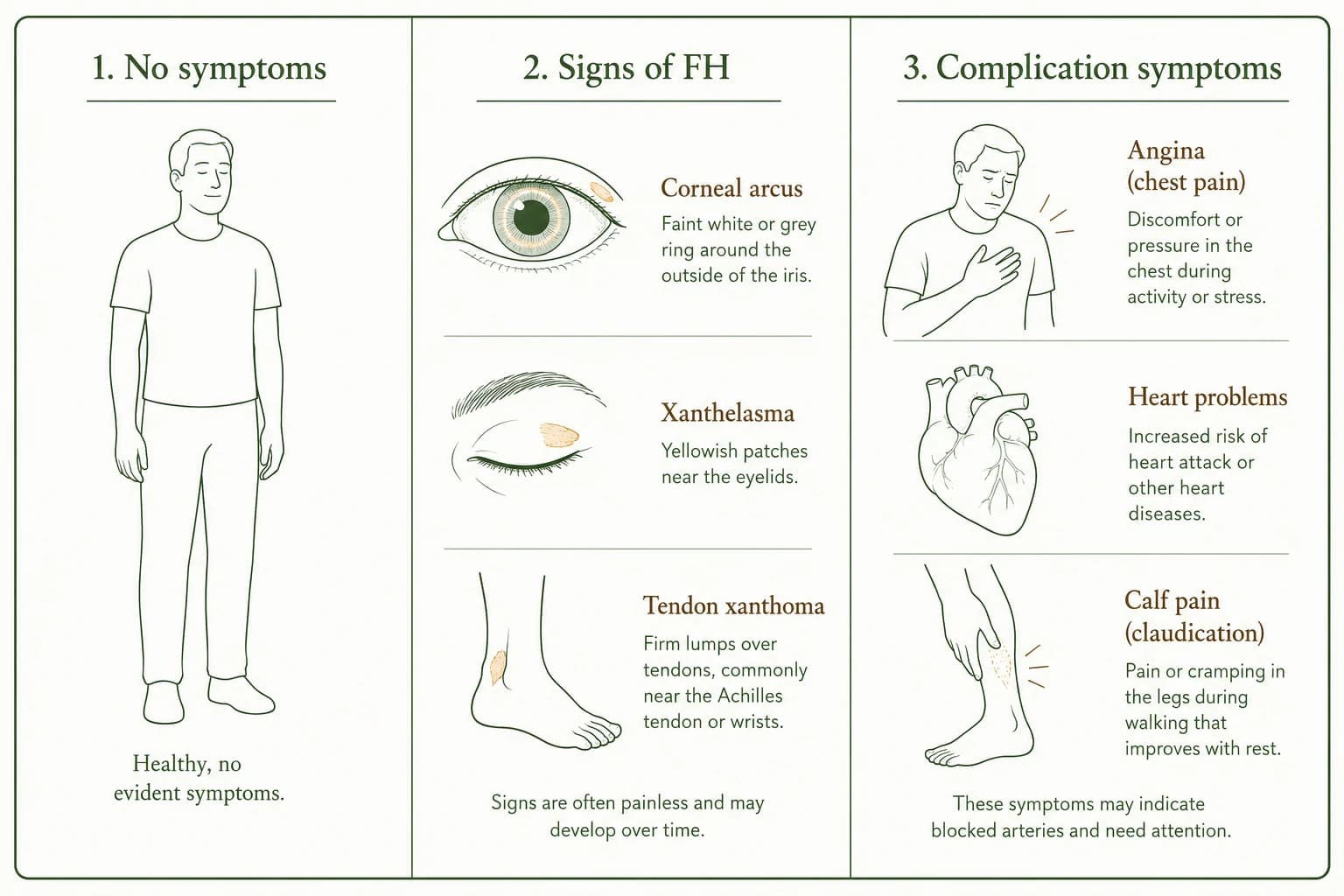
None of these signs mean "you definitely have FH" — they mean it's worth getting a lipid panel and, depending on the result and your family history, a conversation about genetic testing. FH diagnosis actually draws on three things together, a physical exam, blood lab results, and personal or family history, but the AHA is explicit that "many" people with FH show no physical exam findings at all, so a normal-looking exam doesn't rule it out (AHA).
FH itself is more common than most people assume: heterozygous FH affects roughly 1 in 250 people by the older estimate, or closer to 1 in 311 per a more recent meta-analysis, rising to about 1 in 17 among people who already have cardiovascular disease. Globally, only about 1% of the roughly 25 million people with FH have actually been diagnosed (CDC Office of Genomics and Precision Health).
Symptoms of Cholesterol's Complications
What people often mistake for "cholesterol symptoms" are really symptoms of a complication that cholesterol contributed to over years, not something plain high cholesterol produces directly. MedlinePlus's FH-specific page documents these complication-adjacent signs: early chest pain or angina, calf cramping when walking (a sign of peripheral artery disease), non-healing sores on the toes, and stroke-like symptoms such as sudden speech difficulty, facial drooping, weakness, or loss of balance (MedlinePlus).
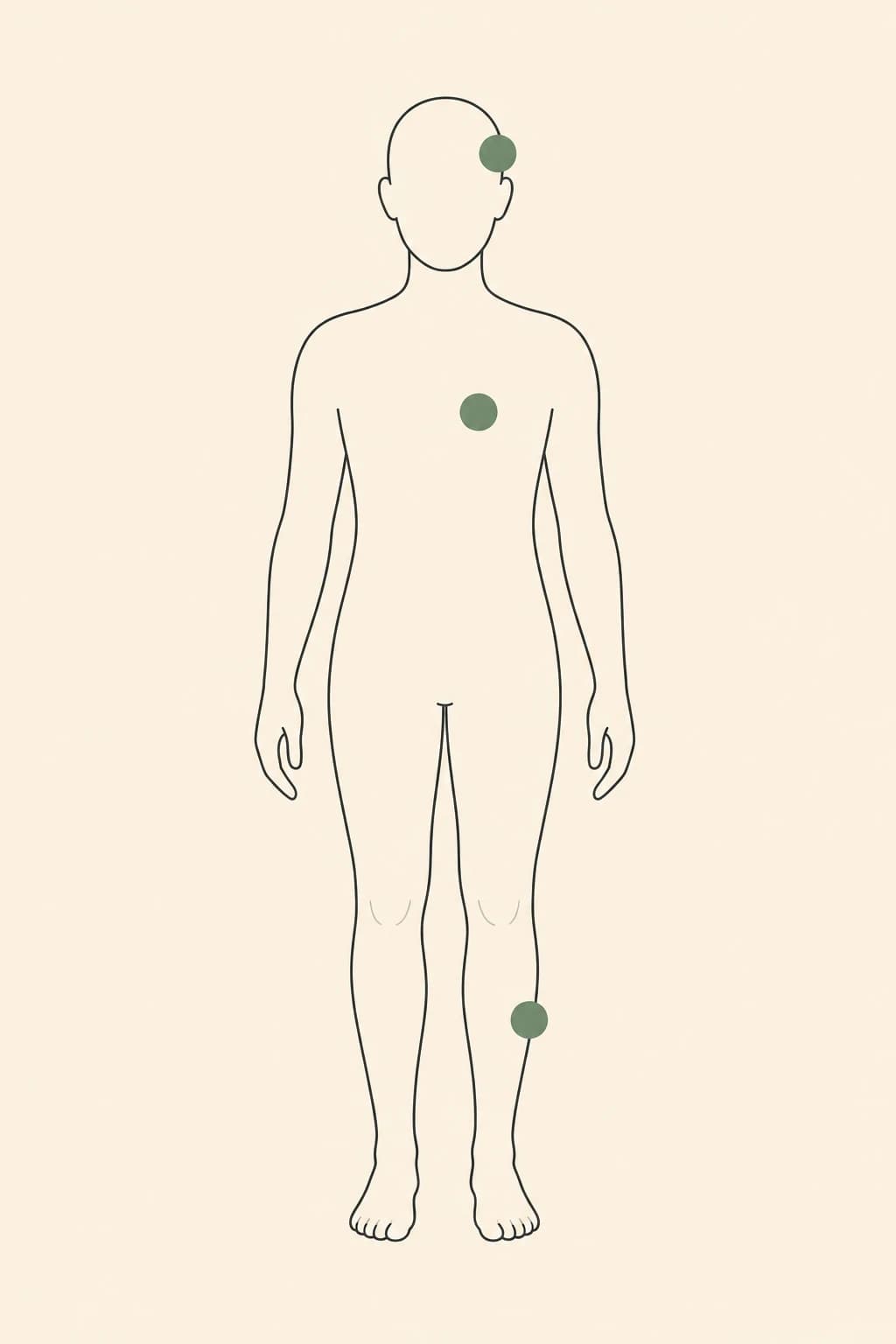
These are a distinct, later-stage category, not an early-warning system for cholesterol itself, and any of them warrants immediate medical attention rather than a wait-and-see approach.
Why So Many "Warning Signs" Lists Get This Wrong
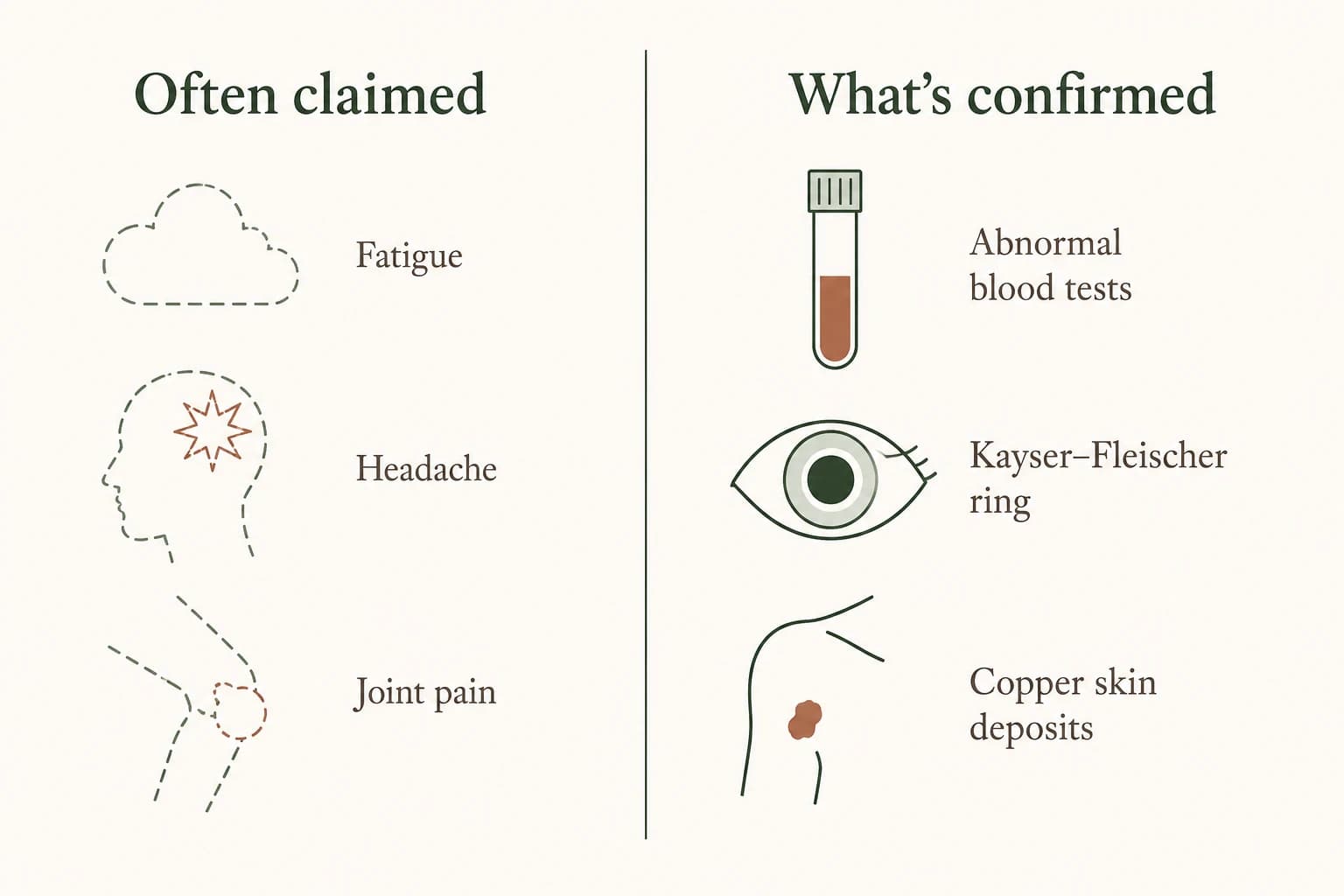
A lot of ranking content lists fatigue, frequent headaches, joint pain or stiffness, and "brain fog" as cholesterol symptoms, sometimes claiming women specifically experience vaguer symptoms than men. None of these appear on NHLBI's, MedlinePlus's, or Cleveland Clinic's symptom pages, and we found no clinical citation anywhere for the sex-specific symptom claim specifically. It's worth stating plainly rather than quietly ignoring, since it's easy to run into this content while searching.
The likely explanation isn't malicious, just imprecise: fatigue and headaches are extremely common, non-specific complaints. It's easy for a coincidental symptom to get anecdotally attached to a cholesterol diagnosis without any actual causal evidence behind the connection.
What Causes High Cholesterol?
A mix of daily habits, genetics, underlying medical conditions, and certain medications. On the lifestyle side, NHLBI names two specific numeric thresholds worth knowing rather than a vague "eat better": getting more than 10% of your daily calories from saturated fat, and drinking more than two alcoholic drinks a day for men or one for women, are both independently associated with raising cholesterol. NHLBI also names eight medical conditions that can raise cholesterol, including diabetes, hypothyroidism, chronic kidney disease, sleep apnea, HIV/AIDS, and lupus, plus seven medication categories, including beta-blockers, diuretics, and steroids (NHLBI). No major source we checked quantifies what share of cases are primarily lifestyle-driven versus genetic — that split isn't something we could verify as a real, sourced percentage, so it's worth being skeptical of any page that states one. For the full causes and hereditary breakdown, see what actually causes high cholesterol.
How Is High Cholesterol Diagnosed?
A simple blood test, a lipid panel, is the only reliable way to find out, since, as covered above, there's usually nothing to feel. A March 13, 2026 guideline update from the American College of Cardiology and American Heart Association (ACC.org) now means non-fasting panels are sufficient for most people as a baseline test: the guideline recommends "a standard nonfasting or fasting lipid profile" to document baseline lipid levels, reserving a fasting sample mainly for a family history of dyslipidemia or premature ASCVD, a known or suspected triglyceride-metabolism disorder, or non-fasting triglycerides of 400 mg/dL or higher (Guideline Central, summarizing the 2026 ACC/AHA/Multisociety Dyslipidemia Guideline) — testing has genuinely gotten more convenient, not because symptoms got easier to spot, but because the science around fasting requirements moved on. For what your actual numbers mean, see normal cholesterol levels; for the full testing walkthrough, see cholesterol test and lipid panel guide.
What Helps If Your Cholesterol Is High?
Diet and lifestyle changes first for most people, with medication, typically a statin, added when overall risk is higher. To give one concrete, sourced number rather than vague reassurance: statins can lower LDL by roughly 30% up to about 60% at maximum intensity (rosuvastatin 40mg) (NCBI Bookshelf / Endotext). For the full, numbers-based lifestyle breakdown, see how to lower cholesterol; for the medication landscape, see cholesterol medication.
Bottom Line
High cholesterol won't announce itself. The handful of physical signs that genuinely do appear point toward a genetic form worth investigating rather than an everyday case, and a blood test, not a symptom checklist, is still the only real way to know where you stand. If you just got a number back and want to know what it means, start with our cholesterol guide or head straight to normal cholesterol levels to see where you fall.
Frequently Asked Questions (FAQ)
Can high cholesterol make you tired or cause brain fog? No clinical authority we checked, NHLBI, MedlinePlus, Cleveland Clinic, or Mayo Clinic, lists fatigue or brain fog as a symptom of high cholesterol itself; these are common, non-specific complaints that get anecdotally attached to a cholesterol diagnosis without supporting evidence.
What does it mean if you have cholesterol deposits (xanthelasma) under your eyes? Xanthelasma, yellowish deposits around the eyelids, can be a sign of very high or familial cholesterol and is worth a lipid panel and a conversation with your doctor, though it can also occur in people with normal cholesterol.
Is chest pain a symptom of high cholesterol? Chest pain itself isn't a symptom of high cholesterol directly — it can be a symptom of coronary artery disease, a complication that high cholesterol contributes to over years, which is a different thing from cholesterol "announcing itself."
Do men and women have different cholesterol symptoms? We could not find this claim supported by any major clinical authority — high cholesterol itself is asymptomatic regardless of sex, and claims of distinct, vaguer symptoms in women specifically are not backed by a citation in the sources we checked.
If high cholesterol has no symptoms, how do you find out you have it? A simple blood test, called a lipid panel, is the only reliable way to find out — there's no physical sensation to notice beforehand, which is exactly why routine testing matters more than watching for symptoms.
Medical disclaimer: This article is for informational purposes only. Always consult a qualified healthcare provider before making changes to your health routine.
Sources
- National Heart, Lung, and Blood Institute (NIH). Blood Cholesterol — Symptoms. https://www.nhlbi.nih.gov/health/blood-cholesterol/symptoms
- National Heart, Lung, and Blood Institute (NIH). Blood Cholesterol — Causes. https://www.nhlbi.nih.gov/health/blood-cholesterol/causes
- Cleveland Clinic. Hyperlipidemia (High Cholesterol) — Health article. Reviewed February 10, 2026. https://my.clevelandclinic.org/health/diseases/21656-hyperlipidemia
- Cleveland Clinic. Hypercholesterolemia — Health article. Reviewed August 1, 2022. https://my.clevelandclinic.org/health/diseases/23921-hypercholesterolemia
- MedlinePlus Medical Encyclopedia (National Library of Medicine, NIH). Familial Hypercholesterolemia. Reviewed May 8, 2024. https://medlineplus.gov/ency/article/000392.htm
- American Heart Association. Familial Hypercholesterolemia (FH). Reviewed March 13, 2026. https://www.heart.org/en/health-topics/cholesterol/genetic-conditions/familial-hypercholesterolemia-fh
- CDC Office of Genomics and Precision Health. How Common Is FH? — Genomics and Precision Health Blog, published January 25, 2021. https://blogs.cdc.gov/genomics/2021/01/25/how-common-is-fh/
- National Center for Health Statistics (CDC), via NCBI Bookshelf. Total and High-density Lipoprotein Cholesterol in Adults: United States, August 2021–August 2023 — NCHS Data Brief No. 515, published November 2024. https://www.ncbi.nlm.nih.gov/books/NBK610675/
- American College of Cardiology. ACC/AHA Release New Clinical Guideline for Managing Dyslipidemia — Journal scan, published March 13, 2026. https://www.acc.org/latest-in-cardiology/journal-scans/2026/03/13/15/20/acc-aha-release-new-clinical-guideline-for-managing-dyslipidemia
- Guideline Central. Summary of the 2026 ACC/AHA/Multisociety Dyslipidemia Guideline. https://www.guidelinecentral.com/guideline/5099440/
- NCBI Bookshelf / Endotext. Cholesterol Lowering Drugs. https://www.ncbi.nlm.nih.gov/books/NBK395573/

Olivia Smith, RDN
A registered dietitian who's heard every version of "but I feel fine."