Some supplements genuinely lower LDL or triglycerides by measurable, trial-verified amounts. One of the most popular "natural" options is, pharmacologically, a statin with real quality-control problems. And none of them has the large-outcomes-trial evidence a prescription statin has. This guide covers what's actually been studied, at what dose, and what the safety picture looks like — for the broader biology of cholesterol, see our cholesterol guide.
Do Cholesterol Supplements Actually Work?
Yes, several have real evidence for modest cholesterol reduction — but "modest" and "proven to prevent heart attacks and strokes" are different claims, and it's worth judging every supplement below against both ends of a real scale: diet changes alone can lower cholesterol by roughly 10% over 8 to 12 weeks (British Heart Foundation), while a statin can lower LDL anywhere from about 27% up to a maximal 60% at the highest dose (rosuvastatin 40mg), depending on the drug and dose (NCBI Bookshelf / Endotext). For the broader lifestyle picture beyond supplements, see how to lower cholesterol and our cholesterol diet guide.
Psyllium and Other Soluble Fiber
About 10g of psyllium fiber a day, taken for at least three weeks, lowered LDL by about 13 mg/dL (0.33 mmol/L) in a pooled analysis of 28 controlled trials (Harvard Health Publishing). The FDA's own health-claim threshold is close to this: 10.2g of psyllium husk a day, providing about 7g of soluble fiber, is the qualifying level the FDA concluded reduces coronary heart disease risk (FDA / Federal Register, 1998).
The mechanism in one sentence: soluble fiber binds bile acids in the gut, so the liver pulls more LDL cholesterol out of the blood to make replacement bile acids. Practically, start at a lower dose with plenty of water and increase gradually — bloating and gas are common early side effects that tend to settle down.
Plant Sterols and Stanols
Plant sterols and stanols, at about 2g a day, can lower LDL by roughly 8–10% (Cleveland Clinic). Worth knowing: the FDA's minimum labeling threshold for a health claim is 0.65g per serving, taken twice daily, or 1.3g a day — lower than the 2g dose actually used in the trials behind that 8–10% figure, which means many fortified foods or supplements are dosed closer to the labeling minimum than the effective research dose.
The mechanism: sterols and stanols structurally resemble cholesterol closely enough to block some of its absorption in the gut. Not recommended for people with sitosterolemia, a rare genetic disorder, and not well studied in children.
Omega-3 Fish Oil
About 1g a day of omega-3 fatty acids provides some cardiovascular benefit for the general population, based on a 2019 review of three major trials, and EPA and DHA specifically can lower triglycerides by roughly 15% per a separate 2020 review (NCCIH). Worth being precise here: omega-3's proven lipid effect is on triglycerides, not LDL, a distinction most supplement listicles blur. The general-population baseline is two servings of fatty fish a week, about 3oz cooked each (American Heart Association).
One underused distinction worth clearing up: FDA-approved prescription omega-3 products, such as icosapent ethyl, studied in the REDUCE-IT trial, are a different formulation with different regulatory testing than an over-the-counter fish oil capsule, and they're approved specifically for very high triglycerides (NCCIH) — not a like-for-like swap with a supplement-aisle bottle.
Niacin (Vitamin B3)
Prescription-strength niacin, typically titrated from 500mg up to 1,000–2,000mg a day, lowers LDL and raises HDL. The real differentiator most competitor lists skip: "niacin didn't show cardiovascular benefit when added to statins" in modern trials (Cleveland Clinic) — a meaningful caveat for anyone considering it alongside an existing statin, not just on its own.
Flushing is the most common side effect, with episodes lasting roughly 20 to 30 minutes and tending to fade over weeks of continued use. High-dose niacin is a physician-supervised intervention requiring periodic liver-enzyme monitoring, not an over-the-counter, self-directed regimen.
Red Yeast Rice: What the Label Doesn't Tell You
Red yeast rice lowers cholesterol because it naturally contains monacolin K, a compound structurally identical to the prescription statin lovastatin (NCCIH). An effective dose of red yeast rice is, functionally, an unregulated statin, and the safety picture reflects that:
- The FDA has treated red yeast rice products with significant monacolin K as unapproved new drugs, meaning they can't legally be marketed as dietary supplements.
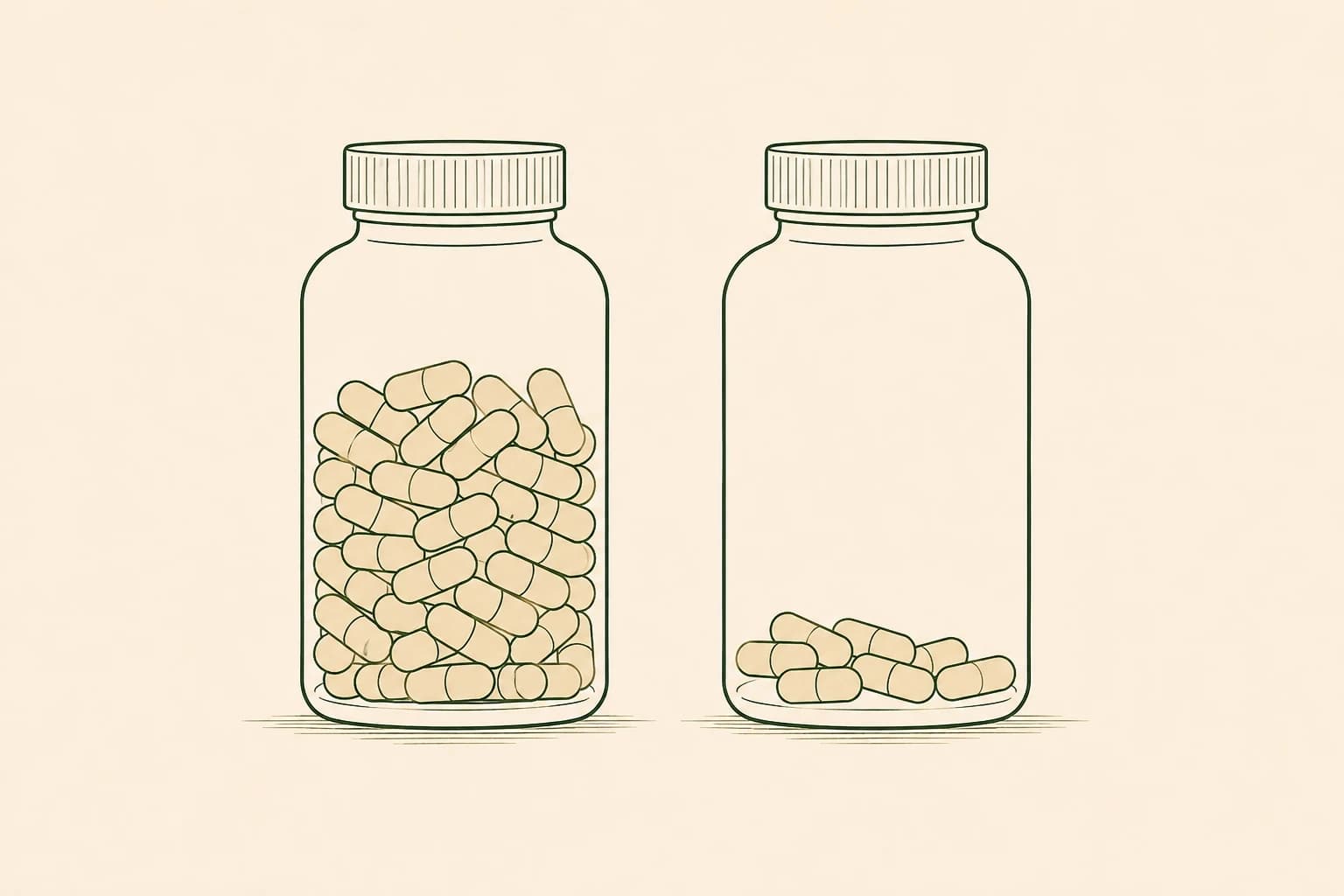
- A 2017 analysis of 28 commercial brands found monacolin K content ranged 60-fold, from 0.09mg to 5.48mg per 1,200mg of product, and none of the labels stated the actual quantity — two identically labeled bottles can deliver very different doses.
- Some tested products are contaminated with citrinin, a kidney-toxic compound, including 4 products in a 2021 analysis that were specifically labeled "citrinin-free" and weren't.
- The side-effect profile mirrors statins directly: muscle, kidney, and liver damage risk, plus digestive issues.
(All four points per NCCIH.) For context on how real these effects are: one study cited by WebMD found 2.4g/day of red yeast rice associated with about a 22% LDL reduction, and another found 1.2g/day associated with about a 26% reduction over 8 weeks (WebMD) — genuinely drug-level effects, not a mild herbal extra.
Because it's pharmacologically a statin, taking red yeast rice alongside a prescribed statin risks unknowingly doubling statin exposure. That's exactly the kind of thing to raise with a doctor or pharmacist before combining, not something to figure out by trial and error.
How These Supplements Compare to Statins
| Supplement | Studied dose | Typical lipid effect | What's proven |
|---|---|---|---|
| Psyllium | ~10g/day, 3+ weeks | LDL down ~13 mg/dL (0.33 mmol/L) | LDL-lowering shown in trials, not outcomes |
| Plant sterols | ~2g/day | LDL down ~8–10% | Same |
| Niacin | 1,000–2,000mg/day | LDL down, HDL up | No added cardiovascular benefit shown when added to statins |
| Red yeast rice | Unregulated; label doesn't state actual dose | Comparable to a low-to-moderate-dose statin | Same mechanism and risk profile as a statin, without the manufacturing oversight |
| Omega-3 (prescription) | ~4g/day EPA+DHA | Triglycerides down, not LDL | Approved specifically for very high triglycerides |
| Statins (moderate-to-high intensity) | Varies by drug/dose | LDL down 27–60%+ | The only option here with large randomized-trial evidence of fewer heart attacks and strokes, not just lower numbers |
That outcomes-evidence gap is worth knowing before choosing between a supplement and a doctor's medication recommendation, especially for anyone with existing heart disease or very high LDL. For the full medication landscape, see cholesterol medication; for statin-specific side effects, see statin side effects.
Before You Try a Cholesterol Supplement
Talk to a doctor or pharmacist before starting any of these, especially if you're already taking a statin or another cholesterol medication — red yeast rice and niacin both carry real interaction and dosing risk. Red yeast rice's 60-fold brand-to-brand variation is the concrete cautionary example worth remembering: supplements aren't FDA-approved for safety or efficacy the way drugs are, so brand-to-brand consistency can't be assumed. Extra caution applies during pregnancy or breastfeeding, and with existing liver or kidney conditions, particularly with niacin and red yeast rice. For the broader eating pattern that supports any of these supplements rather than replacing food entirely, see anti-inflammatory foods; for the full lifestyle picture, see how to lower cholesterol. One beverage that turns up in this conversation sits outside the supplement category entirely: hibiscus tea, whose meta-analysed LDL effect is small and borderline — see hibiscus tea and blood pressure.
Frequently Asked Questions (FAQ)
Is red yeast rice basically a natural statin? Functionally, yes — it naturally contains monacolin K, a compound structurally identical to the prescription statin lovastatin, which is why the FDA has treated red yeast rice products with significant monacolin K as unapproved drugs, not legal dietary supplements.
Why do two bottles of red yeast rice from different brands not work the same way? A 2017 analysis of 28 commercial brands found monacolin K content varied 60-fold between products, and none of the labels stated the actual quantity, so two identically labeled bottles can deliver very different doses.
Does niacin help lower cholesterol if you're already taking a statin? Niacin can still lower LDL and raise HDL on its own, but in modern trials it "didn't show cardiovascular benefit when added to statins," according to Cleveland Clinic — a real limitation worth knowing before adding it to an existing statin regimen.
How much psyllium do you actually need to lower LDL? About 10 grams a day, taken for at least three weeks, was associated with an LDL reduction of roughly 13 mg/dL (0.33 mmol/L) in a pooled analysis of 28 controlled trials.
Are over-the-counter fish oil supplements the same as prescription omega-3 medication? No — FDA-approved prescription omega-3 products are a different formulation with different regulatory testing, approved specifically for very high triglycerides, not interchangeable with an over-the-counter fish oil capsule.
Medical disclaimer: This article is for informational purposes only. Always consult a qualified healthcare provider before making changes to your health routine.
Sources
- British Heart Foundation. How Long Does It Take to Lower Cholesterol? https://www.bhf.org.uk/informationsupport/heart-matters-magazine/medical/how-long-to-lower-cholesterol
- NCBI Bookshelf / Endotext. Cholesterol Lowering Drugs. https://www.ncbi.nlm.nih.gov/books/NBK395573/
- Harvard Health Publishing. Psyllium Fiber, Regularity, and Healthier Lipid Levels. https://www.health.harvard.edu/heart-health/psyllium-fiber-regularity-and-healthier-lipid-levels
- FDA / Federal Register, Vol. 63 No. 32. Final Rule on Soluble Fiber From Psyllium Husk and Coronary Heart Disease, February 18, 1998. https://www.govinfo.gov/content/pkg/FR-1998-02-18/html/98-4074.htm
- Cleveland Clinic. Plant Sterols (Phytosterols): How They Help Manage Cholesterol. Reviewed July 30, 2022. https://my.clevelandclinic.org/health/drugs/17368-phytosterols-sterols--stanols
- NCCIH (National Center for Complementary and Integrative Health, NIH). Omega-3 Supplements: In Depth. https://www.nccih.nih.gov/health/omega3-supplements-in-depth
- American Heart Association. Fish and Omega-3 Fatty Acids. https://www.heart.org/en/healthy-living/healthy-eating/eat-smart/fats/fish-and-omega-3-fatty-acids
- Cleveland Clinic. Niacin (Vitamin B3) Capsules and Tablets. https://my.clevelandclinic.org/health/drugs/18874-niacin-capsules-and-tablets
- NCCIH (National Center for Complementary and Integrative Health, NIH). Red Yeast Rice. Reviewed November 2022. https://www.nccih.nih.gov/health/red-yeast-rice
- WebMD. Red Yeast Rice and Cholesterol. https://www.webmd.com/cholesterol-management/red-yeast-rice

Olivia Smith, RDN
A registered dietitian who gets asked about red yeast rice more than anything else.