Hibiscus is the one herbal tea with a genuinely impressive number attached to it — and the one where the number is most often quoted without the two caveats that decide whether it applies to you. This guide gives you the figures exactly as they were published, then spends equal time on why they must not be over-read.
What hibiscus tea is
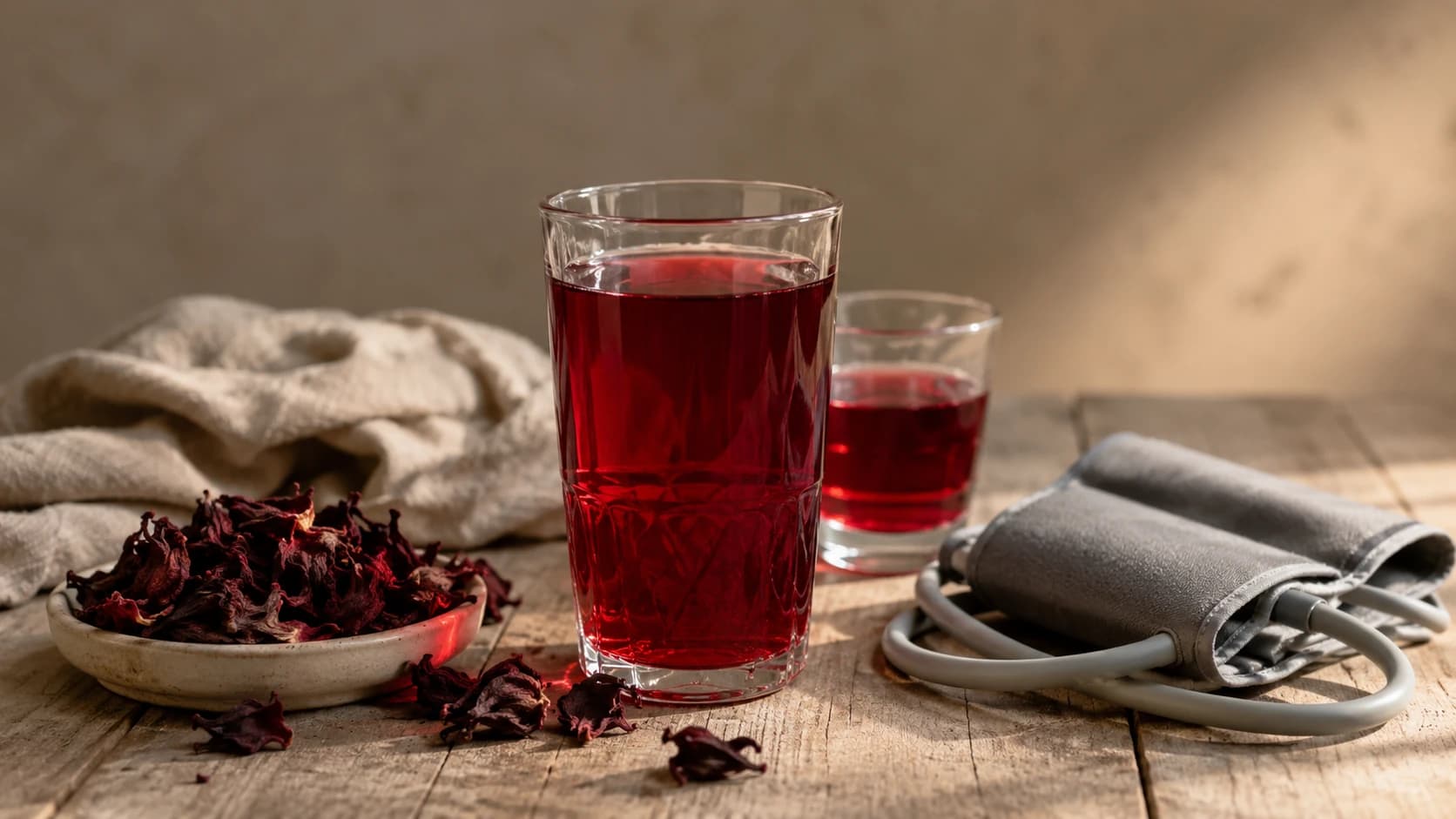
Hibiscus tea is an infusion of the dried calyces — the fleshy sepals around the seed pod — of Hibiscus sabdariffa. It is deep red, sharply tart, and naturally caffeine-free. You will meet it as sour tea in the research literature, karkade in Egypt and Sudan, zobo in Nigeria, agua de Jamaica in Mexico, and simply "hibiscus" or "roselle" on a supermarket shelf.
It is worth being precise about the plant. Hibiscus sabdariffa is what the blood-pressure trials used. Ornamental garden hibiscus is a different species and has not been studied this way.
The headline number — and its confidence interval
A 2022 systematic review and meta-analysis searched five databases up to June 2021 and pooled 17 chronic trials. Compared with placebo, hibiscus lowered systolic blood pressure by:
−7.10 mmHg (95% CI −13.00 to −1.20), I² = 95%, P = 0.02
The effect was greatest in people whose blood pressure was already elevated at baseline (Ellis et al., 2022).
Seven millimetres of mercury is not trivial — it is in the range you might expect from a meaningful dietary change. But read the interval, not just the point estimate. The true effect is somewhere between "barely detectable" (1.2 mmHg) and "as much as a medicine" (13 mmHg), and the analysis cannot narrow it further than that.
What the single best trial did, and who it excluded
The most quotable individual study is a randomised, double-blind, placebo-controlled trial in 65 pre- and mildly hypertensive adults aged 30–70, given either three 240 mL servings of brewed hibiscus tea per day or a placebo beverage for six weeks. At six weeks:
- Systolic: −7.2 ± 11.4 mmHg with hibiscus vs −1.3 ± 10.0 with placebo, P = 0.030
- Diastolic: −3.1 ± 7.0 vs −0.5 ± 7.5, P = 0.160 — not statistically significant
- Mean arterial pressure: −4.5 ± 7.7 vs −0.8 ± 7.4, P = 0.054, borderline
- Higher baseline systolic pressure predicted a greater response (r = −0.421, P = 0.010)
Now the detail that changes everything: the participants were, in the paper's own words, "not taking blood pressure (BP)-lowering medications." That was a deliberate design choice, and it means the study cannot answer the question most people arriving here are actually asking. It also means the honest reading of "hibiscus lowers blood pressure" is: in people whose pressure is mildly raised and untreated.
Note too that only the systolic result was significant. Articles that report "hibiscus lowers blood pressure" without saying which number are rounding off a real limitation.
Why the results vary so much (I² = 95%, and what that means)
I² is a measure of how much of the variation between trials is more than chance. 95% is about as high as it gets. In plain terms: the 17 trials did not find the same thing, and pooling them into one number is a summary of a disagreement rather than a consensus.
Plausible reasons the studies differ, none of them standardised across the literature: how much dried calyx per cup, steeping time and temperature, whether the preparation was a tea or an extract, trial length, and — the big one — the participants' starting blood pressure.
This is why the article you are reading will not tell you hibiscus "works". It tells you the pooled estimate points to a reduction, that the reduction is larger in people who start higher, and that the spread around it is wide.
Who responds most
Two independent lines of evidence point the same way, which is the strongest thing this topic has going for it:
- The meta-analysis found the magnitude of reduction greatest in those with elevated blood pressure at baseline (Ellis 2022).
- Within the single trial, higher baseline systolic predicted a greater fall (r = −0.421, P = 0.010) (McKay 2010).
So the person most likely to notice anything is someone whose readings sit above ideal but who is not yet treated. If your blood pressure is normal, expect very little — and there is nothing in this evidence suggesting benefit in pushing a normal reading lower.
For reference, the NHS considers a reading of 140/90 or higher, measured by a healthcare professional, to be high blood pressure (NHS). High blood pressure usually has no symptoms, so a reading is the only way to know where you stand.
How much, and how it was actually brewed in the trials
The dose that produced the best-documented result was three 240 mL servings per day, for six weeks (McKay 2010). That is roughly three large mugs daily — a habit, not a cup when you remember.
Practical brewing, consistent with how a strong infusion is made:
- Use a generous amount of dried calyces — around a heaped teaspoon or a full teabag per cup, more if your calyces are large and whole.
- Water just off the boil. Hibiscus is robust.
- Cover and steep 5–10 minutes. Covering matters for any infusion, as our herbal tea benefits guide explains.
- Drink it unsweetened. Sugar added to reach three cups a day works against the reason you are drinking it. It is also excellent iced.
I cannot tell you the exact gram weight or steep time used in every pooled trial — that variation is part of why I² was 95%.
What it does to LDL cholesterol
The same meta-analysis found hibiscus lowered LDL cholesterol compared with other teas and placebo:
−6.76 mg/dL (95% CI −13.45 to −0.07), I² = 64%, P = 0.05
That confidence interval touches zero at one end and the P value sits exactly on the conventional threshold. It is a hint, not a result to build a plan on. If lowering LDL is your goal, the interventions with far better evidence are covered in how to lower cholesterol and supplements to lower cholesterol — and what LDL actually is, in LDL cholesterol. Hibiscus is not a substitute for any of them.
Hibiscus vs licorice: two herbal teas, opposite directions
This contrast is the most useful thing to take away, because it dismantles the idea that "herbal tea" is one category with one effect.
Licorice root contains glycyrrhizic acid, which inhibits the enzyme 11β-hydroxysteroid dehydrogenase type 2 and produces sodium retention, potassium loss and raised blood pressure. Case reports describe hypertension and oedema with potassium of 3.1 mmol/L after three weeks of licorice herbal tea (Cureus, 2023), and potassium of 1.8 mmol/L in a man who drank licorice tea daily for 18 months (Medicine, 2020).
Licorice is a common sweetening ingredient in blended caffeine-free teas — including, sometimes, in hibiscus blends. Read the ingredients. Our guide to herbal tea and medication interactions covers this in full.
Who should be careful (and the pregnancy question)
If you already take blood-pressure medication. This has not been studied properly. McKay's trial excluded these participants by design, and I could not find a human study of hibiscus co-administered with an antihypertensive. The only interaction data I found is an animal study in rats and rabbits reporting that hibiscus extract increased and prolonged plasma concentrations of hydrochlorothiazide (J Med Food, 2011) — an animal signal, not a human finding, but a reason to tell your clinician rather than to reassure yourself. If you do drink it, keep monitoring your readings.
If you are pregnant or breastfeeding. I could not find an authoritative human safety statement on hibiscus tea in pregnancy, and I will not manufacture reassurance. The direct evidence I located is in rats: maternal consumption of aqueous Hibiscus sabdariffa extract during pregnancy or lactation was associated with reduced maternal food and fluid intake, increased postnatal weight gain and delayed puberty onset in female offspring (Niger J Physiol Sci, 2008). Animal data at unknown human-equivalent doses does not establish harm from a cup of tea — but it does mean the honest answer is the data are insufficient, and this is a question for your midwife or doctor.
If you have low blood pressure, or find yourself lightheaded on standing, three strong cups a day is not a neutral habit.
What this does not replace
Hibiscus tea is a pleasant, caffeine-free, sugar-free drink with a plausible and repeatedly measured modest effect on systolic blood pressure in untreated people. That is a real thing to be able to say about a beverage.
It is not a treatment for hypertension. Nothing in this evidence supports reducing or stopping a prescribed medicine, and the NHS is clear that high blood pressure is usually symptomless — so "feeling fine" is not a measurement (NHS). If you are on treatment, the drug you are already taking is the intervention with the evidence behind it; see cholesterol medication for the parallel argument on the lipid side.
Your next step: if you have not had a reading recently, get one. If it is above ideal and you are not on treatment, hibiscus is a reasonable thing to add to the changes your clinician recommends — and easy to test, because blood pressure is measurable at home.
Frequently Asked Questions (FAQ)
Does hibiscus tea contain caffeine? No. Hibiscus sabdariffa is not related to Camellia sinensis and contains no caffeine, which is why it appears in caffeine-free blends. See caffeine-free bedtime teas for the wider caffeine picture.
Is hibiscus tea as good as blood-pressure medication? No, and the meta-analysis is often misread on this point. It reported that hibiscus produced reductions statistically indistinguishable from medication (systolic 2.13 mmHg, 95% CI −2.81 to 7.06, P = 0.40, I² = 91%). A non-significant difference with a wide interval and severe heterogeneity is an absence of evidence of difference — not evidence of equivalence (Ellis 2022).
How long before it does anything? The best trial measured its result at six weeks, with weekly readings in between (McKay 2010). Treat six weeks as the timescale for a fair test.
Does hibiscus tea have side effects? The trial above reported the intervention as well tolerated at three servings a day for six weeks. The situations that need care are the ones above: existing blood-pressure treatment, low blood pressure, and pregnancy, where the human data is simply missing.
Can hibiscus affect my iron levels? Polyphenol-rich infusions inhibit the absorption of non-haem iron, which is a timing issue rather than a reason to stop — does herbal tea count as water? covers the measured numbers and the fix.
How we made this guide: Researched, written, and fact-checked by The Wellness Voyage editorial team, with every health claim backed by a citable source — recognised health authorities and peer-reviewed studies are linked throughout and listed in full below. We fact-check and review this article periodically and update it as the evidence changes; the last reviewed and updated date is shown with this article. It is written to inform, not to replace personalised advice from a qualified healthcare professional.
Medical disclaimer: This article is for informational purposes only. Always consult a qualified healthcare provider before making changes to your health routine.
Sources
- Ellis LR, Zulfiqar S, Holmes M, Marshall L, Dye L, Boesch C. A systematic review and meta-analysis of the effects of Hibiscus sabdariffa on blood pressure and cardiometabolic markers. Nutrition Reviews, 2022;80(6):1723–1737 — PubMed. https://pubmed.ncbi.nlm.nih.gov/34927694/
- McKay DL, Chen CY, Saltzman E, Blumberg JB. Hibiscus sabdariffa L. tea (tisane) lowers blood pressure in prehypertensive and mildly hypertensive adults. The Journal of Nutrition, 2010;140(2):298–303 — PubMed. https://pubmed.ncbi.nlm.nih.gov/20018807/
- NHS. High blood pressure (hypertension). https://www.nhs.uk/conditions/high-blood-pressure-hypertension/
- Herb-drug interaction between the extract of Hibiscus sabdariffa L. and hydrochlorothiazide in experimental animals. Journal of Medicinal Food, 2011 — PubMed. https://pubmed.ncbi.nlm.nih.gov/21480802/
- Mechanism of the delayed puberty onset in offspring of rats that consumed aqueous extract of Hibiscus sabdariffa during pregnancy. Nigerian Journal of Physiological Sciences, 2008 — PubMed. https://pubmed.ncbi.nlm.nih.gov/19434218/
- A Licorice-Flavored Edema: A Case Report of Glycyrrhizic Acid Toxicity From Chronic Licorice Root Consumption. Cureus, 2023 — PubMed. https://pubmed.ncbi.nlm.nih.gov/36874748/
- Severe asymptomatic hypokalemia associated with prolonged licorice ingestion: A case report. Medicine (Baltimore), 2020 — PubMed. https://pubmed.ncbi.nlm.nih.gov/32791684/
All sources accessed 27 August 2026.

Emily Johnson, MSc, RH (AHG)
A herbalist who reads the studies so you do not have to.