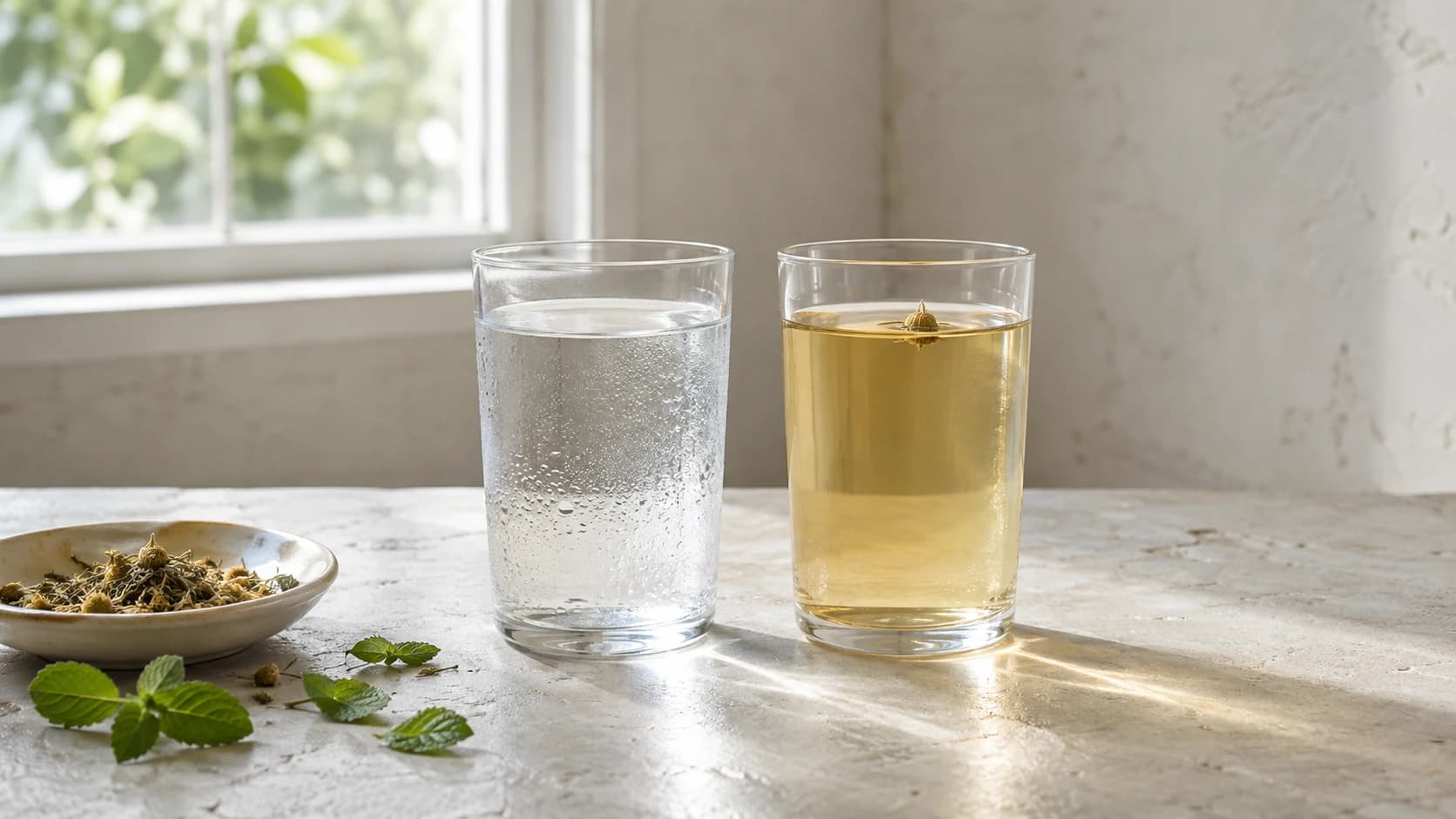
There are two completely different products sold as "tea for constipation", and telling them apart is the whole job. One is a pleasant plant infusion with very little evidence behind it. The other is a medicine, regulated as a drug, with a label instruction that most people who drink it have never read. If the box in your cupboard says "detox", "slimming" or "cleanse", this article is mostly about that one.
Two very different things are sold as "constipation tea"
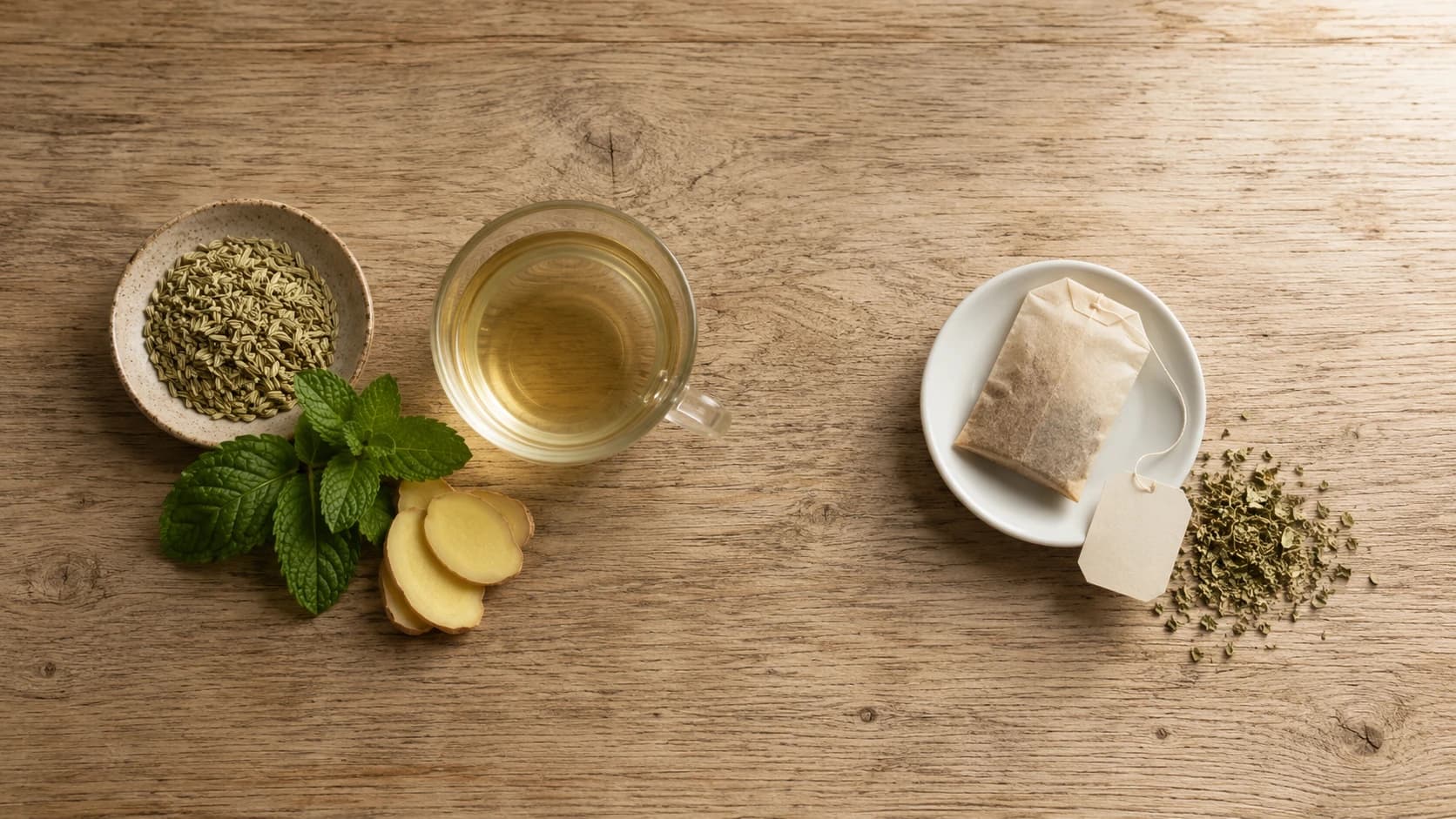
Teas that are food. Peppermint, ginger, fennel, dandelion leaf. These are ordinary infusions. They may be soothing, they contribute fluid, and their evidence for constipation specifically is thin to non-existent.
Teas that are a drug in a teabag. Senna leaf, and to a lesser extent cascara and rhubarb root. These contain anthraquinone compounds that act directly on the colon. In the United States, senna is sold as an over-the-counter drug with a Drug Facts panel, not as a food. The distinction is not a metaphor — it is a regulatory fact you can check on the box.
Almost every problem in this topic comes from someone treating the second kind as if it were the first.
What senna actually is, and what it actually does
Senna is a stimulant laxative. It irritates the lining of the colon and increases the muscular contractions that move stool, and it also affects fluid and electrolyte movement across the bowel wall.
You can read the pharmacology straight off a US product label. A typical over-the-counter senna tablet lists sennosides 8.6 mg, with Purpose: Laxative, uses "relieves occasional constipation (irregularity)", and "generally produces a bowel movement in 6–12 hours" (DailyMed). At the time of writing, DailyMed lists hundreds of senna drug labels.
In Europe, the EMA's Committee on Herbal Medicinal Products concluded that senna leaf preparations can be used short term for occasional constipation, on the basis of well-established use — meaning there is bibliographic evidence of effectiveness and safety covering at least ten years in the EU. Its assessment noted studies, mostly in elderly patients with long-term or severe constipation, in which senna taken with fibre was at least as effective as comparators such as lactulose (EMA).
So senna works. That is not in dispute, and it is why the "detox tea" business exists. The question is never whether it does something — it is whether you should be doing it every day.
Why short-term and daily are not the same decision
The instruction is explicit, and it comes from both regulators independently.
United States, on the label: "Do not use laxative products for longer than 1 week unless directed by a doctor." The same panel says to ask a doctor before use if you have stomach pain, nausea, vomiting, or have noticed a sudden change in bowel habits continuing over two weeks — and to stop use and ask a doctor for rectal bleeding, or if you fail to have a bowel movement after using a laxative (DailyMed).
European Union: senna leaf medicines "should only be used in adults and adolescents over the age of 12 years and should not be taken for longer than one week. Usually it is sufficient to take senna leaf medicines two to three times a week" (EMA).
Two regulators, one week, same answer. A tea you drink nightly for a month is outside both.
Dependence, cramping and what the risk actually is
Being precise here matters, because this is the area where confident and unsourced claims circulate most freely.
What I can source. The US National Institute of Diabetes and Digestive and Kidney Diseases addresses the dependence question directly: "If you've been taking laxatives for a long time and can't have a bowel movement without taking a laxative, talk with your doctor about how you can slowly stop using them. If you stop taking laxatives, over time, your colon should start moving stool normally." NIDDK also states that stimulants should only be used "if your constipation is severe or other treatments have not worked" (NIDDK).
That is the honest shape of the risk: a state where the bowel does not work without the drug, described by a national institute, alongside the reassurance that it generally recovers when the laxative stops — under medical supervision, not abruptly on your own.
What I will not claim. I have not found a primary source quantifying how often that happens, at what dose, or after how long. Cramping is a recognised effect of a drug whose mechanism is increased colonic contraction, and electrolyte disturbance is a plausible consequence of accelerated bowel transit, but I am not going to attach numbers to either without a citable study. If you see an article that does, ask where the figure came from.
One measured fact about what ends up in the cup. A 2021 survey studied the transfer of pyrrolizidine alkaloids — plant contaminants, not the active laxative — from ten teas and herbal teas into their brews. Senna infusions were among the ten. For brews prepared to vendors' instructions, the transfer rate into the drink was 38–100%, median 95%, with total alkaloid concentrations in the herb ranging 154–2,412 ng/g (median 422 ng/g) (Reinhard & Zoller, 2021). The general principle it demonstrates is the one that matters here: what is in the leaf largely ends up in your cup. A teabag is not a gentler delivery system than a tablet just because it is hot and tastes of herbs.
"Detox", "slimming" and "skinny" teas — the same leaf, different marketing
Search for herbal tea side effects and you land in a wall of brand names for slimming teas. The mechanism behind most of them is not mysterious. It is senna, or a close relative, sold under a word that implies wellness rather than pharmacology.
Two consequences follow directly:
- A laxative marketed as a lifestyle product invites daily use — which is exactly what both regulators say not to do. The branding is the risk factor.
- The weight that moves is not fat. Accelerating transit through the bowel moves water and stool weight. There is no mechanism by which a stimulant laxative removes body fat, and our herbal tea benefits guide already covers why "detox" is the wrong frame for any tea.
The framing this article adds is the inverse of the usual myth-bust: the problem with detox teas is not that they do nothing. It is that they do something real, that thing is a short-term medicine, and the packaging hides it.
The gentler options, and how weak the evidence for them is
If you want a tea that is not a laxative, here is what is honestly available.
- Peppermint. Relaxes gut smooth muscle, which is why it has a genuine role in IBS — mostly demonstrated with enteric-coated oil capsules rather than the tea. That is a cramping-and-bloating effect, not a stool-moving one. See peppermint tea for digestion.
- Ginger. Best evidenced for nausea; its effects on gastric emptying are its most-discussed digestive property. I have not found trial evidence that ginger tea treats constipation. See ginger tea and inflammation.
- Fennel. Traditionally used for gas and colic and included in the dysmenorrhoea literature; I found no constipation trials of fennel tea.
- Warm fluid generally. NIDDK's first-line advice includes drinking plenty of water and other liquids, particularly if you increase fibre (NIDDK). A morning hot drink is a reasonable habit and may act partly as a routine cue.
That is a short and unimpressive list, and it should be. There is no gentle herbal tea with good evidence for constipation. Anyone telling you otherwise is filling in a gap the research has not filled.
Worth noting for context: this site's herb library covers the opposite problem too — tormentil and agrimony are the traditional astringent herbs used for diarrhoea. Herbs act in both directions, which is another reason to treat them as active rather than automatically gentle.
Can herbal tea cause constipation?
I found no evidence that ordinary herbal infusions cause constipation, and fluid intake is on the helpful side of the ledger.
What NIDDK does list as causes worth checking includes medicines and supplements: antacids containing aluminium and calcium, anticholinergics and antispasmodics, anticonvulsants, calcium channel blockers, diuretics, iron supplements, medicines for Parkinson's disease, narcotic pain medicines, and some antidepressants. Life and routine changes — pregnancy, ageing, travel, ignoring the urge to go, changing what you eat — are also on the list (NIDDK).
There is one indirect connection worth knowing: herbal teas inhibit non-haem iron absorption substantially, so someone whose iron tablet is being blunted by tea may end up on a higher dose — and iron is on NIDDK's constipation list. The timing fix is in does herbal tea count as water?. And if the discomfort you are describing is bloating and gas rather than hard stool, that is a different problem with different answers — see foods that reduce bloating quickly and why does my stomach hurt after eating salad?.
What actually helps chronic constipation (and why it isn't a drink)
NIDDK's self-care sequence, in its own order (NIDDK):
- Change what you eat and drink. More high-fibre food, plus plenty of water and other liquids if you increase fibre. Depending on age and sex, adults should get 22 to 34 grams of fibre a day.
- Get regular physical activity.
- Try bowel training — aiming for a bowel movement at the same time each day. Trying 15 to 45 minutes after breakfast may help, because eating helps the colon move stool. Give yourself enough time, and go when you feel the need.
- Review medicines and supplements with your doctor if you suspect one is the cause. Do not stop anything on your own.
- Over-the-counter medicines, if your health professional recommends them — fibre supplements, osmotic agents, stool softeners, lubricants, and only then stimulants.
Note where stimulants sit: last, and only for severe constipation or after other treatments have failed. A senna tea drunk as step one inverts the entire sequence.
When constipation needs a doctor, not a teabag
NIDDK says to see a doctor if symptoms do not go away with self-care, or if you have a family history of colon or rectal cancer — and to see a doctor right away with constipation plus any of (NIDDK):
- bleeding from your rectum, or blood in your stool
- constant pain in your abdomen
- inability to pass gas
- vomiting
- fever
- lower back pain
- losing weight without trying
The over-the-counter label adds its own: stop and ask a doctor for rectal bleeding, or if you fail to have a bowel movement after using a laxative — "these may indicate a serious condition" (DailyMed).
Your next step. If this is occasional and you are otherwise well: start with fibre, fluid and movement, and give it a couple of weeks before reaching for anything. If you are already drinking a senna-containing tea most days, that is the thing to raise with a pharmacist or GP — NIDDK's advice is to come off long-term laxatives slowly and with medical guidance, not to stop abruptly. And if you take prescription medicines, herbal tea and medication interactions covers what to check first.
Frequently Asked Questions (FAQ)
How long does senna tea take to work? The US Drug Facts panel says a senna product "generally produces a bowel movement in 6–12 hours" (DailyMed), which is why the directions say to take it at bedtime. A tea's dose is not standardised the way a tablet's is, so the timing is less predictable.
Is senna tea safer than a senna tablet because it's "natural"? No — if anything the reverse, because the dose is less controlled. The transfer study found that what is in the herb largely ends up in the brew (Reinhard & Zoller, 2021), while a tablet at least tells you it contains 8.6 mg of sennosides.
Can children drink senna tea? The EMA's position is that senna leaf medicines should only be used in adults and adolescents over 12 (EMA). US OTC labels give paediatric dosing for the standardised tablet under a doctor's direction and say to ask a doctor for children under two. Either way, an unstandardised tea is the wrong format — ask a paediatrician.
Is senna tea safe in pregnancy? The label instruction is unambiguous: if pregnant or breast-feeding, ask a health professional before use (DailyMed). NIDDK also notes that pregnancy itself can change bowel habits.
What about "smooth move" or "cleanse" style teas without senna on the front? Read the ingredients panel, not the product name. Cascara sagrada and rhubarb root work by a related anthraquinone mechanism. If the box carries a Drug Facts panel, it is a medicine.
How we made this guide: Researched, written, and fact-checked by The Wellness Voyage editorial team, with every health claim backed by a citable source — recognised health authorities and peer-reviewed studies are linked throughout and listed in full below. We fact-check and review this article periodically and update it as the evidence changes; the last reviewed and updated date is shown with this article. It is written to inform, not to replace personalised advice from a qualified healthcare professional.
Medical disclaimer: This article is for informational purposes only. Always consult a qualified healthcare provider before making changes to your health routine.
Sources
- DailyMed (U.S. National Library of Medicine). CHOCOLATE FLAVORED SENNA — standardized senna concentrate tablet, chewable: Drug Facts label. https://dailymed.nlm.nih.gov/dailymed/drugInfo.cfm?setid=5850b0ce-7891-4570-b417-aead1efd4e9b
- European Medicines Agency. Sennae folium (senna leaf) — herbal medicinal product. https://www.ema.europa.eu/en/medicines/herbal/sennae-folium
- National Institute of Diabetes and Digestive and Kidney Diseases (NIDDK). Treatment for Constipation. https://www.niddk.nih.gov/health-information/digestive-diseases/constipation/treatment
- National Institute of Diabetes and Digestive and Kidney Diseases (NIDDK). Symptoms & Causes of Constipation. https://www.niddk.nih.gov/health-information/digestive-diseases/constipation/symptoms-causes
- Reinhard H, Zoller O. Pyrrolizidine alkaloids in tea, herbal tea and iced tea beverages — survey and transfer rates. Food Additives & Contaminants: Part A, 2021;38(11):1914–1933 — PubMed. https://pubmed.ncbi.nlm.nih.gov/34237234/
All sources accessed 27 August 2026.

Emily Johnson, MSc, RH (AHG)
A herbalist who reads the studies so you do not have to.