
Ginger is the herbal tea with the strongest scientific résumé — but its headline strength isn't inflammation, it's nausea. That distinction is worth getting right, because it tells you when ginger tea is a genuinely good idea and when you are asking too much of it. The anti-inflammatory effects are real, but modest; the anti-nausea effects are well proven. Here's how to use ginger for what it actually does, with realistic amounts and one safety note that matters if you take certain medications.
What's in ginger, and how it works
The warmth and bite of ginger come from compounds called gingerols and, once ginger is dried or heated, shogaols. These are the bioactive molecules behind its effects. In the body, they appear to influence inflammatory signalling pathways and the same gut and nervous-system targets involved in nausea (review of ginger meta-analyses, 2025).
The key point: ginger isn't a single-target drug. It nudges several systems gently. That's why its benefits are broad but moderate rather than dramatic.
The anti-inflammatory evidence, honestly
People often hope ginger will work like an anti-inflammatory medication. The evidence supports a smaller story.
Several trials have measured inflammatory markers in the blood after ginger supplementation. Pooled analyses have found that ginger can produce small but significant reductions in C-reactive protein (CRP) and other inflammatory markers (Morvaridzadeh et al., 2020). For osteoarthritis specifically, reviews have found a modest reduction in pain and disability — real, but smaller than many people expect, and with some studies reporting mild stomach side effects.
So ginger tea is a reasonable supporting habit if you're working on overall inflammation, but it belongs alongside the things that move the needle more: an anti-inflammatory eating pattern, regular movement, and sleep. It is not a treatment for an inflammatory condition.
Where ginger really shines: nausea
If you remember one thing, make it this. Ginger has strong, high-quality evidence for nausea:
- Pregnancy. Reviews consistently find ginger improves nausea and vomiting in pregnancy compared with placebo, with a good safety record at culinary doses (Viljoen et al., 2014).
- Chemotherapy. A meta-analysis of randomized trials found ginger helped reduce chemotherapy-induced nausea and vomiting (Chang & Wang, 2018).
- Motion sickness and post-surgery queasiness also have supportive evidence.
This makes ginger tea a sensible first reach for a queasy stomach — and, notably, the better choice than peppermint if you also have reflux, since peppermint can aggravate heartburn. We explain that trade-off in peppermint tea for digestion.
How much, and how to brew
Most research uses up to about 3 to 4 grams of ginger per day in adults; for pregnancy, staying around 1 gram per day is the commonly studied, cautious amount. A strong cup of fresh ginger tea sits comfortably within that range.
To brew a genuinely effective cup:
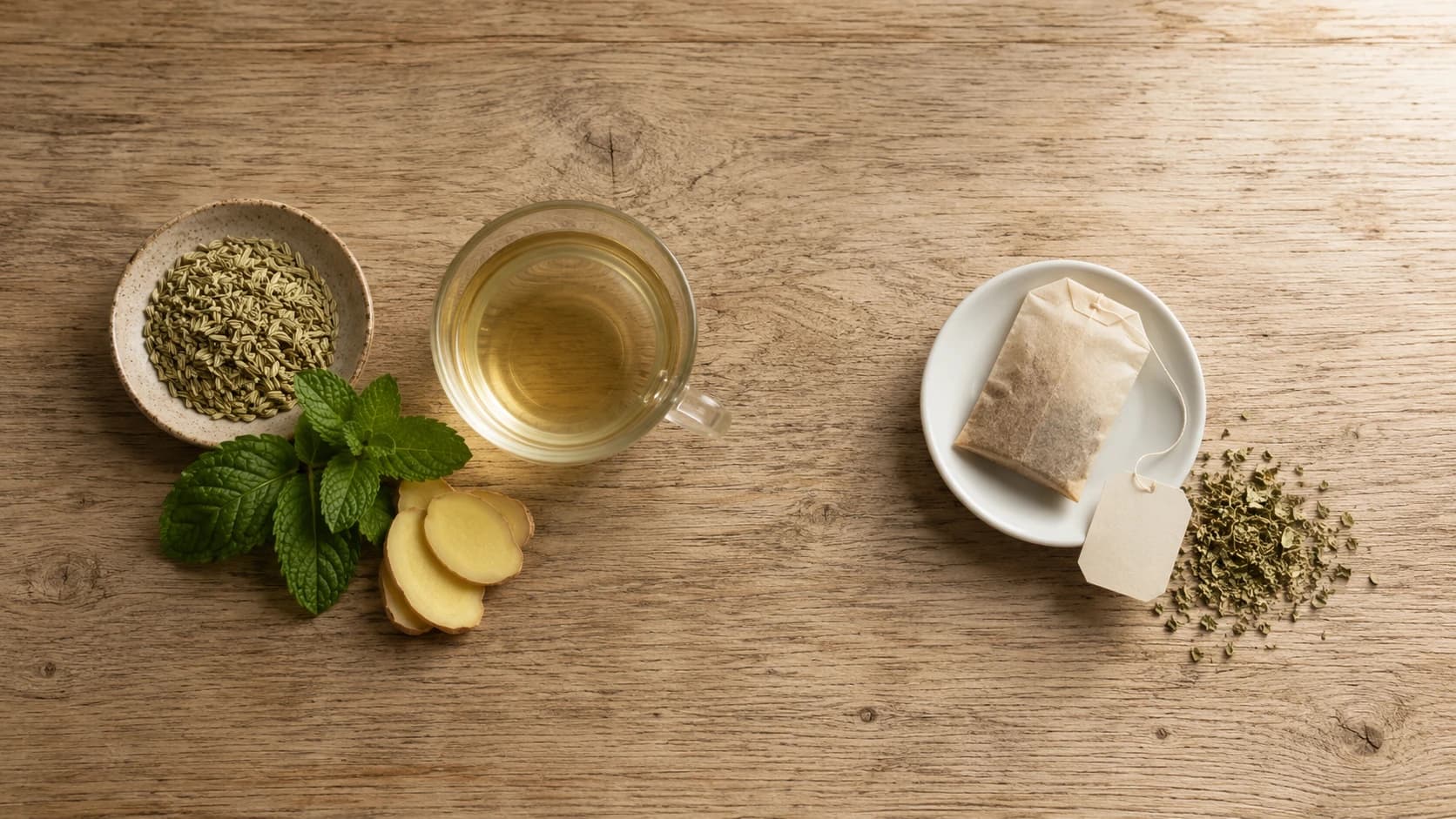
- Use fresh root. Slice or grate a thumb-sized piece (roughly 1–2 cm) per cup.
- Simmer, don't just steep. Roots release more if you simmer them gently for about 10 minutes in a covered pan. This is the step that turns weak ginger water into a proper, warming brew.
- Add lemon or honey to taste — pleasant, and the warmth and fluid help if you're unwell.
Dried ground ginger works too, but fresh root gives a brighter, stronger result.
Common mistakes
- Steeping instead of simmering. Roots need heat and time; a 2-minute steep barely extracts anything.
- Expecting drug-level anti-inflammatory results. Ginger's effect on inflammation is modest. Don't drop prescribed treatment in favour of tea.
- Overdoing it. Very large amounts can cause heartburn, gas, or stomach upset. More is not better.
- Ignoring the blood-thinner caution below.
Safety and who should be careful
Ginger is well tolerated for most people, but a few situations call for care:
- Blood thinners and bleeding risk. Ginger may have a mild antiplatelet effect, and it is named in a systematic review of warfarin interactions. If you take warfarin, an antiplatelet, or another anticoagulant — or you're approaching surgery — talk to your doctor before drinking concentrated ginger regularly, and see herbal tea and medication interactions.
- Pregnancy. Ginger is one of the better-studied herbs in pregnancy and is generally considered safe in moderate, food-level amounts (around 1 g/day), but discuss it with your midwife, especially in larger doses.
- Gallstones. Ginger can increase bile flow; check with a clinician if you have gallstone disease.
- Reflux. Most people tolerate ginger well, but a few find strong brews aggravate heartburn — reduce the strength if so.
For a reliable reference, see the U.S. NCCIH overview of ginger, and for the wider context of which teas earn their place, the herbal tea benefits guide.
Frequently Asked Questions (FAQ)
Is fresh ginger tea stronger than ginger teabags? Generally yes. A simmered piece of fresh root delivers more gingerols than a typical teabag. Teabags are convenient; fresh root is more potent.
Can ginger tea replace anti-inflammatory medication? No. Its anti-inflammatory effect is modest. Use it as a supportive habit, and never stop prescribed medication without talking to your doctor.
Does ginger tea help period cramps? There's some evidence that ginger reduces menstrual pain — three pooled trials found a 1.55-point drop on a 10-point scale, which Cochrane classes as very limited evidence. A strong cup around the start of your period is a sensible thing to try, but the trials used measured doses of powder, not teabags. Our guide to herbal teas for period cramps works through the numbers and the dose gap.
How quickly does ginger help with nausea? For mild queasiness, many people feel some relief within an hour. For pregnancy nausea, regular small amounts through the day tend to work better than one large dose.
How we made this guide: Researched, written, and fact-checked by The Wellness Voyage editorial team, with every health claim backed by a citable source — recognised health authorities and peer-reviewed studies are linked throughout and listed in full below. We fact-check and review this article periodically and update it as the evidence changes; the last reviewed and updated date is shown with this article. It is written to inform, not to replace personalised advice from a qualified healthcare professional.
Medical disclaimer: This article is for informational purposes only. Always consult a qualified healthcare provider before making changes to your health routine.
Sources
- Pharmacological properties of ginger (Zingiber officinale): what do meta-analyses say? A systematic review. 2025 — PMC. https://www.ncbi.nlm.nih.gov/pmc/articles/PMC12343617/
- Morvaridzadeh M, et al. Effect of ginger (Zingiber officinale) on inflammatory markers: a systematic review and meta-analysis of randomized controlled trials. Cytokine, 2020 — ScienceDirect. https://www.sciencedirect.com/science/article/abs/pii/S1043466620302404
- Viljoen E, et al. A systematic review and meta-analysis of the effect and safety of ginger in the treatment of pregnancy-associated nausea and vomiting. Nutrition Journal, 2014 — PMC. https://pmc.ncbi.nlm.nih.gov/articles/PMC3995184/
- Chang WP, Wang YH. Does the Oral Administration of Ginger Reduce Chemotherapy-Induced Nausea and Vomiting? A Meta-analysis of 10 Randomized Controlled Trials. Cancer Nursing, 2018 — PubMed. https://pubmed.ncbi.nlm.nih.gov/30299420/
- National Center for Complementary and Integrative Health (NCCIH). Ginger. https://www.nccih.nih.gov/health/ginger
All sources accessed 4 May 2026.

Emily Johnson, MSc, RH (AHG)
A herbalist who reads the studies so you do not have to.