Agrimony (Agrimonia eupatoria) is a yellow-flowered European herb with a long history of use as an astringent: a remedy that tightens tissue, slows secretions, and soothes irritation. Unlike many herbs whose reputation rests mostly on undocumented folklore, agrimony's standing is backed by something more concrete — formal review by European herbal-medicine authorities — plus laboratory and animal research rather than large human trials. That distinction matters, so this guide leads with agrimony's strongest evidence, then turns to what preclinical research adds and how the herb is actually prepared and dosed.
Agrimony's strongest evidence: three EU-recognized traditional uses
Agrimony's best-documented credential isn't a single study — it's that three independent European phytotherapy bodies, working separately, all recognize overlapping uses for it.
The European Medicines Agency's Committee on Herbal Medicinal Products (HMPC) finalized a European Union herbal monograph on Agrimonia eupatoria L., herba on 28 January 2015 (EMA/HMPC/680597/2013). It recognizes agrimony as a traditional-use herbal medicine — a category that rests on documented use of at least 30 years, including at least 15 years within the EU, rather than on clinical trials (EMA, Agrimoniae herba; EMA/HMPC/680597/2013 monograph). Germany's Commission E reached a similar conclusion for internal use in mild, non-specific diarrhea and external use for inflammation of the mouth and throat (Altmeyers Encyclopedia, Agrimoniae herba). ESCOP, the European Scientific Cooperative on Phytotherapy, lists the same three areas — mild diarrhea, gargling for mouth and throat inflammation, and compresses or rinses to support wound healing (ESCOP, Agrimoniae herba).
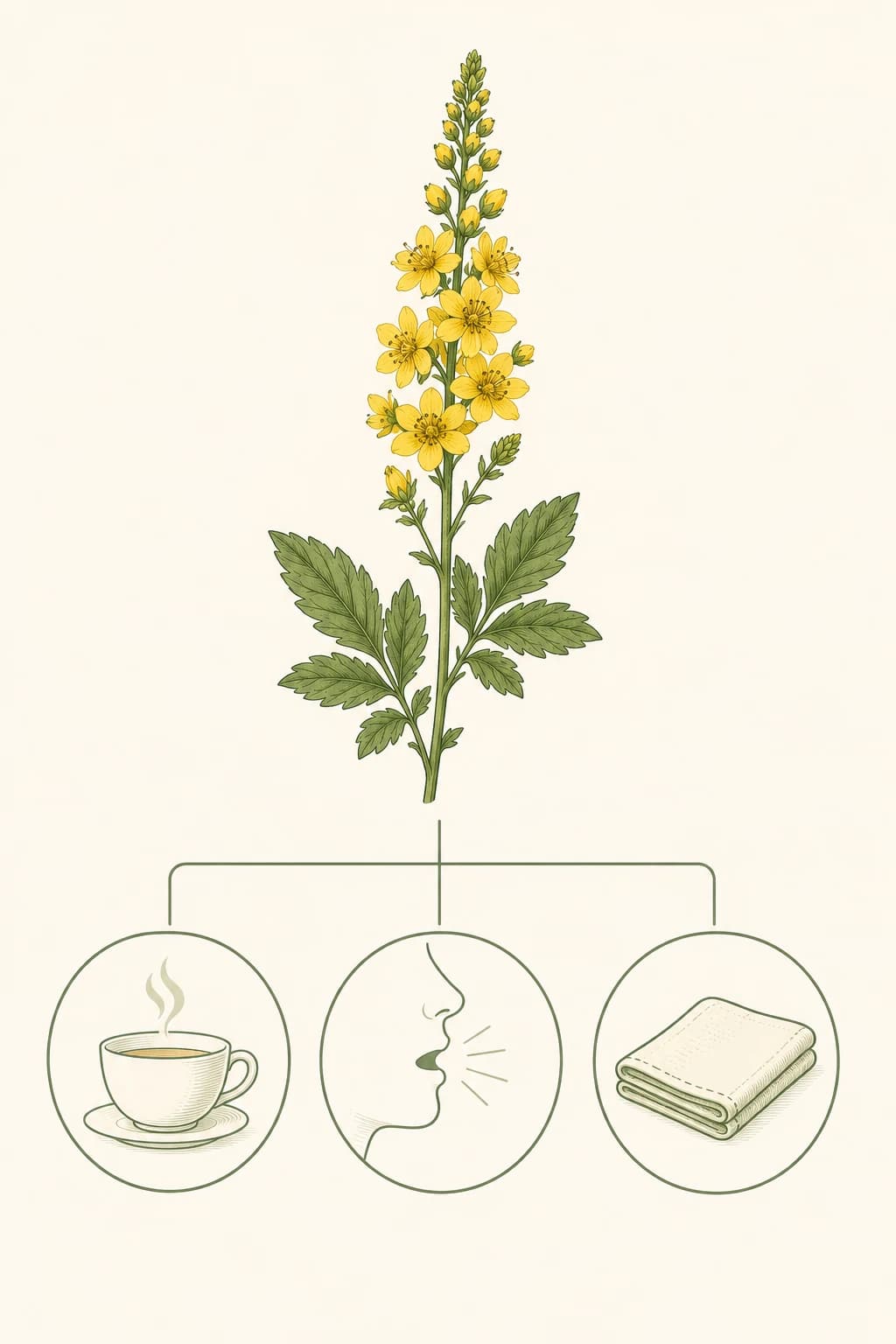
The EMA monograph itself spells out the three recognized indications, in adults, adolescents, and children over 12:
- Oral use for symptomatic relief of mild diarrhoea.
- As a gargle for symptomatic relief of minor inflammation of the mouth and throat.
- Applied to the skin for relief of minor skin inflammation and small, superficial wounds.
The monograph is explicit about the limits of this recognition: it is a traditional-use product "exclusively based upon long-standing use," not a claim backed by clinical trials. It also sets clear thresholds for when self-care should stop — see a doctor or qualified practitioner if diarrhea persists beyond 3 days, or if mouth, throat, or skin symptoms persist beyond 1 week (EMA/HMPC/680597/2013). The monograph also states the herb is not recommended for children under 12, because adequate data for that age group is lacking, and that the only listed contraindication is hypersensitivity to the herb itself.
In practice, this is what those three uses look like: agrimony tea taken for short-term, mild diarrhea; cooled agrimony tea used as a gargle or mouth rinse for a sore throat, mouth ulcers, or gum inflammation (one of its better-supported traditional uses under both EMA and Commission E); and a cooled infusion or decoction applied as a compress or wash for minor skin inflammation and small, superficial wounds. None of this replaces medical care for anything beyond mild, short-lived complaints — deeper, infected, or non-healing wounds, and diarrhea or throat symptoms that don't resolve within the windows above, need professional assessment.
If you're exploring other astringent or digestive herbs, see our guides to tormentil and fumitory, which have overlapping but distinct evidence profiles. For the opposite complaint — and why the teas sold for it are a different category of product altogether — see herbal tea for constipation.
What agrimony is: a tannin-rich astringent in the rose family
Agrimony is a perennial in the rose family (Rosaceae). The parts used medicinally are the aerial parts — leaves, stems, and flowers — gathered in summer. Commission E's phytochemical assessment puts the tannin content at roughly 4–10% catechin-type tannins, alongside flavonoids such as quercetin and kaempferol and various phenolic acids (Altmeyers Encyclopedia, Agrimoniae herba).
The tannins are the key to agrimony's character: they bind proteins, which is what gives the herb its drying, tightening, astringent taste and action. That same protein-binding chemistry is also the reason for two of the safety notes covered further down — its effect on iron absorption and its potential for skin reactions in sunlight — so it's worth keeping in mind as more than a background chemistry detail.
Beyond tradition: what preclinical research adds — and where it stops
The traditional-use recognition above rests on long-standing practice, not modern trials. Separately, a body of laboratory and animal research explains why those traditional uses are biologically plausible. These studies are not proof that agrimony treats a condition in people — that distinction is worth repeating for each one.
Anti-inflammatory and liver-related effects (animal and lab)
A 2022 review and experimental study in Plants (Basel) examined an agrimony herb extract and reported pronounced anti-inflammatory activity (peaking around 5 hours after a 10 mg/kg dose, in a rat paw-swelling model) and hepatoprotective effects at 25 mg/kg, including reduced ALT and AST liver-enzyme levels and less lipid peroxidation in liver tissue (Huzio et al., 2022). This is animal-model data, not evidence that agrimony treats liver disease in people.
Anti-inflammatory, antioxidant, and pain-related signals (in vitro and animal)
A 2017 study in Evidence-Based Complementary and Alternative Medicine tested an agrimony infusion and a polyphenol-enriched fraction of it. Both showed strong antiradical (antioxidant) activity and reduced inflammation in a mouse paw-swelling model. On pain specifically, the infusion produced an analgesic effect in a test for pain arising from irritation (the acetic-acid writhing test) but not in a test for centrally mediated pain (the hot-plate test) — suggesting any pain relief traces to the anti-inflammatory action at the site of irritation, rather than a direct effect on the central nervous system (Santos et al., 2017). Again: mouse data, not a demonstrated pain treatment in humans.
Antioxidant and antimicrobial activity (in vitro)
A 2016 study in the Journal of Food and Drug Analysis tested four types of agrimony extract and found the acetone extract had the strongest antioxidant activity and slowed the growth of several bacteria and fungi in the lab, including biofilm inhibition against Proteus mirabilis and Pseudomonas aeruginosa (Muruzović et al., 2016). This helps explain why the herb was traditionally used as a wound wash and throat gargle, but killing microbes in a test tube does not predict an effect on a real infection.
Wound healing (in vitro and animal)
A 2022 study in In Vivo reported that an agrimony water extract helped skin wounds heal: it boosted the growth of skin cells (fibroblasts and keratinocytes) in culture, and in rats it made wounds stronger and quicker to close, with more collagen-supporting matrix laid down at the wound site (Vasilenko et al., 2022). The authors credited the plant's polyphenols and specifically called for further testing in animal models more similar to humans. Promising, but still animal-level evidence.
Blood-sugar-relevant enzyme activity (in vitro and animal)
A 2016 paper in Molecules compared agrimony and artichoke (Cynara cardunculus) teas in a diabetic-rat model. Agrimony slowed an enzyme (α-glucosidase) that breaks down carbohydrates in the gut and showed strong antioxidant activity, with the authors suggesting it may have potential for helping prevent diabetes-related cardiovascular complications (Kuczmannová et al., 2016). This is early, rat-level evidence, not a reason to use agrimony as a diabetes treatment — but it's directly relevant to a caution covered in the safety section below, for anyone taking blood-sugar-lowering medication.
How agrimony is dosed: official EU reference amounts
The EMA/HMPC monograph gives specific reference amounts for each of the three recognized indications, for adolescents, adults, and the elderly (EMA/HMPC/680597/2013):
- For mild diarrhea (oral): an infusion of 1.5–4 g of comminuted herb in 250 ml (or less) of boiling water, 2–3 times daily; or a tincture (1:5, 45% ethanol), 1–4 ml, 3 times daily; or a liquid extract (1:1, 25% ethanol), 1–3 ml, 3 times daily.
- As a gargle (mouth and throat): an infusion of 1.5 g of comminuted herb in 150 ml of boiling water, 2–4 times daily; or a decoction of 3–4.5 g of comminuted herb in 250 ml (or less) of water, 2–3 times daily; or the same tincture or liquid extract doses above, used as a gargle.
- Applied to the skin: a decoction of 3–10 g of comminuted herb in 250 ml (or less) of water, used as an impregnated dressing on the affected area, or as a bath additive for up to 30 minutes, twice daily.
Germany's Commission E gives a simpler general guide for internal use — a daily amount of roughly 3 to 6 g of dried herb — which is the figure most consumer products reference rather than the more granular per-indication EMA amounts above (Altmeyers Encyclopedia, Agrimoniae herba). Because traditional-use products aren't standardized the way a prescription drug is, follow the label on any commercial product you buy, and don't exceed the durations noted above (3 days for diarrhea, 1 week for throat or skin symptoms) without medical advice. The monograph does not recommend use in children under 12.
Safety, interactions, and who should be cautious
Agrimony is generally well tolerated at traditional doses — the EMA monograph lists no known undesirable effects and no reported cases of overdose, and states that no interactions with other medicines have been formally reported (EMA/HMPC/680597/2013). That's a reassuring baseline, but it reflects a traditional-use safety file rather than a formal interaction study, so a few specific cautions are still worth taking seriously.
- Skin reactions in sunlight. Commission E's monograph specifically notes that topical use of agrimony can occasionally trigger a photoallergic reaction if the treated skin is then exposed to UV light (Altmeyers Encyclopedia, Agrimoniae herba). If you're using an agrimony compress or wash on skin that will be exposed to sun, this is a concrete, herb-specific reason to watch for a reaction, not just a generic "some people are sensitive" caveat.
- Iron and tannin-binding medicines. Agrimony's tannins bind proteins and minerals, including iron. This isn't unique to agrimony — the same tannin-iron binding mechanism was demonstrated for tea in a classic 1975 study in Gut, which found tannin-containing beverages can meaningfully reduce absorption of non-heme iron from food and supplements (Disler et al., 1975). As a practical precaution, separate agrimony from iron supplements or alkaloid-based medicines by at least 2 hours.
- A theoretical interaction with diabetes medication. The preclinical enzyme research above found agrimony can inhibit an enzyme involved in carbohydrate digestion and lower blood sugar markers in diabetic rats (Kuczmannová et al., 2016). Consistent with that mechanism, consumer drug-interaction references such as WebMD flag a possible interaction between agrimony and blood-sugar-lowering medications, on the theory that combining them could increase the risk of blood sugar dropping too low (WebMD, Agrimony). This hasn't been formally studied in people and isn't listed in the EMA monograph's own interaction section, but if you take medication for diabetes, it's a reasonable, source-grounded reason to monitor your blood sugar and check with your prescriber before using agrimony regularly.
- High tannin intake generally can cause stomach upset, nausea, or constipation in some people. Those prone to constipation should use agrimony sparingly.
- Pregnancy and breastfeeding: the EMA monograph states that safety hasn't been established and, in the absence of sufficient data, use isn't recommended during pregnancy or lactation.
- Children under 12: the monograph's traditional-use recognition doesn't extend to this age group, due to a lack of adequate data.
- The only formal contraindication in the monograph is hypersensitivity to the herb itself.
See a healthcare provider before using agrimony if you're managing a chronic condition or taking prescription medicine. For general guidance on choosing and using herbal products safely, the NCCIH is a reliable starting point (its herb-specific fact sheets don't currently include agrimony, but its general safety guidance applies).
Frequently Asked Questions (FAQ)
Is agrimony scientifically proven to work? Its traditional uses are recognized by three independent European bodies — the EMA/HMPC, Germany's Commission E, and ESCOP — based on long-standing documented use, and laboratory and animal studies support why those uses are plausible. But there are no large human clinical trials, so "proven" is too strong a word.
Can I use agrimony every day? Short courses at standard doses are consistent with EMA and Commission E guidance. The EMA monograph advises seeing a doctor if diarrhea lasts beyond 3 days or throat/skin symptoms beyond a week; longer-term daily use should be supervised by a practitioner.
Is agrimony the same as hemp agrimony? No. Hemp agrimony (Eupatorium cannabinum) is a different plant with a different safety profile. This article covers Agrimonia eupatoria only.
Can I apply agrimony to my skin before going outside? Use caution. Commission E's monograph notes topical agrimony can occasionally cause a photoallergic skin reaction after sun exposure, so avoid strong sun on treated skin and watch for irritation.
Does agrimony interact with medications? No interactions are formally documented in the EMA monograph, but its tannins can reduce absorption of iron and some medicines (separate doses by at least 2 hours), and its preclinical blood-sugar-lowering activity is a reasonable reason for caution if you take diabetes medication.
Medical disclaimer: This article is for informational purposes only. Always consult a qualified healthcare provider before making changes to your health routine.
Sources
- European Medicines Agency (EMA/HMPC). Agrimoniae herba (Agrimonia eupatoria L., herba) — herbal medicinal product overview. https://www.ema.europa.eu/en/medicines/herbal/agrimoniae-herba
- Committee on Herbal Medicinal Products (HMPC). European Union herbal monograph on Agrimonia eupatoria L., herba. EMA/HMPC/680597/2013, 28 January 2015. https://www.ema.europa.eu/en/documents/herbal-monograph/final-european-union-herbal-monograph-agrimonia-eupatoria-l-herba-first-version_en.pdf
- ESCOP (European Scientific Cooperative on Phytotherapy). Agrimoniae herba (Agrimony) monograph. https://www.escop.com/downloads/agrimoniae-herba-agrimony/
- Altmeyers Encyclopedia (Department of Phytotherapy). Agrimoniae herba — summary of Commission E findings, phytochemistry, and safety notes. https://www.altmeyers.org/en/naturopathy/agrimoniae-herba-143794
- Huzio N, et al. Phytochemical and Pharmacological Research in Agrimonia eupatoria L. Herb Extract with Anti-Inflammatory and Hepatoprotective Properties. Plants (Basel), 2022 — PubMed. https://pubmed.ncbi.nlm.nih.gov/36145771/
- Santos TN, et al. Antioxidant, Anti-Inflammatory, and Analgesic Activities of Agrimonia eupatoria L. Infusion. Evidence-Based Complementary and Alternative Medicine, 2017 — PubMed. https://pubmed.ncbi.nlm.nih.gov/28491113/
- Muruzović MŽ, et al. Extracts of Agrimonia eupatoria L. as sources of biologically active compounds and evaluation of their antioxidant, antimicrobial, and antibiofilm activities. Journal of Food and Drug Analysis, 2016 — PubMed. https://pubmed.ncbi.nlm.nih.gov/28911559/
- Vasilenko T, et al. Agrimonia eupatoria L. Aqueous Extract Improves Skin Wound Healing: An In Vitro Study in Fibroblasts and Keratinocytes and In Vivo Study in Rats. In Vivo, 2022 — PubMed. https://pubmed.ncbi.nlm.nih.gov/35478102/
- Kuczmannová A, et al. Agrimonia eupatoria L. and Cynara cardunculus L. Water Infusions: Comparison of Anti-Diabetic Activities. Molecules, 2016 — PubMed. https://pubmed.ncbi.nlm.nih.gov/27136516/
- Disler PB, et al. The effect of tea on iron absorption. Gut, 1975 — PubMed. https://pubmed.ncbi.nlm.nih.gov/1168162/
- WebMD. Agrimony: Overview, Uses, Side Effects, Precautions, Interactions, Dosing. https://www.webmd.com/vitamins/ai/ingredientmono-604/agrimony
- National Center for Complementary and Integrative Health (NCCIH). Herbs at a Glance. https://www.nccih.nih.gov/health/herbsataglance
All sources accessed 10 July 2026.

Emily Johnson, MSc, RH (AHG)
Registered Herbalist (AHG) specializing in natural remedies and medicinal plants, with a focus on the traditional and evidence-based uses of healing herbs.