
Tormentil is a small European plant whose root has a long use as an astringent, mainly for diarrhoea and sore mouths. What sets it apart from many of the herbs we cover is that one of its traditional uses has actually been tested in a real randomised, placebo-controlled human trial — not just a lab dish or centuries of folklore. This guide leads with that trial, then works outward to the weaker evidence, the plant's official regulatory status, and dosage and safety.
The clinical trial: what an actual RCT found for children's diarrhoea
Most traditional astringent herbs have never been tested in a proper human trial. Tormentil has. A randomised, double-blind, placebo-controlled study assigned 40 children (aged 3 months to 7 years) with confirmed rotavirus diarrhoea, treated at a children's infectious-disease hospital in St Petersburg, Russia, to either tormentil root extract or a matching placebo, given three times a day until the diarrhoea stopped or for up to 5 days (Subbotina et al., 2003).
The result: diarrhoea lasted about 3 days in the tormentil group versus about 5 days on placebo, and 40% of treated children were symptom-free within 48 hours compared with 5% on placebo. Treated children also needed less oral rehydration fluid, and no side effects were reported.
A double-blind, placebo-controlled result like this is uncommon for a folk astringent herb — for most plants in this category, all that exists is laboratory and animal work, or a long history of use, not a human trial. A 2020 pharmacology review of tormentil research made this point directly: laboratory and animal studies broadly support the plant's traditional reputation for diarrhoea and mucosal inflammation, but clinical trials on it remain scarce overall (Melzig & Böttger, 2020). That makes the rotavirus trial a genuine, if modest, exception in this herb's evidence base.
It's still one trial, in young children, from a single hospital, and it does not appear to have been replicated at larger scale since. Read it as a real and promising signal, not as definitive proof that tormentil works for every kind of diarrhoea in every age group.
Where the evidence is thinner: ulcerative colitis
A second human study looked at ulcerative colitis rather than infectious diarrhoea, and the evidence here is weaker. Sixteen adults with active disease were given tormentil extract in escalating doses — 1,200, 1,800, 2,400, then 3,000 mg per day, each dose held for three weeks with washout periods in between — openly, with no placebo group. Disease-activity scores and inflammatory markers improved at the 2,400 mg/day dose, with mild upper-abdominal discomfort in around 38% of patients as the main downside, not severe enough for anyone to stop treatment (Huber et al., 2007).
Because there was no placebo arm, this study cannot show that tormentil itself caused the improvement — ulcerative colitis symptoms naturally fluctuate, and open-label designs are prone to placebo and observer effects. It's best read as an early, hypothesis-generating signal rather than evidence that tormentil treats ulcerative colitis. Anyone with active ulcerative colitis needs proper medical management, not self-treatment with an herbal extract.
The plant: botany, chemistry, and why tannins do the work
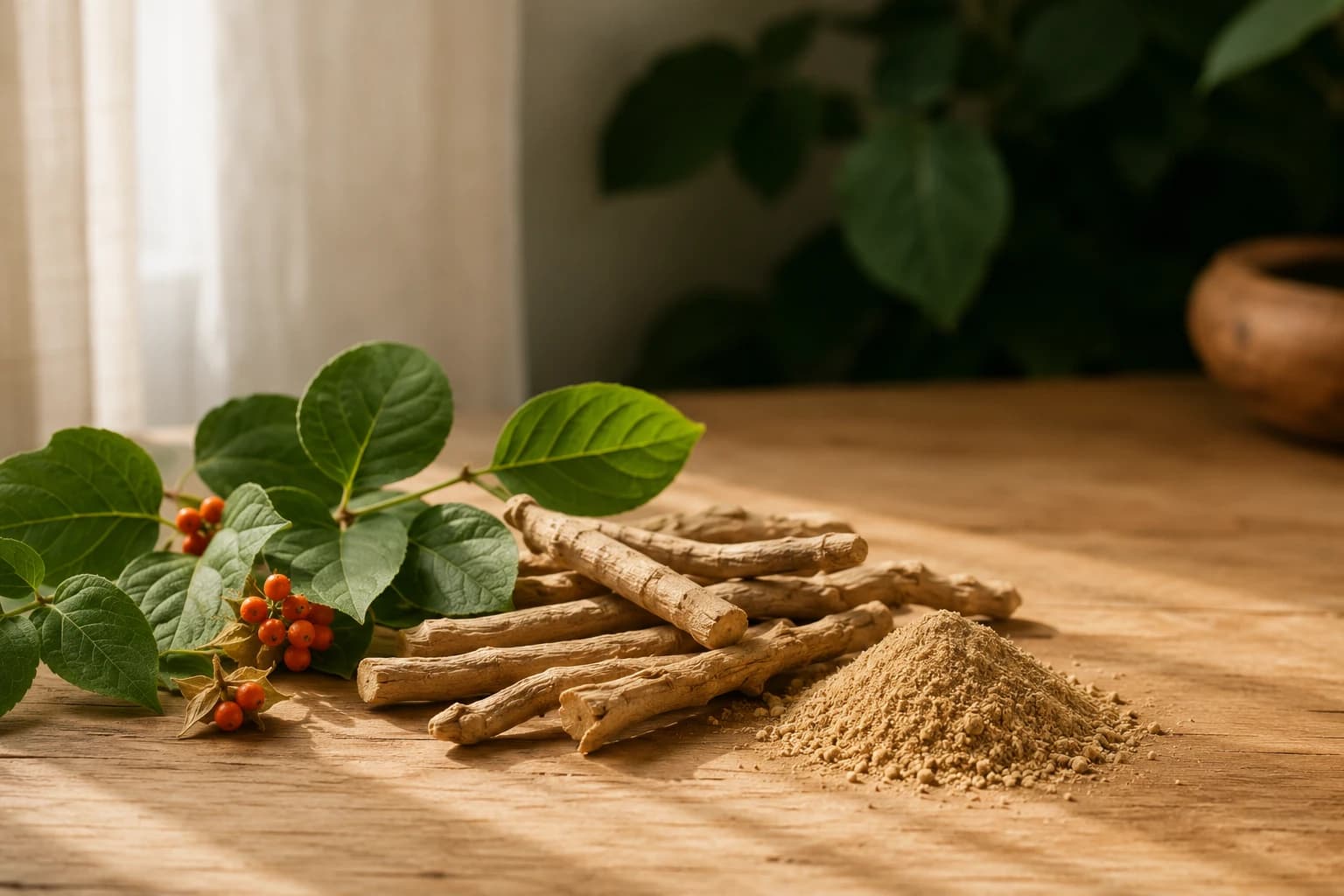
Tormentil is Potentilla erecta (also written P. tormentilla), a low creeping perennial in the rose family with yellow four-petalled flowers. It grows across Europe and Asia on heaths, moorland, and acidic soils. The medicinal part is the dark, gnarled rhizome, dug up and dried.
Its activity comes mostly from a high level of tannins, around 15–20%, along with related compounds such as ellagitannins (including agrimoniin), catechins, and triterpenes. A review of the whole Potentilla genus found that most of the plant's effects can be explained by these tannins (Tomczyk & Latté, 2009). Tannins bind and tighten proteins, which is what gives the root its drying, puckering action — the same mechanism behind both the diarrhoea trial above and its traditional use as a mouth and gum rinse.

Official recognition: a traditional-use status, not a clinical approval
Europe's herbal medicines committee (the HMPC) formally recognises tormentil root for two uses: the symptomatic treatment of mild diarrhoea, and, as a mouthwash or gargle, minor inflammation of the lining of the mouth (EMA, Tormentillae rhizoma).
It's worth being precise about what that status actually rests on. This is a "traditional use" registration — grounded in a documented history of at least 30 years of use worldwide, including at least 15 years within the EU — not a "well-established use" designation, which would require robust clinical trial data. In practice, that means the committee's approval is built on tormentil's long safety record and laboratory-supported plausibility, not directly on the rotavirus trial described above, even though that trial happens to support the same use.
The monograph also sets clear limits on self-treatment: for diarrhoea, see a doctor if symptoms worsen or continue for more than 3 days; for mouth inflammation, if it continues for more than a week (EMA, Tormentillae rhizoma). Broader folk claims for tormentil — treating arthritis, heavy periods, urinary problems, or cancer — fall outside this recognised use and are not backed by good human studies, so treat them as tradition only.
Traditional astringent uses beyond the trials
Beyond the diarrhoea and mouth uses above, tormentil has historically been used as a gargle for sore throats, as a wash for minor wounds and skin irritation, and for bleeding gums. These reflect its astringent action and a long folk record, not proven medical treatment (Tomczyk & Latté, 2009).
Herbs act in both directions, and it is worth knowing the counterpart: the plants sold for the opposite problem are stimulant laxatives with a one-week label limit, not gentle infusions — see herbal tea for constipation.
How it's prepared and dosed
The recognised uses are short-term and self-limiting. Practitioner and monograph ranges are roughly:
- Tea (decoction): about 2–3 g of cut or powdered rhizome per cup. Because tannins are the active part, a brief simmer is enough; drink up to a few times a day for short-term diarrhoea.
- Mouth rinse: a stronger tea or a few drops of tincture in water, swirled and spat out, for minor mouth inflammation.
- Tincture: small amounts (commonly around 10–20 drops in water) as directed on the product.
Follow the monograph's own limits: stop and see a doctor if diarrhoea doesn't improve within 3 days, or if mouth inflammation continues beyond a week (EMA, Tormentillae rhizoma). Seek medical care right away if diarrhoea contains blood or comes with a high fever or signs of dehydration.
Safety, interactions, and who should avoid it
- Stomach upset: the most common complaint is mild stomach or upper-abdominal discomfort, sometimes nausea, especially at higher doses.
- Tannins and absorption: the high tannin content can reduce how well your gut absorbs iron and some medicines, so separate tormentil from supplements and drugs by a couple of hours.
- Pregnancy and breastfeeding: safety is not established, so avoid it.
- Children: the diarrhoea trial used a specific dosed extract under medical supervision; do not improvise doses for children at home.
- Serious or lasting symptoms: ongoing diarrhoea, blood in the stool, or inflammatory bowel disease need proper medical care. Do not use tormentil in place of treatment, and check with a clinician if you take prescription medicines.
For background on using herbs safely, see NCCIH.
For other astringent and digestive herbs, see our guides to agrimony and cramp bark.
Frequently Asked Questions (FAQ)
Is there real clinical trial evidence behind tormentil, or is it only traditional use? Yes — unlike many astringent herbs, tormentil has an actual randomised, placebo-controlled trial behind one of its uses: in 40 children with rotavirus diarrhoea, it cut the illness from about 5 days to about 3 and got more children symptom-free by 48 hours. That's a genuine, if small, clinical result, not just tradition or lab data, though it hasn't been repeated in a larger trial since.
What is tormentil officially recognised for? Europe's herbal medicines committee recognises it, based on long traditional use, for mild diarrhoea and, as a rinse, minor mouth inflammation. This traditional-use status rests on safety history rather than the clinical trial above; wider folk uses aren't part of that recognition.
Can tormentil treat ulcerative colitis? An open-label study without a placebo group found improvement at higher doses, but that design can't prove tormentil was responsible. Ulcerative colitis needs proper medical care; do not self-treat it with tormentil.
Is tormentil safe? For short-term use it is generally well tolerated, with mild stomach upset the main issue. Avoid it in pregnancy and breastfeeding, keep it apart from iron and medicines, and do not use it internally for long periods without advice.
Medical disclaimer: This article is for informational purposes only. Always consult a qualified healthcare provider before making changes to your health routine.
Sources
- Subbotina MD, et al. Effect of oral administration of tormentil root extract (Potentilla tormentilla) on rotavirus diarrhea in children: a randomized, double-blind, controlled trial. Pediatric Infectious Disease Journal, 2003 — PubMed. https://pubmed.ncbi.nlm.nih.gov/12913771/
- Huber R, et al. Tormentil for active ulcerative colitis: an open-label, dose-escalating study. Journal of Clinical Gastroenterology, 2007 — PubMed. https://pubmed.ncbi.nlm.nih.gov/17881930/
- Melzig MF, Böttger S. Tormentillae rhizoma — Review for an Underestimated European Herbal Drug. Planta Medica, 2020;86(15):1050-1057 — PubMed. https://pubmed.ncbi.nlm.nih.gov/32155655/
- Tomczyk M, Latté KP. Potentilla — a review of its phytochemical and pharmacological profile. Journal of Ethnopharmacology, 2009;122(2):184-204 — PubMed. https://pubmed.ncbi.nlm.nih.gov/19162156/
- European Medicines Agency (EMA). Potentilla erecta (Tormentillae rhizoma) — herbal monograph and assessment. https://www.ema.europa.eu/en/medicines/herbal/tormentillae-rhizoma
- National Center for Complementary and Integrative Health (NCCIH). Herbs at a Glance. https://www.nccih.nih.gov/health/herbsataglance
All sources accessed 10 July 2026.

Emily Johnson, MSc, RH (AHG)
Registered Herbalist (AHG) specializing in natural remedies and medicinal plants, with a focus on the traditional and evidence-based uses of healing herbs.