

LDL and HDL are the two lipoproteins a standard cholesterol test reports, and most people meet both terms before anyone explains how they actually differ. Here's the side-by-side version, plus what "good" and "bad" leave out.
LDL vs HDL at a Glance
| LDL | HDL | |
|---|---|---|
| Full name | Low-density lipoprotein | High-density lipoprotein |
| Common nickname | "Bad" cholesterol | "Good" cholesterol |
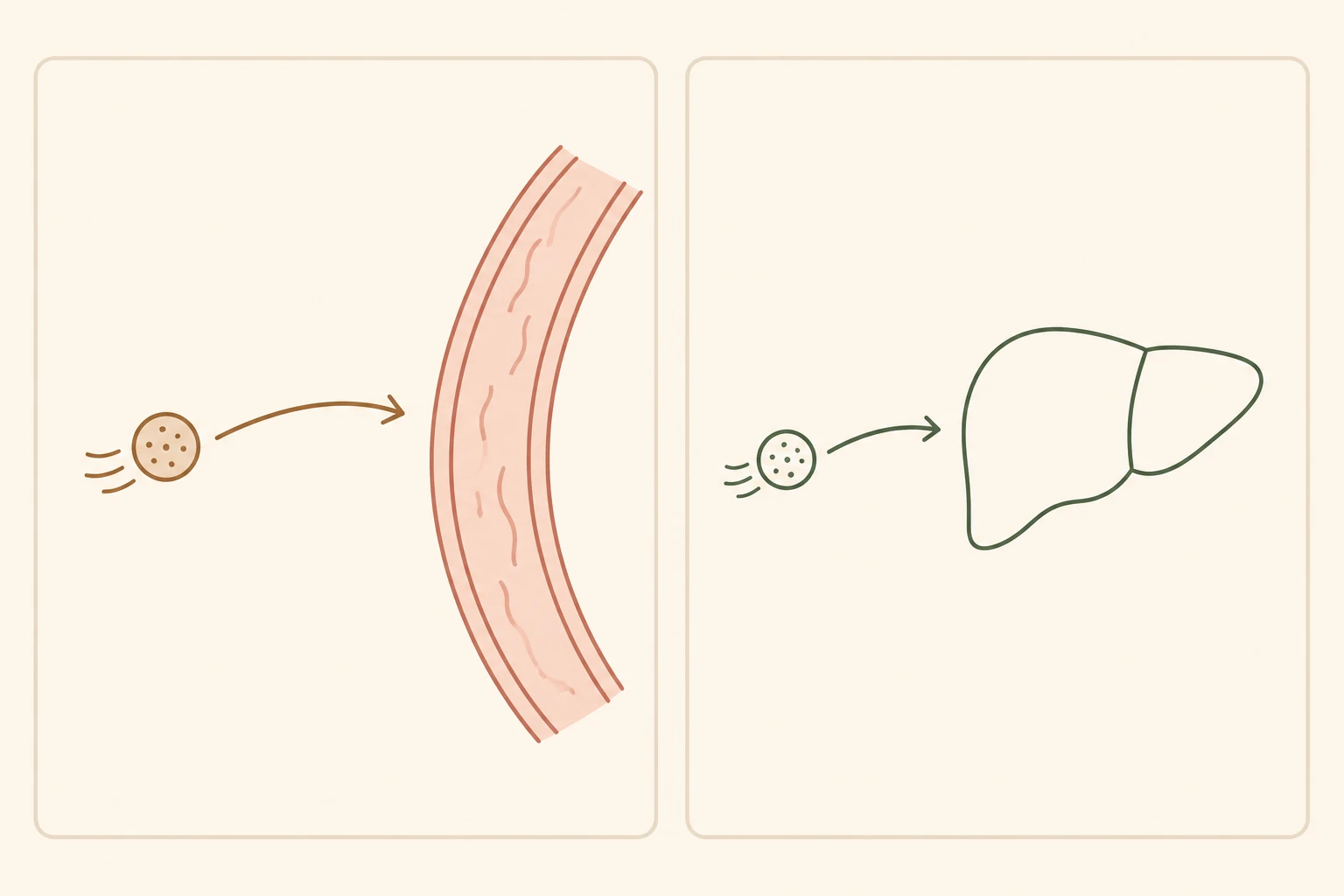
| What it does | Carries cholesterol from the liver to the rest of the body | Carries excess cholesterol from tissues back to the liver |
| Normal range (mg/dL) | Below 100 (optimal) | 40–80 (men) / 50–80 (women) |
| Same range (mmol/L) | Below 2.59 | 1.03–2.07 (men) / 1.29–2.07 (women) |
| Main effect on arteries | Can deposit into artery walls and contribute to plaque when too much is circulating | Helps clear excess cholesterol away from artery walls for disposal |
These ranges come from Cleveland Clinic's published cutpoints for LDL and HDL. You can check the mmol/L conversion yourself: divide the mg/dL figure by 38.67 (NCBI Bookshelf, lipid conversion factors) — for example, 100 ÷ 38.67 ≈ 2.59 mmol/L, and 80 ÷ 38.67 ≈ 2.07 mmol/L. For the full age-stratified breakdown across all four lipid markers, see normal cholesterol levels, and our lipids explained guide for the broader reference-range framework.
LDL and HDL Are Lipoproteins, Not Types of Fat
Cholesterol doesn't dissolve in blood on its own, so it has to be carried by particles called lipoproteins, "like little boats that travel through your bloodstream," as Cleveland Clinic puts it (Cleveland Clinic). LDL and HDL are two different carriers of the same cholesterol molecule, not two different substances — the National Heart, Lung, and Blood Institute defines lipoproteins the same way structurally: particles "made of lipids (fats) and proteins" that carry cholesterol through the blood (NHLBI).
Cholesterol itself isn't the enemy here. Your liver makes about 80% of the body's cholesterol because your cells genuinely need it (Cleveland Clinic), and the brain alone holds roughly 20% of the body's total cholesterol, required for synapse and dendrite formation, according to peer-reviewed research (PMC). What varies between LDL and HDL is the direction they carry cholesterol, not what cholesterol is.

Good Cholesterol vs Bad Cholesterol: Why the Nicknames Stick
HDL is called "good" because it collects cholesterol from artery walls and tissues and carries it back to the liver for disposal; LDL is called "bad" because, when too much of it is circulating, it can deposit into artery walls and contribute to plaque buildup — for the full breakdown of what LDL does and how to read your own result, see LDL cholesterol. The American Heart Association frames it the same direction: "HDL carries LDL cholesterol away from the arteries and back to the liver, where the LDL is broken down and passed from the body," while LDL "contributes to fatty buildups in arteries (atherosclerosis)" (American Heart Association).
That framing is a useful functional shorthand, not a strict rule. It's exactly why very-high HDL and the non-HDL/apoB nuance below deserve their own honest treatment rather than getting flattened into "more good cholesterol is always better."
What Raises and Lowers Each One
Largely the same set of levers moves both numbers, often in different directions. Diets high in saturated and trans fat, along with smoking, tend to raise LDL and lower HDL. Regular physical activity and moderate weight loss tend to raise HDL. Genetics, including familial hypercholesterolemia, can push LDL high independent of diet entirely. In practice, what shows up on a repeat lipid panel is rarely one lever pulled in isolation — it's usually some combination of these moving together. For the full, numbers-based breakdown of what actually moves each marker and by how much, see what actually moves the numbers.

Is There Such a Thing as HDL Being Too High?
Technically, yes. Cleveland Clinic's own HDL range table lists above 80 mg/dL (2.07 mmol/L) as its own "High" category, worth a conversation with your provider rather than an automatic win (Cleveland Clinic). Some research suggests very-high-HDL particles don't always function protectively, but exactly why isn't yet settled in patient-facing terms — this cannot be confirmed as a clear, agreed-upon mechanism at a consumer-content level, so it's worth stating honestly rather than guessing at an explanation. For the fuller discussion, including what to ask your doctor if your HDL is unusually high, see HDL cholesterol.
Beyond LDL and HDL: What Non-HDL and apoB Add
LDL and HDL don't capture the whole picture. Non-HDL cholesterol, your total cholesterol minus your HDL, also counts VLDL and other cholesterol-carrying particles that LDL alone misses. Cleveland Clinic recommends keeping non-HDL no more than 30 mg/dL above your LDL target, and notes that a further marker, apoB, which counts the actual number of artery-affecting particles, is "even more accurate at predicting risk than non-HDL" (Cleveland Clinic — Non-HDL Cholesterol).
A March 13, 2026 update from the American College of Cardiology, the American Heart Association, and several partner societies adds another marker to that conversation: the guideline recommends Lp(a), a separate genetically-determined lipoprotein, "should be measured at least once in adulthood" — a de facto universal one-time screening recommendation, more current than any competitor content addressing this comparison (ACC.org). None of this replaces LDL and HDL on a routine panel, but it's worth knowing these numbers exist if your family history or your LDL result warrants a closer look.
Bottom Line
Neither LDL nor HDL alone tells the whole story. Both matter, and in practice, context, family history, existing heart disease, and your other risk factors, usually matters more than either cutoff read in isolation. For the fuller picture of what cholesterol is and does before you dig into either number specifically, see our cholesterol guide.
Frequently Asked Questions (FAQ)
Is LDL always "bad" and HDL always "good"? As a rough shorthand, yes, but not without exception — a very high HDL isn't automatically better, and neither number alone captures your full risk picture, which is why context like family history and other risk factors still matters.
Can your LDL and HDL both be high at the same time? Yes. They're measured and reported separately on a lipid panel, so it's entirely possible to have an elevated LDL and a high HDL on the same results, which is one reason doctors look at the full panel rather than a single number.
Is there such a thing as HDL cholesterol being too high? Technically yes — Cleveland Clinic lists HDL above 80 mg/dL (2.07 mmol/L) as its own category worth discussing with a clinician, since an unusually high result can sometimes reflect something other than extra protection.
What's the difference between LDL cholesterol and non-HDL cholesterol? LDL is one specific carrier particle. Non-HDL cholesterol (total cholesterol minus HDL) captures LDL plus other cholesterol-carrying particles like VLDL, giving a broader picture than LDL alone.
Which matters more for heart disease risk, LDL or HDL? Both matter, but LDL has the stronger, more directly actionable evidence base — lowering it with proven interventions like statins reduces cardiovascular events, while raising HDL with medication has not reliably done the same in major trials.
Medical disclaimer: This article is for informational purposes only. Always consult a qualified healthcare provider before making changes to your health routine.
Sources
- Cleveland Clinic. LDL Cholesterol — Health article. https://my.clevelandclinic.org/health/articles/24391-ldl-cholesterol
- Cleveland Clinic. HDL Cholesterol — Health article. https://my.clevelandclinic.org/health/articles/24395-hdl-cholesterol
- NCBI Bookshelf (AHRQ). Lipid Conversion Factors, Appendix A. https://www.ncbi.nlm.nih.gov/books/NBK83505/
- Cleveland Clinic. What Is Cholesterol? — Health article. https://my.clevelandclinic.org/health/articles/23922-what-is-cholesterol
- National Heart, Lung, and Blood Institute (NIH). Blood Cholesterol — Health topic overview. https://www.nhlbi.nih.gov/health/blood-cholesterol
- Cholesterol: Its Regulation and Role in Central Nervous System Disorders — Peer-reviewed review, PubMed Central. https://pmc.ncbi.nlm.nih.gov/articles/PMC3483652/
- American Heart Association. HDL (Good), LDL (Bad) Cholesterol and Triglycerides. https://www.heart.org/en/health-topics/cholesterol/hdl-good-ldl-bad-cholesterol-and-triglycerides
- Cleveland Clinic. Non-HDL Cholesterol — Health article. https://my.clevelandclinic.org/health/articles/non-hdl-cholesterol
- American College of Cardiology. ACC/AHA Release New Clinical Guideline for Managing Dyslipidemia — Journal scan, published March 13, 2026. https://www.acc.org/latest-in-cardiology/journal-scans/2026/03/13/15/20/acc-aha-release-new-clinical-guideline-for-managing-dyslipidemia

Olivia Smith, RDN
A registered dietitian who explains lab numbers without the jargon.