

Enlicitide, sold under the brand name Lipfendra, became the first oral PCSK9 inhibitor approved by the FDA on July 16, 2026 — a genuinely new option in a drug class that, until now, only came as an injection (Merck, FDA-approved Prescribing Information; Merck press release). This is what's confirmed as of July 22, 2026, six days after approval: what enlicitide is, how well it lowered LDL cholesterol in the trials that got it approved, and — just as important — what it hasn't yet proven. For the broader medication landscape it belongs to, see cholesterol medication; for the basics of cholesterol itself, see our cholesterol guide.
What Is Enlicitide (Lipfendra)?
Enlicitide is the generic name; Lipfendra is the brand name Merck sells it under — the same drug, split the same way atorvastatin and Lipitor are. The FDA approved it on July 16, 2026 as a once-daily, 20mg oral tablet, indicated as an adjunct to diet and exercise to reduce LDL cholesterol in adults with hypercholesterolemia, including heterozygous familial hypercholesterolemia (HeFH) (Merck, FDA-approved Prescribing Information). It's the first drug in its class, PCSK9 inhibitors, that comes as a pill rather than an injection.
Chemically, enlicitide is a macrocyclic peptide — a ring-shaped chain of amino acids, not a small-molecule drug like a statin and not an antibody like the existing injectable PCSK9 inhibitors (Merck, FDA-approved Prescribing Information). Merck's development code name for it was MK-0616, and the approved tablet uses the decanoate salt form of the molecule, enlicitide decanoate. As of this approval, enlicitide/Lipfendra is a real, prescribable medication, not an experimental drug still confined to trials.
How an Oral PCSK9 Inhibitor Works
PCSK9 is a protein the liver makes that normally attaches to LDL receptors and marks them for destruction after they've done their job pulling LDL out of the blood. Block PCSK9, and the liver keeps more of those receptors in circulation, clearing more LDL cholesterol as a result (Merck, FDA-approved Prescribing Information) — the same downstream effect as the injectable PCSK9 antibodies, just reached through a different kind of molecule taken by mouth.
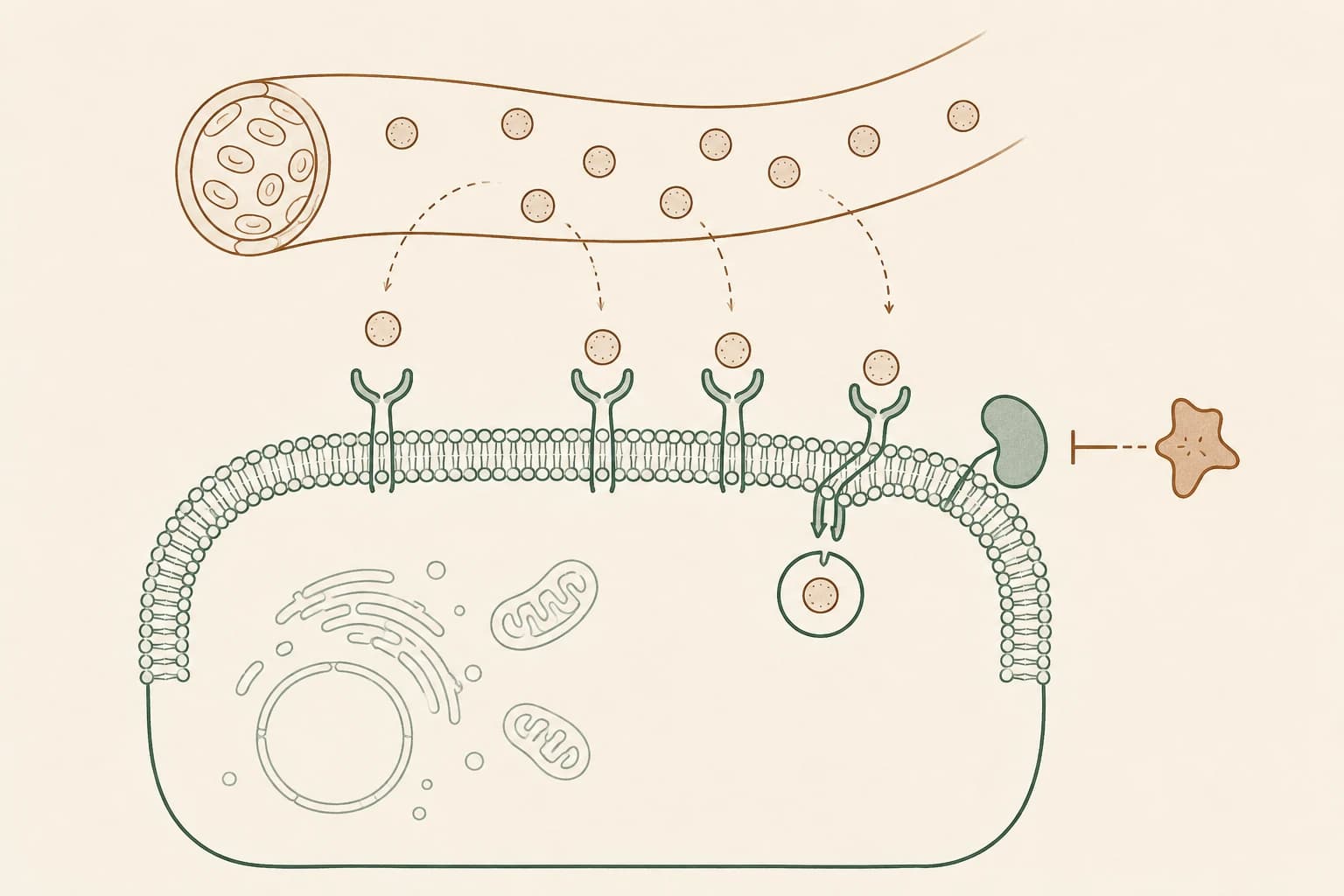
The idea that blocking PCSK9 would lower cholesterol didn't start with a drug — it started with a genetic accident. A 2005 study sequenced the PCSK9 gene in 128 people with unusually low LDL cholesterol and found two mutations, Y142X and C679X, that disabled the gene outright; carriers had LDL cholesterol running about 40% lower than average (Cohen et al., Nature Genetics, 2005, via PubMed) — a natural experiment showing that a body making less-functional PCSK9 ends up with meaningfully lower LDL, the exact effect a PCSK9-inhibiting drug is designed to reproduce.
What makes enlicitide notable isn't the mechanism — evolocumab (Repatha) and alirocumab (Praluent) have blocked PCSK9 for years — it's the delivery. Every other approved PCSK9 inhibitor is an injection. Enlicitide reaches the same target with a tablet swallowed once a day. For where LDL cholesterol fits into your own numbers, see LDL cholesterol.
How Much Does Enlicitide Lower LDL Cholesterol? (The Proven Part)
In the trials that led to its approval, enlicitide lowered LDL cholesterol by 55.8% to 59.4% compared with placebo at 24 weeks, depending on the trial population — a genuinely large effect, in the same range as the injectable PCSK9 antibodies.
CORALreef Lipids (NCT05952856), the pivotal trial in general hypercholesterolemia, enrolled 2,912 adults, 1,942 of them randomized to enlicitide and 970 to placebo; LDL-C fell 55.8% versus placebo at week 24 — a 57.1% drop in the enlicitide group against a 3.0% increase in the placebo group (Merck; TCTMD). The FDA-approved label lists a slightly smaller figure, 2,904 patients, for this trial's safety analysis — most likely the enrolled-versus-actually-dosed distinction rather than a discrepancy in the underlying data (Merck, FDA-approved Prescribing Information).
CORALreef HeFH (NCT05952869), the trial in people with heterozygous familial hypercholesterolemia, randomized 303 adults 2:1 to enlicitide or placebo on top of their existing statin; LDL-C fell 59.4% versus placebo at week 24 (Merck). Both trials also reported a 28% reduction in Lp(a), a cholesterol-carrying particle whose levels are largely set by genetics and that diet and most other cholesterol drugs don't move (American Heart Association Newsroom).
A third trial, CORALreef AddOn (NCT06450366), compared enlicitide directly against two other oral non-statin drugs at 8 weeks: it produced a 56.7% greater LDL-C reduction than bempedoic acid and a 36.0% greater reduction than ezetimibe (both p<0.001), and 78.2% of people on enlicitide hit the trial's goal of at least a 50% LDL-C drop with a final level under 55 mg/dL, versus just 2.0% on bempedoic acid and 8.0% on ezetimibe (Merck).
What Enlicitide Has NOT Yet Proven: Heart Attack and Stroke Risk
Enlicitide is approved because it lowers LDL cholesterol, a marker strongly linked to cardiovascular risk — not because it has its own proof that it prevents heart attacks, strokes, or death. That's a real gap, not a technicality.
The FDA label's own language on this is precise, and worth reading closely: "Cardiovascular outcomes trials have demonstrated that reducing LDL-C lowers the risk for major adverse cardiovascular events (MACE) in adults at increased risk when treated with statins or monoclonal antibody PCSK9 inhibitors as an add-on to statin therapy" (Merck, FDA-approved Prescribing Information). Read that again: it names statins and monoclonal-antibody PCSK9 inhibitors — not enlicitide. Enlicitide's own dedicated cardiovascular-outcomes trial, CORALreef Outcomes (NCT06008756), had enrolled more than 14,500 people and was listed as active but not recruiting, with an estimated primary completion date around November 2029 and full study completion around 2031, per a CenterWatch registry listing of the trial (CenterWatch) — treat that completion date as a registry estimate rather than a fixed one, since ClinicalTrials.gov's own page did not render its full study record directly during our research for this article.

Cardiologists commenting on the approval have made the same point directly. Dr. Jeffrey Berger of NYU Langone Health told TCTMD: "We are still awaiting cardiovascular outcomes data specifically demonstrating that this oral PCSK9 inhibitor reduces events such as heart attacks and strokes" (TCTMD). Writing in Forbes, Dr. Robert Glatter compared it directly to the injectable evolocumab: Repatha "has been shown...to actually reduce heart attacks and strokes — not just lower cholesterol numbers," while Lipfendra "hasn't been tested long enough yet to know whether it does the same" (Forbes).
The consumer-health outlet The People's Pharmacy put the caution in starker historical terms, pointing to two earlier cholesterol drugs, evacetrapib and torcetrapib, that both improved cholesterol numbers substantially in trials but were later shown to provide no cardiovascular benefit — or, in torcetrapib's case, more cardiovascular events and deaths — when their own outcomes trials finally read out (The People's Pharmacy). That's this outlet's own editorial framing, not a claim about enlicitide itself, but it's why the distinction matters rather than being pedantic. As of July 22, 2026, the honest answer to "does enlicitide prevent heart attacks and strokes" is: not yet demonstrated, and won't be for years.
The Full PCSK9-Inhibitor Landscape: How Enlicitide Compares
As of enlicitide's approval, five FDA-approved drugs work through the PCSK9 pathway — and enlicitide is the only one you swallow rather than inject.
| Drug | Brand | How it's taken | Maker | FDA approval |
|---|---|---|---|---|
| Evolocumab | Repatha | Injection, every 2–4 weeks | Amgen | Long-approved; has its own cardiovascular-outcomes data |
| Alirocumab | Praluent | Injection, every 2–4 weeks | Regeneron/Sanofi | Long-approved; has its own cardiovascular-outcomes data |
| Inclisiran | Leqvio | Injection, twice yearly | Novartis | Approved |
| Lerodalcibep | Lerochol | Injection, once monthly | LIB Therapeutics | December 15, 2025 |
| Enlicitide | Lipfendra | Oral tablet, once daily | Merck | July 16, 2026 |
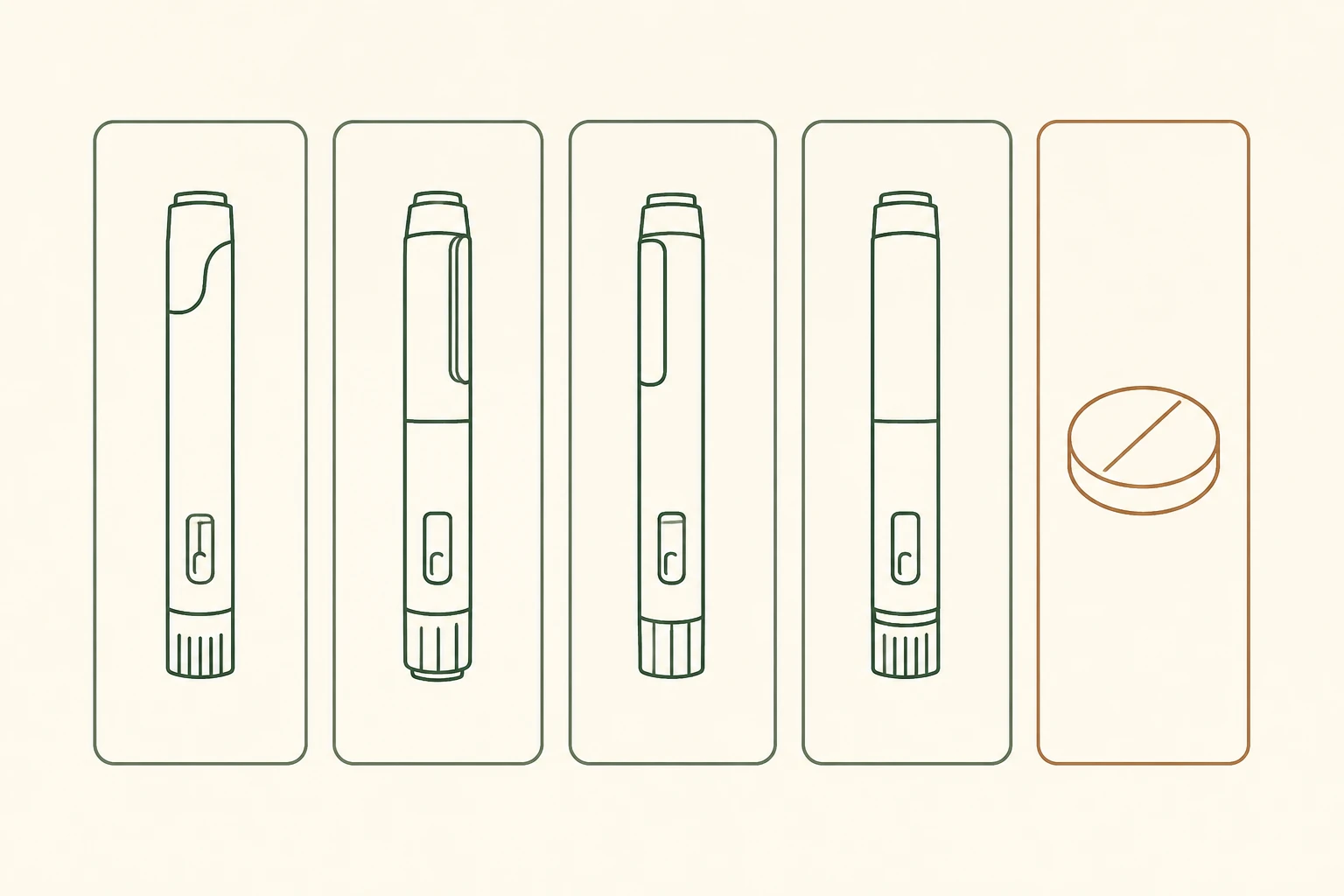
(Table compiled from TCTMD's comparator list and LIB Therapeutics' own press release, which puts lerodalcibep's own LDL-C reduction at 60% or more in people with or at high risk for cardiovascular disease, and about 59% in HeFH.)
Enlicitide matches the injectable antibodies' LDL-lowering magnitude in a pill instead of a needle; its real advantage so far is convenience, not proven superiority. Evolocumab and alirocumab already have their own outcomes data: per Harvard Health, those two injectables have been shown to reduce heart attacks, strokes, and cardiovascular death by up to 20% among high-risk people over periods of five years or more (Harvard Health Publishing). For how PCSK9 inhibitors fit alongside statins and other drug classes, see our full cholesterol medication guide, and for what's actually documented about statin side effects specifically, see statin side effects.
Dosing, Safety, and Side Effects
This is general, publicly available label information, not personalized dosing guidance — how or whether to take enlicitide is a decision made with a prescriber, not from an article. The FDA-approved label documents enlicitide as one 20mg tablet, once daily, on an empty stomach in the morning, with water, black coffee, or plain tea — with at least 30 minutes before eating or drinking anything else. The tablet is swallowed whole, not split, crushed, or chewed; a missed dose is taken as soon as possible as long as it's still at least 30 minutes before the next food or drink, and two doses are never taken in the same day (Merck, FDA-approved Prescribing Information). The label lists no contraindications.
On side effects, the most authoritative source available, the FDA label itself, reports that in the CORALreef HeFH trial, the most common adverse reactions occurring more often than on placebo were diarrhea (7% on enlicitide versus 2% on placebo) and dizziness (9% versus 4%) (Merck, FDA-approved Prescribing Information). In the larger CORALreef Lipids trial, Merck's own press release describes the overall adverse-event rate as comparable to placebo, and notes that fewer people actually stopped the drug because of a side effect on enlicitide (3.1%) than on placebo (4.1%) (Merck).
On pregnancy, the label advises discontinuing enlicitide once pregnancy is recognized unless the benefit to the patient outweighs the risk to the fetus, based on the drug's mechanism rather than any observed human harm; animal studies at doses many times higher than the human dose (58-fold in rats, 51-fold in rabbits) found no adverse effects on the developing fetus (Merck, FDA-approved Prescribing Information). For a comparison point on how a different cholesterol-drug class's side effects have actually played out in large trials, see statin side effects.
Who Might Be a Candidate for Enlicitide?
Enlicitide is FDA-approved as an adjunct to diet and exercise to lower LDL cholesterol in adults with hypercholesterolemia, including heterozygous familial hypercholesterolemia — a genetic condition that affects roughly 1 in 250 people (Merck, FDA-approved Prescribing Information; Merck, CORALreef HeFH press release). Note the word adjunct: in the trials that supported approval, enlicitide was added on top of diet and, for most participants, an existing statin — it's a next step for people whose LDL is still elevated despite those foundations, not a substitute for them. For what those foundational lifestyle changes actually look like, and how much they realistically move the number, see how to lower cholesterol.
Whether enlicitide, an injectable PCSK9 inhibitor, or an adjustment to an existing statin makes the most sense for a specific person is a conversation to have with a prescriber, based on real labs and risk factors — not a decision to make from a news headline about a new pill. That's true of any option on the comparison table above, but especially true of the newest one.
How Much Does Lipfendra Cost?
Lipfendra's list price is $10.50 per tablet, or about $315 for a 30-day supply — which works out to roughly $3,830 a year at list price ($10.50 × 365 days), a figure independently reported by both Yahoo Finance and the Chicago Sun-Times in their coverage of the approval (Yahoo Finance; Chicago Sun-Times). That's list price only, not what any individual patient actually pays after insurance.
How that compares to the injectable PCSK9 options depends on which source you check: Yahoo Finance puts injectable PCSK9 pricing at roughly $500 to $600 a month, while Harvard Health's independently reported figure is $200 to $500 or more a month — worth naming both rather than picking one, since they don't fully agree (Yahoo Finance; Harvard Health Publishing). Merck has said it plans to list Lipfendra on the federal TrumpRx.gov drug-discount platform, but had not set a TrumpRx-specific price as of the approval news cycle, and insurance and formulary coverage were still undetermined at that point too — the Chicago Sun-Times specifically flagged that how much insurers decide to cover "could limit the number of people it might reach" (Yahoo Finance; Chicago Sun-Times). Given how recent this approval is, check current pricing and your own coverage directly rather than treating any figure here as fixed.
Frequently Asked Questions (FAQ)
Is enlicitide the same thing as Lipfendra? Yes — enlicitide is the generic (chemical) name, and Lipfendra is the brand name Merck sells it under; they refer to the exact same FDA-approved drug.
Does enlicitide replace my statin? No. In the trials that led to its approval, enlicitide was mostly added on top of an existing statin, not used instead of one, and only a doctor can say whether replacing or adding to a specific medication makes sense for you.
Has enlicitide been proven to prevent heart attacks or strokes? Not yet. It's approved based on lowering LDL cholesterol, a strong risk marker, but its own cardiovascular-outcomes trial, CORALreef Outcomes, isn't expected to report results until around 2029.
How is enlicitide different from injectable PCSK9 inhibitors like Repatha or Praluent? It works the same way but comes as a once-daily pill instead of an injection given every few weeks; its LDL-lowering effect is similar in size, but unlike Repatha and Praluent, it doesn't yet have its own proof that it reduces heart attacks or strokes.
How much does Lipfendra cost, and will insurance cover it? Its list price is $10.50 per tablet, or about $315 for a 30-day supply, though insurance coverage and a possible discount-program price were still being finalized as of the drug's July 2026 approval — check current pricing directly rather than relying on the list price alone.
Medical disclaimer: This article is for informational purposes only. Always consult a qualified healthcare provider before making changes to your health routine.
Sources
- Merck. LIPFENDRA (enlicitide) — FDA-approved Prescribing Information, Rev. 7/2026. https://www.merck.com/product/usa/pi_circulars/l/lipfendra/lipfendra_pi.pdf
- Merck. Merck's LIPFENDRA (Enlicitide) Is the First and Only Once-Daily Oral PCSK9 Inhibitor Approved by the U.S. FDA — Press release, July 16, 2026. https://www.merck.com/news/mercks-lipfendra-enlicitide-is-the-first-and-only-once-daily-oral-pcsk9-inhibitor-approved-by-the-u-s-fda-to-reduce-ldl-c-in-adults-with-hypercholesterolemia/
- Merck. Merck's Enlicitide Decanoate, an Investigational Oral PCSK9 Inhibitor, Significantly Reduced LDL-C in Phase 3 CORALreef Lipids Trial — Press release, November 8, 2025. https://www.merck.com/news/mercks-enlicitide-decanoate-an-investigational-oral-pcsk9-inhibitor-significantly-reduced-ldl-c-in-phase-3-coralreef-lipids-trial/
- Merck. Merck's Enlicitide Decanoate, an Investigational Oral PCSK9 Inhibitor, Significantly Reduced LDL-C in Adults With Heterozygous Familial Hypercholesterolemia (HeFH) in Phase 3 CORALreef HeFH Trial — Press release, November 9, 2025. https://www.merck.com/news/mercks-enlicitide-decanoate-an-investigational-oral-pcsk9-inhibitor-significantly-reduced-ldl-c-in-adults-with-heterozygous-familial-hypercholesterolemia-hefh-in-phase-3-coralreef-hefh-tr/
- Merck. Merck's Enlicitide Decanoate, an Investigational Oral PCSK9 Inhibitor, Demonstrated Significantly Greater LDL-C Reductions at Eight Weeks Compared to Guideline-Recommended Oral Non-Statin Therapies (CORALreef AddOn) — Press release, March 30, 2026. https://www.merck.com/news/mercks-enlicitide-decanoate-an-investigational-oral-pcsk9-inhibitor-demonstrated-significantly-greater-ldl-c-reductions-at-eight-weeks-compared-to-guideline-recommended-oral-non-statin-ther/
- TCTMD. FDA Approves Enlicitide, an Oral PCSK9 Inhibitor, for LDL-Lowering — Published July 16, 2026. https://www.tctmd.com/news/fda-approves-enlicitide-oral-pcsk9-inhibitor-ldl-lowering
- Forbes (Robert Glatter). A Novel Pill For Cholesterol: FDA Approves Lipfendra — Published July 17, 2026. https://www.forbes.com/sites/robertglatter/2026/07/17/a-novel-pill-for-cholesterol-fda-approves-lipfendra/
- Harvard Health Publishing. Newly Approved Pill Cuts LDL Cholesterol Levels by More Than Half — Published July 20, 2026. https://www.health.harvard.edu/heart-health/newly-approved-pill-cuts-ldl-cholesterol-levels-by-more-than-half
- American Heart Association Newsroom. Investigational Daily Pill Lowered "Bad" Cholesterol as Much as Injectables — Published November 8, 2025. https://newsroom.heart.org/news/investigational-daily-pill-lowered-bad-cholesterol-as-much-as-injectables
- LIB Therapeutics. US FDA Approves LIB Therapeutics' Lerochol for Adults With Elevated LDL Cholesterol — Press release, December 15, 2025. https://libtherapeutics.com/news-and-events/us-food-and-drug-administration-approves-lib-therapeutics-lerochol-for-adults-with-elevated-ldl-cholesterol.html
- Yahoo Finance. FDA Approves First-of-Its-Kind Cholesterol Pill Lipfendra: What It Will Cost — Published July 17, 2026. https://finance.yahoo.com/personal-finance/banking/article/fda-approves-first-of-its-kind-cholesterol-pill-lipfendra-what-it-will-cost-204503986.html
- Chicago Sun-Times. Cholesterol Pill Lipfendra Gets FDA Approval as Heart Disease Treatment — Published July 16, 2026. https://chicago.suntimes.com/health/2026/07/16/cholesterol-pill-lipfendra-fda-heart-disease-enlicitide
- The People's Pharmacy. Lipfendra (Enlicitide) Slashes LDL Cholesterol — But Does It Save Lives? — Published July 16, 2026. https://www.peoplespharmacy.com/articles/lipfendra-enlicitide-slashes-ldl-cholesterol-does-it-save-lives
- Cohen J, Pertsemlidis A, Kotowski IK, Graham R, Garcia CK, Hobbs HH. Low LDL Cholesterol in Individuals of African Descent Resulting From Frequent Nonsense Mutations in PCSK9 — Nature Genetics, 2005, via PubMed. https://pubmed.ncbi.nlm.nih.gov/15654334/
- CenterWatch. Enlicitide Decanoate (MK-0616 Oral PCSK9 Inhibitor) Cardiovascular Outcomes Study (MK-0616-015) CORALreef Outcomes — Trial listing, NCT06008756. https://www.centerwatch.com/clinical-trials/listings/NCT06008756/enlicitide-decanoate-mk-0616-oral-pcsk9-inhibitor-cardiovascular-outcomes-study-mk-0616-015-coralreef-outcomes

Olivia Smith, RDN
A registered dietitian who reads the trial data before believing the headline about any new cholesterol drug.