Quick answer: For most home use, one to three sessions a week sustained over weeks to months is the frequency Cleveland Clinic describes, and trial protocols mostly sit between every other day and a few times weekly. Session length should come from your device's manufacturer, because it only means something alongside that device's output. Doubling either number is the most common mistake, and it makes results worse rather than better.
The number that matters is dose, not frequency
Almost every "how often" question in this field is really a dose question in disguise. Dose is irradiance multiplied by time, and irradiance depends on how far you sit from the emitter. Two people running "ten minutes, three times a week" on different devices at different distances are not doing the same thing at all.
That is why there is no universal schedule, and why anyone offering one without asking what device you own is guessing.
Why more is worse: the biphasic dose response
This is the part that overturns normal consumer intuition, so it is worth the detail.
Photobiomodulation follows a biphasic dose response. Too little light does nothing; an intermediate dose produces the effect; beyond that the effect shrinks, disappears and can reverse. Huang and colleagues catalogued this across models (Huang et al., 2011):
- Cultured fibroblasts: peak proliferation at 2.5 J/cm², cell damage at 10 J/cm².
- Mouse cortical neurons: optimal ATP response around 3 J/cm², declining above that.
- Traumatic brain injury model: 36 J/cm² effective; 360 J/cm² made the benefit "totally disappear" and worsened early neurological outcomes.
The authors' summary is that more does not necessarily mean better. The renaming of the field away from "low-level laser therapy" toward "photobiomodulation" happened partly because the same wavelength can stimulate or inhibit depending only on dose.
For a home user this rarely means harm. It means running a 30-minute session because 10 minutes felt insufficient, and quietly getting a worse outcome while believing you are being diligent.
What the trials actually did
Rather than inventing a protocol, here is what produced the published results:
| Target | Protocol used | Source |
|---|---|---|
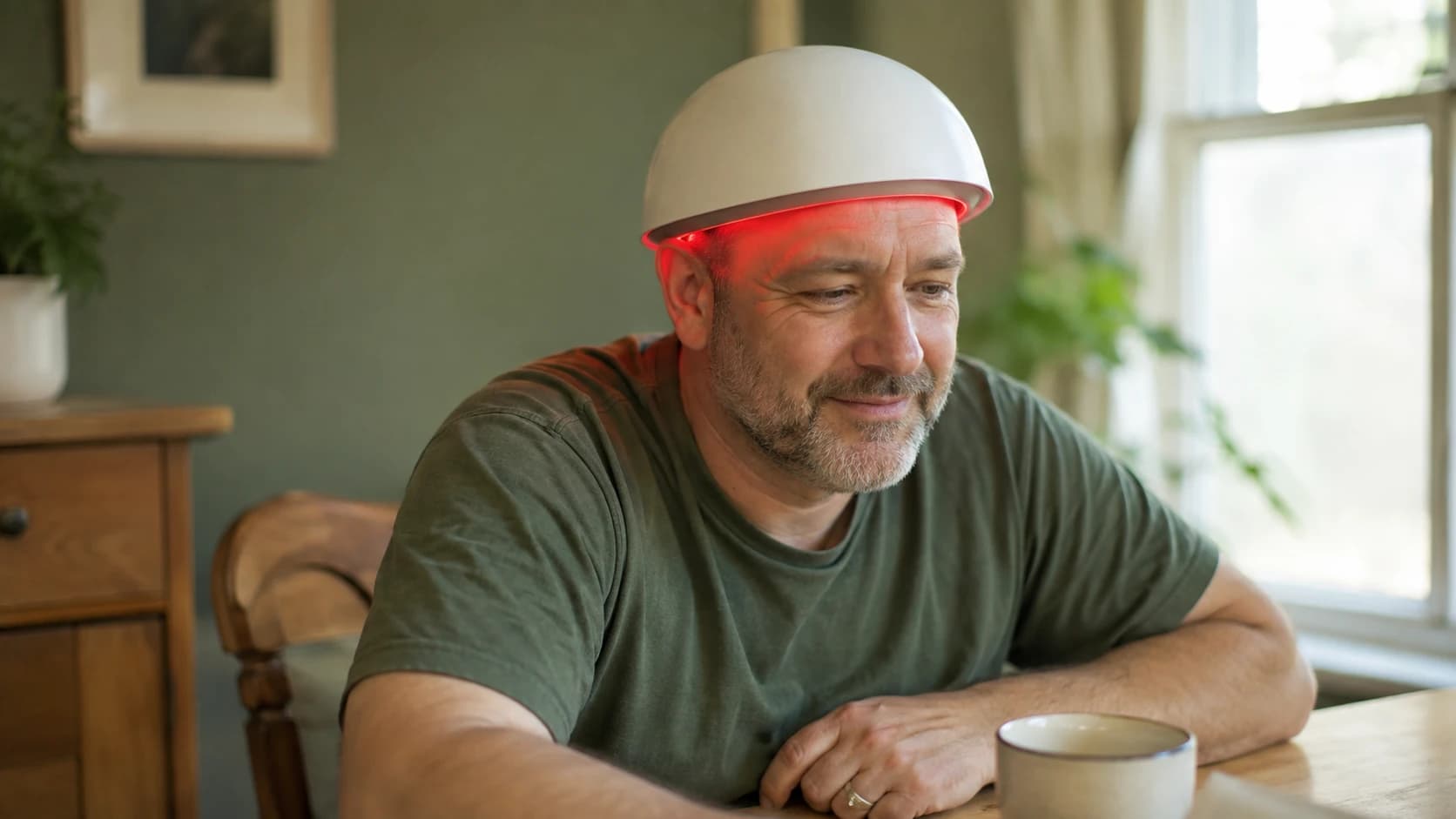
| Pattern hair loss | 25 minutes, every other day, for 16 weeks (655 ± 5 nm helmet) | Yoon et al., 2020 |
| Rheumatoid arthritis, hands | 2–3 times weekly for 4 weeks | Brosseau et al., 2005 |
| Large muscle groups | Doses of 60–300 joules per session in positive trials | Leal-Junior et al. |
| General consumer guidance | 1–3 times a week for weeks or even months | Cleveland Clinic |
Two patterns stand out. First, nothing in the evidence base runs multiple sessions a day. Second, the studies that produced results ran for months, not weeks — which makes frequency far less important than persistence.
A workable starting framework
This is a framework for reading your own device's instructions, not a prescription that overrides them.
- Start with the manufacturer's stated session length and frequency. They know their device's output; you do not. If they say ten minutes three times weekly, that is your starting point.
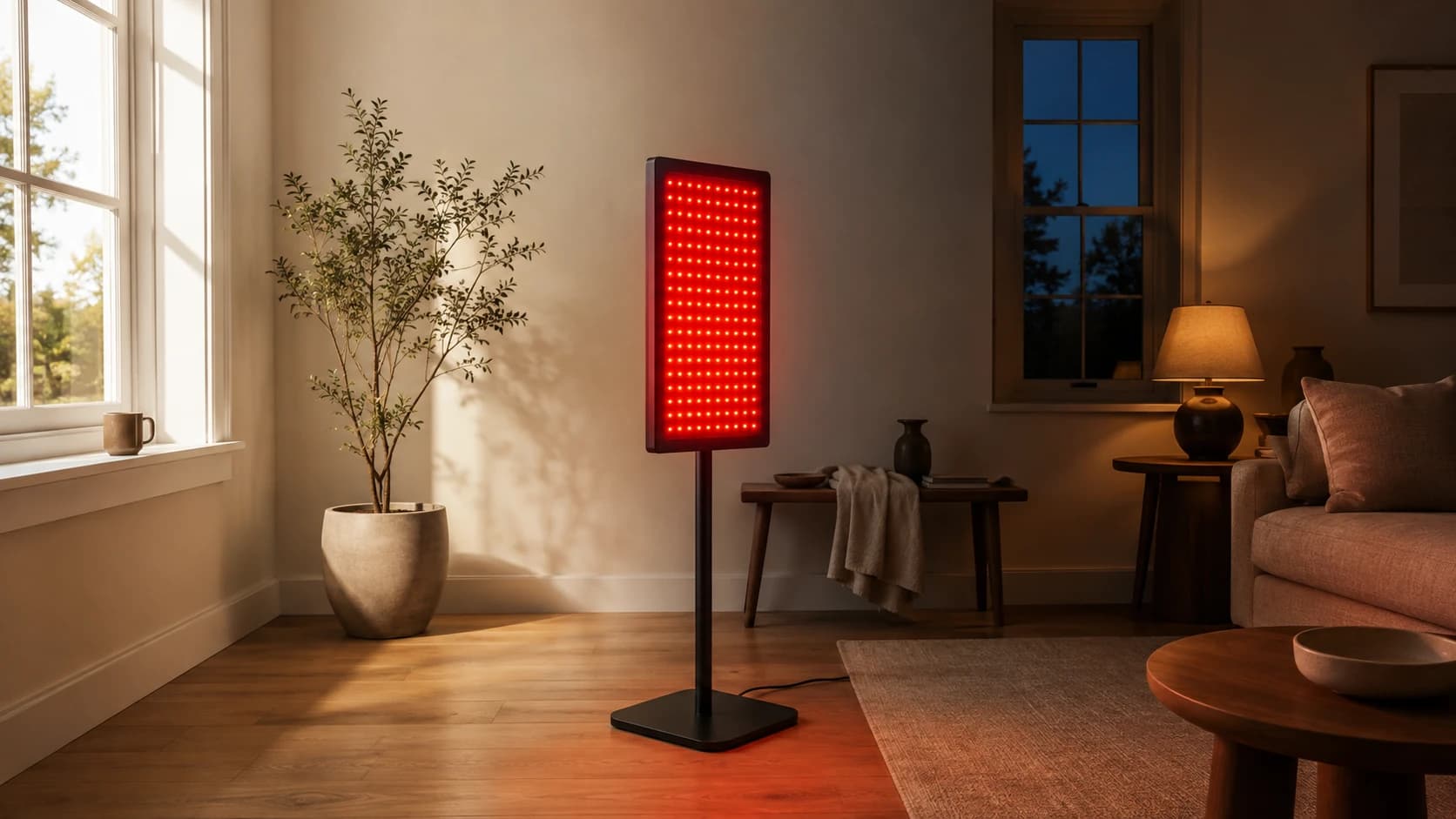
- Fix your distance and keep it fixed. Irradiance falls off sharply with distance, so a session at 6 inches and one at 18 inches are different doses. Mark the spot. This is the single biggest source of inconsistency in home use, and it is the problem a mask solves by construction and a panel leaves to you.
- Hold it for twelve weeks before changing anything. The trials above measured at 4 to 16 weeks. Changing your protocol at week three means you never find out whether the first one worked.
- If you increase anything, increase frequency before duration. Adding a fourth short session is closer to the trial protocols than doubling one session's length, and it stays further from the top of the dose curve.
- Do not stack devices on the same area. A mask and a panel on the same skin in one evening is an unknown combined dose.
Red light therapy at home: what changes outside a clinic
Three differences are worth planning around before you build a routine.
Output is lower. Most positive trials used clinical laser devices, and a 2024 review notes LED light in home devices does not penetrate the way clinical laser light does (Lawrence & Sorra, 2024). Cleveland Clinic's version: at-home devices "may be less powerful than devices that may be used by dermatologists or other trained skin professionals". The realistic response is patience, not longer sessions.
Nobody is measuring for you. In a clinic the dose is set by someone with a spectroradiometer reading. At home it is set by you, from a manufacturer figure that was probably not independently verified. Consistency of distance and time is the only lever you actually control.
Adherence is the real variable. Every published result rests on months of repetition. A ten-minute routine you do while listening to something beats a twenty-minute one you abandon in week five. Choosing a device you will genuinely use is a bigger determinant of your outcome than any specification on the box — which is one honest argument for the mask format, and for the setups in our home device roundup.
Timing: does it matter when?
For exercise, yes — somewhat. Pooled evidence favours applying red light before exercise for muscle soreness, and a separate review found effects on soreness at 72 and 96 hours rather than 24 or 48 (Tsou et al., 2025). Detail in the muscle recovery guide.
For skin, we found no controlled evidence establishing that morning or evening sessions differ in effect. Choose the time you will actually keep.
When to stop and reassess
- Skin stays irritated after sessions rather than settling — reduce or pause, and see the reported side effects.
- Twelve weeks of consistent use with no change at all — the honest conclusion is that this modality may not do anything for your particular concern. That is a real outcome, covered in what the trials found.
- Before you start, if you take a photosensitising medication or have a light-sensitive condition, read the contraindications guide.
For the broader picture, our red light therapy overview grades every claim in the category.
Frequently Asked Questions (FAQ)
How often should you use red light therapy? Cleveland Clinic describes ongoing treatment one to three times a week for weeks or even months. Trial protocols vary by target — the main sham-controlled hair-growth trial used 25-minute sessions every other day for 16 weeks. Start with the manufacturer's stated frequency and hold it for at least twelve weeks before judging.
Can you use red light therapy every day? Some trial protocols were daily or every other day, so daily use is not inherently wrong. But photobiomodulation follows a biphasic dose response in which too much light reduces the benefit, so daily use only makes sense if each session stays within the device's recommended time, not on top of it.
How long should a red light therapy session be? Follow the manufacturer's guidance for your specific device, because session length is only meaningful alongside that device's output and your distance from it. As a reference point, the sham-controlled hair trial used 25 minutes and many face masks specify around 10 minutes.
What happens if you use red light therapy too much? The benefit shrinks. In cultured fibroblasts, proliferation peaked at 2.5 J/cm² and cells were damaged at 10 J/cm². In a brain injury model, 36 J/cm² was effective while 360 J/cm² made the benefit disappear entirely and worsened early outcomes.
How long until red light therapy works? Skin trials typically run weeks to months; the main hair-growth trial measured its result at 16 weeks. Cleveland Clinic frames it as ongoing treatment over weeks or months. Twelve weeks of consistency is a fair minimum before deciding whether it is doing anything for you.
Medical disclaimer: This article is for informational purposes only. Always consult a qualified healthcare provider before making changes to your health routine.
Sources
- Huang YY, Sharma SK, Carroll J, Hamblin MR. Biphasic dose response in low level light therapy — an update. Dose-Response, 2011 — PubMed Central. https://pmc.ncbi.nlm.nih.gov/articles/PMC3315174/
- Yoon JS, Ku WY, Lee JH, Ahn HC. Low-level light therapy using a helmet-type device for the treatment of androgenetic alopecia. Medicine (Baltimore), 2020 — PubMed Central. https://pmc.ncbi.nlm.nih.gov/articles/PMC7373546/
- Brosseau L, et al. Low level laser therapy (Classes I, II and III) for treating rheumatoid arthritis. Cochrane Database of Systematic Reviews, 2005. https://www.cochrane.org/evidence/CD002049_low-level-laser-therapy-rheumatoid-arthritis
- Leal-Junior EC, Lopes-Martins RA, Bjordal JM. Clinical and scientific recommendations for photobiomodulation dosing in muscle tissue — PubMed Central. https://pmc.ncbi.nlm.nih.gov/articles/PMC6546960/
- Cleveland Clinic. Red Light Therapy — patient education article. https://my.clevelandclinic.org/health/articles/22114-red-light-therapy
- Lawrence J, Sorra K. Photobiomodulation as medicine. Journal of Functional Morphology and Kinesiology, 2024 — PubMed Central. https://pmc.ncbi.nlm.nih.gov/articles/PMC11503318/
- Tsou et al. Photobiomodulation and delayed-onset muscle soreness, 2025 — PubMed Central. https://pmc.ncbi.nlm.nih.gov/articles/PMC12286287/
All sources accessed 11 August 2026.

Marcus Thorne
A wellness tools researcher who thinks the dose-response curve is the whole ballgame.