

Quick answer: Four groups have a genuine reason to check with a clinician before starting: people with a photosensitivity condition, people taking a photosensitising medication, anyone with an undiagnosed or changing skin lesion in the treatment area, and people who are pregnant. Everything else on the typical internet contraindication list is either unsourced or applies to a different kind of light.
Why most contraindication lists are unreliable
If you search this question, you will find near-identical ten-item lists on device-seller and spa websites: thyroid conditions, epilepsy, pacemakers, active infections, hyperthyroidism, tattoos. Almost none of them carry a citation, and the lists borrow from each other.
Two distortions run through them:
- The photosensitivity evidence is about ultraviolet light. The medical literature on drug-induced and disease-related photosensitivity was built around sunlight and UV exposure. Red light therapy operates at roughly 620–700 nm and near-infrared at 700–1440 nm, far from UV. Carrying a UV precaution across to red light is defensible caution — but it is caution, not a demonstrated interaction, and honest writing should say which it is.
- Devices are not all the same. Many "red light" masks also run blue modes, and some combine light with radiofrequency or microcurrent. A warning that belongs to one of those features often gets attached to red light generally.
What follows separates what is documented from what is precautionary.
Documented: photosensitivity conditions
The Lupus Foundation of America states that 40% to 70% of people with lupus find their disease made worse by exposure to UV rays from sunlight or artificial light, and that flares can bring fatigue, joint pain, tingling and numbness rather than only a rash. Its practical advice includes covering fluorescent and halogen bulbs with UV-filtering shields and choosing low-intensity indoor bulbs (Lupus Foundation of America).
That guidance is about ultraviolet, and it does not by itself establish a risk from 660 nm light. But it does establish that this is a population whose light exposure is actively managed by their care team, which makes it a clinician's call rather than a self-service one.
The porphyrias deserve a more precise treatment than they usually get, because the precision cuts both ways. In erythropoietic protoporphyria, the offending molecule — protoporphyrin IX — absorbs between 320 and 595 nm, peaking around 400–420 nm in what is called the Soret band (Sernicola et al., 2021). The red and near-infrared wavelengths used in photobiomodulation sit above that documented range. That is a genuinely relevant fact — and it is still not a green light, because many consumer devices emit more than one wavelength and because a rare phototoxic condition is exactly the situation where a specialist, not an article, should decide.
Documented: photosensitising medications
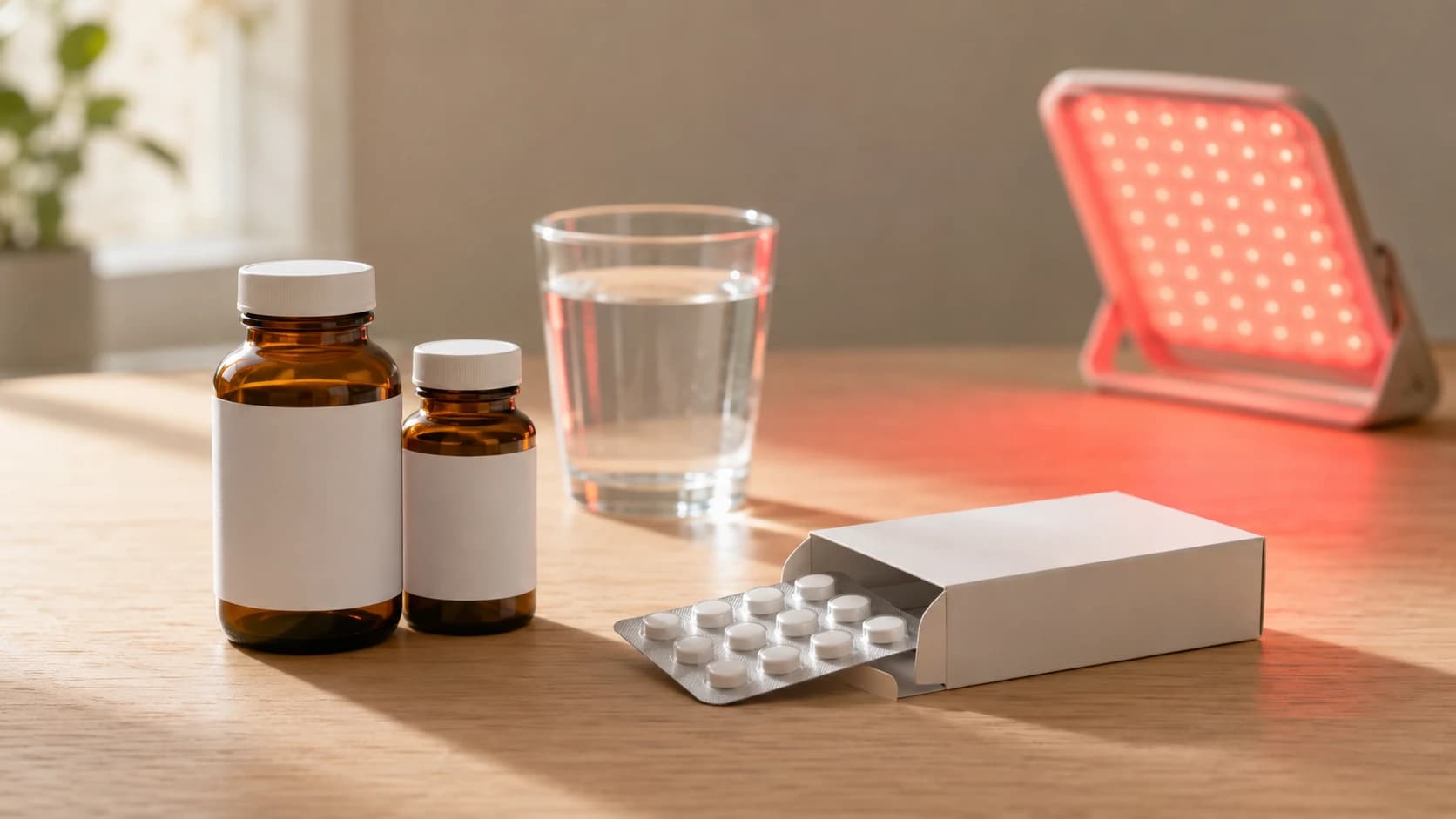
The Skin Cancer Foundation maintains a list of medications that cause skin to react abnormally to light. It includes (Skin Cancer Foundation):
| Class | Examples listed |
|---|---|
| Antibiotics | Ciprofloxacin, co-trimoxazole, dapsone, tetracycline |
| Retinoids | Isotretinoin, acitretin (oral); tretinoin, tazarotene (topical) |
| Diuretics | Furosemide, hydrochlorothiazide |
| Antiarrhythmics | Amiodarone, quinidine |
| NSAIDs | Ibuprofen, ketoprofen, naproxen |
| Other | Hydroxychloroquine, griseofulvin, chlorpromazine, St John's wort |
| Topical | Coal tar, psoralen, fluorouracil, aminolevulinic acid |
Again, the honest framing: this list describes reactions to sunlight and ultraviolet exposure. Applying it to red light therapy is precautionary. But if you are on any of these, the cost of asking your prescriber is one question, and the cost of guessing is not knowable from a webpage.
Topical retinoids deserve a separate mention for a non-photosensitivity reason: skin on tretinoin or tazarotene is often already irritated, and adding a new stimulus to compromised skin is a poor sequencing decision regardless of wavelength.
Documented as out of scope: children
The 2025 international expert consensus that concluded photobiomodulation is safe scoped that conclusion explicitly to adult patients (Maghfour et al., 2025). A safety statement about adults is not a safety statement about children. That is a limit of the evidence rather than a finding of risk — but it means paediatric use belongs with a clinician.
Precautionary, because the evidence is absent: pregnancy
We could not find controlled evidence establishing either safety or harm from red light therapy in pregnancy. Pregnancy appears on precautionary lists for the same reason it appears on most such lists: pregnant people are routinely excluded from trials, so the data does not exist to say either way.
That is a genuine unknown, and it should be described as one. Absence of evidence is not evidence of harm — and it is also not a basis for reassurance.
Situations that need a clinician first, not a device
- An undiagnosed or changing skin lesion in the treatment area. Shining anything at a mole you have not had assessed is the wrong order of operations. Get it looked at, then decide.
- Active skin cancer under treatment. This is an oncology and dermatology decision, not a consumer one.
- Reduced sensation in the treatment area. If you cannot reliably feel heat or discomfort, you cannot use your own comfort as a stopping signal.
- Recent procedures or broken skin. Wait until the skin has healed, or ask the clinician who performed the procedure.
What we could not verify
Several items appear on circulating lists that we could not trace to a credible source in relation to red light therapy specifically:
- Thyroid conditions. We found no credible source establishing harm from red or near-infrared light to the thyroid. It appears widely online without one.
- Pacemakers and implanted devices. This precaution belongs to electromagnetic and radiofrequency devices. Where a combination device includes radiofrequency or microcurrent, the warning attaches to that component — check what your device actually emits.
- Epilepsy. Photosensitive epilepsy is triggered by flicker at particular frequencies, not by wavelength as such. If you have photosensitive epilepsy, the relevant question is whether the device pulses and at what rate, which is a question for the manufacturer and your neurologist.
- Tattoos. We found no evidence of harm; concerns online are largely about pigment and heat, and photobiomodulation is defined as non-thermal.
Stating these as unverified rather than dropping them is deliberate: you are likely to encounter them elsewhere, and knowing that they lack a traceable source is more useful than not seeing them at all.
If you are cleared to proceed
Two pages carry the practical detail: what actually gets reported in trials for what actually gets reported, and how often you should use red light therapy for session length and frequency — which matters more than most people realise, since overuse reduces benefit rather than adding to it. For the wider picture, see our red light therapy overview.
One universal rule regardless of group: use the eye protection supplied, and be strictest about it if your device has a blue mode. The only well-documented human eye injury from a consumer LED mask involved blue light used with the eyes open.
Frequently Asked Questions (FAQ)
Who should avoid red light therapy? The groups with a genuine reason to check with a clinician first are people with a photosensitivity condition, anyone taking a photosensitising medication, anyone with an undiagnosed or changing skin lesion in the treatment area, and people who are pregnant. The 2025 expert consensus that found photobiomodulation safe scoped that finding to adult patients.
Can you use red light therapy while pregnant? We could not find controlled evidence establishing either safety or harm in pregnancy, which is why pregnancy appears on precautionary lists rather than evidence-based ones. Absence of evidence is not evidence of harm, but it does make this a question for your own clinician rather than a website.
Does red light therapy interact with medications? Photosensitising drugs — including some antibiotics, retinoids, diuretics, amiodarone and St John's wort — are documented by the Skin Cancer Foundation as causing abnormal reactions to light. That documentation concerns sunlight and ultraviolet exposure specifically, so extending it to red light is a precaution rather than a demonstrated interaction. Ask your prescriber.
Is red light therapy safe if you have lupus? The Lupus Foundation of America states that 40% to 70% of people with lupus find their disease worsened by exposure to UV rays from sunlight or artificial light. Because that guidance is about ultraviolet rather than red wavelengths, this is specifically a conversation to have with your rheumatologist before starting.
Can children use red light therapy? The 2025 JAAD expert consensus concluded that photobiomodulation is a safe non-invasive option for adult patients. That statement is scoped to adults and is not a paediatric safety finding, so use in children should be a clinician's decision.
Medical disclaimer: This article is for informational purposes only. Always consult a qualified healthcare provider before making changes to your health routine.
Sources
- Lupus Foundation of America. UV Exposure: What You Need to Know. https://www.lupus.org/resources/uv-exposure-what-you-need-to-know
- Skin Cancer Foundation. Photosensitivity Report — Medications. https://www.skincancer.org/risk-factors/photosensitivity/medications/
- Sernicola A, Cama E, Pelizzo MG, et al. In vitro assessment of solar filters for erythropoietic protoporphyria in the action spectrum of protoporphyrin IX. Frontiers in Medicine, 2021 — PubMed Central. https://pmc.ncbi.nlm.nih.gov/articles/PMC8720878/
- Maghfour J, et al. Evidence-based consensus on the clinical application of photobiomodulation. Journal of the American Academy of Dermatology, 2025 — journal abstract. https://www.jaad.org/article/S0190-9622(25)00659-0/abstract
- Kim TG, Chung J, Han J, Jin KH, Shin JH, Moon SW. Photochemical retinopathy induced by blue light emitted from a light-emitting diode face mask. Medicine (Baltimore), 2020 — PubMed Central. https://pmc.ncbi.nlm.nih.gov/articles/PMC7302677/
- Cleveland Clinic. Red Light Therapy — patient education article. https://my.clevelandclinic.org/health/articles/22114-red-light-therapy
- Photobiomodulation CME part I. Journal of the American Academy of Dermatology, 2024 — journal abstract. https://www.jaad.org/article/S0190-9622(24)00186-5/abstract
All sources accessed 9 August 2026.

Marcus Thorne
A wellness tools researcher who checks whether a contraindication list has a source behind it.