Quick answer: Probably not, for either of the two things they're sold on. A 2023 Cochrane review of 17 randomized trials found blue-light filtering glasses likely make no difference to eye strain from computer use, and rated the sleep evidence too inconsistent to draw a conclusion. A newer 2025 meta-analysis focused specifically on objective sleep tracking found the same thing: no statistically significant effect. The American Academy of Ophthalmology does not recommend them.
The Short Answer, From the Best Available Evidence
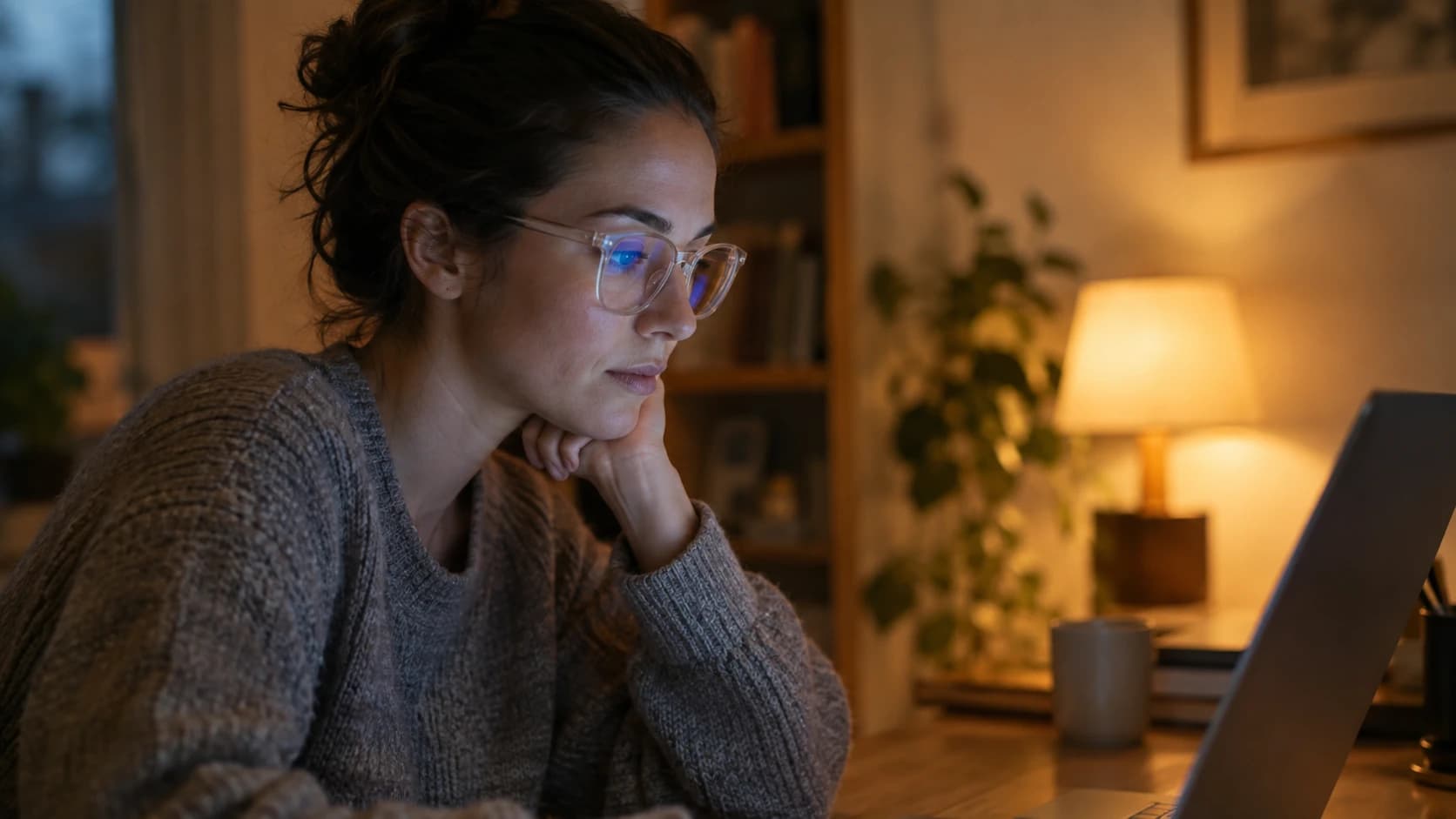
Blue-light-blocking glasses are marketed on two separate claims: that they reduce digital eye strain, and that they protect your sleep from evening screen use. Neither claim holds up well once it's tested in a controlled trial rather than a customer review.
That's not the same as saying the underlying biology is fake. Blue light genuinely does suppress melatonin in the evening — a well-documented effect, most famously shown in a 2015 study where reading on a backlit e-reader before bed delayed melatonin release and next-morning alertness compared with a printed book (Chang et al., 2015). The gap is between that real mechanism and the specific product built to address it. Filtering some blue light through a lens is a different intervention than the one tested in that kind of study, and when researchers have actually tested the glasses themselves, the results have been underwhelming.
What the Cochrane Review Actually Found
The most rigorous evidence available is a 2023 Cochrane systematic review — the type of study designed specifically to pool every relevant trial and weigh the quality of each one. It combined 17 randomized controlled trials from six countries, covering 619 participants, and compared people wearing blue-light filtering lenses against people wearing regular, non-filtering lenses (Singh et al., 2023).
Eye Strain
For short-term digital eye strain, the review concluded that blue-light filtering lenses "may not attenuate symptoms of eye strain with computer use," and rated this evidence as low certainty. Only three of the 17 trials specifically measured visual fatigue, and all three reported no significant difference between people wearing blue-light filtering lenses and people wearing regular ones.
Eye Health
On broader eye health, the review couldn't draw conclusions at all. None of the 17 trials measured contrast sensitivity, colour discrimination, glare discomfort, or macular health — the retinal-protection claim some brands lean on — so there's simply no trial evidence either supporting or refuting that specific benefit.
Sleep
Sleep was the most inconsistent outcome. Across six trials that measured it, three reported an improvement with blue-light filtering lenses and three found no difference. The reviewers rated this very low certainty and explicitly flagged it as inconclusive rather than negative — meaning it's genuinely unresolved, not disproven, but there also isn't a clear basis to expect a sleep benefit from the current evidence.
The review's authors called for larger, longer, better-designed trials, noting that none of the existing studies ran longer than five weeks. It's also worth being precise about what a "may make no difference" conclusion means: it's not proof that the glasses do nothing for every single person, but it is a clear statement that the average effect across the best trials available isn't large or consistent enough to detect.
A more recent, narrower look at sleep specifically backs this up. A November 2025 meta-analysis pooled three double-blind, crossover randomized trials — 49 participants in total — that used wrist actigraphy (an objective sleep-tracking method, rather than self-reported sleep diaries) to measure blue-light glasses' effect on falling asleep, total sleep time, sleep efficiency, and nighttime waking. None of the four measures reached statistical significance (Luna-Rangel et al., 2025). The authors were careful to note the small sample size and short trial durations (roughly one week each) as real limitations, and suggested the glasses might work as, in their words, "a pragmatic adjunct, not a stand-alone therapy" — a more measured framing than the marketing usually offers, and still short of solid proof of a sleep benefit.
Why Blue-Light Glasses Got Marketed So Heavily Anyway
None of this happened because the science was fabricated. It happened because a real, well-established finding — blue light suppresses melatonin — got extended into a specific consumer product without that product being tested to the same standard.
Digital eye strain is also a real and common experience, which gives the marketing something true to point at. But the American Academy of Ophthalmology attributes most digital eye strain to how people use screens, not the light they emit: staring at a fixed distance for long stretches reduces blink rate, which dries out the eyes, and poor screen positioning or an outdated prescription adds to that (American Academy of Ophthalmology). Blue light offers a simple, purchasable story for a problem that's mostly about ergonomics and blinking — and a pair of glasses is an easier sell than "take more breaks and blink on purpose."
What the American Academy of Ophthalmology Says
The AAO's position is direct: it "does not recommend blue light–blocking glasses," and states plainly that there is a lack of scientific evidence that blue light from computer screens damages the eyes in the first place. It also points to research finding no measurable UVA or UVB radiation coming from computer screens, addressing a related but separate claim sometimes folded into blue-light marketing (American Academy of Ophthalmology).
Instead of special eyewear, the AAO recommends the 20-20-20 rule (every 20 minutes, look at something roughly 20 feet away for 20 seconds), sitting about an arm's length from the screen with the display slightly below eye level, using artificial tears for dryness, and keeping your prescription current. For evening sleep specifically, its advice is more straightforward than any glasses purchase: avoid screens for two to three hours before bed, or use a device's built-in night mode.
Is There Any Reason to Wear Them?
If you find them comfortable and you like how they look, there's no strong evidence of harm. The Cochrane review found no consistent pattern of side effects tied to the blue-light filter itself — a small share of participants reported headaches, discomfort, or lower mood, but similar rates turned up in the control groups wearing regular lenses, which suggests those effects weren't caused by the filtering.
What the evidence doesn't support is buying them with a specific expectation that they'll meaningfully cut eye strain or fix a sleep problem. If that's the goal, the interventions with actual trial support — reducing screen time before bed, changing screen habits during the day — are a better use of the money and effort.
Blue-Light Glasses vs. Actually Changing Your Screen Habits
This is the more useful distinction than "do they work": blue-light glasses are a technology fix aimed at the light itself, while the stronger evidence points toward behavior — how late you're on a screen, how bright it is, and what you're doing on it. Our deeper look at screen time and blue light before bed covers what the sleep research actually supports on that front, including why reducing evening screen use and dimming brightness tends to matter more than the color of the light.
It's also worth separating this from a different light-based product entirely: red light therapy uses red and near-infrared light for skin, hair, and certain pain conditions, and has its own, separate evidence base — good and bad — that has nothing to do with blue-light filtering. They're often mentioned in the same "wellness light gadget" breath, but the trials, the wavelengths, and the claims are unrelated.
Frequently Asked Questions (FAQ)
Do blue light glasses actually reduce eye strain? Probably not, according to the best available evidence. A 2023 Cochrane review of 17 randomized controlled trials in 619 people found that blue-light filtering lenses may make no difference to short-term eye strain from computer use compared with regular lenses, rating the evidence as low certainty.
Do blue light glasses help you sleep better? The evidence is inconsistent and weak. The 2023 Cochrane review rated sleep-quality evidence as very low certainty, with three of six trials showing improvement and three showing none. A more recent 2025 meta-analysis of objective sleep tracking in 49 people found no statistically significant effect on falling asleep faster, sleeping longer, or sleeping more efficiently.
What did the Cochrane review actually conclude? That current evidence does not support prescribing blue-light filtering lenses to the general population for eye strain, and that sleep and eye-health effects remain unclear because the included trials were small, short (five weeks or less), and did not test outcomes like contrast sensitivity or melatonin levels.
Does the American Academy of Ophthalmology recommend blue light glasses? No. The AAO states it does not recommend special eyewear for computer use, citing a lack of evidence that blue light from screens damages the eyes, and recommends the 20-20-20 rule and standard screen ergonomics instead.
The following two questions extend past the site's five-question structured-data limit; they remain fully answered below for readers, just not included in this page's FAQ schema markup.
If they don't work, why are blue light glasses so popular? Mainly because the underlying idea — that blue light suppresses melatonin — is real and well established in sleep science, even though it doesn't automatically follow that a pair of tinted lenses fixes it. Digital eye strain is also genuinely common, and blue light offers a simple, purchasable explanation for a problem that's usually about blinking less and staring at a fixed distance for hours.
Is there any downside to wearing blue light glasses? The Cochrane review found no consistent pattern of harm. A small percentage of participants reported headaches, discomfort, or lower mood, but similar rates showed up in the non-filtering control groups, so these don't appear to be caused by the blue-light filter itself.
Medical disclaimer: This article is for informational purposes only. Always consult a qualified healthcare provider before making changes to your health routine.
Sources
- Singh S, Keller PR, Busija L, McMillan P, Makrai E, Lawrenson JG, Hull CC, Downie LE. Blue-light filtering spectacle lenses for visual performance, sleep, and macular health in adults. Cochrane Database of Systematic Reviews, 2023(8):CD013244 — Cochrane systematic review via PMC. https://pmc.ncbi.nlm.nih.gov/articles/PMC10436683/
- American Academy of Ophthalmology. Are Blue Light–Blocking Glasses Worth It? — Professional medical association patient guidance. https://www.aao.org/eye-health/tips-prevention/are-computer-glasses-worth-it
- Luna-Rangel GA, et al. Efficacy of blue-light blocking glasses on actigraphic sleep outcomes: a systematic review and meta-analysis of randomized controlled crossover trials. Frontiers in Neurology, 2025 — Peer-reviewed meta-analysis via PMC. https://pmc.ncbi.nlm.nih.gov/articles/PMC12668929/
- Chang AM, Aeschbach D, Duffy JF, Czeisler CA. Evening use of light-emitting eReaders negatively affects sleep, circadian timing, and next-morning alertness. Proceedings of the National Academy of Sciences, 2015 — Peer-reviewed original research. https://www.pnas.org/doi/10.1073/pnas.1418490112
All sources accessed 9 September 2026.

Marcus Thorne
A wellness tools researcher who checked the Cochrane review before the product reviews.