Quick answer: The best-supported red light therapy benefits are pattern hair loss, wound healing in clinical settings, and skin aging. Muscle soreness and joint pain sit in the middle. Weight loss, detox and general immune support sit at the bottom, with no accepted evidence behind them.
Every list of red light therapy benefits you can find online has the same problem: it puts "reduces wrinkles" and "boosts metabolism" in the same bulleted list, in the same typeface, with the same confidence. One of those has a randomised controlled trial behind it. The other has a supplement-shop blog post. This page grades them.
How the grades below were assigned
Three tiers, and the criteria are stated so you can disagree with them:
- Supported — endorsed by a formal expert consensus, or demonstrated in randomised controlled trials with a control or sham group.
- Mixed — statistically positive pooled results, but with low or very low certainty ratings, small trials, or heterogeneity the reviewers themselves flagged.
- Not supported — no accepted evidence, or an authoritative source stating the evidence is absent.
The primary reference for the top tier is the 2025 evidence-based consensus on photobiomodulation, produced by an international panel of 21 experts using a systematic literature review and a two-round Delphi process (Maghfour et al., 2025).
Supported: hair regrowth in pattern hair loss
Androgenetic alopecia — pattern hair loss — appears on the 2025 consensus list of indications with sufficient evidence, and it is one of the few consumer-facing uses that gets there.
The trial detail is better than most people expect. A 16-week multicentre, randomised, double-blind, sham-device-controlled trial of 59 adults used a helmet combining 21 laser diodes and 30 LEDs at 655 ± 5 nm for 25 minutes every other day. Hair density rose by 41.90 hairs/cm² in the treated group against 0.72 hairs/cm² in the sham group, and hair thickness rose 7.50 μm against a 15.03 μm decline (both P < .001), with no adverse events over the 16 weeks (Yoon et al., 2020).
Two caveats belong in the same breath. The device was a purpose-built scalp helmet, not a face mask or a general panel, and 59 people is a small trial. The fuller picture, including what the devices cost and how they are regulated, is in red light therapy for hair growth.
Supported: skin aging, collagen and texture
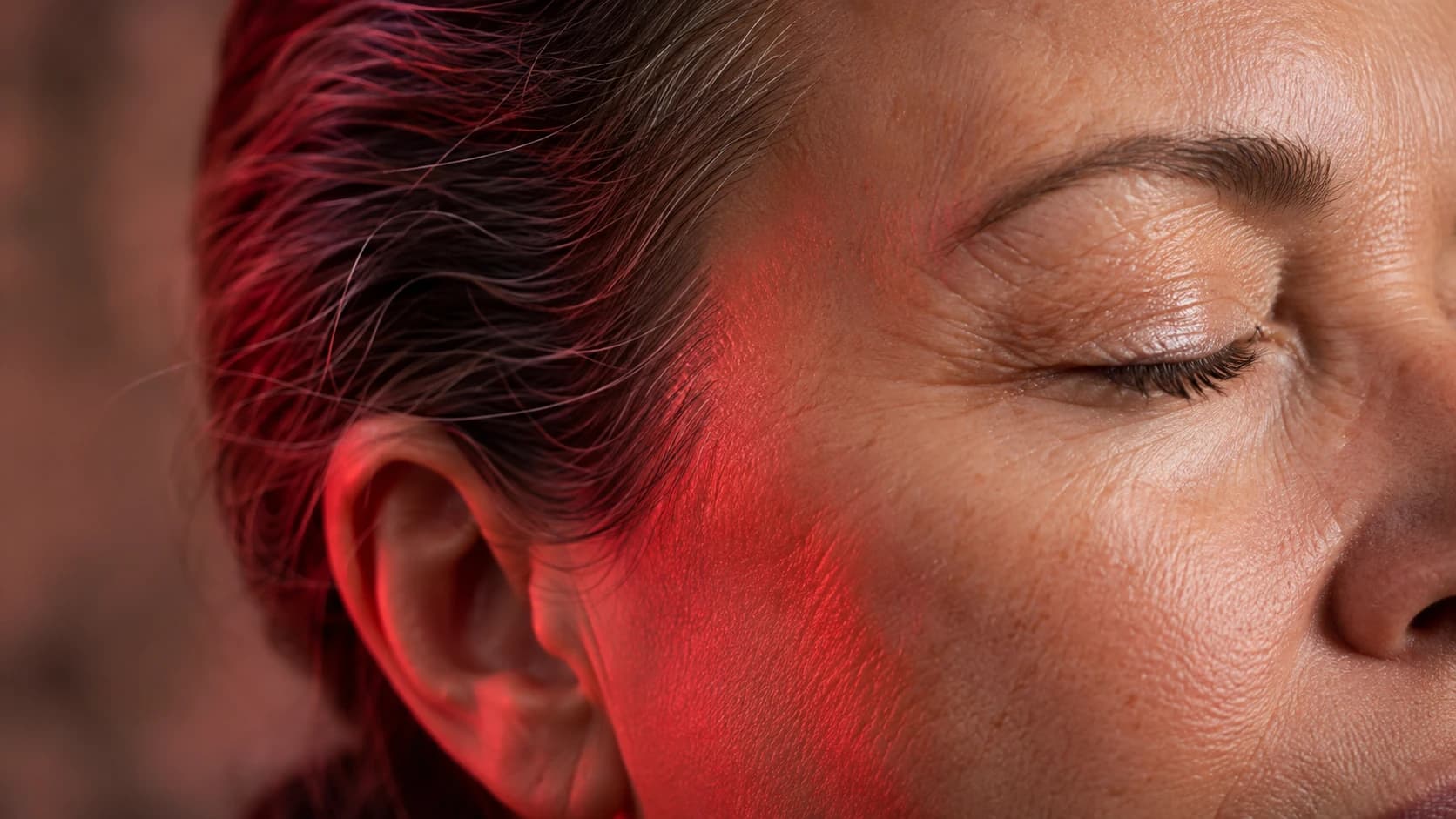
This is the benefit with the longest consumer track record, and it holds up reasonably well. A randomised controlled trial of 136 people found that regular red and near-infrared treatment improved skin complexion, reduced measured skin roughness and increased intradermal collagen density compared with an untreated control group (Wunsch & Matuschka, 2014). A broader review of light therapy in skin reported that most patients improved by at least one photoaging grade after a course of LED treatment (Avci et al., 2013).
"At least one photoaging grade" is worth sitting with. It is a genuine, measurable improvement. It is not a facelift. Our red light therapy for skin guide breaks down where the skin evidence is strong and where — acne, in particular — it thins out badly.
Supported, but clinically: wound healing and radiation dermatitis
The 2025 consensus lists wound ulcers of multiple causes, decubitus ulcers, diabetic foot ulcer pain, peripheral neuropathy and acute radiation dermatitis among the indications with sufficient evidence. These are the strongest entries on the whole list — and they are also the ones least relevant to a person buying a panel online, because they involve supervised treatment of an active medical problem. A pressure ulcer is not a home-device situation.
Mixed: muscle soreness and exercise recovery
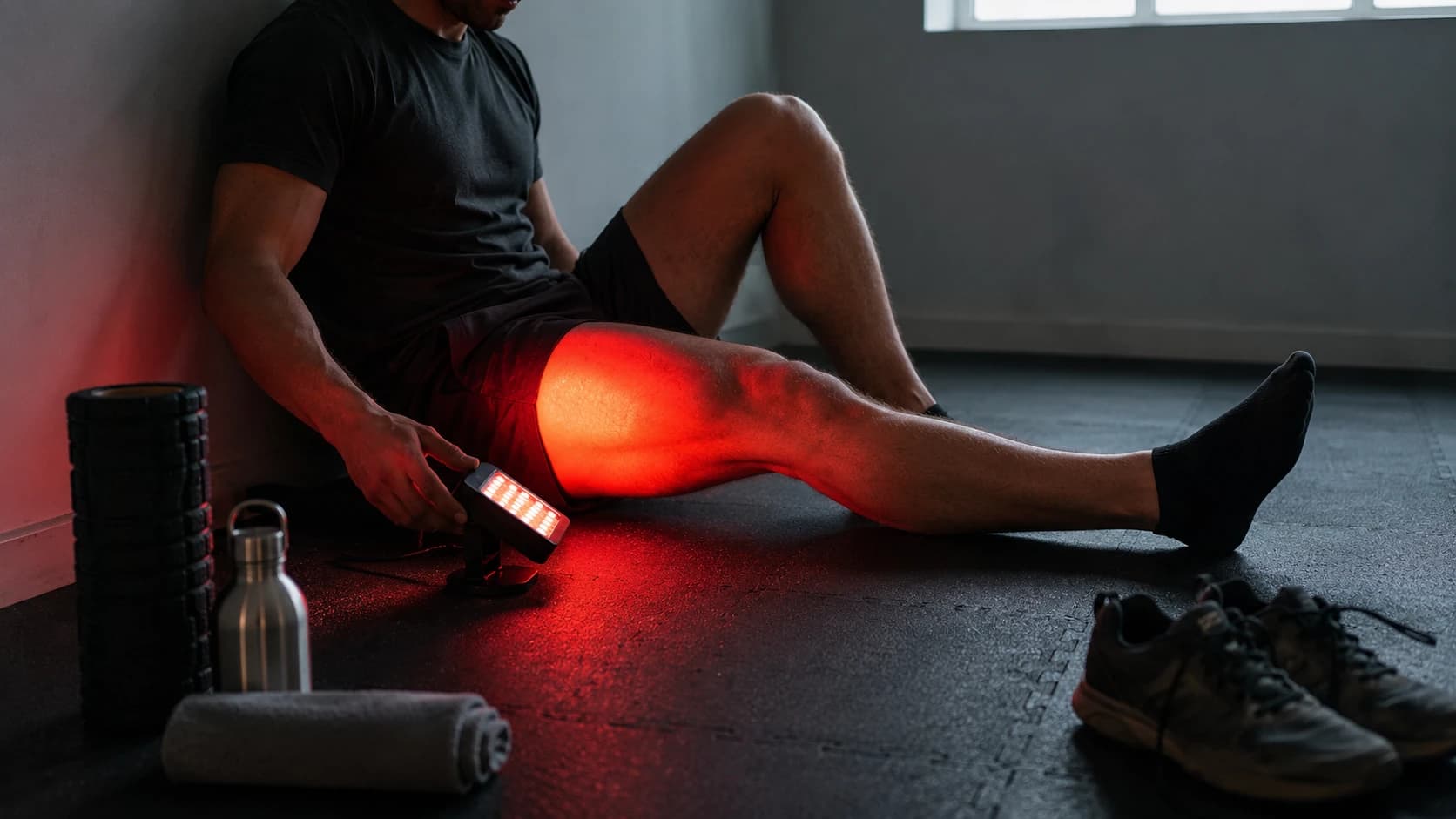
The recovery evidence is real but smaller than the marketing implies, and it is oddly timing-specific. Pooled evidence favours using it before exercise, and a separate review found no clear effect on soreness at 24 or 48 hours but moderate effects at 72 and 96 hours (Tsou et al., 2025). The dosing that produced benefit in positive trials clustered in the 60–300 joule range per session for large muscle groups (Leal-Junior et al.).
That is a benefit. It is a benefit of the size that shows up in a pooled analysis, not one you will unmistakably feel on a Tuesday. The full version, including how to time sessions, is in the muscle recovery guide.
Mixed: joint and musculoskeletal pain
Pain is the benefit where the honest grade is most likely to disappoint. Photobiomodulation for knee osteoarthritis produced a moderate pooled reduction in pain at rest across 10 trials in 542 people — but the authors rated the certainty of that evidence very low, and found no significant improvement in a functional walking test (Oliveira et al., 2024).
Rheumatoid arthritis of the hands has an older but cleaner result: a Cochrane review of five placebo-controlled trials in 222 patients found pain fell 1.10 points on a 0–10 scale and morning stiffness fell 27.5 minutes, with no significant change in range of motion, function, swelling or grip strength (Brosseau et al., 2005).
Both results are covered properly, with the caveats intact, in red light therapy for pain.
Not supported: weight loss, detox, general immunity
Cleveland Clinic is unusually direct here: "There's no scientific evidence to support red light therapy use in weight loss, cancer, cellulite removal or mental health conditions" (Cleveland Clinic). The mental-health line is the one most often misread: there is good evidence for light therapy in depression, but it is for bright white light, not red — what the depression evidence actually covers separates the two.
The weight-loss claim in particular survives on a regulatory misreading, which is worth understanding before you spend anything: the FDA product code covering low-level laser body-contouring devices is defined as "non-invasive reduction in fat layer for body contouring" — a circumference measurement, not scale weight. We take that apart in red light therapy for weight loss.
"Detox", "cellular energy boost" and "immune support" as standalone consumer claims have no trial evidence of the kind used above. The mitochondrial mechanism is real — see how red light therapy works — but a mechanism is not an outcome, and a great deal of marketing depends on the reader not noticing the difference.
The benefit nobody advertises
Red light therapy has no UV exposure, no downtime, no needles, and a good safety record in adults — the 2025 expert consensus concluded that red light photobiomodulation does not cause DNA damage and is a safe non-invasive option for adult patients. For a cosmetic or adjunctive intervention, a low ceiling paired with a low floor is a genuinely reasonable trade. What it is not is a reason to expect more from it.
What it does carry is a real set of exclusions. Before starting, read the exclusions guide and the safety record — and for the overall picture, our red light therapy overview.
Frequently Asked Questions (FAQ)
What are the proven benefits of red light therapy? A 21-expert international panel writing in the Journal of the American Academy of Dermatology in 2025 found sufficient evidence for photobiomodulation in androgenetic alopecia, wound ulcers of various causes, decubitus ulcers, diabetic foot ulcer pain, peripheral neuropathy and acute radiation dermatitis. Skin aging has separate randomised trial support.
How much can red light therapy actually improve skin? In a randomised controlled trial of 136 people, red and near-infrared treatment improved skin complexion, reduced measured skin roughness and increased intradermal collagen density compared with an untreated control group. The changes were real but gradual, measured over weeks rather than days.
Does red light therapy reduce inflammation? Anti-inflammatory effects are the proposed mechanism behind several of its accepted uses, and reviews describe reduced oxidative stress and altered inflammatory signalling. What has not been established is a general, whole-body anti-inflammatory benefit in healthy people — that specific claim is marketing rather than a trial finding.
Are red light therapy benefits permanent? No published evidence supports permanence. The Cochrane review of laser therapy in rheumatoid arthritis found benefits over four weeks of treatment but noted the effects did not appear long-lasting, and Cleveland Clinic describes red light therapy as requiring ongoing treatment.
Which benefit has the weakest evidence? Weight loss. Cleveland Clinic states plainly that there is no scientific evidence supporting red light therapy for weight loss, cancer, cellulite removal or mental health conditions.
Medical disclaimer: This article is for informational purposes only. Always consult a qualified healthcare provider before making changes to your health routine.
Sources
- Maghfour J, et al. Evidence-based consensus on the clinical application of photobiomodulation. Journal of the American Academy of Dermatology, 2025 — journal abstract. https://www.jaad.org/article/S0190-9622(25)00659-0/abstract
- Yoon JS, Ku WY, Lee JH, Ahn HC. Low-level light therapy using a helmet-type device for the treatment of androgenetic alopecia. Medicine (Baltimore), 2020 — PubMed Central. https://pmc.ncbi.nlm.nih.gov/articles/PMC7373546/
- Wunsch A, Matuschka K. A controlled trial to determine the efficacy of red and near-infrared light treatment. Photomedicine and Laser Surgery, 2014 — PubMed. https://pubmed.ncbi.nlm.nih.gov/24286286/
- Avci P, et al. Low-level laser (light) therapy (LLLT) in skin. Seminars in Cutaneous Medicine and Surgery, 2013 — PubMed Central. https://pmc.ncbi.nlm.nih.gov/articles/PMC4126803/
- Tsou et al. Photobiomodulation and delayed-onset muscle soreness, 2025 — PubMed Central. https://pmc.ncbi.nlm.nih.gov/articles/PMC12286287/
- Leal-Junior EC, Lopes-Martins RA, Bjordal JM. Clinical and scientific recommendations for photobiomodulation dosing in muscle tissue — PubMed Central. https://pmc.ncbi.nlm.nih.gov/articles/PMC6546960/
- Oliveira S, Andrade R, Valente C, et al. Effectiveness of photobiomodulation in reducing pain and disability in patients with knee osteoarthritis. Physical Therapy, 2024. https://academic.oup.com/ptj/article-abstract/104/8/pzae073/7679396
- Brosseau L, et al. Low level laser therapy (Classes I, II and III) for treating rheumatoid arthritis. Cochrane Database of Systematic Reviews, 2005. https://www.cochrane.org/evidence/CD002049_low-level-laser-therapy-rheumatoid-arthritis
- Cleveland Clinic. Red Light Therapy — patient education article. https://my.clevelandclinic.org/health/articles/22114-red-light-therapy
All sources accessed 7 August 2026.

Marcus Thorne
A wellness tools researcher more interested in effect sizes than in adjectives.