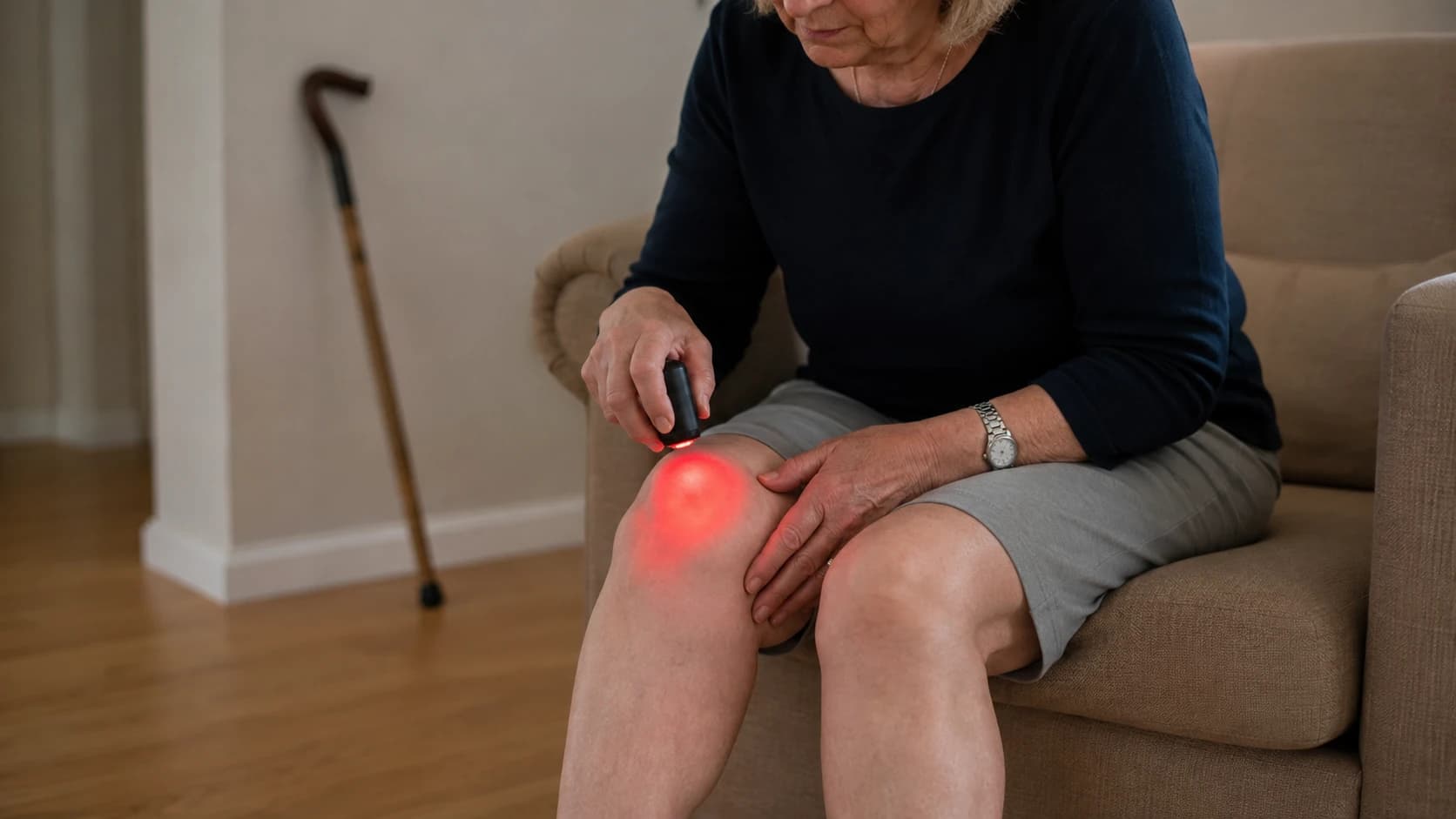
Quick answer: Cleveland Clinic states there is no scientific evidence supporting red light therapy for weight loss. The claim survives because some clinic laser systems really are FDA-cleared — but for something else. The FDA category they sit in is defined as "non-invasive reduction in fat layer for body contouring", which is a tape-measure outcome, not a scale outcome. That one substitution is where the entire marketing case comes from.
The clearest statement first
Cleveland Clinic: "There's no scientific evidence to support red light therapy use in weight loss, cancer, cellulite removal or mental health conditions" (Cleveland Clinic).
The 2025 international expert consensus on photobiomodulation, produced by 21 experts using a systematic review and a two-round Delphi process, found sufficient evidence for androgenetic alopecia, various wound ulcers, decubitus ulcers, diabetic foot ulcer pain, peripheral neuropathy and acute radiation dermatitis (Maghfour et al., 2025). Weight and fat are not on that list.
So why does the claim persist? Because part of it is technically true, and the true part is not the part being sold.
What is actually FDA-cleared, in the FDA's own words
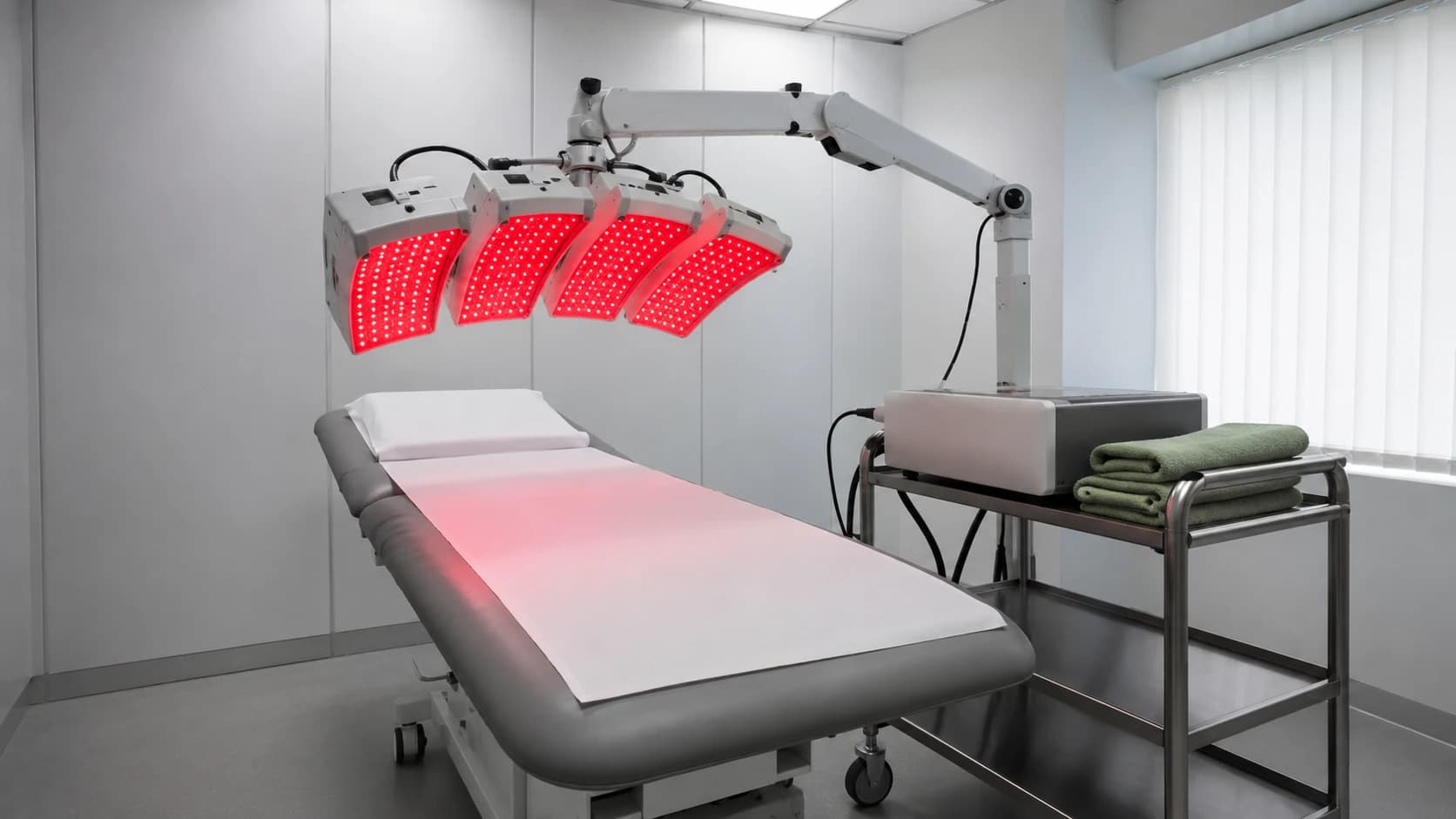
There is a real device category here. The FDA maintains product code OLI, and its own database gives the device name and definition:
Device name: Fat Reducing Low Level Laser Definition: Non-invasive reduction in fat layer for body contouring — 21 CFR 878.5400, Class II
Multiple devices are cleared under it. Erchonia's Zerona line, for example, appears repeatedly in the FDA's 510(k) database — including Erchonia Zerona VZ8 (K243811, January 2025) and Erchonia Violet ZERONA Z6 OTC (K231474, July 2023).
Now read the definition again. It says body contouring. It says fat layer. It does not say weight. And "cleared" under a Class II 510(k) means the manufacturer showed substantial equivalence to an existing device — not that a new outcome was proven.
Body contouring and weight loss are different endpoints
This is the substitution that does all the work in the marketing, so it is worth spelling out.
| Body contouring | Weight loss | |
|---|---|---|
| What is measured | Circumference at treated sites — waist, hips, thighs | Total body mass |
| Instrument | Tape measure | Scale |
| Typical claim window | Immediately after a short treatment course | Sustained over months |
| What the FDA code covers | This one | Not this one |
A device can produce a measurable change in the first column while producing nothing in the second. When an advertisement moves from "clinically proven fat reduction" to "lose weight without exercise", it has crossed from one column to the other without telling you.
Two further things worth knowing about circumference as an endpoint: it is affected by posture, hydration, measurement position and who is holding the tape, and it says nothing on its own about how long any change lasts.
What we could not verify
Specific trial figures for laser body contouring circulate widely — a commonly repeated pair of numbers concerns inches lost across waist, hips and thighs in a placebo-controlled trial. We were not able to open and verify those primary results for this article, and every version we found sat on a commercial page rather than in a source we could check.
So we are not repeating them. What we can state with confidence is what the FDA's own category description says, and what Cleveland Clinic says about weight loss. Those two facts are enough to answer the question a shopper is actually asking.
The home-device version of the claim is weaker still
Even if you take the body-contouring evidence at its most favourable, it does not transfer to a panel bought online.
The cleared devices in product code OLI are clinic laser systems, applied under supervision on a defined protocol. A 2024 review notes that the LED light in home devices does not penetrate the way clinical laser light does (Lawrence & Sorra, 2024), and Cleveland Clinic's consumer summary is that at-home devices "may be less powerful than devices that may be used by dermatologists or other trained skin professionals". A home LED panel is not a cleared body-contouring laser, and no clearance it may hold covers fat.
What about "boosting metabolism"?
The mitochondrial mechanism is real — red and near-infrared light is absorbed in the mitochondria and alters cellular energy production and signalling (Hamblin, 2018). That is genuine science, and it is also the most over-extended sentence in this entire industry.
A mechanism at the cellular level is not a whole-body metabolic outcome. Between "mitochondria respond to light" and "you will burn more calories" sits an enormous amount of physiology that no one has demonstrated. We found no controlled evidence of meaningful, sustained changes in metabolic rate or body weight in humans from red light therapy. If a page tells you otherwise, check whether its citation measures cells or people. The mechanism itself, and where it legitimately stops, is covered in what the light actually does in a cell.
Where red light therapy does touch exercise
There is one honest, evidence-backed connection between red light and body composition efforts, and it is indirect: recovery. Pooled evidence favours applying red light before exercise for muscle soreness, and a 2025 review found moderate effects on soreness at 72 and 96 hours after hard eccentric exercise (Tsou et al., 2025).
Better recovery can support more consistent training, and consistent training does affect body composition. That is a legitimate chain — and notice how much longer and more conditional it is than "red light burns fat". Our muscle recovery guide covers the protocol.
The bottom line
If weight loss is your goal, this is not the tool, and no reading of the current evidence makes it one. Red light therapy has real, documented uses — they are laid out claim by claim in what is actually supported and graded in our what the evidence does support. Fat is not among them, and the FDA's own device description is the quickest way to see why.
Frequently Asked Questions (FAQ)
Does red light therapy work for weight loss? Cleveland Clinic states there is no scientific evidence supporting red light therapy for weight loss. The FDA-cleared low-level laser devices in this space are cleared under a product code defined as "non-invasive reduction in fat layer for body contouring" — a circumference measurement, not scale weight.
What is the difference between body contouring and weight loss? Body contouring clearance concerns measured circumference at treated sites such as waist, hips and thighs. Weight loss concerns total body mass. A device can be cleared for the first without any finding about the second, and the FDA product code description refers only to the fat layer and body contouring.
Are red light therapy fat loss devices FDA approved? They are cleared, not approved. Low-level laser body-contouring devices sit under Class II 510(k) product code OLI, which means the manufacturer demonstrated substantial equivalence to an existing device rather than proving a new outcome.
Can a home red light panel reduce belly fat? We found no credible evidence that a consumer LED panel reduces body fat. The cleared body-contouring devices are clinic laser systems, and a 2024 review notes that LED light in home devices does not penetrate the way clinical laser light does.
Does red light therapy boost metabolism? The mitochondrial mechanism behind photobiomodulation is real, but a mechanism is not an outcome. We found no controlled evidence that red light therapy produces meaningful, sustained changes in metabolic rate or body weight in humans.
Medical disclaimer: This article is for informational purposes only. Always consult a qualified healthcare provider before making changes to your health routine.
Sources
- Cleveland Clinic. Red Light Therapy — patient education article. https://my.clevelandclinic.org/health/articles/22114-red-light-therapy
- US Food and Drug Administration. Device classification and 510(k) Premarket Notification database — product code OLI, "Fat Reducing Low Level Laser", 21 CFR 878.5400; records K243811 and K231474. https://www.accessdata.fda.gov/scripts/cdrh/cfdocs/cfpmn/pmn.cfm
- Maghfour J, et al. Evidence-based consensus on the clinical application of photobiomodulation. Journal of the American Academy of Dermatology, 2025 — journal abstract. https://www.jaad.org/article/S0190-9622(25)00659-0/abstract
- Lawrence J, Sorra K. Photobiomodulation as medicine. Journal of Functional Morphology and Kinesiology, 2024 — PubMed Central. https://pmc.ncbi.nlm.nih.gov/articles/PMC11503318/
- Hamblin MR. Mechanisms and mitochondrial redox signaling in photobiomodulation. Photochemistry and Photobiology, 2018 — PubMed. https://pubmed.ncbi.nlm.nih.gov/29164625/
- Tsou et al. Photobiomodulation and delayed-onset muscle soreness, 2025 — PubMed Central. https://pmc.ncbi.nlm.nih.gov/articles/PMC12286287/
All sources accessed 13 August 2026. FDA records reflect the openFDA data release of 3 August 2026.

Marcus Thorne
A wellness tools researcher who reads what a device was actually cleared to do.