Quick answer: Red light therapy has pooled trial evidence for several pain conditions, and the effect sizes are real but small — a 1.10-point drop on a 0–10 pain scale in rheumatoid arthritis, a moderate pooled reduction in knee osteoarthritis rated very low certainty. The strongest-sounding numbers come from a review its own quality assessors said should be read with caution. None of it supports replacing anything you are already doing.
Why this page leads with certainty ratings
Pain research is where effect sizes get quoted without their error bars more than anywhere else in this field. A reviewer can find a statistically significant pooled benefit and simultaneously rate their own confidence in it as very low — because the trials were small, varied wildly in protocol, or carried a risk of bias.
Both halves of that sentence are true at once, and dropping the second half is how "red light therapy relieves arthritis pain" becomes a headline. Every result below carries its own rating.
Knee osteoarthritis: positive, at very low certainty
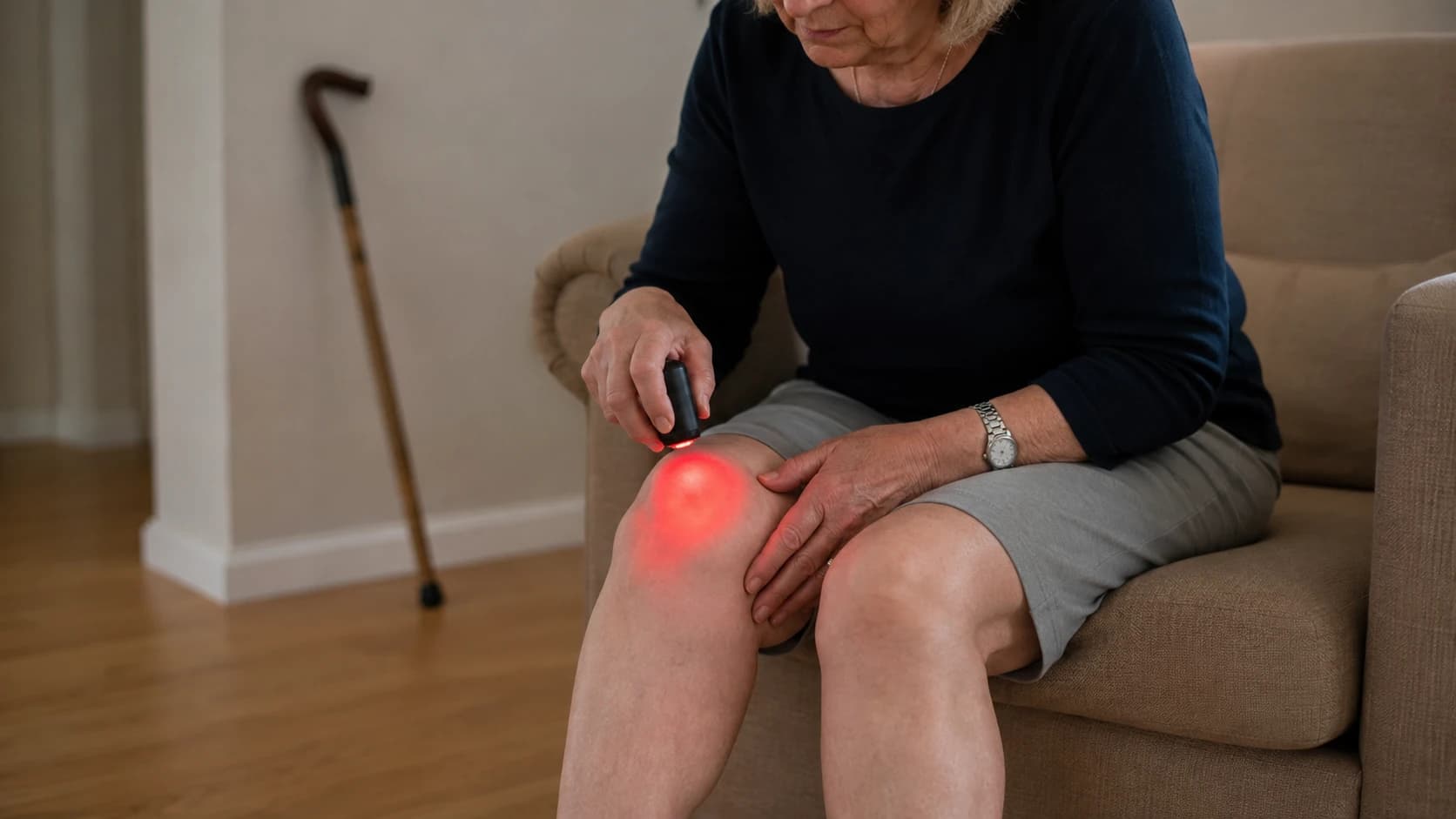
The most recent systematic review with meta-analysis pooled 10 randomised placebo-controlled trials in 542 people, 80% female, mean age 64.3 (Oliveira et al., 2024).
- Pain at rest: SMD −0.7 (95% CI −1.1 to −0.2) — a moderate effect.
- Subgroup, one week of treatment: SMD −1.0 (95% CI −1.5 to −0.5) — a large effect.
- Timed Up and Go test: SMD −0.1 (95% CI −0.5 to 0.4) — no significant difference.
- GRADE certainty of evidence: very low.
The authors' own conclusion is measured: photobiomodulation "can reduce pain intensity and may improve disability in patients with knee osteoarthritis. This intervention may thus be considered but in combination with other recommended therapies."
The functional result deserves attention. Pain scores improved; a timed walking-and-turning test did not. Feeling less pain and moving better are different outcomes, and only one of them moved.
Rheumatoid arthritis: the cleanest arthritis result, and it is small
A Cochrane review pooled five placebo-controlled trials in 222 patients, with treatment applied mostly to the hands, generally two to three times weekly for four weeks (Brosseau et al., 2005).
| Outcome | Result |
|---|---|
| Pain | −1.10 points on a 0–10 scale |
| Morning stiffness | −27.5 minutes |
| Tip-to-palm flexibility | +1.3 cm |
| Range of motion | No significant difference |
| Function, swelling, grip strength | No significant difference |
The review graded this "silver" level evidence for short-term treatment of up to four weeks, noted the effects did not appear long-lasting, and reported no side effects across the included trials.
A 27-minute reduction in morning stiffness is a genuinely meaningful change to a morning. A 1.10-point move on a 10-point pain scale is real but modest. Both are honest to state; neither supports a claim of resolving rheumatoid arthritis.
Neck pain: the biggest numbers, and the biggest caveat
The most-cited pain result in this field comes from a Lancet systematic review and meta-analysis of 16 randomised trials in 820 participants (Chow et al., 2009):
- Acute neck pain: RR 1.69 (95% CI 1.22–2.33) for pain improvement versus placebo.
- Chronic neck pain, categorical: RR 4.05 (95% CI 2.74–5.98).
- Chronic neck pain intensity: a 19.9 mm reduction (95% CI 10–29.7).
- Duration: relief persisted up to 22 weeks after treatment ended.
Then the part that rarely travels with those figures. The DARE quality assessors flagged considerable clinical heterogeneity across the included studies and uncertainty about possible bias in the small trials, and concluded the results "should be interpreted with a degree of caution". Reported side effects — tiredness, nausea, headache, increased pain — were mostly mild, but half the trials did not report side-effect data at all.
A relative risk of 4.05 is a striking number. It is also a number its own assessors asked you to discount.
Muscle soreness after exercise
Distinct from clinical pain and covered in depth separately: the evidence favours applying red light before exercise, and a 2025 review found no clear effect on soreness at 24 or 48 hours but moderate effects at 72 and 96 hours (Tsou et al., 2025). Doses associated with benefit in positive trials clustered at 60–300 joules per session for large muscle groups (Leal-Junior et al.). The full protocol detail is in our muscle recovery guide.
The gap between these trials and your living room
Every number above was produced under conditions your home setup does not reproduce.
Device type. Most positive pain trials used clinical lasers. A 2024 review states that LED light in home devices does not penetrate the way coherent clinical laser light does (Lawrence & Sorra, 2024). For deep joint tissue, penetration is the entire question.
Dose control. Trial doses were measured. At home the dose is whatever your device produces at whatever distance you happened to sit, and photobiomodulation follows a biphasic dose response in which overshooting reduces the benefit (Huang et al., 2011).
Supervision. Trial participants were positioned by clinicians who knew where the joint was and how far the light had to travel.
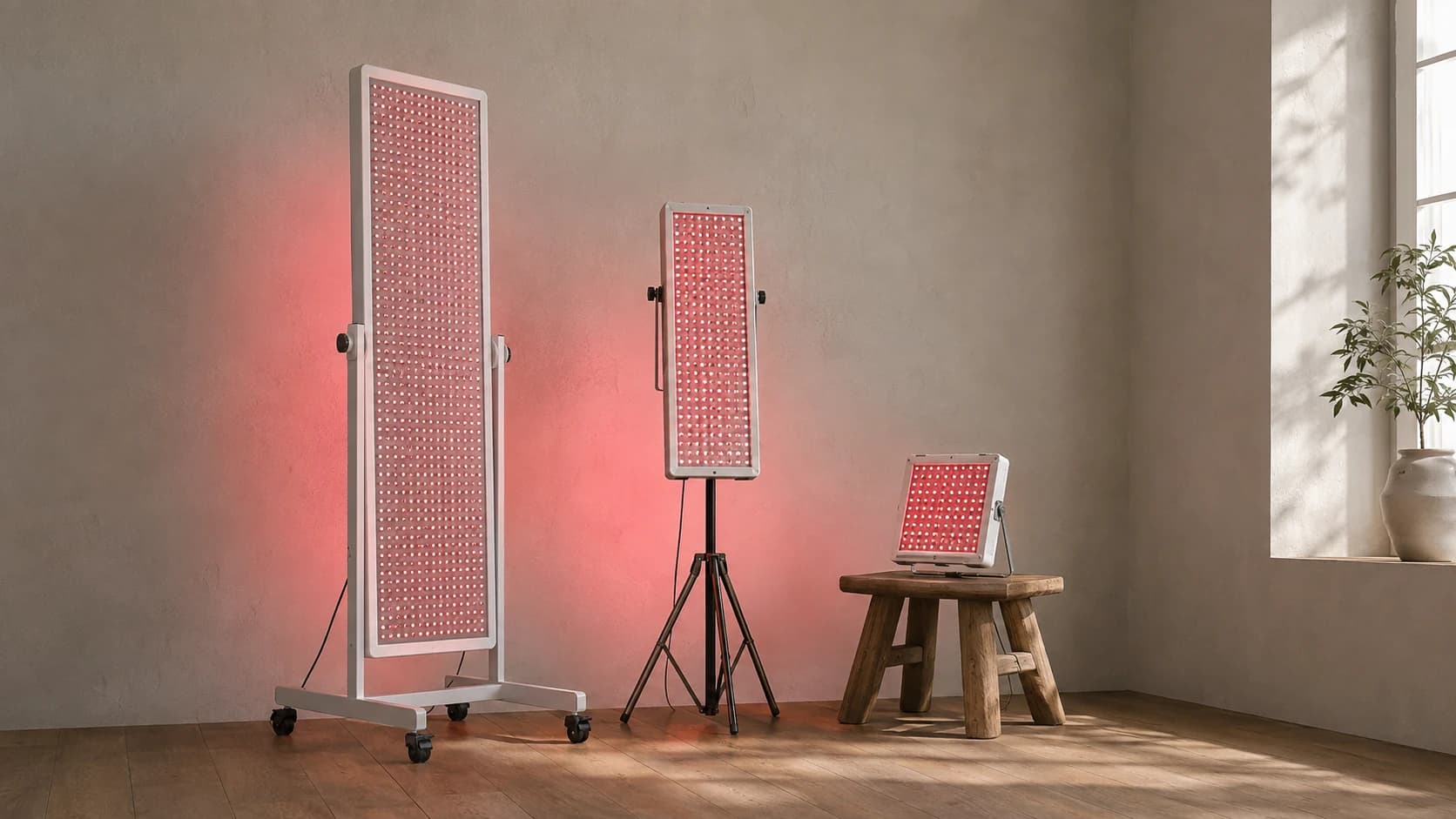
The practical translation: whatever the pooled effect size, expect less of it at home. Choosing hardware for depth rather than surface area is covered in red light therapy panels.
Where this fits in a pain plan
The knee osteoarthritis authors put it plainly — consider it in combination with other recommended therapies. Nothing in this evidence base supports substituting light for exercise therapy, weight management, physiotherapy or prescribed medication, and any change to prescribed treatment belongs with the clinician managing it.
What it can reasonably be: a low-risk adjunct with no reported side effects in the arthritis literature, a short session time, and a modest chance of a modest improvement. For a persistent problem where the alternatives carry more downside, that trade can be reasonable. Just size the expectation to the effect, not to the marketing.
For where pain sits relative to every other claim made for this technology, see how the benefits compare and the how pain compares with the other claims. Before starting, check the documented contraindications — reduced sensation in the treatment area is specifically relevant here.
Frequently Asked Questions (FAQ)
Does red light therapy work for pain? For some kinds, modestly. Pooled photobiomodulation reduced pain at rest in knee osteoarthritis across 10 trials in 542 people, though the authors rated that evidence very low certainty. A Cochrane review in rheumatoid arthritis found pain fell 1.10 points on a 0-10 scale and morning stiffness fell 27.5 minutes over four weeks.
Does red light therapy help arthritis? The two main arthritis types have different evidence. For rheumatoid arthritis of the hands, a Cochrane review found short-term reductions in pain and morning stiffness with "silver" level evidence, but no change in function, swelling or grip strength. For knee osteoarthritis, the pooled pain benefit was rated very low certainty.
How long does pain relief from red light therapy last? In the neck pain review, relief persisted up to 22 weeks after treatment ended in chronic cases — though the reviewers flagged considerable heterogeneity and possible small-trial bias. The Cochrane rheumatoid arthritis review found the effects did not appear long-lasting.
Can red light therapy replace pain medication? No. The knee osteoarthritis authors concluded photobiomodulation "may thus be considered but in combination with other recommended therapies", not instead of them. Any change to prescribed pain treatment is a decision for the clinician managing it.
Do home red light devices work for pain like clinic devices? Most positive pain trials used clinical laser devices, and a 2024 review notes LED light in home devices does not penetrate as deeply as clinical laser light. Expect a smaller effect at home than the trial numbers suggest.
Medical disclaimer: This article is for informational purposes only. Always consult a qualified healthcare provider before making changes to your health routine.
Sources
- Oliveira S, Andrade R, Valente C, et al. Effectiveness of photobiomodulation in reducing pain and disability in patients with knee osteoarthritis: a systematic review with meta-analysis. Physical Therapy, 2024;104(8):pzae073. https://academic.oup.com/ptj/article-abstract/104/8/pzae073/7679396
- Brosseau L, et al. Low level laser therapy (Classes I, II and III) for treating rheumatoid arthritis. Cochrane Database of Systematic Reviews, 2005, CD002049. https://www.cochrane.org/evidence/CD002049_low-level-laser-therapy-rheumatoid-arthritis
- Chow RT, Johnson MI, Lopes-Martins RA, Bjordal JM. Efficacy of low-level laser therapy in the management of neck pain. The Lancet, 2009 — DARE quality-assessed abstract, NCBI Bookshelf. https://www.ncbi.nlm.nih.gov/books/NBK78464/
- Tsou et al. Photobiomodulation and delayed-onset muscle soreness, 2025 — PubMed Central. https://pmc.ncbi.nlm.nih.gov/articles/PMC12286287/
- Leal-Junior EC, Lopes-Martins RA, Bjordal JM. Clinical and scientific recommendations for photobiomodulation dosing in muscle tissue — PubMed Central. https://pmc.ncbi.nlm.nih.gov/articles/PMC6546960/
- Lawrence J, Sorra K. Photobiomodulation as medicine. Journal of Functional Morphology and Kinesiology, 2024 — PubMed Central. https://pmc.ncbi.nlm.nih.gov/articles/PMC11503318/
- Huang YY, Sharma SK, Carroll J, Hamblin MR. Biphasic dose response in low level light therapy — an update. Dose-Response, 2011 — PubMed Central. https://pmc.ncbi.nlm.nih.gov/articles/PMC3315174/
All sources accessed 12 August 2026.

Marcus Thorne
A wellness tools researcher who reports the certainty rating alongside the effect size.