Quick answer: Panels, lamps, machines and beds are marketing categories, not physical ones. They all emit the same red and near-infrared wavelengths; what changes is how much area they cover and how well they control distance. The specification that decides everything — irradiance at a stated distance — is the one most listings quote incompletely.
The format names, decoded
The retail vocabulary here is loose, which is convenient for sellers and confusing for everyone else.
| Term | What it usually means | Best suited to |
|---|---|---|
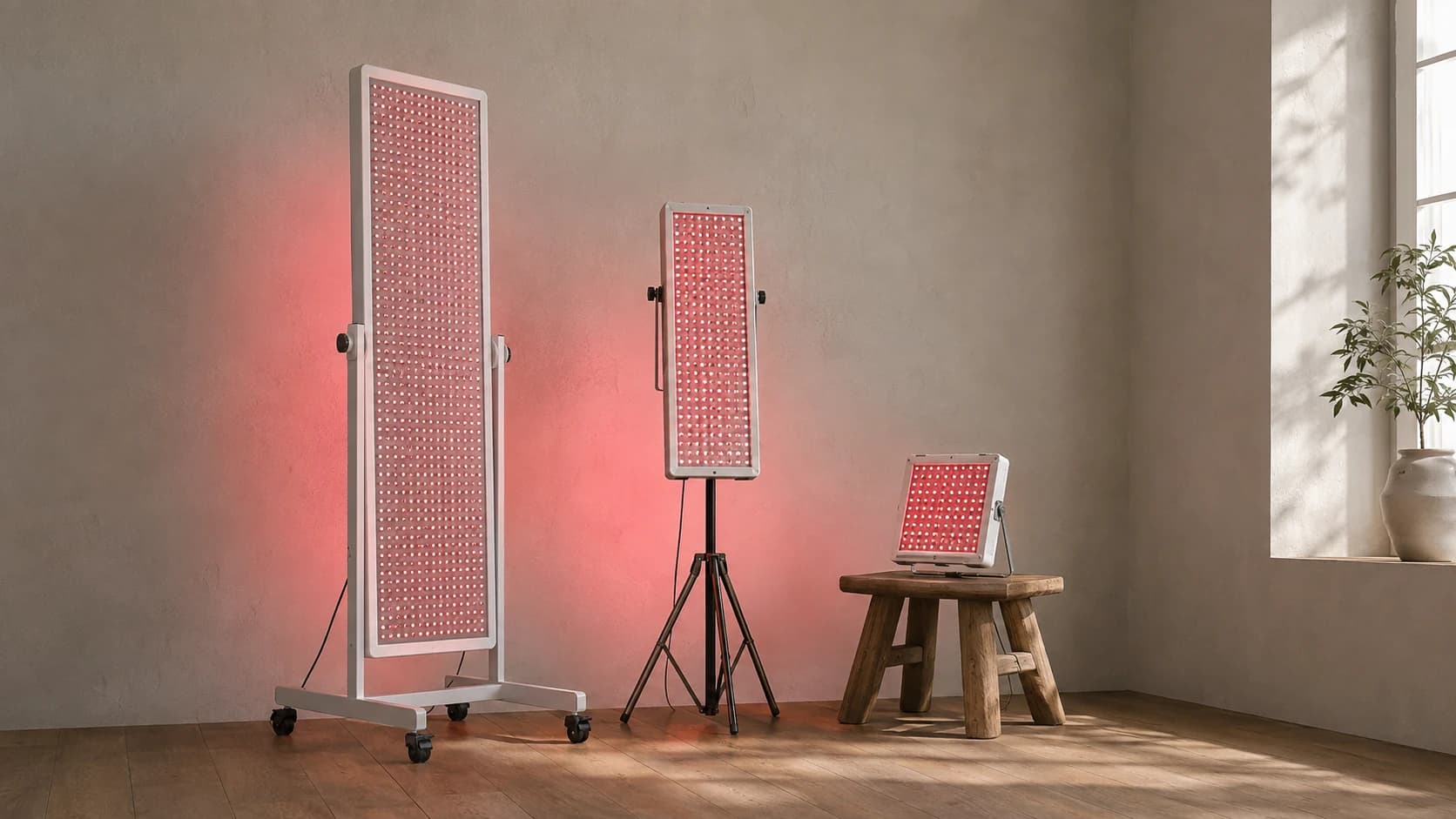
| Lamp | A single bulb-style emitter, often on a stand or gooseneck arm | One small area at a time — a shoulder, an elbow, a section of face |
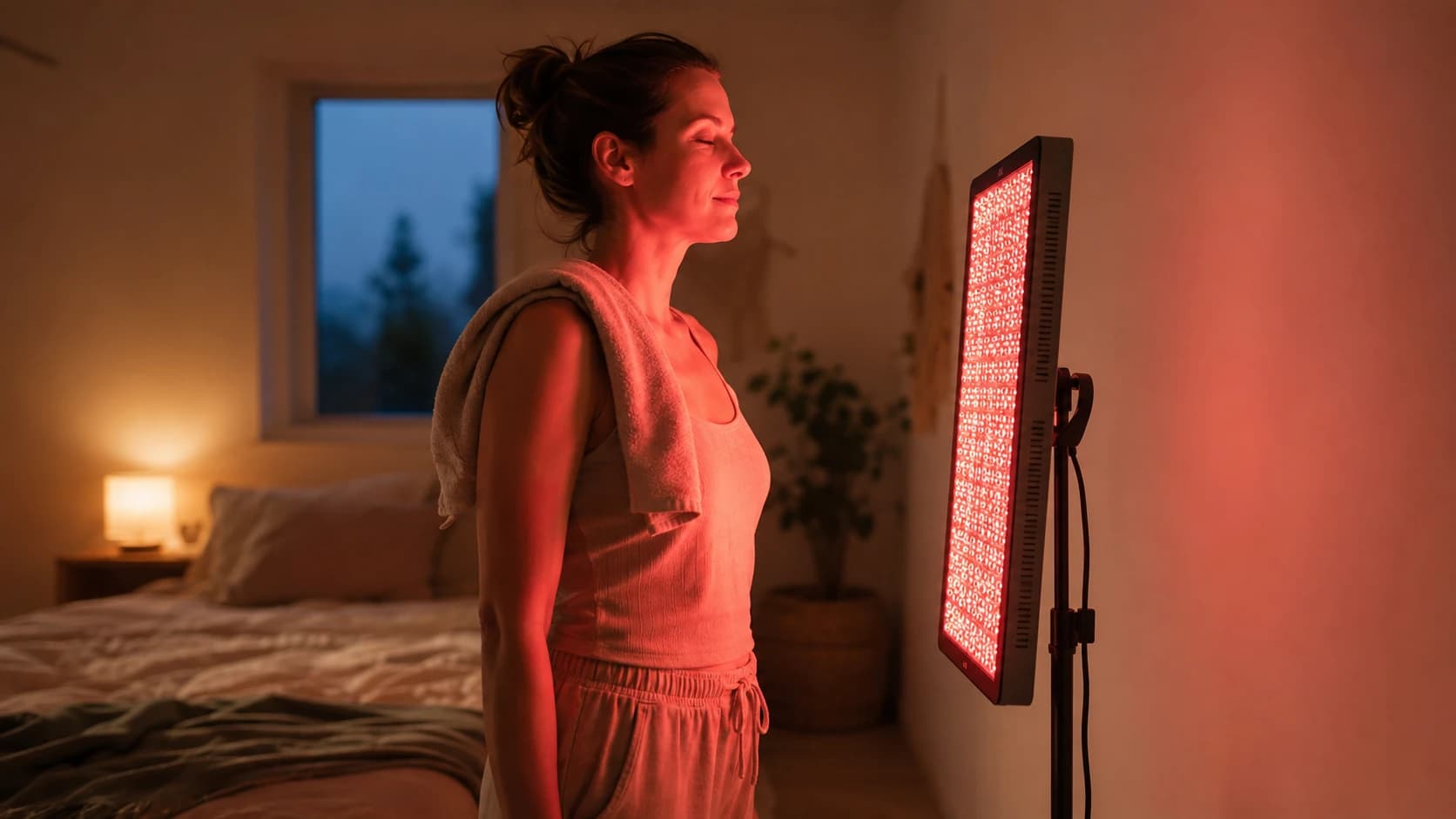
| Panel | A flat array of LEDs, from tabletop-size to full-length | Larger regions: back, thigh, torso |
| Machine | Generic retail term covering panels, beds and clinic units | Nothing specific — treat it as a word, not a category |
| Bed / full-body | Enclosure or large array treating most of the body at once | Convenience at commercial-clinic scale and price |
| Mask / wand | Face-specific formats | Covered separately in red light therapy masks |
If you are searching for a "red light therapy machine" and finding wildly different products, that is why. The word does not narrow anything down.
The one specification that actually matters
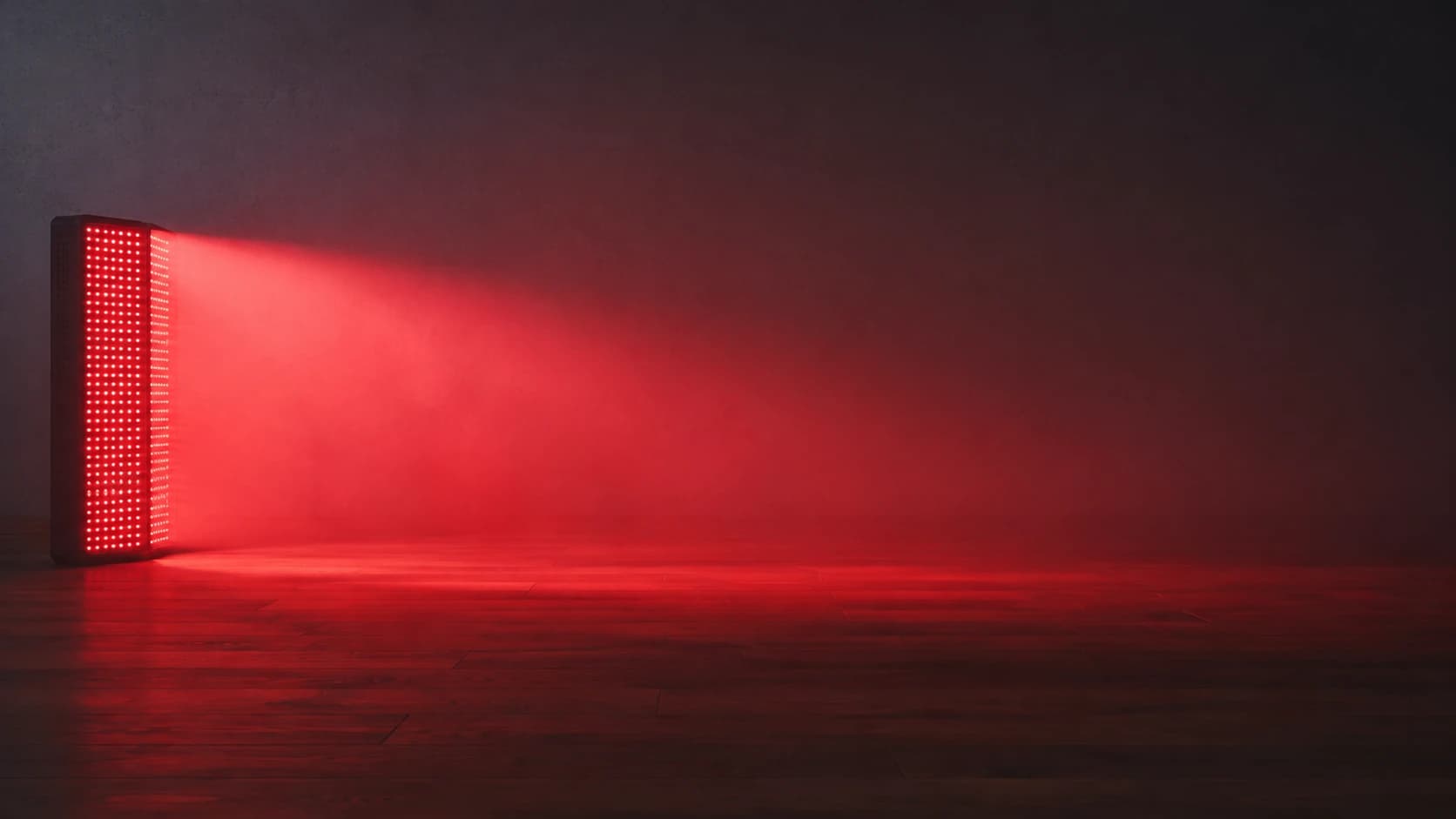
Irradiance — the power arriving per unit area, usually quoted in mW/cm² — determines how much light your tissue receives per second. Multiply it by session time and you get the dose.
The problem is that irradiance falls off sharply with distance from the emitter, so a figure without a distance attached is not a specification. "70 mW/cm²" measured at 3 inches and "70 mW/cm²" measured at 12 inches describe very different devices, and listings routinely publish the first kind of number next to usage instructions implying the second.
Two questions to ask before buying:
- At what distance was this measured? If the seller cannot say, the number is decorative.
- Was it measured by anyone other than the manufacturer? Consumer irradiance claims are typically manufacturer-supplied and not confirmed by an independent spectroradiometer. This is an industry-wide gap rather than a single brand's failing, and it is the honest reason to be sceptical of any panel marketed primarily on its power figure.
Why a bigger number is not a better result
This is where panel marketing runs directly into the underlying science.
Photobiomodulation follows a biphasic dose response: too little light does nothing, an intermediate dose produces the effect, and past that point the benefit shrinks and can reverse. Huang and colleagues documented this repeatedly — cultured fibroblasts peaked at 2.5 J/cm² and were damaged at 10 J/cm², and in a traumatic brain injury model 36 J/cm² was effective while 360 J/cm² made the benefit "totally disappear" (Huang et al., 2011).
So a very high-irradiance panel is not automatically better; it is a device that reaches the optimal dose faster and overshoots it faster. What a bigger panel genuinely buys you is coverage — treating a whole back in one session instead of four repositionings. That is a time saving, and time savings are the main reason people stay consistent, which is not nothing.
For dosing that has actually been associated with benefit: in positive muscle trials, doses clustered in the 60–300 joule range per session for large muscle groups (Leal-Junior et al.). Translating that into minutes is the job of how often you should use red light therapy.
Wavelengths: what the two numbers on the box mean
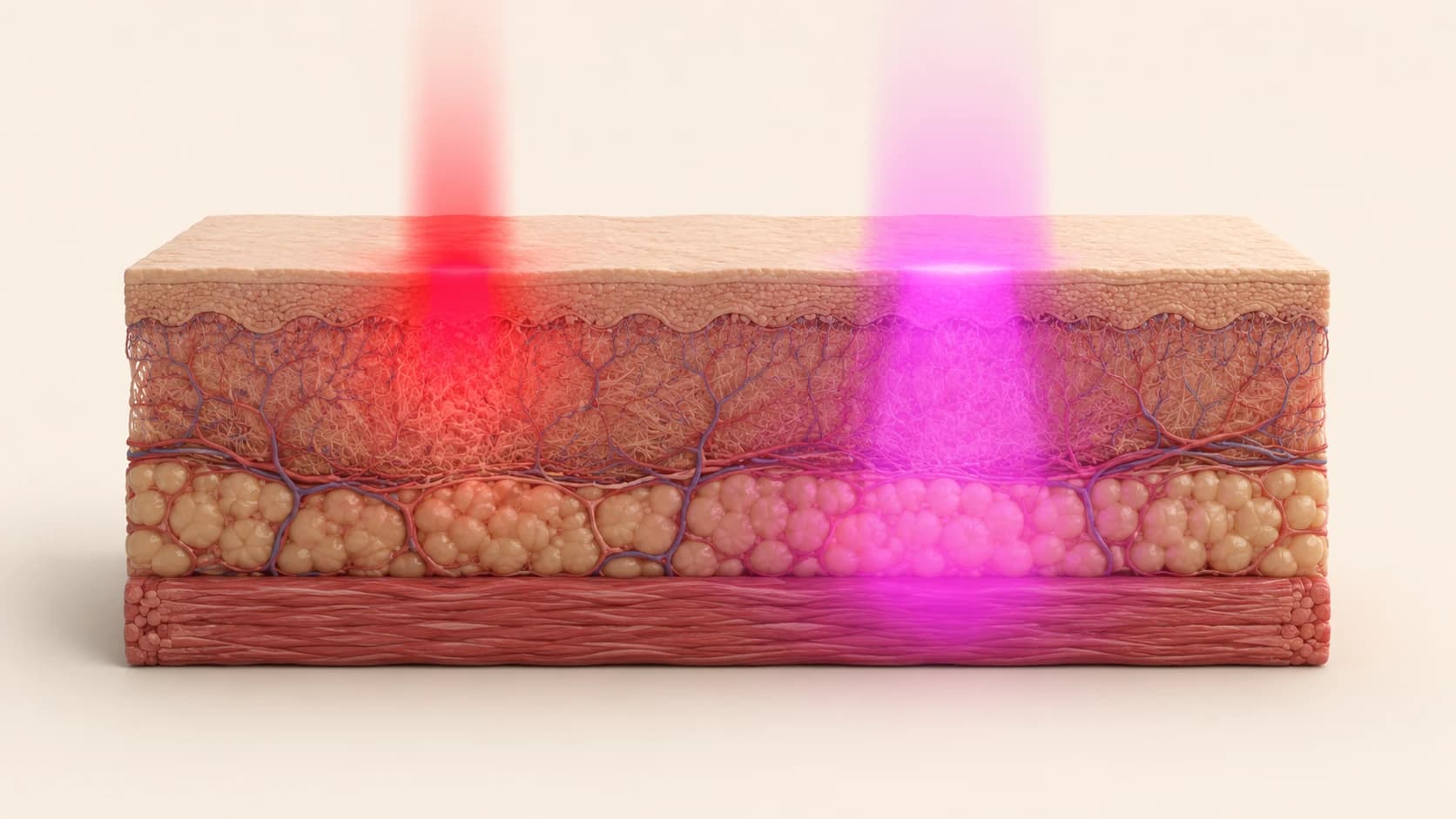
Nearly every panel advertises around 660 nm (visible red, absorbed at and near the surface) and around 850 nm (near-infrared, penetrating further toward muscle and joint tissue). Photobiomodulation as a field spans roughly 620–700 nm red and 700–1440 nm near-infrared (JAAD CME, 2024).
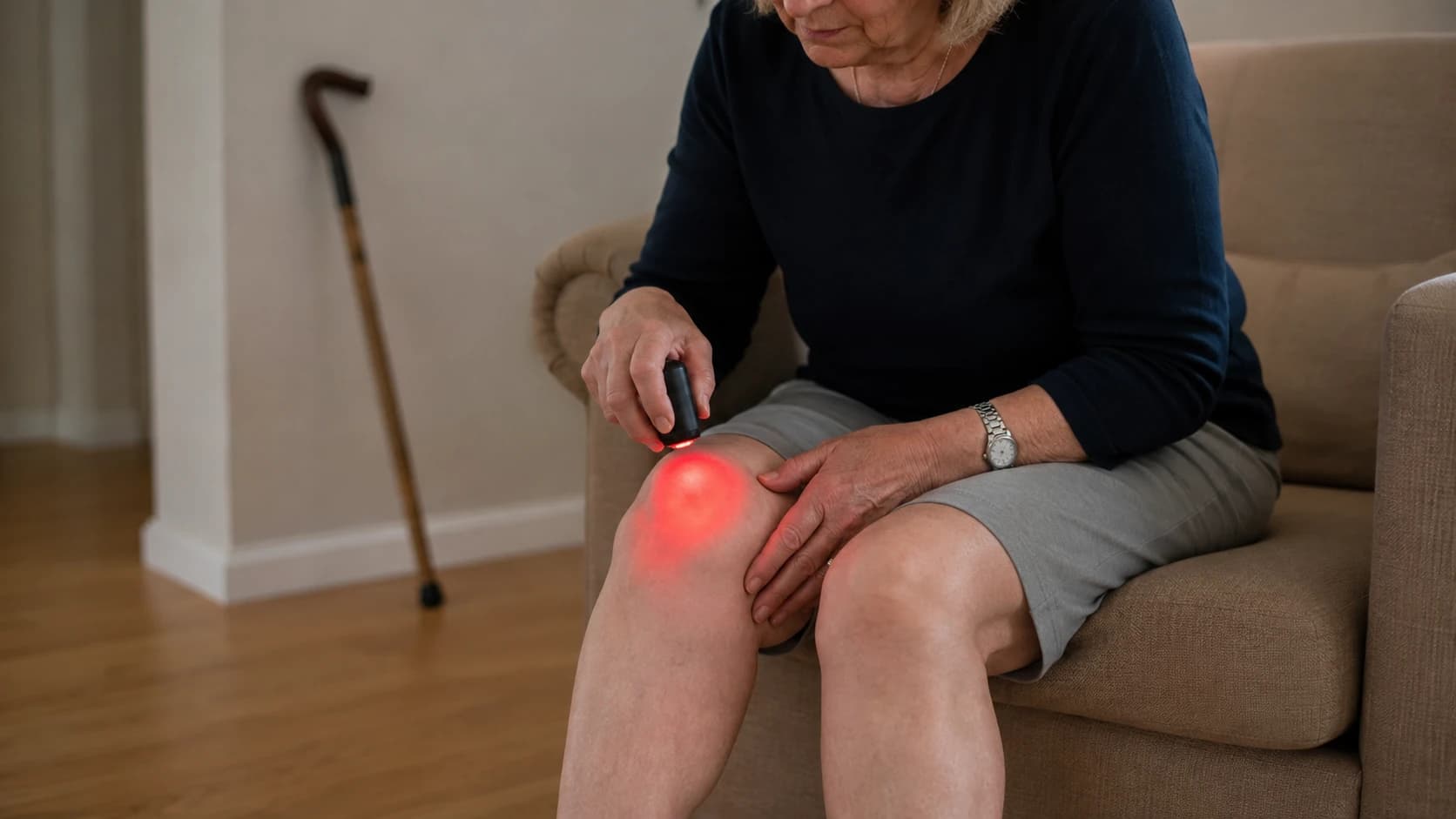
The practical implication is that panel choice should follow target depth. A near-infrared-heavy panel for fine lines is working below the tissue you care about; a surface-only red lamp aimed at a knee is doing very little for the joint underneath. The mechanism detail is in how red light therapy works.
Be aware of one visual oddity: near-infrared is largely invisible. A panel running only its 850 nm channel can look nearly off. That is expected, not a fault.
What a panel realistically does
For muscles and recovery, the evidence is meaningful but modest — strongest when applied before exercise, and with effects on soreness showing at 72 and 96 hours rather than at 24 or 48 (Tsou et al., 2025). Our muscle recovery guide covers the protocol detail.
For joint pain, pooled photobiomodulation results for knee osteoarthritis showed a moderate reduction in pain at rest across 10 trials in 542 people — but the authors rated that evidence very low certainty and found no significant improvement in a functional walking test (Oliveira et al., 2024). More in red light therapy for pain.
The caveat on every one of these numbers: most of the underlying trials used clinical laser devices. A 2024 review states plainly that LED light in home devices does not penetrate the way clinical laser light does (Lawrence & Sorra, 2024).
Regulatory status: what to expect and what to ignore
Panels sit in a messier regulatory position than masks. Face masks are typically cleared under the FDA product code OHS, "Light Based Over The Counter Wrinkle Reduction". Devices making pain claims fall under NHN, defined for non-thermal lasers "for adjunctive use in pain therapy". Both are Class II 510(k) pathways, meaning substantial equivalence to an existing device — not approval, and not evidence that a device works.
You will also see the phrase "manufactured in an FDA-registered facility". That refers to the facility being registered, not to the device being cleared or approved. It is one of the most common sleights of hand in this category. Anything genuinely cleared has a K-number you can look up in the FDA's 510(k) database.
A short buying checklist
- Irradiance and the distance it was measured at. Both, or neither counts.
- Wavelengths in nanometres, not "red light" as a phrase.
- Coverage area matched to the body part you actually intend to treat.
- A timer, because dose is irradiance × time and guessing defeats the point.
- Eye protection included, and used — see the safety guidance.
- Mounting or a stand that lets you reproduce the same distance every session. Variable distance is variable dose.
- Fan noise, if it will live in a bedroom. Larger panels move air.
For specific current models compared side by side, see our best red light therapy device for home use roundup. For the evidence picture behind all of it, start at the the claim-by-claim evidence map.
Frequently Asked Questions (FAQ)
What is the difference between a red light therapy panel, lamp and machine? They differ in coverage and mounting, not in physics. A lamp is usually a single bulb-style emitter for one small area. A panel is a flat array covering a larger region such as a back or thigh. "Machine" is a generic retail word covering panels, beds and clinic units. All deliver the same red and near-infrared wavelengths.
What irradiance does a red light therapy panel need? An irradiance figure is meaningless without the distance it was measured at, because output falls off sharply with distance. Ask for both numbers together. Consumer figures are usually manufacturer-supplied rather than independently verified by third-party measurement, which is an industry-wide gap.
Is a bigger panel always better? Bigger means more coverage per session, which mainly saves time. It does not mean a stronger effect on any given patch of skin, and photobiomodulation follows a biphasic dose response where past an optimal dose the benefit shrinks rather than grows.
Do red light therapy panels help with pain? The pooled evidence is real but weak. Photobiomodulation for knee osteoarthritis reduced pain at rest across 10 trials in 542 people, but the authors rated that evidence very low certainty and found no significant improvement in a functional walking test.
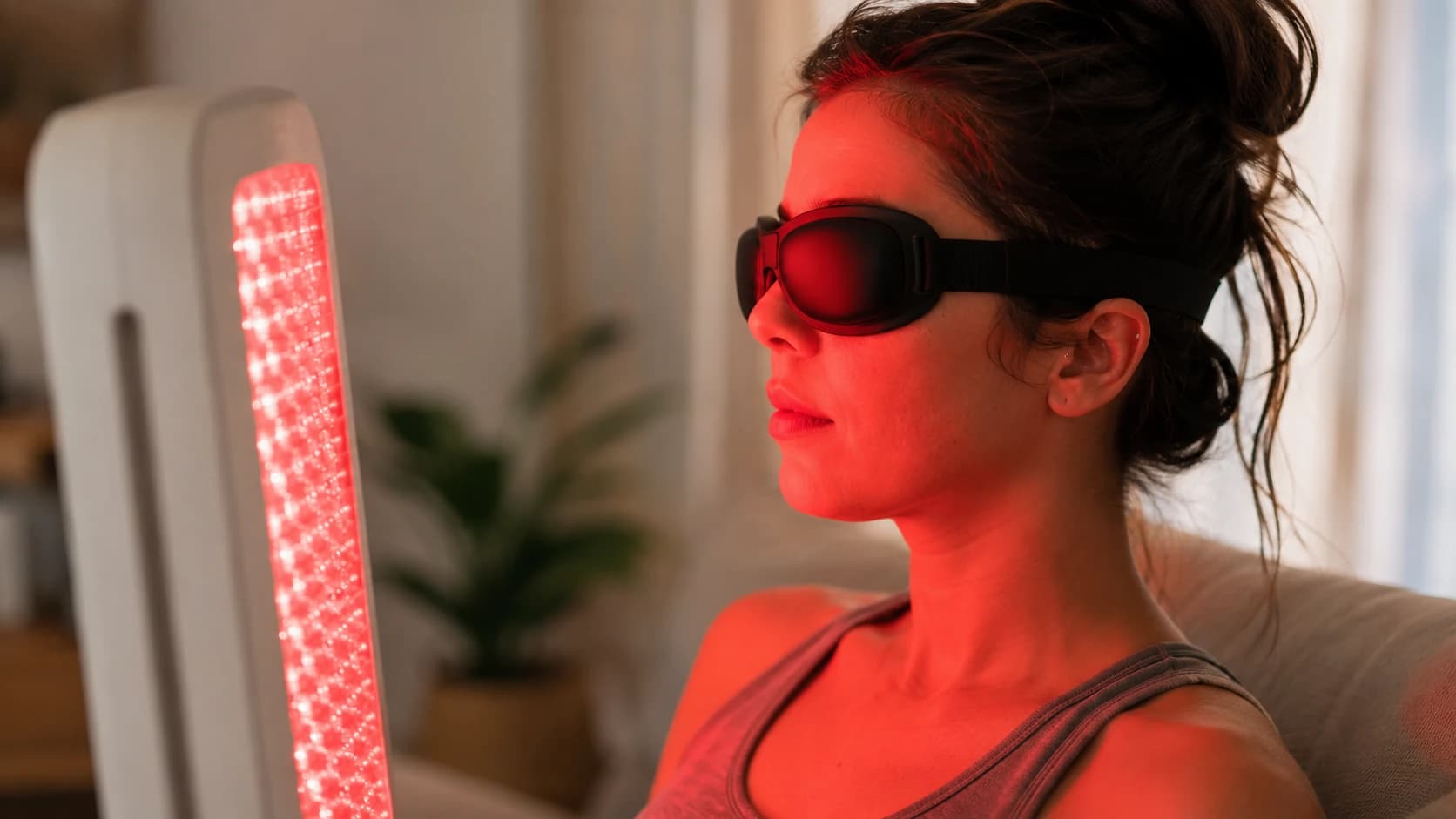
Are panels or masks better? It depends on the body part. A mask covers the face evenly and hands-free but reaches nothing below the jaw. A panel covers backs, legs, shoulders and joints but relies on you controlling distance and positioning yourself.
Medical disclaimer: This article is for informational purposes only. Always consult a qualified healthcare provider before making changes to your health routine.
Sources
- Huang YY, Sharma SK, Carroll J, Hamblin MR. Biphasic dose response in low level light therapy — an update. Dose-Response, 2011 — PubMed Central. https://pmc.ncbi.nlm.nih.gov/articles/PMC3315174/
- Leal-Junior EC, Lopes-Martins RA, Bjordal JM. Clinical and scientific recommendations for photobiomodulation dosing in muscle tissue — PubMed Central. https://pmc.ncbi.nlm.nih.gov/articles/PMC6546960/
- Photobiomodulation CME part I. Journal of the American Academy of Dermatology, 2024 — journal abstract. https://www.jaad.org/article/S0190-9622(24)00186-5/abstract
- Tsou et al. Photobiomodulation and delayed-onset muscle soreness, 2025 — PubMed Central. https://pmc.ncbi.nlm.nih.gov/articles/PMC12286287/
- Oliveira S, Andrade R, Valente C, et al. Effectiveness of photobiomodulation in reducing pain and disability in patients with knee osteoarthritis. Physical Therapy, 2024. https://academic.oup.com/ptj/article-abstract/104/8/pzae073/7679396
- Lawrence J, Sorra K. Photobiomodulation as medicine. Journal of Functional Morphology and Kinesiology, 2024 — PubMed Central. https://pmc.ncbi.nlm.nih.gov/articles/PMC11503318/
- US Food and Drug Administration. 510(k) Premarket Notification database — product codes OHS and NHN. https://www.accessdata.fda.gov/scripts/cdrh/cfdocs/cfpmn/pmn.cfm
All sources accessed 11 August 2026.

Marcus Thorne
A wellness tools researcher who wants to know the measurement distance before the irradiance number.