Quick answer: Documented red light therapy side effects are mild and uncommon. The one well-described human eye injury from a consumer LED face mask involved blue light with the eyes open, not red light. The most realistic downside is not injury at all — it is overdoing sessions, which reduces the benefit rather than increasing it.
Search "red light therapy dangers" and you will find a great deal of confident writing with no citations attached. This page sticks to what is on the record, and says plainly where the record is thin.
What the authoritative sources actually say
Cleveland Clinic's assessment is the clearest consumer-facing summary: red light therapy "appears to be safe and isn't associated with any side effects, at least, if used short-term and as directed." It follows immediately with the caveat that matters: "if products are misused — perhaps used too often or not according to directions — there's a chance your skin or eyes (if not protected) could be damaged" (Cleveland Clinic).
On the deeper safety question, an international panel of 21 experts writing in the Journal of the American Academy of Dermatology in 2025 concluded that red light photobiomodulation does not cause DNA damage and that photobiomodulation is a safe non-invasive option for adult patients (Maghfour et al., 2025).
Note the word adult. That consensus is scoped to adult patients; it is not a paediatric safety finding.
Side effects that have actually been reported in trials
The best side-effect reporting in this literature comes from the pain trials, because those studies ran longest and tracked adverse events most systematically.
The Lancet review of low-level laser therapy for neck pain pooled 16 randomised trials in 820 participants and reported side effects including tiredness, nausea, headache and increased pain — mostly mild, with only one significant difference between groups. The reviewers noted that half the trials did not report side-effect data at all, which is a real limitation rather than a reassuring silence (Chow et al., 2009).
The Cochrane review of laser therapy in rheumatoid arthritis reported no side effects across its included trials and specifically noted that laser therapy "has few side-effects" (Brosseau et al., 2005). The 16-week sham-controlled hair-growth trial reported no adverse events over the full study (Yoon et al., 2020).
So the honest summary is: mild and infrequent where it was measured, and under-measured in a meaningful share of the literature.
The one documented eye injury — and what it was really about
This is the case everyone half-remembers and almost everyone describes wrongly.
A 37-year-old woman developed distorted vision after using an LED face mask for 20 minutes every two days for a month, with her eyes open while going about daily activities. Imaging showed a chorioretinal lesion with destruction of the retinal pigment epithelium and photoreceptor damage. She was treated with an intravitreal injection; her visual distortion improved after four weeks, though the retinal pigment epithelium damage persisted (Kim et al., 2020).
Three details are routinely dropped when this case is retold:
- The mask emitted three bands at once: blue at 460–470 nm, red at 620–680 nm and infrared at 760–900 nm. The authors attribute the photochemical injury to the blue component — that is a mechanistic judgement about which band did the damage, not an experiment that isolated blue. Red and near-infrared were present too.
- The eyes were open throughout, during ordinary activity, for a month.
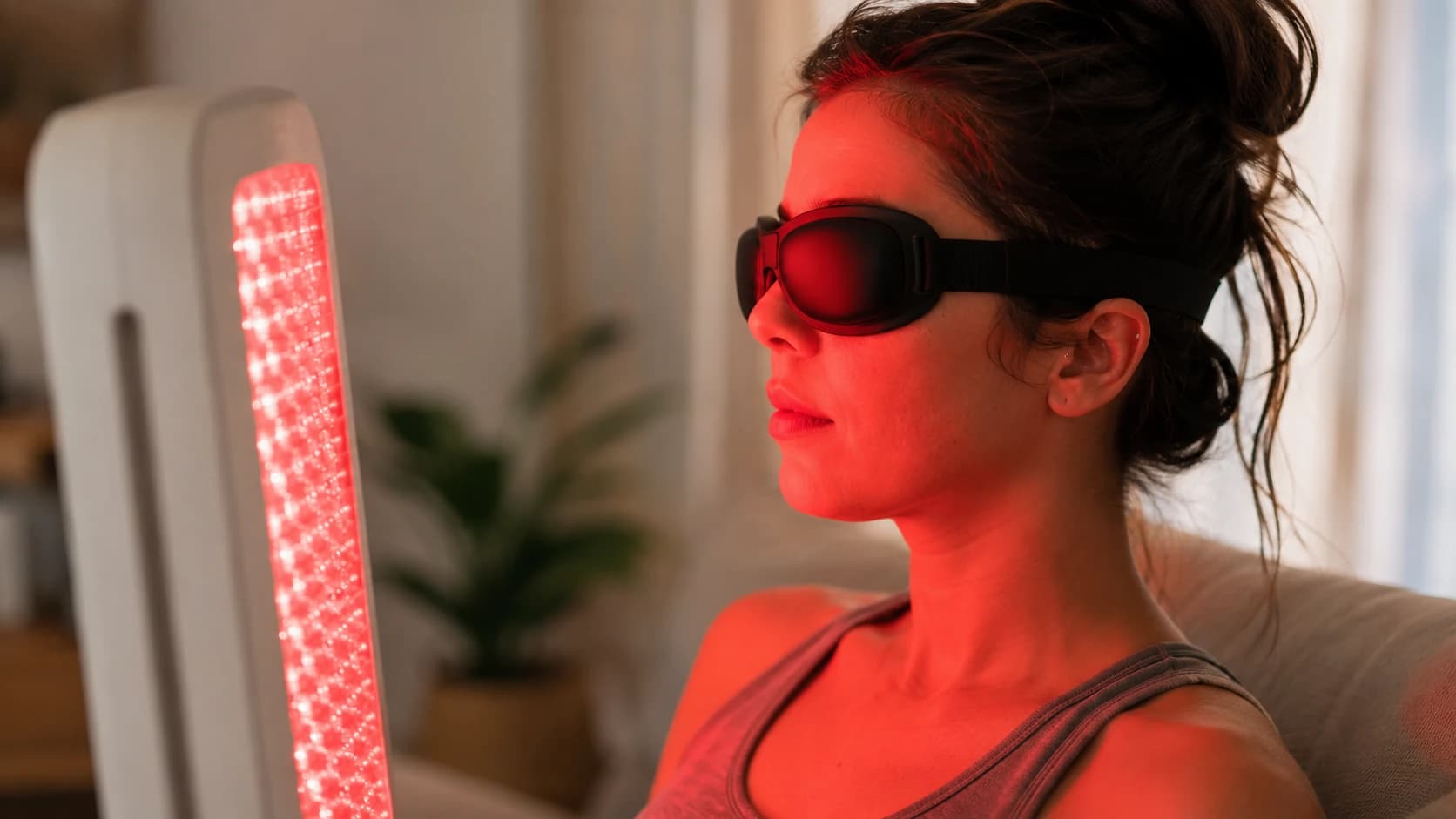
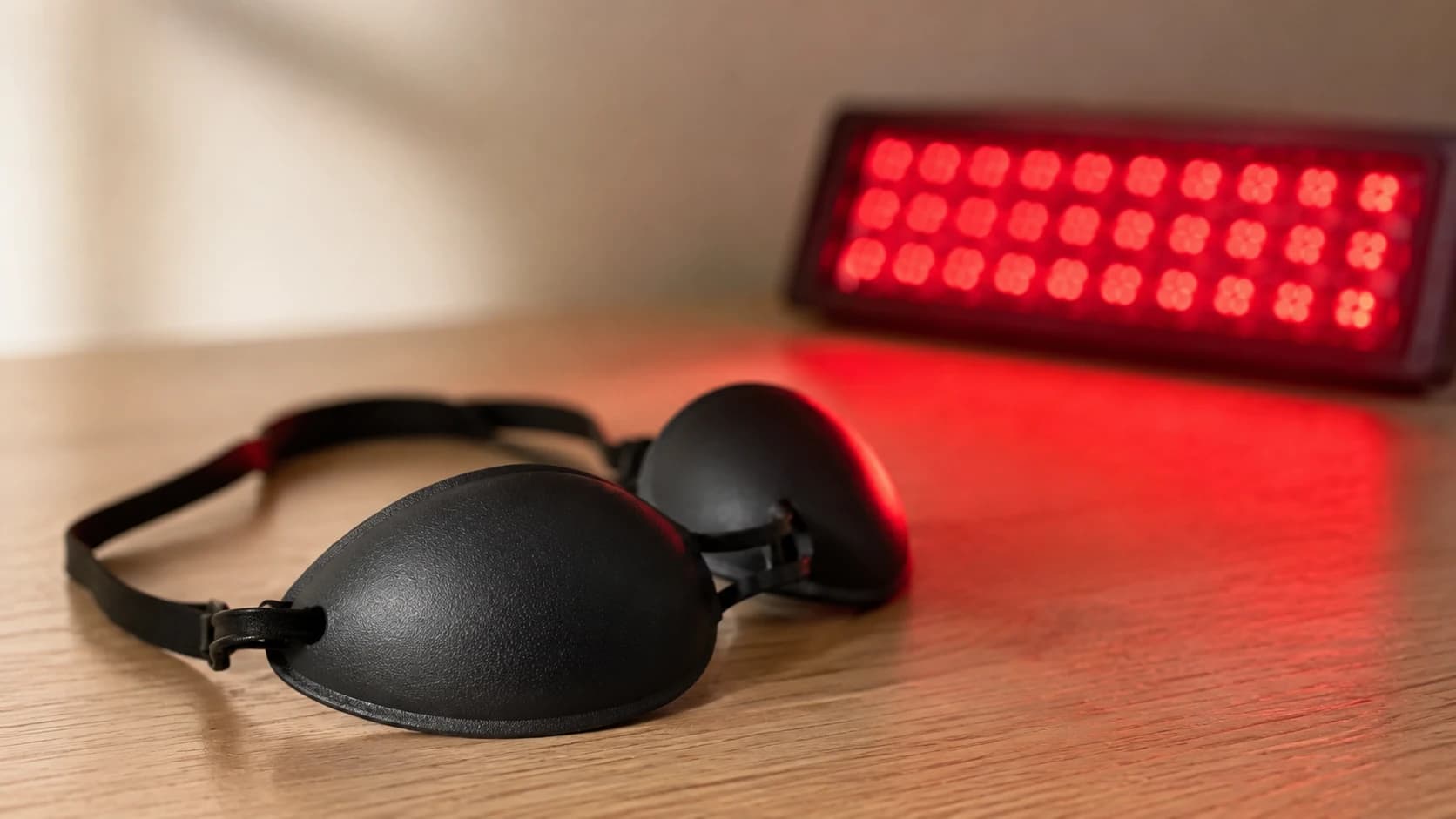
- The authors' own recommendation was to use red or infrared light with longer wavelengths for retinal safety, and to ensure the eyes are covered during LED face mask use.
That last point is the opposite of how the case is usually deployed. It is not evidence that red light damages eyes; it is a documented reason to take eye coverage seriously with any LED mask, and a reason to be more careful with blue modes than red ones. If your mask has a blue setting for acne, that is the setting to be strict about.
The realistic "danger": dosing past the peak
The most likely way to get less out of red light therapy is to try to get more out of it.
Photobiomodulation follows a biphasic dose response. Too little light does nothing; an intermediate dose produces the effect; past that point the effect shrinks, disappears and can reverse. Huang and colleagues documented the pattern across models — cultured fibroblasts peaked at 2.5 J/cm² and were damaged at 10 J/cm², and in a traumatic brain injury model 36 J/cm² was effective while 360 J/cm² made the benefit "totally disappear" and worsened early outcomes (Huang et al., 2011).
For a home user, this rarely means injury. It means running 30-minute sessions instead of 10-minute ones and quietly getting a worse result while assuming you are being thorough. The practical fix is in how often you should use red light therapy.
Common fears, checked against the evidence
| Concern | What the record supports |
|---|---|
| Skin cancer / DNA damage | Red and near-infrared light is not ultraviolet, and the 2025 JAAD expert consensus concluded red light PBM does not cause DNA damage |
| Burns | Photobiomodulation is defined as non-thermal. A device that gets genuinely hot is operating outside that definition — treat heat as a fault, not a feature |
| Eye damage from red light | The documented consumer-mask retinopathy case involved a mask emitting blue, red and infrared together, worn with the eyes open; the authors attribute the lesion to the blue component. Red light was present and was not implicated, but it was not tested in isolation. Eye protection is the sensible default with any LED device |
| Headache or fatigue after sessions | Reported in the neck-pain trials, mostly mild, and not clearly separated from placebo in most included studies |
| Redness after a session | Commonly described anecdotally; we found no controlled trial quantifying its frequency in home users, so we cannot put a number on it |
That last row is deliberate. Transient flushing is one of the most frequently mentioned effects online and one of the least documented in the literature. We could not verify a reliable incidence figure, so we are not inventing one.
Skin tone: the one place the wavelength choice matters
This is missing from most safety pages on this topic, so it is worth stating plainly.
Visible light — not just UV — can drive pigmentation, and the effect is not the same across skin tones. A 2020 review in the International Journal of Cosmetic Science (Campiche et al., 2020) states that "it is well established that irradiation with blue light causes hyperpigmentation in skin", and reports that visible-light-induced pigmentation was seen in Fitzpatrick phototypes IV to VI but not in phototype II. Their own study found measurable hyperpigmentation in phototypes III and IV.
Two things follow, and only two:
- If you have a mid-to-deep skin tone and your device has a blue mode, that mode carries a real pigmentation risk for you that it does not carry for someone with very fair skin. If you have melasma or post-inflammatory hyperpigmentation, this is the setting to avoid or to discuss with a dermatologist.
- This finding is about blue light, not red. That same review does not address red light at all, and red and near-infrared wavelengths are more often studied as treatments for pigmentation than as causes of it. We are not going to extrapolate a red-light risk from a blue-light finding — but nor should a safety page stay silent on the one wavelength-and-skin-tone interaction that is well documented.
Where the evidence is genuinely thin
Three honest gaps, stated as gaps:
- Long-term home use. The trials above ran weeks to months. There is no substantial long-term safety dataset for someone using a consumer panel several times a week for years.
- Children and adolescents. The 2025 consensus scoped its safety statement to adult patients. That is not the same as a finding about children.
- Pregnancy. We found no controlled evidence establishing safety or harm. That absence is the reason pregnancy appears on precautionary lists — covered in the contraindications page.
Practical safety, in six lines
- Wear the eye protection supplied, and be strictest about it on blue settings.
- Do not stare into the diodes, even on red.
- Follow the manufacturer's time and distance; longer is not better.
- Stop and reassess if skin stays irritated after a session rather than settling.
- Do not treat over an undiagnosed or changing skin lesion — get it looked at first.
- If you take medication or have a light-sensitive condition, read who should not use red light therapy before your first session.
For the wider picture of what this technology does and doesn't do, start with our red light therapy overview and the honest pros and cons of the evidence.
Frequently Asked Questions (FAQ)
What are the side effects of red light therapy? Reported side effects are mostly mild. Cleveland Clinic states red light therapy appears safe and is not associated with side effects when used short-term and as directed, while noting that misuse can damage skin or unprotected eyes. In the largest neck-pain review, reported effects included tiredness, nausea, headache and increased pain, mostly mild — though half those trials did not report side-effect data at all.
Is red light therapy dangerous? Not on the current evidence, when used as directed by adults. The 2025 expert consensus in the Journal of the American Academy of Dermatology concluded that red light photobiomodulation does not cause DNA damage and is a safe non-invasive option for adult patients. The documented harms involve misuse, eye exposure and blue rather than red wavelengths.
Can red light therapy damage your eyes? The one well-documented human case of retinal injury from a consumer LED face mask involved a device emitting blue (460–470 nm), red (620–680 nm) and infrared (760–900 nm) simultaneously, worn with the eyes open. The authors attribute the photochemical lesion to the blue component and recommended red or infrared light of longer wavelength for retinal safety, while stressing that the eyes should be covered during LED mask use.
Can you overdo red light therapy? Yes, and the effect is not what people expect. Photobiomodulation follows a biphasic dose response — beyond an optimal dose the benefit shrinks and can reverse. In one brain injury model a 36 J/cm² dose was effective while 360 J/cm² made the benefit disappear entirely.
Does red light therapy cause cancer or skin damage? Red and near-infrared light is not ultraviolet, so it does not carry the UV mechanism behind skin cancer. The 2025 JAAD expert consensus specifically concluded that red light photobiomodulation does not cause DNA damage.
Medical disclaimer: This article is for informational purposes only. Always consult a qualified healthcare provider before making changes to your health routine.
Sources
-
Cleveland Clinic. Red Light Therapy — patient education article. https://my.clevelandclinic.org/health/articles/22114-red-light-therapy
-
Maghfour J, et al. Evidence-based consensus on the clinical application of photobiomodulation. Journal of the American Academy of Dermatology, 2025 — journal abstract. https://www.jaad.org/article/S0190-9622(25)00659-0/abstract
-
Kim TG, Chung J, Han J, Jin KH, Shin JH, Moon SW. Photochemical retinopathy induced by blue light emitted from a light-emitting diode face mask. Medicine (Baltimore), 2020 — PubMed Central. https://pmc.ncbi.nlm.nih.gov/articles/PMC7302677/
-
Chow RT, Johnson MI, Lopes-Martins RA, Bjordal JM. Efficacy of low-level laser therapy in the management of neck pain. The Lancet, 2009 — DARE quality-assessed abstract, NCBI Bookshelf. https://www.ncbi.nlm.nih.gov/books/NBK78464/
-
Brosseau L, et al. Low level laser therapy (Classes I, II and III) for treating rheumatoid arthritis. Cochrane Database of Systematic Reviews, 2005. https://www.cochrane.org/evidence/CD002049_low-level-laser-therapy-rheumatoid-arthritis
-
Yoon JS, Ku WY, Lee JH, Ahn HC. Low-level light therapy using a helmet-type device for the treatment of androgenetic alopecia. Medicine (Baltimore), 2020 — PubMed Central. https://pmc.ncbi.nlm.nih.gov/articles/PMC7373546/
-
Huang YY, Sharma SK, Carroll J, Hamblin MR. Biphasic dose response in low level light therapy — an update. Dose-Response, 2011 — PubMed Central. https://pmc.ncbi.nlm.nih.gov/articles/PMC3315174/
-
Campiche R, et al. Pigmentation effects of blue light irradiation on skin and how to protect against them. International Journal of Cosmetic Science, 2020 — PubMed Central. https://pmc.ncbi.nlm.nih.gov/articles/PMC7496068/
All sources accessed 9 August 2026.

Marcus Thorne
A wellness tools researcher who would rather cite a case report than a rumour.