Quick answer: Red light therapy works by delivering red and near-infrared light at power levels too low to heat tissue, where it is absorbed inside the mitochondria and changes how the cell produces energy and signals. Whether anything useful comes of that depends almost entirely on two variables most marketing skips: wavelength and dose.
That a mechanism exists is not seriously disputed. Exactly which molecule absorbs the light first still is — and separately, how much of any laboratory effect survives the trip to a home device is where most disappointment with this category comes from. Both are covered below.
The definition that rules things out
A 2024 CME review in the Journal of the American Academy of Dermatology defines photobiomodulation as the use of red light at roughly 620–700 nm and near-infrared light at roughly 700–1440 nm at non-thermal power levels (JAAD CME, 2024).
That single sentence settles three arguments:
- Heat is not the mechanism. A device that warms your skin may feel therapeutic, but warming is not what the photobiomodulation literature is describing. If the sensation is what you are paying for, you are buying an infrared heat lamp.
- UV is not involved. These wavelengths sit far from ultraviolet. There is no tanning and no UV-mediated DNA damage pathway.
- Power level is part of the definition. "Non-thermal" is not a safety footnote here. It is one of the defining conditions.
The step that actually happens in the cell
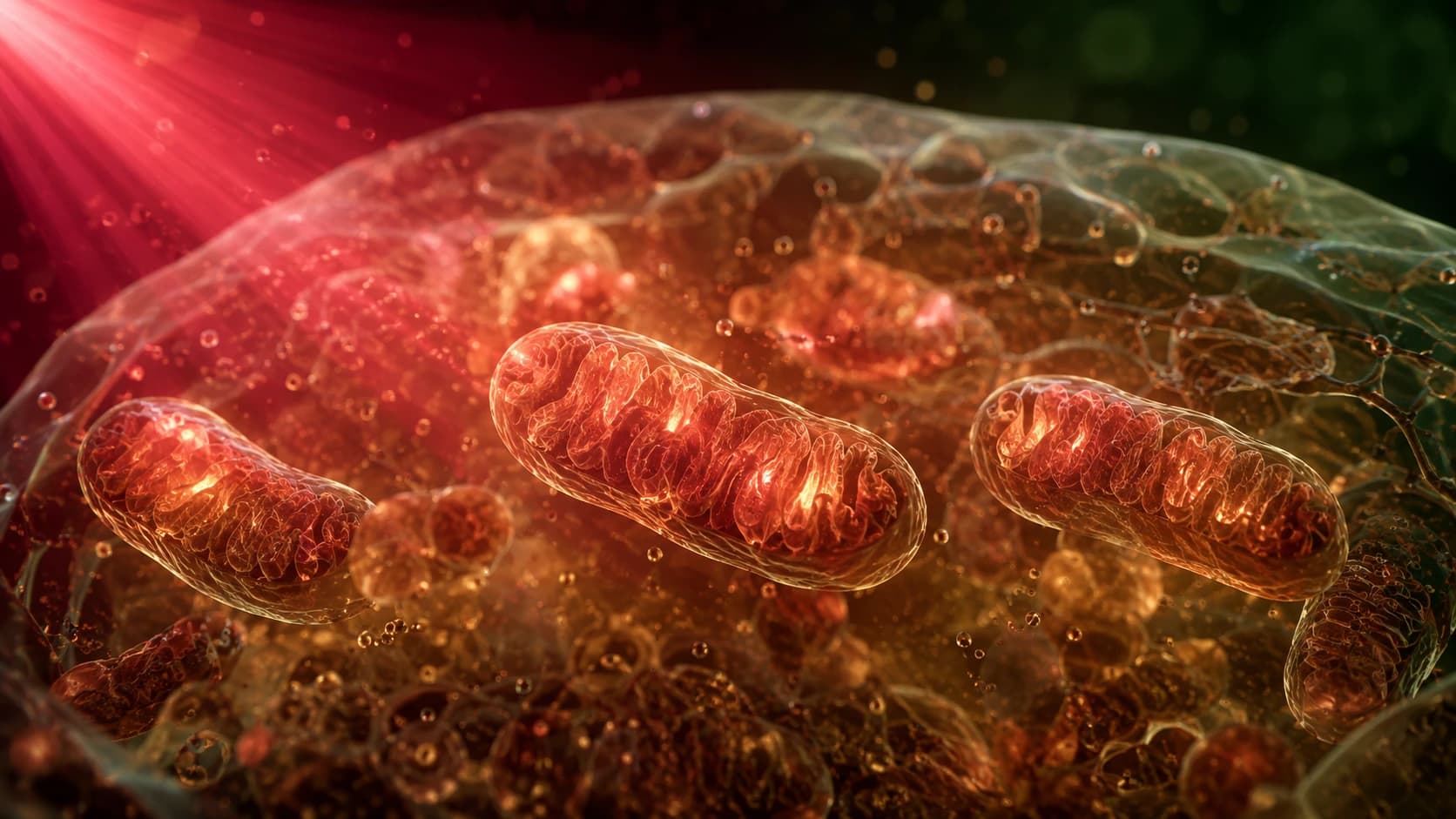
Red and near-infrared photons pass into tissue and are absorbed by chromophores — molecules that accept light energy. The most-studied candidate is cytochrome c oxidase (CCO), Complex IV of the mitochondrial respiratory chain.
One caveat belongs here rather than in a footnote: CCO is the leading proposed photoacceptor, not a settled one. Work published since has reported photobiomodulation effects in cell systems that do not depend on cytochrome c oxidase, and alternative candidates — including light-sensitive ion channels and structured water at membrane interfaces — remain under investigation. Anyone telling you the mechanism is fully nailed down is overstating it.
Hamblin's work on mitochondrial redox signalling describes the downstream consequences: changes in ATP production, shifts in reactive oxygen species used as signalling molecules, and knock-on effects on gene transcription (Hamblin, 2018). In skin specifically, reviews describe the practical version of this — fibroblasts nudged toward producing more collagen and fewer of the enzymes that degrade it (Avci et al., 2013).
Here is the part worth internalising: a mechanism is not an outcome. "Light is absorbed by mitochondria, mitochondria make energy, therefore this treats X" is a chain of reasoning, not a finding. Which endpoints have actually been measured in people is a separate question, answered in does red light therapy work.
Wavelength decides depth
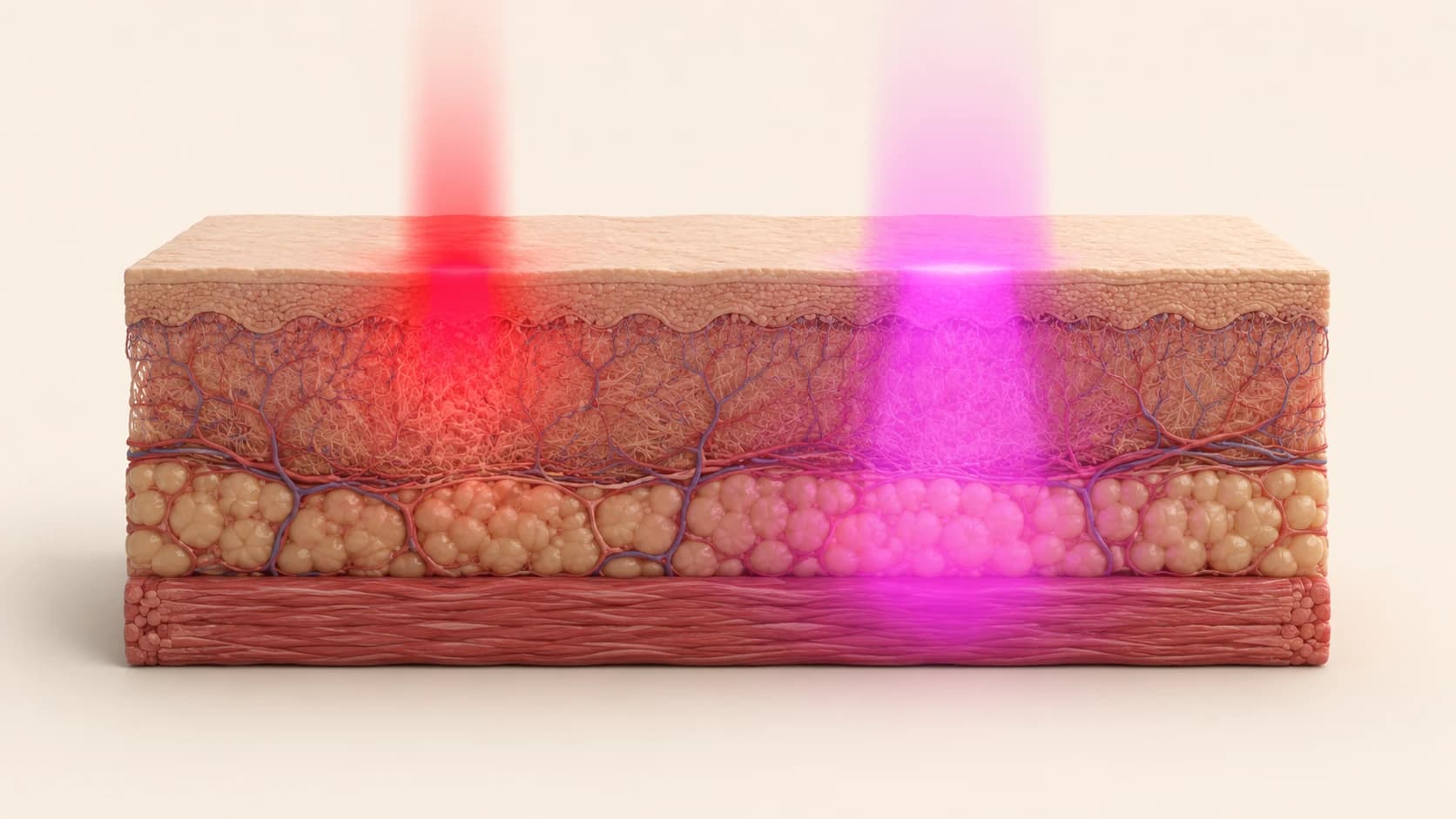
This is why nearly every panel on the market advertises two numbers.
Around 660 nm — visible red. Absorbed at and near the surface. This is the range that maps to skin concerns: texture, fine lines, complexion. It is also the range you can see, which is why red light devices glow red.
Around 850 nm — near-infrared. Penetrates further, toward muscle and joint tissue. It is largely invisible, which unnerves first-time users; a panel running only near-infrared can look almost off.
The practical consequence is that matching the wavelength to the target tissue is not a detail. A near-infrared-heavy panel aimed at fine lines is working at the wrong depth, and a surface-only red device aimed at a knee joint is doing very little for the joint. If you are choosing hardware around this, red light therapy panels covers what the specs on a box do and don't tell you.
Dose decides whether anything happens
This is the single most misunderstood part of the field, and it runs against every instinct a consumer has.
Photobiomodulation follows a biphasic dose response, sometimes called the Arndt–Schulz curve: too little light does nothing, an intermediate dose produces the effect, and past that point the effect shrinks, disappears and can reverse. Huang and colleagues catalogued this across models (Huang et al., 2011):
| Model | Dose that worked | Dose that didn't |
|---|---|---|
| Cultured fibroblasts | Peak proliferation at 2.5 J/cm² | Cell damage at 10 J/cm² |
| Mouse cortical neurons | Optimal ATP response around 3 J/cm² | Declining response at higher fluences |
| Traumatic brain injury model | 36 J/cm² at 50 mW/cm² effective | 360 J/cm² at 500 mW/cm² — benefit "totally disappeared" |
The authors' own summary is blunt: more does not necessarily mean better. That is why the field renamed itself away from "low-level laser therapy" — the same wavelength can stimulate or inhibit depending only on how much of it you deliver.
For muscle tissue specifically, the doses associated with benefit in positive trials clustered in the 60–300 joule range per session for large muscle groups (Leal-Junior et al.). Translating any of that into "how many minutes, how far away, how many days a week" is the job of how often you should use red light therapy.
Why the laboratory result shrinks on your kitchen counter
Three losses stack up between a published trial and a home session.
Delivered power. Most positive trials used clinical laser devices. A 2024 review tabulates the difference in reach: laser systems are described as penetrating up to roughly 50 mm, LED devices as superficial at roughly 2–10 mm (Lawrence & Sorra, 2024). Worth being precise about why, because this is the single most repeated error in consumer writing on the topic: the gap is a matter of output power, irradiance and beam collimation — not of coherence. Lasers are coherent and LEDs are not, but that property is not what drives penetration depth, and the review lists the two as separate device characteristics rather than deriving one from the other. Cleveland Clinic makes the practical point for consumers: at-home devices "may be less powerful than devices that may be used by dermatologists or other trained skin professionals" (Cleveland Clinic).
Distance. Irradiance falls off sharply with distance from the emitter. A figure measured at 3 inches is not the figure you get at 12 inches, and manufacturer specifications rarely state the measurement distance prominently.
Verification. Consumer irradiance claims are typically manufacturer-supplied and not independently confirmed by a third-party spectroradiometer. This is an industry-wide gap, not a single brand's failing.
None of that makes home devices pointless. It does mean the honest translation of a clinical trial to a home panel is "a fraction of a modest effect", which is a very different sentence from the one on the box.
Does the mechanism explain the whole product category?
No — and noticing where it stops is the most useful thing you can take from this page. The mitochondrial mechanism supports plausibility for tissue-level effects at the site being treated: skin, a hair follicle, a superficial joint. It does not, by itself, support systemic claims about metabolism, fat or detoxification. Cleveland Clinic states there is no scientific evidence for red light therapy in weight loss, cancer, cellulite removal or mental health conditions — the mood claim being a straight confusion with bright-light therapy for depression, which is a different technology — and we take the first of those apart in red light therapy for weight loss.
For the full graded map of what the light has and hasn't been shown to do, start at our the graded evidence map.
Before you use one: the safety basics
This page is about mechanism, but two mechanical facts on it have direct safety consequences, so they belong here rather than only on the safety page.
- Near-infrared is invisible, and that is a trap. A panel running only its 850 nm channel can look almost off. It is still delivering energy, and "it doesn't look like it's doing anything" is not a reason to move closer or extend the session. Judge dose by the manufacturer's stated distance and time, never by brightness.
- Protect your eyes. Cleveland Clinic advises shielding the eyes and following the directions supplied, and notes that misuse — too often, or against instructions — creates a chance of harm to skin or unprotected eyes (Cleveland Clinic). Be strictest about this on any device with a blue mode.
Photosensitising medication, pregnancy, active skin cancer and a handful of other situations warrant a conversation with a clinician before starting; who should not use red light therapy sets out which of those are documented and which are merely repeated, and red light therapy side effects covers what has actually been reported.
Frequently Asked Questions (FAQ)
How does red light therapy work in the body? Red and near-infrared light is absorbed inside the mitochondria, most likely by cytochrome c oxidase, the fourth complex of the respiratory chain. Reviews describe the downstream consequences as changes in ATP production, altered reactive-oxygen-species signalling and shifts in gene transcription. Note the direction is dose-dependent rather than simply upward: the same wavelength can raise or lower ATP depending on how much light is delivered. The light is not heating the tissue — photobiomodulation is defined as non-thermal.
What wavelength is best for red light therapy? It depends on depth. Red light around 660 nm is absorbed at and near the skin surface, so it suits skin concerns. Near-infrared around 850 nm penetrates further toward muscle and joint tissue. Photobiomodulation as a field is defined across roughly 620–700 nm red and 700–1440 nm near-infrared.
Is red light therapy the same as infrared heat? No. An infrared heat lamp works by warming tissue. Photobiomodulation is defined as using light at non-thermal power levels, so heating is not the mechanism. If a device feels hot, that heat is not what the research is describing.
Does more light mean better results? No — the opposite, past a point. Photobiomodulation follows a biphasic dose response. In cultured fibroblasts, proliferation peaked at 2.5 J/cm² and cells were damaged at 10 J/cm². In one brain injury model, 36 J/cm² was effective while 360 J/cm² made the benefit disappear entirely.
Why do clinical devices outperform home devices? Most positive trials used clinical laser systems, which deliver far more power to a smaller area than a consumer LED panel. A 2024 review puts laser penetration at up to roughly 50 mm against roughly 2–10 mm for LED devices. The difference comes from output power, irradiance and beam collimation — not from laser light being coherent, which is a common misconception.
Medical disclaimer: This article is for informational purposes only. Always consult a qualified healthcare provider before making changes to your health routine.
Sources
- Photobiomodulation CME part I. Journal of the American Academy of Dermatology, 2024 — journal abstract. https://www.jaad.org/article/S0190-9622(24)00186-5/abstract
- Hamblin MR. Mechanisms and mitochondrial redox signaling in photobiomodulation. Photochemistry and Photobiology, 2018 — PubMed. https://pubmed.ncbi.nlm.nih.gov/29164625/
- Avci P, et al. Low-level laser (light) therapy (LLLT) in skin. Seminars in Cutaneous Medicine and Surgery, 2013 — PubMed Central. https://pmc.ncbi.nlm.nih.gov/articles/PMC4126803/
- Huang YY, Sharma SK, Carroll J, Hamblin MR. Biphasic dose response in low level light therapy — an update. Dose-Response, 2011 — PubMed Central. https://pmc.ncbi.nlm.nih.gov/articles/PMC3315174/
- Leal-Junior EC, Lopes-Martins RA, Bjordal JM. Clinical and scientific recommendations for photobiomodulation dosing in muscle tissue — PubMed Central. https://pmc.ncbi.nlm.nih.gov/articles/PMC6546960/
- Lawrence J, Sorra K. Photobiomodulation as medicine. Journal of Functional Morphology and Kinesiology, 2024 — PubMed Central. https://pmc.ncbi.nlm.nih.gov/articles/PMC11503318/
- Cleveland Clinic. Red Light Therapy — patient education article. https://my.clevelandclinic.org/health/articles/22114-red-light-therapy
All sources accessed 8 August 2026.

Marcus Thorne
A wellness tools researcher who thinks the mechanism is more interesting than the marketing.