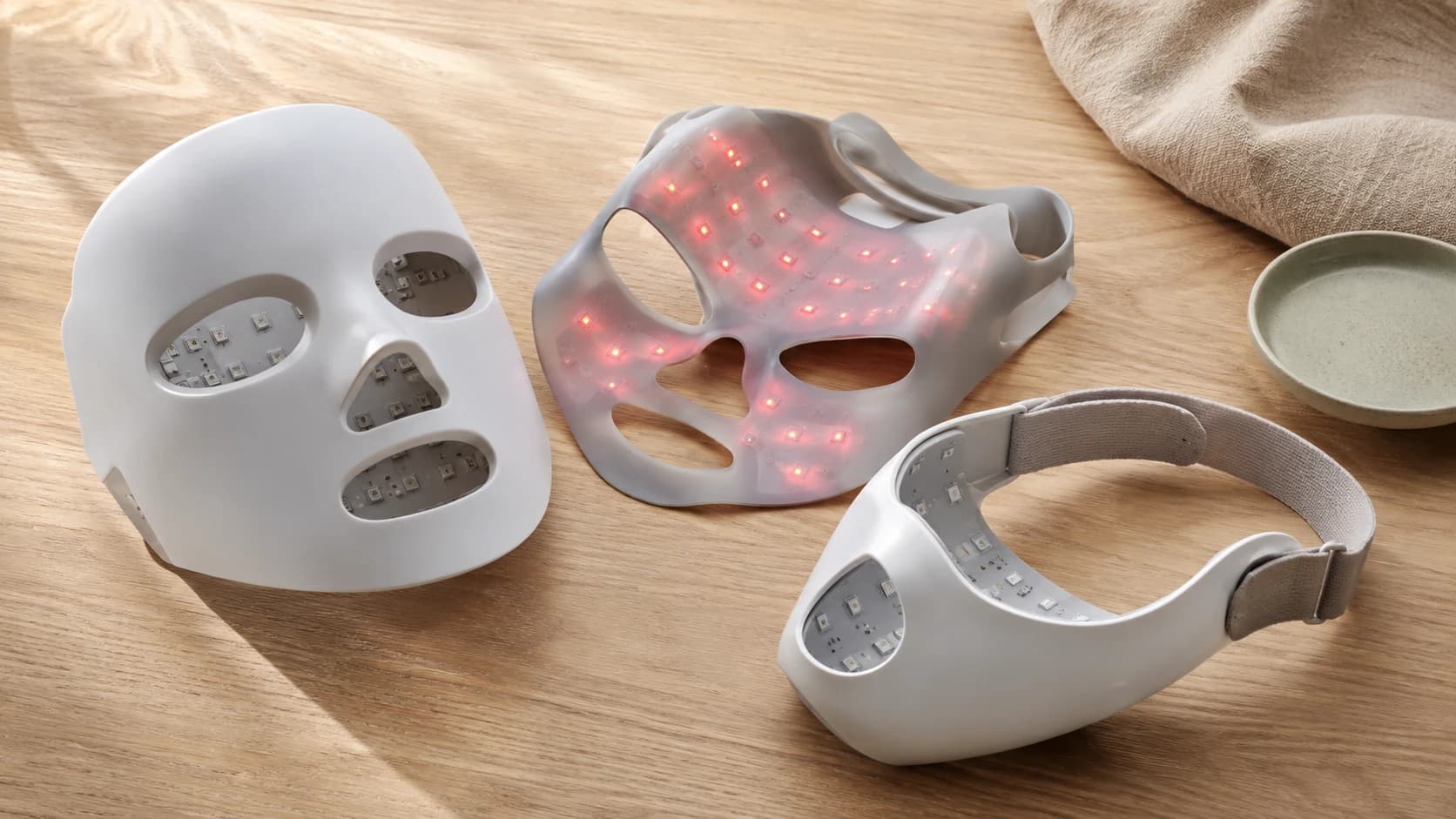
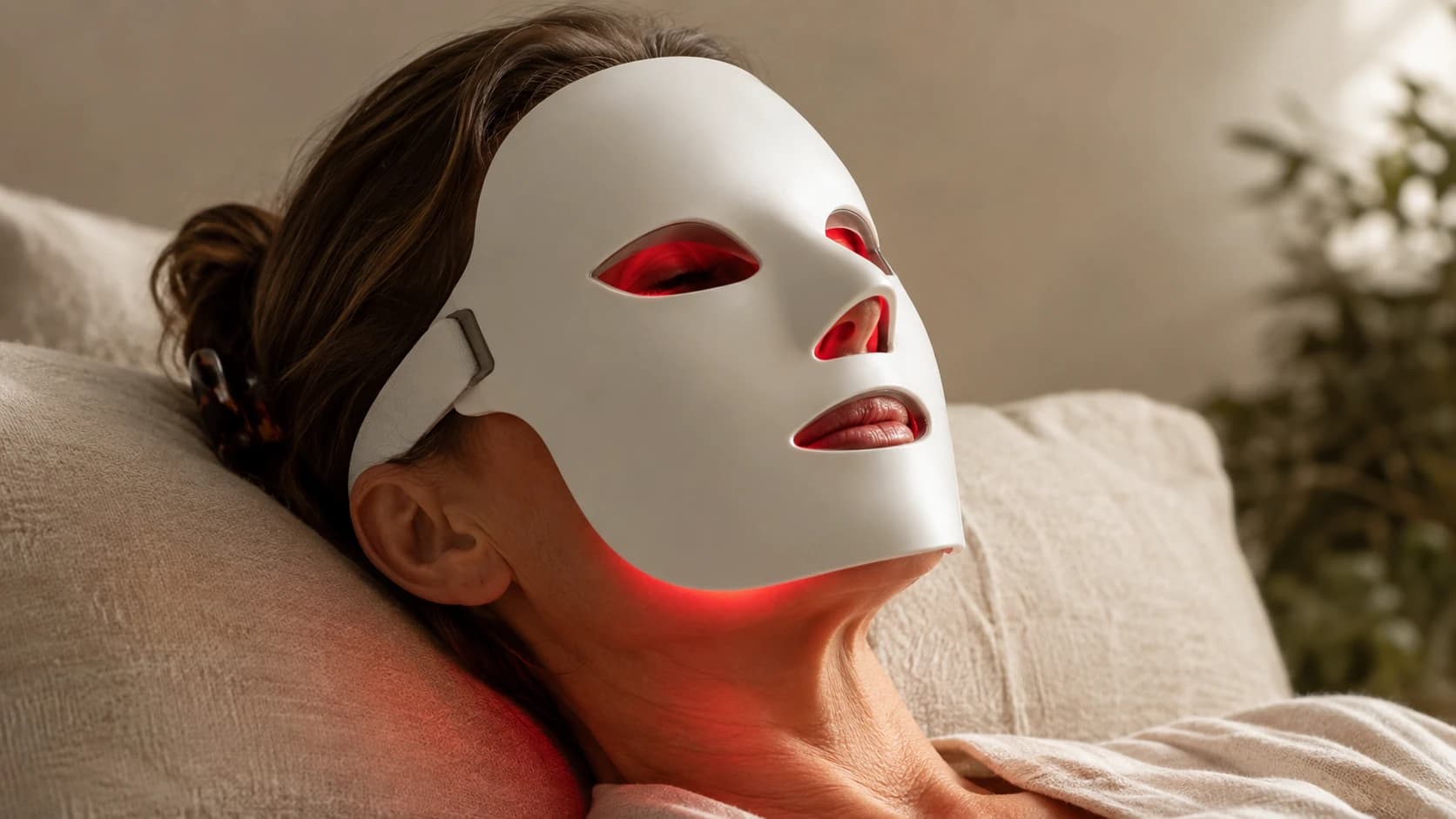
Quick answer: A red light therapy mask delivers the same wavelengths as a panel, in a format that covers the face evenly and hands-free. Its real advantage is not power — it is adherence. The evidence that matters is for the light, not for the mask shape, and the "FDA-cleared" label on the box certifies less than most buyers assume.
What a mask actually is
Strip away the design and a red light therapy mask is an array of LEDs held at a fixed distance from your face, usually running red light around 630–660 nm and often near-infrared around 830–850 nm. Some add blue for acne. The wavelengths, the mechanism and the dose behaviour are identical to any other photobiomodulation device — the whole of the underlying mechanism applies unchanged.
What differs is delivery geometry, and that turns out to matter more than it sounds.
Red light therapy mask benefits, honestly stated
The skin benefit belongs to the light. A randomised controlled trial of 136 people found that regular red and near-infrared treatment improved skin complexion, reduced measured skin roughness and increased intradermal collagen density against an untreated control (Wunsch & Matuschka, 2014). A broader review reported that most patients improved by at least one photoaging grade after a course of LED treatment (Avci et al., 2013). That is the ceiling: real, measurable, gradual.
The format benefits belong to the mask. These are genuine and under-discussed:
- Even coverage. Every zone gets treated simultaneously, at a consistent distance. Working a small handheld wand across a face by hand does not achieve that.
- Fixed geometry. Irradiance falls off sharply with distance. A mask that sits on your face removes the single biggest source of session-to-session variation.
- Hands-free, so you keep doing it. Every trial result in this field depends on months of consistency. A ten-minute treatment you can do while doing something else is a treatment you will still be doing in week twelve.
What a mask does not do better. It is not more powerful than a panel, it does not reach deeper, and it cannot treat anything below the jawline. If your goal is a knee or a lower back, see red light therapy panels.
And the caveat that applies to the whole category: most of the strongest trials used clinical laser devices, and a 2024 review notes LED light in home devices does not penetrate the way clinical laser light does (Lawrence & Sorra, 2024). Cleveland Clinic's consumer-facing version: at-home devices "may be less powerful than devices that may be used by dermatologists" (Cleveland Clinic).
What "FDA-cleared" actually certifies
This is the most consequential thing to understand before buying, and it takes two minutes to verify yourself.
Nearly every LED face mask sold in the United States is cleared under a Class II product code the FDA labels OHS — "Light Based Over The Counter Wrinkle Reduction", regulation 21 CFR 878.4810. As of the FDA's early-August 2026 data release, there were 158 clearances on file under that code. Acne-mode devices are typically cleared under OLP, defined for over-the-counter treatment of mild to moderate acne vulgaris.
Three consequences follow:
- Cleared is not approved. A 510(k) clearance means the manufacturer demonstrated substantial equivalence to a device already legally marketed. It is not a finding that the device produces a particular result in you.
- The claim is narrow. OHS covers wrinkle reduction. A mask cleared under OHS has not been cleared for anything else it may be advertised as doing.
- You can check it. Every clearance is public in the FDA's 510(k) database, searchable by device name or applicant.
One thing that will confuse you when you search: many masks are cleared under the contract manufacturer's name, not the brand on the box. The CurrentBody Skin LED Light Therapy Mask Series 2 was cleared in June 2025 under Shenzhen Kaiyan Medical Equipment Co., for instance. So not finding your brand by name is not proof of anything — it means you need to search the manufacturer too, or ask the seller for the K-number.
The one safety point specific to masks
A mask sits directly over your eyes. That makes eye protection a design question rather than an optional accessory.
The clearest documented case: a 37-year-old woman developed photochemical retinopathy after using an LED face mask for 20 minutes every two days for a month with her eyes open during ordinary activity. Imaging showed retinal pigment epithelium destruction; treatment partially resolved it (Kim et al., 2020).
The detail that matters: that was blue light at 460–470 nm, and the authors' own recommendation was to prefer red or infrared light with longer wavelengths for retinal safety and to ensure the eyes are covered during LED face mask use. If your mask has a blue acne mode, that is the mode to be strict about. Full detail in our side-effects page.
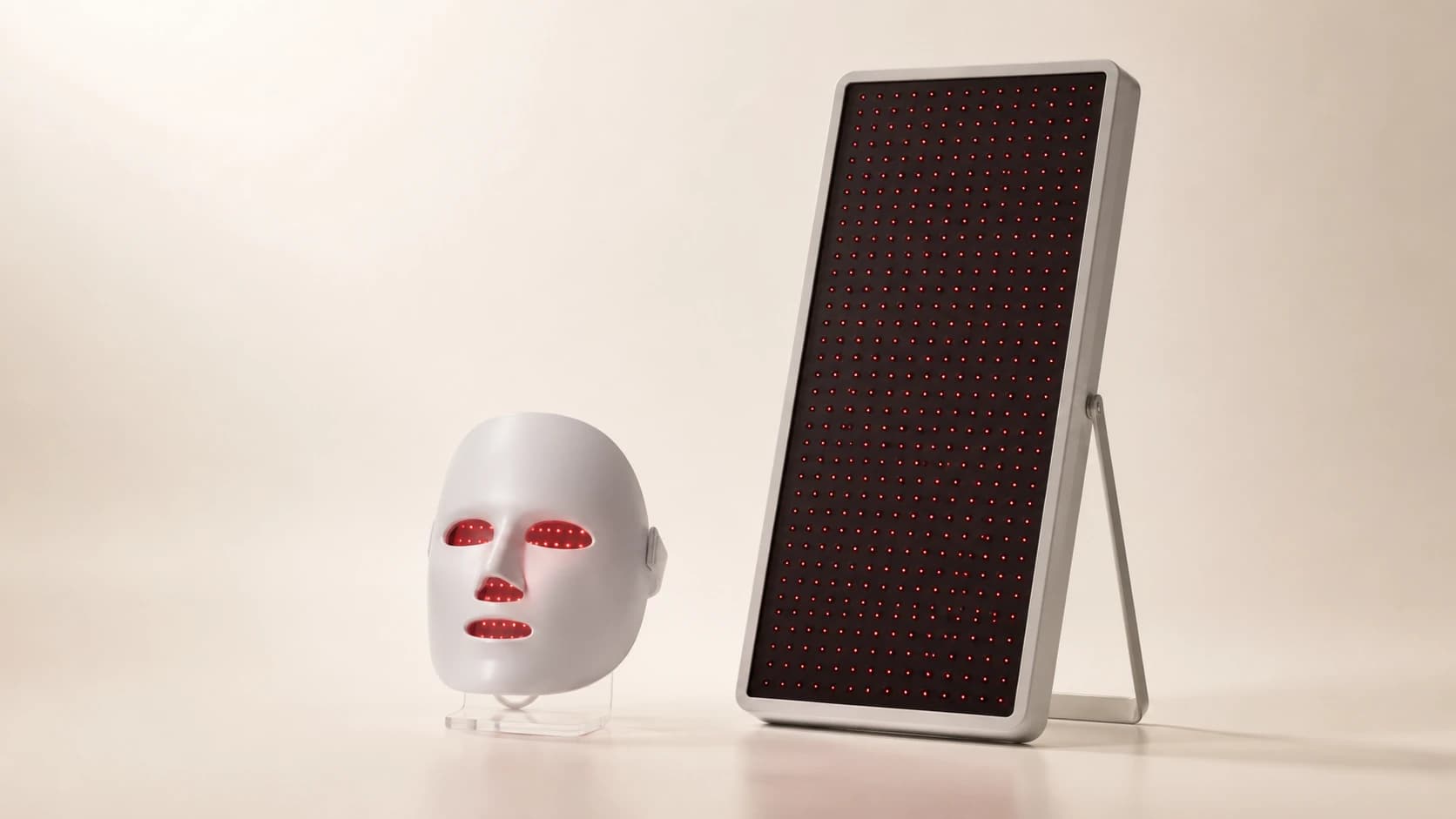
Mask versus panel, decided by body part
| Mask | Panel | |
|---|---|---|
| Best for | Face, neck with a matching accessory | Back, legs, shoulders, joints, whole body |
| Coverage | Even and contoured, all zones at once | Broad but flat; you reposition for each area |
| Distance control | Fixed by the device sitting on your face | Depends on you measuring and repeating it |
| Session length | Typically around 10 minutes | Varies widely by device and target |
| Hands-free | Yes | Usually, once mounted or on a stand |
| Typical spend | Roughly $100–$400 | Roughly $60–$600+ depending on size |
The decision is not really mask-versus-panel. It is what am I treating. If the honest answer is "my face", a mask wins on adherence alone. If it is anything else, the mask cannot reach it.
What to look for on a spec sheet
- Stated wavelengths, in nanometres. "Red light" with no number is not a specification. Look for around 630–660 nm and, if deeper effects are claimed, near-infrared around 830–850 nm.
- Whether there is a blue mode, and whether the eye protection is adequate for it.
- A K-number, or a manufacturer name you can search. Any seller making an FDA claim should be able to give you one.
- Session length and recommended frequency from the manufacturer — and see how often to use red light therapy, because more is genuinely not better.
- Fit. A rigid mask that does not sit against your face has just reintroduced the distance problem it was supposed to solve.
For specific current models compared against these criteria, see the best red light therapy mask guide. For the broader evidence picture, start at our the evidence behind the light itself.
Frequently Asked Questions (FAQ)
What are the benefits of a red light therapy mask? The realistic benefit is gradual improvement in skin texture, fine lines and complexion. A randomised controlled trial of 136 people found red and near-infrared light improved complexion, reduced measured skin roughness and increased intradermal collagen density. The mask format's own advantage is even, hands-free coverage of the whole face, which makes consistency easier.
Do red light therapy masks actually work? For skin aging, the underlying wavelengths have controlled trial support, though most of the strongest trials used clinical devices rather than consumer masks. Expect a modest, gradual change over eight to twelve weeks of consistent use, not a transformation.
What does FDA-cleared mean on a red light mask? Nearly all of these masks are cleared under a Class II 510(k) product code the FDA calls "Light Based Over The Counter Wrinkle Reduction". Clearance means the manufacturer showed substantial equivalence to a device already on the market. It is not FDA approval and it is not a finding that the device will work for you.
Is a mask better than a panel? For the face specifically, a mask gives even, hands-free coverage and is far easier to be consistent with. A panel covers much larger areas — back, legs, joints — that a mask physically cannot reach. The right answer follows the body part, not the price.
Do red light masks need eye protection? Use whatever protection the manufacturer supplies, and be strictest on blue modes. The one well-documented retinal injury from a consumer LED mask involved blue light at 460 to 470 nm used with the eyes open; the authors recommended covering the eyes during LED face mask use.
Medical disclaimer: This article is for informational purposes only. Always consult a qualified healthcare provider before making changes to your health routine.
Sources
- Wunsch A, Matuschka K. A controlled trial to determine the efficacy of red and near-infrared light treatment. Photomedicine and Laser Surgery, 2014 — PubMed. https://pubmed.ncbi.nlm.nih.gov/24286286/
- Avci P, et al. Low-level laser (light) therapy (LLLT) in skin. Seminars in Cutaneous Medicine and Surgery, 2013 — PubMed Central. https://pmc.ncbi.nlm.nih.gov/articles/PMC4126803/
- US Food and Drug Administration. 510(k) Premarket Notification database — product codes OHS and OLP. https://www.accessdata.fda.gov/scripts/cdrh/cfdocs/cfpmn/pmn.cfm
- Kim TG, Chung J, Han J, Jin KH, Shin JH, Moon SW. Photochemical retinopathy induced by blue light emitted from a light-emitting diode face mask. Medicine (Baltimore), 2020 — PubMed Central. https://pmc.ncbi.nlm.nih.gov/articles/PMC7302677/
- Lawrence J, Sorra K. Photobiomodulation as medicine. Journal of Functional Morphology and Kinesiology, 2024 — PubMed Central. https://pmc.ncbi.nlm.nih.gov/articles/PMC11503318/
- Cleveland Clinic. Red Light Therapy — patient education article. https://my.clevelandclinic.org/health/articles/22114-red-light-therapy
- Photobiomodulation CME part I. Journal of the American Academy of Dermatology, 2024 — journal abstract. https://www.jaad.org/article/S0190-9622(24)00186-5/abstract
All sources accessed 10 August 2026. FDA clearance counts reflect the openFDA data release of 3 August 2026.

Marcus Thorne
A wellness tools researcher who reads the 510(k) record before the product page.