Quick answer: Pattern hair loss is the strongest consumer-facing case in the whole red light therapy category — the only one that is both endorsed by a formal expert consensus and demonstrated against a sham device in a randomised trial. The result is real and measurable. It is also specific to one type of hair loss, requires a scalp-specific device, and takes about four months.
Why this claim is different from the others
Most red light therapy claims rest on trials with an untreated control group, where participants know whether they are being treated. Hair loss has something better: a sham device.
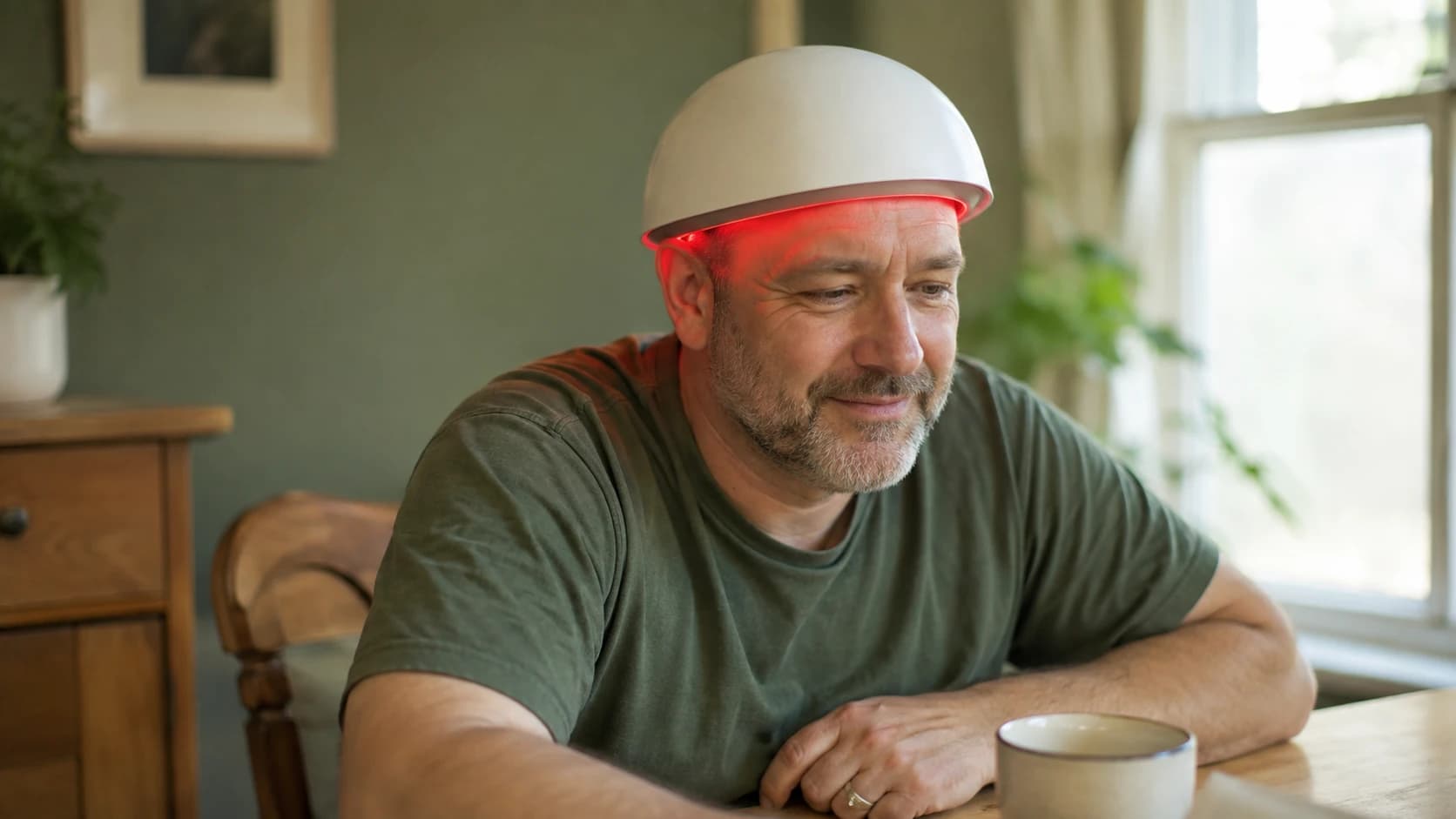
In a 16-week multicentre, randomised, double-blind trial, 59 adults aged 19–65 used either a real helmet — 21 laser diodes and 30 LEDs at 655 ± 5 nm, roughly 2.36 mW/cm² — or an identical-looking helmet that did nothing, for 25 minutes every other day (Yoon et al., 2020).
| Outcome at 16 weeks | Treated | Sham |
|---|---|---|
| Hair density | +41.90 hairs/cm² | +0.72 hairs/cm² |
| Hair thickness | +7.50 μm | −15.03 μm |
Both differences were significant at P < .001, and no adverse events occurred over the study.
The sham arm is what makes this persuasive. Everyone sat under a helmet; only one group's helmet was emitting. And the sham group's hair thickness kept declining, which is what pattern hair loss does when left alone.
A second, separately FDA-cleared device has reported a similar result. REVIAN RED (Photonmd, Inc.), an at-home dual-wavelength LED cap cleared under the same OAP product code as the devices in the table below, was tested in a randomised, double-blind, sham-controlled trial of 81 adults with androgenetic alopecia (39 on the active cap, 42 on a sham). Sessions were 10 minutes daily for up to 26 weeks. Among participants who used the device as directed, the company has reported a gain of roughly 21 more hairs/cm² than the sham group at 16 weeks. That result has not been published in an independent peer-reviewed journal — it has been shared through a manufacturer press release and covered by trade press, not verified through peer review the way Yoon's trial was. Treat it as a second, supportive data point from an FDA-cleared device, not as equal-weight confirmation.
Both trials enrolled men and women without reporting the result separately by sex, so neither confirms whether the effect size differs between them. Photobiomodulation specifically for female pattern hair loss has its own registered study protocol, combining it with microneedling (Fabbrocini et al., 2019) — as of this writing that is a published trial design, not a completed trial with results.
The expert-panel backing
Independently of any single trial, an international panel of 21 experts working from a systematic review and a two-round Delphi process listed androgenetic alopecia among the indications with sufficient evidence to support photobiomodulation (Maghfour et al., 2025). Very few consumer uses of this technology appear on that list. Hair does.
Two hair-specific professional bodies say something similar in their own patient education. The American Academy of Dermatology's hair-loss page lists low-level laser therapy among treatments "a few studies suggest" may help, and the International Society of Hair Restoration Surgery covers red light and LED therapy in its own patient-facing material (AAD; ISHRS).
What this evidence does not cover
The trial and the consensus are both about androgenetic alopecia — pattern hair loss, the gradual, genetically influenced thinning that follows a recognisable distribution. That specificity matters, because hair loss is not one condition:
- Alopecia areata is autoimmune and patchy. We found no comparable controlled evidence for photobiomodulation here.
- Telogen effluvium is diffuse shedding triggered by illness, stress, childbirth or nutritional deficiency, and it usually resolves when the trigger does.
- Scarring alopecias destroy the follicle. Once the follicle is gone, no light will bring it back.
- Hair loss from medical treatment follows its own course and belongs with the treating team.
- Post-hair-transplant use is heavily marketed, largely by hair-transplant clinics, as a way to speed healing or protect grafts. The AAD's own patient page lists this among the things "a few studies suggest" light therapy may help with, but we found no large-scale randomised trial establishing that it speeds graft survival or prevents shock loss after a transplant. The marketing volume around this claim is well ahead of the trial evidence behind it.
If you do not already know which of these you have, that assessment comes before any device purchase. A device aimed at the wrong diagnosis is money spent on the wrong problem, and in a scarring alopecia it is time lost that mattered.
The device category is separate — and checkable
Hair devices are not general red light devices, and the FDA treats them separately. Scalp lasers sit under product code OAP — "Laser, Comb, Hair" (21 CFR 890.5500, Class II), a distinct category from the OHS code covering over-the-counter wrinkle-reduction masks. The FDA's early-August 2026 data release lists 112 clearances under OAP.
Recent cleared examples, all publicly searchable in the FDA's 510(k) database:
| Device | Clearance | Cleared |
|---|---|---|
| CurrentBody Skin Dual Light Hair Growth Helmet (MZ-07) | K251017 | June 2025 |
| iRestore Elite (ID-510) | K222081 | October 2022 |
| Bosley Booster 128 / 162 Laser Cap | K240456 | May 2024 |
| LaserCap Family of Lasers 300, 224, 120, 80 | K203826 | March 2021 |
A 2022 systematic review and meta-analysis in the Journal of Clinical and Aesthetic Dermatology looked specifically at this device category: as of its January 2020 search cutoff it counted 32 FDA-approved home-use devices, and pooling seven double-blind randomised trials of them found a significant increase in hair density versus sham, across both comb- and helmet-type devices and in both sexes (Lueangarun et al., 2022).
Two practical consequences:
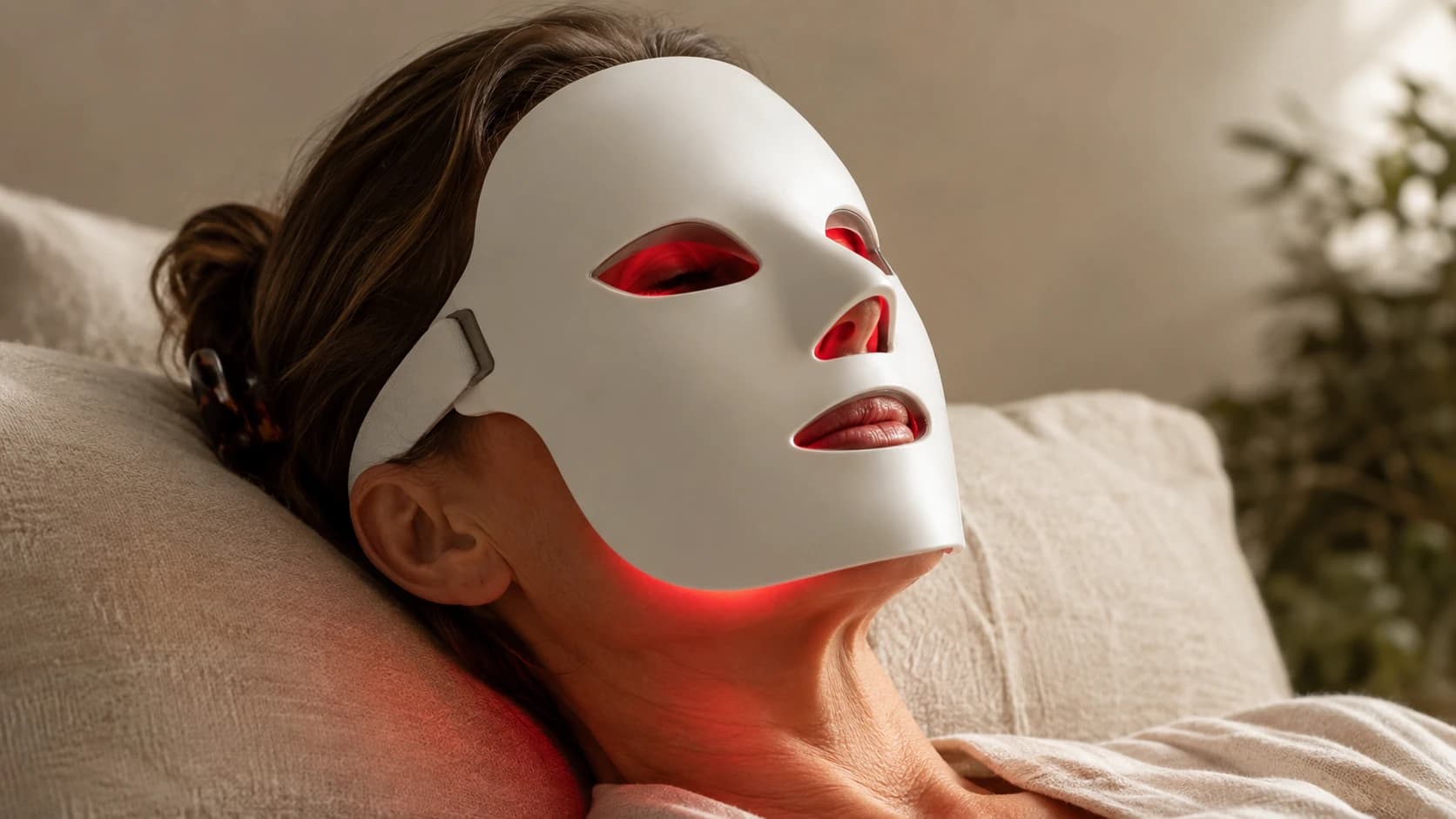
- A face mask or body panel is the wrong tool. Scalp devices are built to deliver light through hair to the skin beneath. Nothing about a facial mask's geometry does that.
- Cleared is not approved. A 510(k) clearance means substantial equivalence to an existing device, not a finding that it will regrow your hair. What it does tell you is that the device belongs to the category the trials studied.
What the mechanism is thought to be
The general mechanism applies here as everywhere: red and near-infrared light is absorbed in the mitochondria, altering cellular energy production and signalling (Hamblin, 2018). A 2013 review from Harvard Medical School's Wellman Center for Photomedicine covers the hair-specific evidence for this mechanism in more depth (Avci et al., 2013). Hair follicles cycle between growth, transition and resting phases, and the working hypothesis is that photobiomodulation influences that cycling.
Being straight about it: the trial above measured hairs and micrometres, not follicle biology. The mechanism is plausible and consistent with the field; the evidence is the density and thickness numbers. If you want the cellular detail, see the mechanism, explained.
Realistic expectations
Timeline. Sixteen weeks. The trial's protocol was 25 minutes every other day for four months before the measurement. Anyone judging at week four is judging noise.
Magnitude. An increase of 41.9 hairs/cm² is a genuine, measurable gain — and it is a density change, not a restored hairline. Photographs will show less than the instrument did, for the reasons covered in does red light therapy work.
Persistence. The trial ran 16 weeks and stopped there. There is no published evidence that gains persist after you stop, and no reason from the mechanism to assume they would.
More is not better. The usual biphasic dose response applies — running the helmet daily instead of every other day departs from the protocol that produced the result, and past the optimal dose the benefit shrinks (Huang et al., 2011).
Trial size. Fifty-nine people is small. The result is well-designed rather than large, and it deserves to be described that way.
How It Compares to Minoxidil and Finasteride
Quick answer: In an indirect statistical comparison across studies, light therapy for hair growth ranks alongside dutasteride and ahead of finasteride and minoxidil for total hair gained at 24 weeks — but this is not a head-to-head trial, and two of the five treatments below did not reach statistical significance in the analysis.
A 2022 Bayesian network meta-analysis pooled 17 randomised controlled trials of pattern-hair-loss treatments and modelled how each would compare if tested directly against the others (Feldman et al., 2022). In men, at 24 weeks:
| Treatment | Total hairs/cm² gained at 24 weeks (men) |
|---|---|
| Low-level light therapy | 18.75 |
| Dutasteride | 18.37 |
| Minoxidil 5% | 13.13 |
| Finasteride | 12.38 |
| Minoxidil 2% | 10.54 |
Of these five, light therapy, dutasteride and minoxidil 5% were statistically significant against placebo in the model; finasteride and minoxidil 2% were not. The same analysis reported separate, lower figures for women and covered two proprietary supplement products not shown here — this table is for men only and should not be extended to women's outcomes.
This is an indirect, network meta-analysis comparison — a statistical model built from trials that were never run against each other — not a head-to-head randomised trial of light therapy against minoxidil or finasteride in the same participants. No such head-to-head trial exists yet. That is weaker evidence than Yoon's sham-controlled trial above, but it is no longer no evidence.
Does Adding Minoxidil to Light Therapy Help?
Real-world use often combines the two, and the published evidence on whether that beats minoxidil alone is genuinely mixed. A 2024 randomised trial in Chinese women with female pattern hair loss found that adding a 655 nm LED helmet to 2% minoxidil produced better hair-diameter and hair-maturity outcomes than minoxidil alone (Yang et al., 2024). A 2025 systematic review and meta-analysis pooling four randomised trials found no statistically significant difference in hair count or hair diameter between minoxidil alone and minoxidil plus light therapy, at any timepoint measured (Alosaimi et al., 2025). The two are not necessarily contradictory — different populations, devices and protocols — but neither supports a specific claim about how much combining the two adds, and nobody should expect the combination to reliably outperform minoxidil alone.
Where it fits alongside established treatments
This page is not the place for a treatment plan. A direct, head-to-head randomised trial of light therapy against minoxidil or finasteride still doesn't exist — what exists is the indirect network-meta-analysis comparison above, a different and weaker kind of evidence than a head-to-head trial, but no longer nothing. What can be said plainly is that photobiomodulation for pattern hair loss is a non-invasive option with no adverse events reported in the 16-week trial, and that the 2025 consensus concluded red light photobiomodulation does not cause DNA damage and is safe for adult patients.
Whether it belongs in your plan, alone or alongside something else, is a dermatologist's question. Before starting, read the groups who should check first and red light therapy side effects. For how hair compares with every other claim in this category, see the graded benefit list and the red light therapy overview.
Frequently Asked Questions (FAQ)
Does red light therapy work for hair loss? For androgenetic alopecia — pattern hair loss — it has the strongest consumer evidence in the whole category. The 2025 expert consensus in the Journal of the American Academy of Dermatology lists it among indications with sufficient evidence, and a 16-week sham-controlled trial found hair density rose 41.90 hairs per cm² against 0.72 in the sham group.
Does red light therapy work for all types of hair loss? The evidence is specifically for androgenetic alopecia. We found no comparable controlled evidence for alopecia areata, scarring alopecias, telogen effluvium or hair loss from medical treatment. Those have different mechanisms and need a dermatologist's assessment first.
Are there side effects from red light therapy on the scalp? The 16-week sham-controlled trial reported no adverse events over the full study, and the 2025 expert consensus concluded that red light photobiomodulation does not cause DNA damage and is safe for adult patients. Longer-term home-use safety data is limited.
How does red light therapy compare to minoxidil or finasteride? In an indirect network meta-analysis, light therapy ranked competitively with dutasteride and ahead of finasteride and minoxidil for hair gained at 24 weeks in men — but that is a statistical model across separate trials, not a head-to-head trial, and two of the five treatments compared did not reach statistical significance. No head-to-head randomised trial against minoxidil or finasteride exists yet.
What kind of device do you need for hair growth? A scalp-specific device. The trial evidence used helmets and caps built to deliver light through hair to the scalp, and the FDA maintains a separate device category, product code OAP, for hair lasers. A face mask or general body panel is not designed to deliver light to the scalp.
How long does red light therapy take to regrow hair? The main sham-controlled trial measured its result at 16 weeks, using 25-minute sessions every other day. That is the realistic timeframe — roughly four months of consistent use before a fair assessment, not weeks.
Medical disclaimer: This article is for informational purposes only. Always consult a qualified healthcare provider before making changes to your health routine.
Sources
- Yoon JS, Ku WY, Lee JH, Ahn HC. Low-level light therapy using a helmet-type device for the treatment of androgenetic alopecia: a 16-week, multicenter, randomized, double-blind, sham device-controlled trial. Medicine (Baltimore), 2020 — PubMed Central. https://pmc.ncbi.nlm.nih.gov/articles/PMC7373546/
- Maghfour J, et al. Evidence-based consensus on the clinical application of photobiomodulation. Journal of the American Academy of Dermatology, 2025 — journal abstract. https://www.jaad.org/article/S0190-9622(25)00659-0/abstract
- US Food and Drug Administration. 510(k) Premarket Notification database — product code OAP, records K251017, K222081, K240456, K203826. https://www.accessdata.fda.gov/scripts/cdrh/cfdocs/cfpmn/pmn.cfm
- Hamblin MR. Mechanisms and mitochondrial redox signaling in photobiomodulation. Photochemistry and Photobiology, 2018 — PubMed. https://pubmed.ncbi.nlm.nih.gov/29164625/
- Huang YY, Sharma SK, Carroll J, Hamblin MR. Biphasic dose response in low level light therapy — an update. Dose-Response, 2011 — PubMed Central. https://pmc.ncbi.nlm.nih.gov/articles/PMC3315174/
- Feldman PR, Gentile P, Piwko C, et al. Hair regrowth treatment efficacy and resistance in androgenetic alopecia: a systematic review and continuous Bayesian network meta-analysis. Frontiers in Medicine, 2022 — PubMed Central. https://pmc.ncbi.nlm.nih.gov/articles/PMC9900126/
- Photonmd, Inc. (REVIAN). Clinical safety and efficacy of an at-home, dual-wavelength red light hair growth system in subjects with androgenetic alopecia — manufacturer-reported results, not independently peer-reviewed. https://revian.com/research/clinical-safety-efficacy-of-an-at-home-dual-wavelength-red-light-hair-growth-system-in-subjects-with-androgenetic-alopecia/
- Avci P, Gupta GK, Clark J, Wikonkal N, Hamblin MR. Low-level laser (light) therapy (LLLT) for treatment of hair loss. Lasers in Surgery and Medicine, 2014 — PubMed. https://pubmed.ncbi.nlm.nih.gov/23970445/
- American Academy of Dermatology. Hair loss: diagnosis and treatment. https://www.aad.org/public/diseases/hair-loss/treatment/diagnosis-treat
- International Society of Hair Restoration Surgery. A guide to red light therapy for hair loss. https://ishrs.org/red-light-therapy-hair-loss/
- Lueangarun S, Visutjindaporn P, Parcharoen Y, Jamparuang P, Tempark T. A systematic review and meta-analysis of randomized controlled trials of United States Food and Drug Administration-approved, home-use, low-level light/laser therapy devices for pattern hair loss. Journal of Clinical and Aesthetic Dermatology, 2022 — https://jcadonline.com/laser-therapy-hair-loss/
- Tantiyavarong J, Charoensuksira S, Meephansan J, et al. Red and green LED light therapy: a comparative study in androgenetic alopecia. Photodermatology, Photoimmunology & Photomedicine, 2024 — PubMed. https://pubmed.ncbi.nlm.nih.gov/39368074/
- Yang X, Qiao R, Cheng W, Lan X, Li Y, Jiang Y. Comparative efficacy of 2% minoxidil alone against combination of 2% minoxidil and low-level laser therapy in female pattern hair loss — a randomized controlled trial in Chinese females. Photodiagnosis and Photodynamic Therapy, 2024 — ScienceDirect. https://www.sciencedirect.com/science/article/pii/S157210002400005X
- Alosaimi A, Algarni A, Alharbi A, et al. Comparative efficacy of minoxidil alone versus minoxidil combined with low-level laser therapy in the treatment of androgenic alopecia: a systematic review and meta-analysis. Journal of Dermatological Treatment, 2025 — https://www.tandfonline.com/doi/full/10.1080/09546634.2024.2447355
- Fabbrocini G, Cantelli M, Masarà A, et al. The role of photobiomodulation when associated with microneedling in female pattern hair loss: a randomized, double blind, parallel group, three arm, clinical study protocol. Medicine (Baltimore), 2019 — PubMed Central. https://pmc.ncbi.nlm.nih.gov/articles/PMC6709013/
Sources 1–5 accessed 12 August 2026; sources 6–15 accessed 8 September 2026. FDA clearance counts reflect the openFDA data release of 3 August 2026.

Marcus Thorne
A wellness tools researcher who thinks the sham-controlled trial is the only interesting kind.