
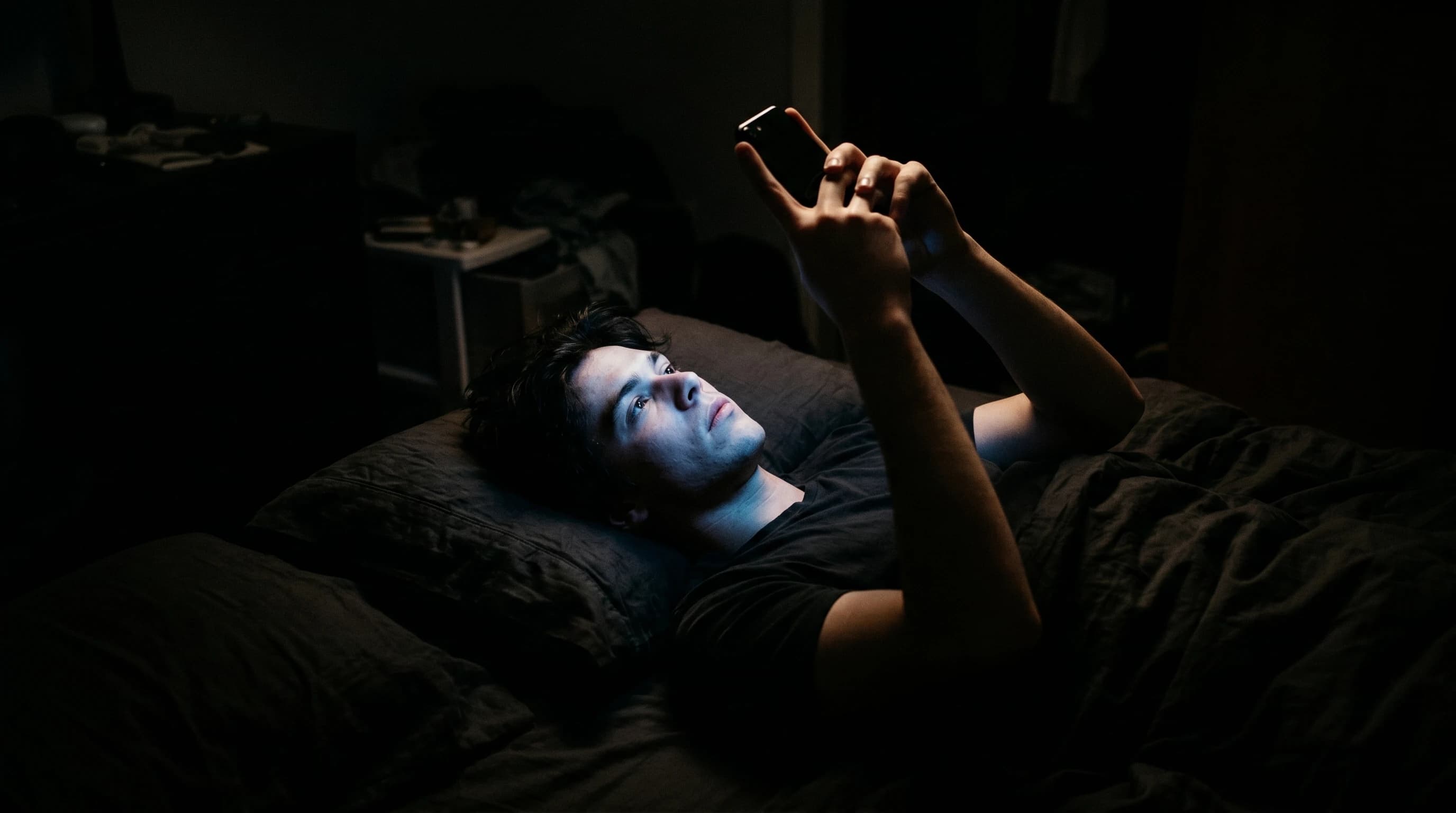
You have probably heard that the blue light from screens wrecks your sleep, and that blue-light glasses will fix it. The mechanism is real, but the popular story is overstated. How late you are on your devices, and how engaged, likely matters as much as the light itself, and blue-light glasses have surprisingly weak evidence behind them.
Here is what the research actually shows, and what genuinely helps.
What the early research showed
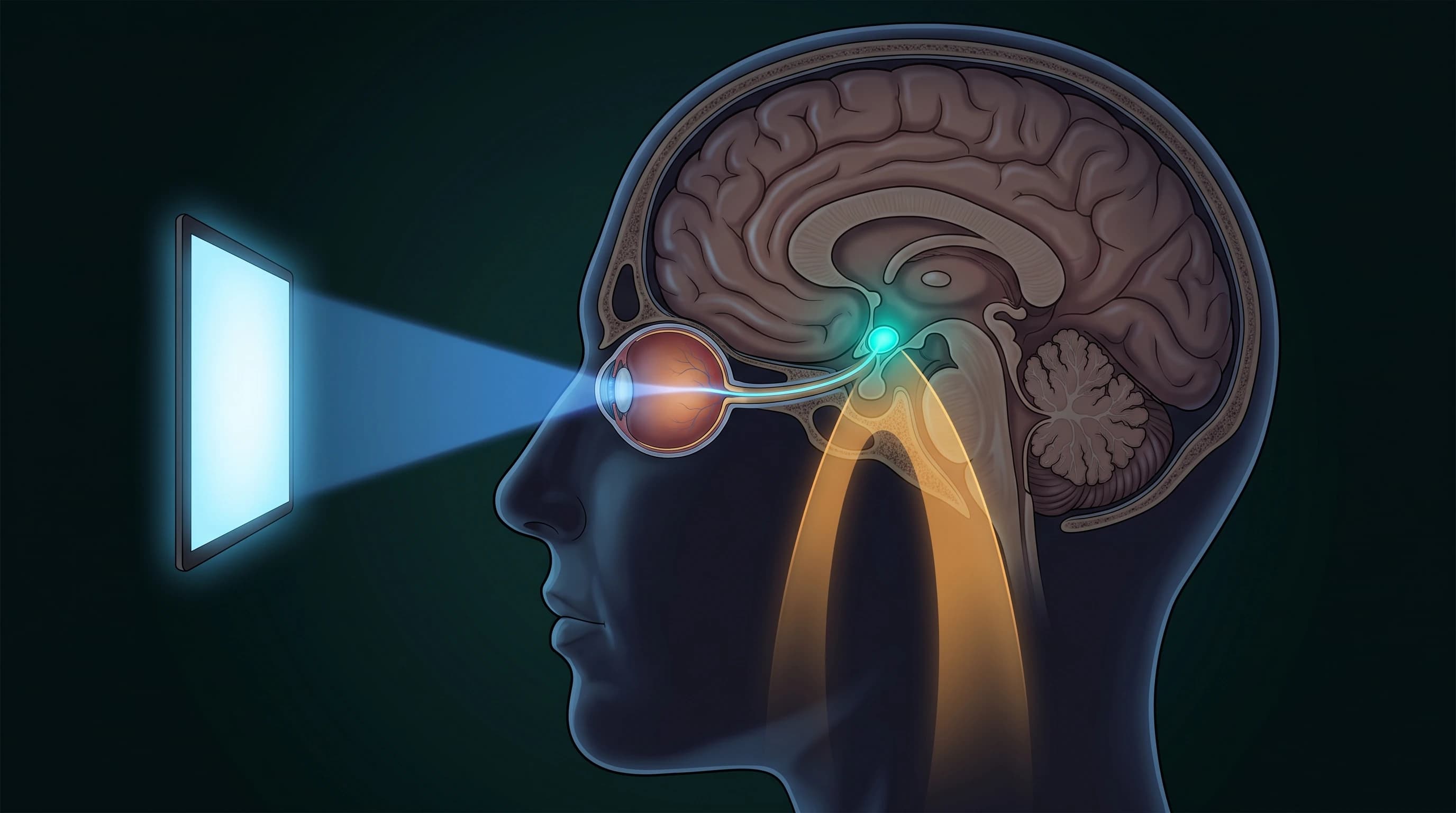
One study is often cited as proof. In a 2015 trial published in PNAS, adults who read on a light-emitting e-reader for four hours before bed, compared with a printed book, had lower evening melatonin, took longer to fall asleep, and showed a circadian delay of about an hour and a half, which left them groggier the next morning (Chang et al., 2015). The biology is solid: special light-sensitive cells in the eye respond most to short-wavelength (blue) light, and evening exposure suppresses the rising melatonin that prepares you for sleep.
Two caveats matter. The study had only 12 participants, and it used four hours of a screen at maximum brightness, close to a worst case. It shows blue light can affect sleep, not that a dimmed phone for twenty minutes will.
What more recent research has clarified
Three things have come into focus since.
First, actually reducing evening blue light helps less than you would expect. A meta-analysis of blue-light-reduction interventions, including blue-blocking glasses, found mixed and generally modest effects on measured sleep. The improvements were bigger in what people reported than in objective sleep, and clearest in groups with sleep or mood disorders rather than healthy sleepers (Shechter et al.).
Second, large real-world studies link screens to worse sleep but cannot pin it on blue light. A 2025 analysis of more than 122,000 adults found that screen use before bed was associated with poorer sleep quality and slightly less sleep (Zhong et al., 2025). It was observational, so it shows association, not cause, and it could not separate the light from the content, the timing, or the arousal of being on a device.
Third, that arousal piece is probably underrated. Stimulating content, notifications, late-night scrolling, and emotionally activating messages keep your mind switched on, which delays sleep regardless of wavelength. What you do on the screen may matter as much as the screen's color. In practice, that means passively reading or watching something calm is a different proposition from actively scrolling, messaging, or engaging with emotionally charged content — the second group is the bigger lever, even before you touch a light setting.
Are blue-light glasses worth it?
This is where the gap between marketing and evidence is widest. A 2023 Cochrane review, the most rigorous summary available, concluded that blue-light-filtering glasses may not reduce eye strain from screens, and rated that evidence as low certainty. Their effect on sleep quality was indeterminate and mixed, rated very low certainty, and none of the included trials were free of bias (Singh et al., 2023).
The honest verdict: blue-light glasses are low-risk and harmless if you find them comfortable, but do not expect them to rescue your sleep. Your effort is better spent on the basics below.
Who this matters more for: In the meta-analysis cited above, the clearest benefits showed up in people with sleep or mood disorders, not healthy sleepers — so shift workers and anyone managing insomnia or a mood disorder may get more out of blue-light interventions than the average reader, even though the overall evidence stays mixed and modest (Shechter et al.).
What actually helps with evening sleep
The strongest sleep habits are not about the color of your screen.
At a glance, here's how the main options compare, based on the evidence already cited in this article:
| Approach | Evidence strength | What it actually targets |
|---|---|---|
| Blue-light glasses | Low certainty for eye strain; very low certainty for sleep (Cochrane review) | Filters some blue wavelength; doesn't address timing or content |
| Night mode / dimming | Mixed, modest effect (meta-analysis) | Reduces total light output; free and simple |
| Consistent sleep-wake times + morning light | Well-established behavioral guidance | Supports the circadian clock directly |
| Protecting a wind-down hour | Better supported than any gadget | Targets mental arousal, not just light |
- Keep consistent sleep and wake times. Your sleep-wake cycle runs on a circadian clock that also governs hormones like cortisol (sleep and circadian regulation of cortisol); regular timing, plus bright light in the morning, are well-established ways to support it (Sleep Education, AASM) and a useful counterweight to evening screens.
- Protect a wind-down hour. Cutting stimulating screen use before bed is better supported than any gadget, and it targets the arousal effect, not just the light.
- Dim everything. Lower the brightness and use night mode. It is free and consistent with the biology, even if its effect on its own is modest (Shechter et al.). A dim screen emits less total light whatever its color — overall brightness, not just the blue tint, is what seems to matter most.
- Mind the bigger inputs. Late caffeine and an irregular schedule undo more sleep than blue light does.
For the bigger sleep picture, see recovering from sleep debt, and for a nutrient that is often oversold for sleep, magnesium and sleep. A calmer evening routine also fits within mindful habits backed by research and the broader mindful living approach.
Frequently Asked Questions (FAQ)
Does blue light really affect sleep? Yes, the mechanism is real: evening blue light suppresses melatonin and can delay your body clock. But the size of that effect in normal use is smaller than the headlines suggest, and timing and content matter too.
Do I need blue-light glasses? Probably not. The most rigorous review found weak, uncertain evidence that they improve sleep or eye strain. They are harmless, but they are not a fix.
Is night mode enough? Night mode and dimming reduce the light, which helps a little, but they do nothing about stimulating content or a late bedtime. Treat them as one small piece.
Is it the light or the content? Likely both, and the content and timing may matter more. Late-night scrolling disrupts sleep even with the blue light filtered out.
What is the single best thing I can do? Keep consistent sleep and wake times and protect a screen-light wind-down hour. Those beat any glasses or filter.
Medical disclaimer: This article is for informational purposes only. Always consult a qualified healthcare provider before making changes to your health routine.
Sources
- Chang AM, et al. Evening use of light-emitting eReaders negatively affects sleep, circadian timing, and next-morning alertness. PNAS, 2015 — PubMed. https://pubmed.ncbi.nlm.nih.gov/25535358/
- Shechter A, et al. Interventions to reduce short-wavelength ("blue") light exposure at night and their effects on sleep: a systematic review and meta-analysis — PubMed Central. https://pmc.ncbi.nlm.nih.gov/articles/PMC10127364/
- Singh S, et al. Blue-light filtering spectacle lenses for visual performance, sleep, and macular health in adults. Cochrane Database of Systematic Reviews, 2023 — PubMed Central. https://pmc.ncbi.nlm.nih.gov/articles/PMC10436683/
- Zhong C, et al. Electronic Screen Use and Sleep Duration and Timing in Adults. JAMA Network Open, 2025 — PubMed Central. https://pmc.ncbi.nlm.nih.gov/articles/PMC11950897/
- Sleep and Circadian Regulation of Cortisol: A Short Review — PubMed Central. https://pmc.ncbi.nlm.nih.gov/articles/PMC8813037/
- Screen time and sleep: what new studies reveal — Sleep Education, American Academy of Sleep Medicine (AASM). https://sleepeducation.org/screen-time-and-sleep-what-new-studies-reveal/
Sources 1–4 accessed 24 May 2026. Sources 5–6 accessed 11 September 2026.

Sophia Martinez
A wellness researcher focused on what the evidence actually says.