Search "ashwagandha for weight loss" and most pages make the same leap: ashwagandha lowers stress, stress is linked to weight gain, therefore ashwagandha helps you lose weight. Part of that chain is genuinely well-supported. Part of it isn't. This guide keeps the two apart, and looks directly at the trials that measured body weight itself — including an industry-funded result so large it needs independent replication before anyone should rely on it, and a recent null result that's almost never mentioned in competitor content.
Key Takeaways
- Not proven: Ashwagandha is not established as a weight-loss aid — NCCIH and WebMD both stress the evidence gap on this specific use.
- Inconsistent trials: Of the three trials that measured body weight directly, one found a modest positive effect, one found an unusually large effect that needs independent replication, and one recent trial found no significant effect at all.
- Modest and indirect at best: If ashwagandha does anything for weight, the most plausible pathway is small and indirect — through stress and cortisol — not direct fat-burning or appetite suppression.
- No women-only trial exists: None of the trials measuring weight outcomes were designed as women-only or sex-stratified for that endpoint.
- Safest role: a possible minor complement to diet, sleep, movement, and stress management — not a standalone or primary weight-loss strategy.
The Honest, Short Answer First
No, not reliably. Ashwagandha is not a proven, well-established weight-loss aid. NCCIH, the NIH's research center for complementary health, doesn't name weight loss specifically on its ashwagandha page, but it draws the evidence line in the same place: research supports use for insomnia and stress, evidence is unclear for anxiety, and for everything else — including the specific conditions it does name, like diabetes and athletic performance — it says there isn't enough evidence to draw a conclusion (NCCIH). Weight loss falls on the unproven side of that same line. WebMD's ashwagandha page is more direct: ashwagandha has not been studied as a dedicated aid for gaining or losing weight, though it notes one small trial found reduced food cravings in chronically stressed adults (WebMD) — a trial we cover in detail below.
That doesn't mean there is nothing here. A small number of real trials have measured body weight or BMI directly, and their results are genuinely inconsistent: one modest, statistically significant result; one result so large it needs independent replication before it should be trusted; and one recent trial that found no significant change at all. If ashwagandha has any real effect on weight, the most plausible explanation is small and indirect — through stress, cortisol, and sleep — not a direct fat-burning or appetite-suppressing mechanism.
What the Actual Trials Found
Choudhary et al., 2017 is the most-cited of the three. It enrolled 52 adults under chronic stress (38 men, 14 women; 50 completed) and gave half of them 300mg of a standardized, trademarked root extract (KSM-66) twice daily for 8 weeks, versus placebo. Body weight and BMI were secondary measures in what was primarily a stress trial. The ashwagandha group lost significantly more weight than placebo — 3.03% versus 1.46% of body weight (about −2.32kg versus −1.13kg, p=0.0148) — and BMI dropped 2.93% versus 1.4% (p=0.0096). The same trial also found reduced food cravings in the ashwagandha group, which is the finding behind the FAQ below on stress eating (Choudhary et al., 2017). It's a real, statistically significant result — but a modest one, from a trial where only 14 of 52 participants were women, a detail worth flagging plainly on a page built around this exact keyword.
Pakhale et al., 2025 reported a far larger effect, and it deserves scrutiny rather than uncritical citation. Over 24 weeks, 100 adults (91 completing) took 300mg of KSM-66 twice daily or placebo. The ashwagandha group lost 8.46±3.86kg versus 2.41±2.07kg with placebo (P<.0001); BMI fell 3.31±1.57 versus 0.93±0.79 (P<.0001) (Pakhale et al., 2025). That's a magnitude of weight loss that would be unusual even for prescription weight-loss medications, let alone an herbal supplement — we think it deserves real scrutiny rather than being repeated as a typical, expected result. Worth disclosing as context, not as proof of bias: the extract was supplied by Ixoreal BioMed, the KSM-66 manufacturer, the same arrangement as the Choudhary trial above — a funding pattern examined in more depth in our guide to ashwagandha's scientific evidence. Until an independent group replicates a result this size, we're treating it as an outlier that needs confirmation, not a settled finding.
Ballesteros-Torres et al., 2025 is the trial almost no competitor page mentions, and it points the other way. Over 40 days, 43 Mexican adults with overweight or obesity (38 completing: 17 placebo, 21 treatment; 68.4% female overall) took 500mg of a different, non-KSM-66 root extract once daily. Body weight showed no significant difference between groups (p=0.09); BMI likewise showed none (p=0.062). Waist circumference did show a significant reduction, but only within the female participants specifically, and only just — a 1.48cm reduction at p=0.0495, in a small subgroup, in a single short trial (Ballesteros-Torres et al., 2025). We're surfacing that female-specific detail honestly rather than either ignoring it or overselling it: it's a genuinely small, borderline, unreplicated signal, not a demonstrated benefit. The same trial did find significant improvements elsewhere: triglycerides fell by about 31mg/dL more than placebo (p=0.0082), and VLDL cholesterol dropped roughly 77mg/dL more (p=0.0321) — real metabolic effects, just not the body-weight or BMI effect this section is specifically about.
A fourth trial is worth a brief, clearly-caveated mention: Wankhede et al.'s 2015 strength-training trial found a significantly greater drop in body-fat percentage with ashwagandha than placebo (3.5% versus 1.5%, p=0.03) — but that result came alongside 8 weeks of structured resistance training in 57 young men, so it says more about ashwagandha as a training adjunct than as a standalone weight-loss agent, and it isn't women's data either — the same trial's testosterone and strength findings are covered in our ashwagandha benefits for men guide (Wankhede et al., 2015).
At a Glance: The Four Weight-Related Trials
| Trial | Extract & Dose | Duration | Completed (n) | Weight/BMI Result | Independently Funded? |
|---|---|---|---|---|---|
| Choudhary et al., 2017 | KSM-66, 300mg 2x/day | 8 weeks | 50 (38 men, 14 women) | −3.03% weight, −2.93% BMI vs placebo (p<0.05) | No — Ixoreal BioMed supplied extract |
| Pakhale et al., 2025 | KSM-66, 300mg 2x/day | 24 weeks | 91 (mixed-sex) | −8.46kg vs −2.41kg placebo (p<.0001) — outlier, needs replication | No — Ixoreal BioMed supplied extract |
| Ballesteros-Torres et al., 2025 | Non-KSM-66 extract, 500mg 1x/day | 40 days | 38 (68.4% female) | No significant weight or BMI change (p=0.09 / p=0.062) | Not disclosed as industry-supplied in the sources reviewed |
| Wankhede et al., 2015 | KSM-66, 300mg 2x/day + resistance training | 8 weeks | 57 (100% male) | Body fat −3.5% vs −1.5% placebo (p=0.03) — training-confounded | No — Ixoreal BioMed supplied extract |
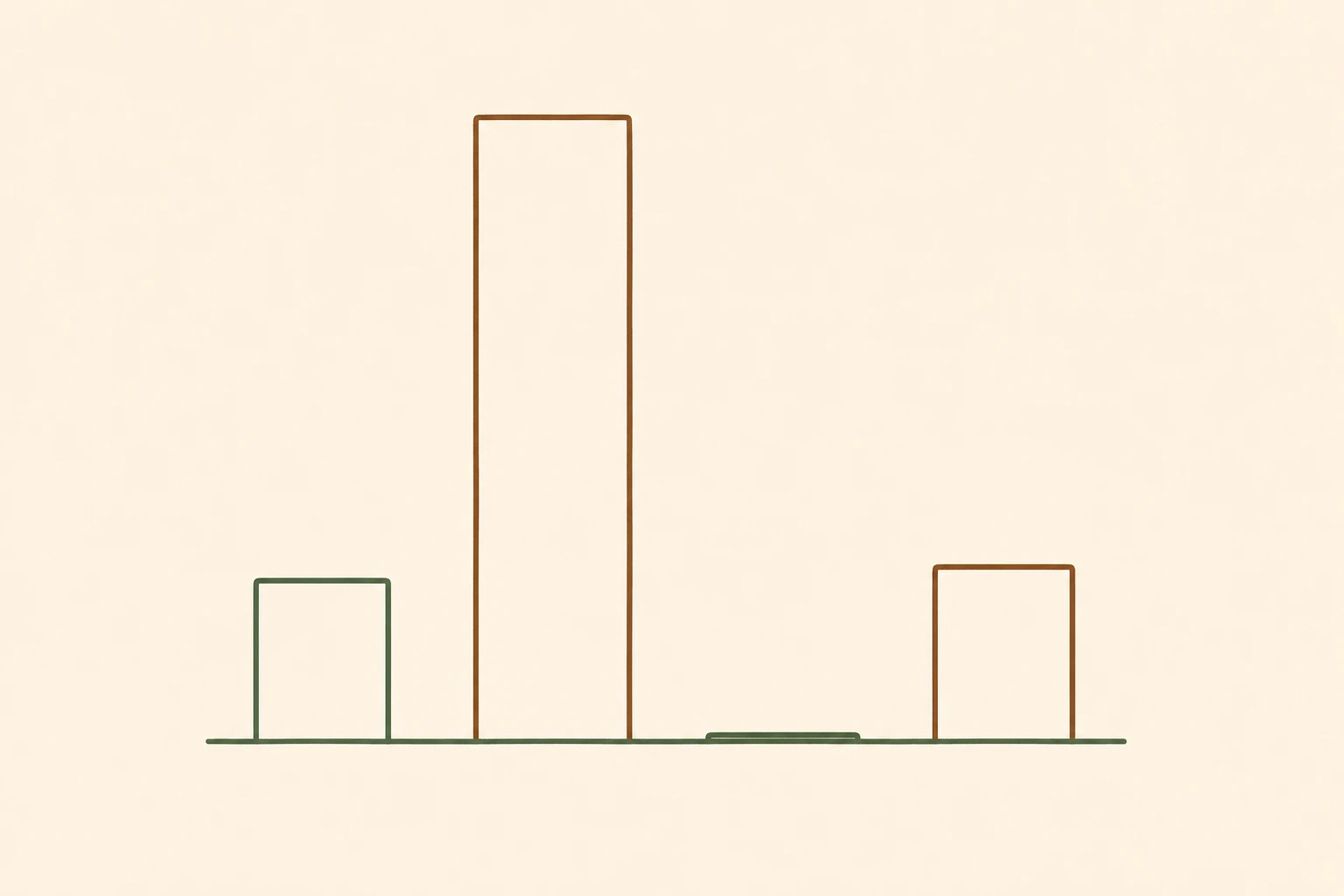
Read top to bottom, the pattern is a modest positive signal, one outsized industry-funded result that needs independent confirmation, and one recent null result — not a consistent, replicated effect.
The Indirect Stress-Cortisol Pathway
Terms used in this section: Ashwagandha (Withania somnifera) is a herb used in traditional Ayurvedic medicine and classified as an adaptogen — a category of herbs studied for how they interact with the body's central stress-response system, the HPA axis (hypothalamic-pituitary-adrenal axis), the network that governs cortisol release.
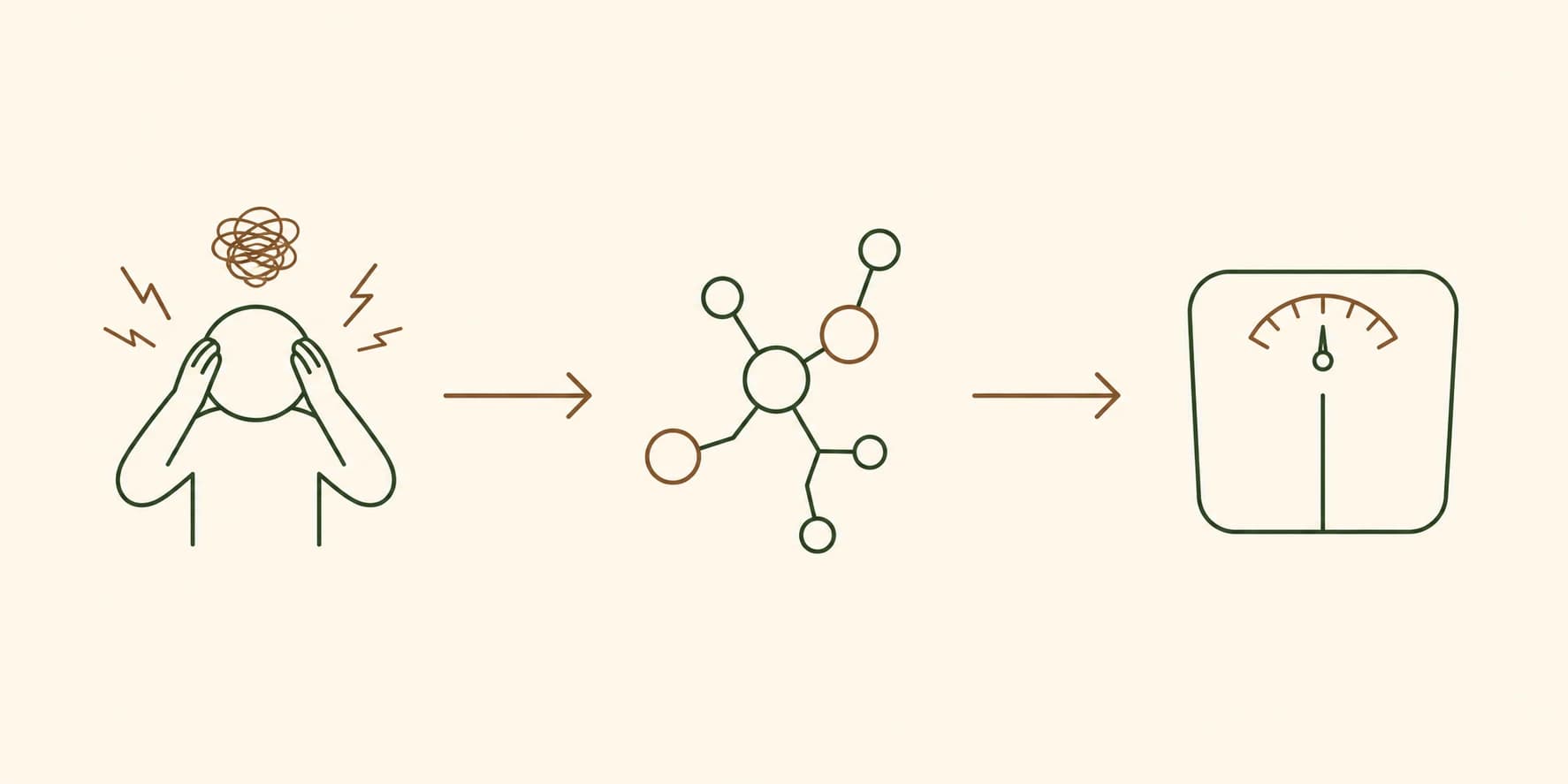
Most marketing for ashwagandha and weight loss implies a mechanism without spelling it out: chronic stress raises cortisol, elevated cortisol is associated with weight gain and visceral (abdominal) fat in some research, and ashwagandha has genuinely decent evidence for lowering perceived stress — covered in full in our ashwagandha benefits guide.
That chain has a real link and a much weaker one. The stress-lowering evidence is solid. The jump from "may lower stress" to "therefore causes weight loss" is not something any trial in this evidence base has directly tested end-to-end. Our cortisol diet guide covers the same caution from the food side: even the best-supported dietary approach to cortisol, a Mediterranean-style eating pattern, produced only small measured changes over 18 months in its defining trial — a reminder that cortisol-focused interventions in general tend to move slowly and modestly, not quickly and dramatically. Treat any claim that lowering cortisol will reliably produce weight loss as an extrapolation, not a tested finding.
Why This Isn't Women-Specific Evidence
Worth stating plainly, since this keyword specifically asks about women: no trial in this evidence base is women-only or menopause/50-plus-specific for weight outcomes.
- Choudhary 2017: 27% women (14 of 52).
- Pakhale 2025: mixed-sex, no separate female analysis for its weight result.
- Ballesteros-Torres 2025: 68.4% female overall — the one trial with a female-specific finding, but only for waist circumference (not weight or BMI), and a small, borderline-significant result in a single trial.
- Wankhede 2015: 100% male; its body-fat result doesn't extend to women at all.
A genuine women-specific weight-loss trial would need to enroll women as its primary study population, power the study to detect an effect by sex, and treat body weight as a primary rather than incidental outcome — none of the three weight trials above were designed that way. For the fuller picture on what genuinely is and isn't female-specific evidence across the whole ashwagandha research base, see our ashwagandha benefits for women guide.
What Extract Form and Dose Were Used
The two larger positive-and-outlier trials used the same product: KSM-66, a standardized root extract, at 300mg twice daily (Choudhary 2017, Pakhale 2025). The null 40-day trial used a different, non-KSM-66 hydroethanolic root extract at 500mg once daily (Ballesteros-Torres 2025) — a different product at a different dose and schedule, which is one more reason these three results aren't directly comparable to each other. For the full breakdown of extract types, standardization, and dosing by goal, see our dosage and timing guide.
Should You Try It for Weight Management?
If you are weighing it against the other supplements marketed for stress and abdominal fat, our graded triage of supplements to reduce cortisol and belly fat puts them side by side — and cortisol belly covers why the underlying premise deserves scepticism in the first place.
A reasonable, non-hyped answer: if you're already considering ashwagandha for stress or sleep, and your doctor has no objection, a modest weight-related side benefit is plausible and low-risk to hope for — but not something to count on, and not a reason to start taking it if weight loss is your only goal. The trials that found a positive effect are inconsistent with each other, one is likely too good to be true pending replication, and the most recent, most rigorous-on-this-specific-outcome trial found nothing. The levers with genuinely strong evidence behind them for weight management remain what they've always been: diet quality, sleep, movement, and stress management as a whole pattern, not any single supplement. If ashwagandha has a place, it's as a minor complement to those, not a replacement for them.
How to Approach Ashwagandha If You're Tracking a Possible Weight Effect
- Check with your doctor or pharmacist first, especially if you take thyroid, blood sugar, or blood pressure medication.
- Choose a standardized extract with a known, studied dose — KSM-66 at 300mg twice daily is what most of the trials above actually tested.
- Record one concrete baseline measure before you start: body weight, waist circumference, or how a specific piece of clothing fits.
- Re-check that same measure at 8 weeks, the shortest window in which any trial found an effect.
- If you continue past 8 weeks, re-check again around 24 weeks — but treat a large effect at this point with the same caution this guide applies to the Pakhale 2025 result.
- Treat no measurable change as a legitimate, likely outcome, not a sign you're doing something wrong — the evidence base does not support guaranteed results.
Frequently Asked Questions (FAQ)
Does ashwagandha actually help you lose weight? Not reliably. A handful of real trials have measured body weight directly, and the results are genuinely inconsistent — one modest positive result (Choudhary et al., 2017), one industry-funded result implausibly larger than almost anything else in this evidence base (Pakhale et al., 2025), and one recent null result (Ballesteros-Torres et al., 2025). It is not a proven, well-established weight-loss aid.
Can ashwagandha reduce belly fat specifically? The evidence is thin and mixed. One trial found a significant waist-circumference reduction, but only in its female participants, in a small subgroup, at a borderline statistical threshold (Ballesteros-Torres et al., 2025). A separate strength-training trial found a body-fat-percentage reduction, but that result is confounded by 8 weeks of structured resistance training, not ashwagandha alone (Wankhede et al., 2015).
Does ashwagandha help with stress-related weight gain or emotional eating? There is a plausible indirect pathway — chronic stress and cortisol are linked to weight gain in some research, and ashwagandha has decent evidence for lowering perceived stress. One trial did find reduced food cravings alongside its modest weight result (Choudhary et al., 2017). But lowering stress is not the same as proven weight loss, and no trial has tested emotional eating as its own dedicated outcome.
Does ashwagandha work better for weight loss in men or women? No trial has directly compared men and women as a study design, so this cannot be answered with confidence either way. The only trial with a majority-female sample (Ballesteros-Torres et al., 2025) found a female-specific waist-circumference effect but no overall weight or BMI effect; the only all-male trial (Wankhede et al., 2015) measured body fat percentage, not weight, in the context of resistance training. The data simply doesn't support a sex comparison for weight outcomes.
Is ashwagandha safe to combine with other weight-loss supplements? We could not find dedicated research testing ashwagandha alongside other weight-loss supplements specifically. General supplement-interaction caution applies — check with a pharmacist or doctor first, especially if any product affects thyroid function, blood sugar, or blood pressure. Our medication interactions guide covers what is and isn't documented for ashwagandha specifically, and our ashwagandha side effects guide covers what to watch for more broadly.
What is the best ashwagandha dosage for weight loss? There is no dosage specifically validated for weight loss as a primary outcome. Most of the trials that measured body weight used 300mg of KSM-66 root extract twice daily (600mg/day total); one used a different, non-KSM-66 extract at 500mg once daily. Since the trials used different products at different doses with inconsistent results, no single dose can be called "the" weight-loss dose — see our full dosage and timing guide for how these doses compare across all use cases.
Can ashwagandha cause weight gain instead of weight loss? Weight gain is not a commonly reported side effect of ashwagandha in the safety literature — WebMD's clinical summary doesn't typically list it as a side effect (WebMD). That said, ashwagandha has not been studied as a dedicated weight-gain or weight-loss aid, so this is an absence-of-signal finding, not a guarantee. If you notice unexpected weight changes while taking it, that's worth mentioning to your doctor rather than assuming it's the supplement.
How long would it take to see any weight effect from ashwagandha? We cannot confirm a specific timeline. The trials that found effects ran 8 to 24 weeks, and the longer trial found a much larger effect — but that trial is also the one most in need of independent replication, so we are not treating its timeline as established either.
Is ashwagandha a substitute for diet and exercise for weight loss? No. Even in the trials that found a statistically significant weight effect, the changes were modest compared to what diet, exercise, and sleep changes reliably produce, and none of the trials position ashwagandha as a replacement for those fundamentals. It's most reasonably framed as a possible minor complement to a broader healthy-weight pattern, not a standalone strategy.
How much of ashwagandha's weight effect is really about cortisol? This is the mechanism most often implied by marketing, but no trial in this evidence base has directly tested and confirmed that cortisol reduction is what's driving the weight changes seen. Ashwagandha does have decent evidence for lowering perceived stress and, in some trials, cortisol; whether that translates causally into weight loss specifically has not been isolated and tested as its own research question.
How we made this guide: Researched, written, and fact-checked by The Wellness Voyage editorial team, with every health claim backed by a citable source — recognised health authorities and peer-reviewed studies are linked throughout and listed in full below. We fact-check and review this article periodically and update it as the evidence changes; the last reviewed and updated date is shown with this article. It is written to inform, not to replace personalised advice from a qualified healthcare professional.
Medical disclaimer: This article is for informational purposes only. Always consult a qualified healthcare provider before making changes to your health routine.
Sources
- National Center for Complementary and Integrative Health (NCCIH). Ashwagandha. https://www.nccih.nih.gov/health/ashwagandha
- WebMD. Ashwagandha — Uses, Side Effects, and More. https://www.webmd.com/vitamins-and-supplements/ashwagandha
- Choudhary D, Bhattacharyya S, Joshi K. Body Weight Management in Adults Under Chronic Stress Through Treatment With Ashwagandha Root Extract: A Double-Blind, Randomized, Placebo-Controlled Trial. J Evid Based Complementary Altern Med, 2017 — PubMed. https://pubmed.ncbi.nlm.nih.gov/27055824/
- Pakhale K, Pakhale R, Srivathsan M, Langade J, Langade D. Efficacy and safety of Ashwagandha (Withania somnifera) root extract on stress and weight management in adults: a prospective, randomized, double-blind, placebo-controlled study. Journal of Medicine and Life, 2025 — PMC. https://pmc.ncbi.nlm.nih.gov/articles/PMC12863098/
- Ballesteros-Torres JM, Vázquez-Aguilar A, Luzardo-Ocampo I, Escalante-Aburto A, Caballero-Prado CJ. Impact of ashwagandha (Withania somnifera L.) supplementation on serum lipid concentrations and anthropometric parameters in adults with overweight and obesity: a double-blind, placebo-controlled pilot study. Nutrition & Metabolism, 2025 — PMC. https://pmc.ncbi.nlm.nih.gov/articles/PMC12595879/
- Wankhede S, Langade D, Joshi K, Sinha SR, Bhattacharyya S. Examining the effect of Withania somnifera on muscle strength and recovery: a randomized controlled trial. J Int Soc Sports Nutr, 2015 — PubMed. https://pubmed.ncbi.nlm.nih.gov/26609282/
All sources accessed 17 July 2026.

Emily Johnson, MSc, RH (AHG)
A registered herbalist who separates real trial data on weight from stress-cortisol marketing extrapolation.