Most "ashwagandha benefits for men" pages quietly do something that isn't quite honest: they take ashwagandha's general-population stress and sleep evidence — tested in mixed groups of men and women — and present it as though it says something specific about being a man. Some of it does. Testosterone, sperm parameters, and a genuine year-long trial in aging men are real, separately-studied territory. This guide draws that line clearly, the same way our ashwagandha benefits for women guide does for the parallel evidence in women. For the shared evidence and the full safety picture, start with our guide to what the evidence actually shows.
At a glance, what the male-specific evidence actually shows:
- Testosterone: Modest, mixed-strength evidence — one trial found an 11.4% rise that was significant only within-group, not clearly better than placebo; a second trial paired with resistance training found a larger increase that was significant versus placebo.
- Fertility: Strong evidence in men with diagnosed fertility problems, with large increases in sperm concentration, motility, and semen volume across multiple trials; more modest improvements in healthy men without a fertility diagnosis.
- Muscle strength: Strong evidence, but only ever tested alongside structured resistance training — not as a stand-alone muscle-builder.
- Sexual performance: One old but real year-long trial in aging men found improved self-reported performance versus placebo — not the same as a diagnosed-ED trial.
- Dosing: Higher isn't automatically better. Match your dose and extract form to your actual goal rather than assuming more raw herb equals more benefit.
What's Actually Male-Specific Evidence, and What Isn't
The stress, cortisol, sleep, and general anxiety research covered in our main benefits guide comes from mixed-sex adult populations — real evidence, but not evidence about men specifically. What genuinely is male-specific: testosterone and DHEA-S measured in male trial participants, sperm and semen-quality outcomes in male fertility trials, muscle-strength trials that recruited men, and one real year-long trial in aging men measuring self-reported sexual performance. Those are the sections below. We're also flagging where a trial's population is broader than "men" alone, since precision here is the whole point of separating this out.
Testosterone and DHEA-S
The most-cited testosterone finding comes from a 2019 trial that's worth describing precisely, because it's often summarized loosely elsewhere. The trial enrolled 60 adults — 37 men and 23 women, ages 18 to 65 — who took 240mg/day of a concentrated extract (Shoden, standardized to 35% withanolide glycosides) or placebo for 60 days. In the male participants specifically, testosterone rose 11.4% from baseline, a statistically significant within-group change (p=.038) (Lopresti et al., 2019). Worth being precise about: the head-to-head comparison against the placebo group's negligible 0.1% change did not reach statistical significance (p=.158) — so this trial alone is suggestive rather than conclusive proof of a testosterone effect versus placebo. The Wankhede 2015 trial below, by contrast, did find a statistically significant between-group difference. The same trial also measured DHEA-S, another androgen hormone, and found it fell 8% in the ashwagandha group versus a 2.5% rise on placebo — the opposite direction from what a "boosts male hormones" narrative would predict. We're citing both numbers because reporting only the flattering one would be exactly the kind of selective citation this site tries not to do.
A separate trial in men specifically found a larger testosterone effect: 57 young men taking 300mg twice daily alongside 8 weeks of resistance training saw testosterone rise 96.2 ng/dL, versus 18.0 ng/dL with placebo and training alone (Wankhede et al., 2015) — covered in more detail in the strength section below, since testosterone wasn't its only outcome.
Muscle Strength and Recovery
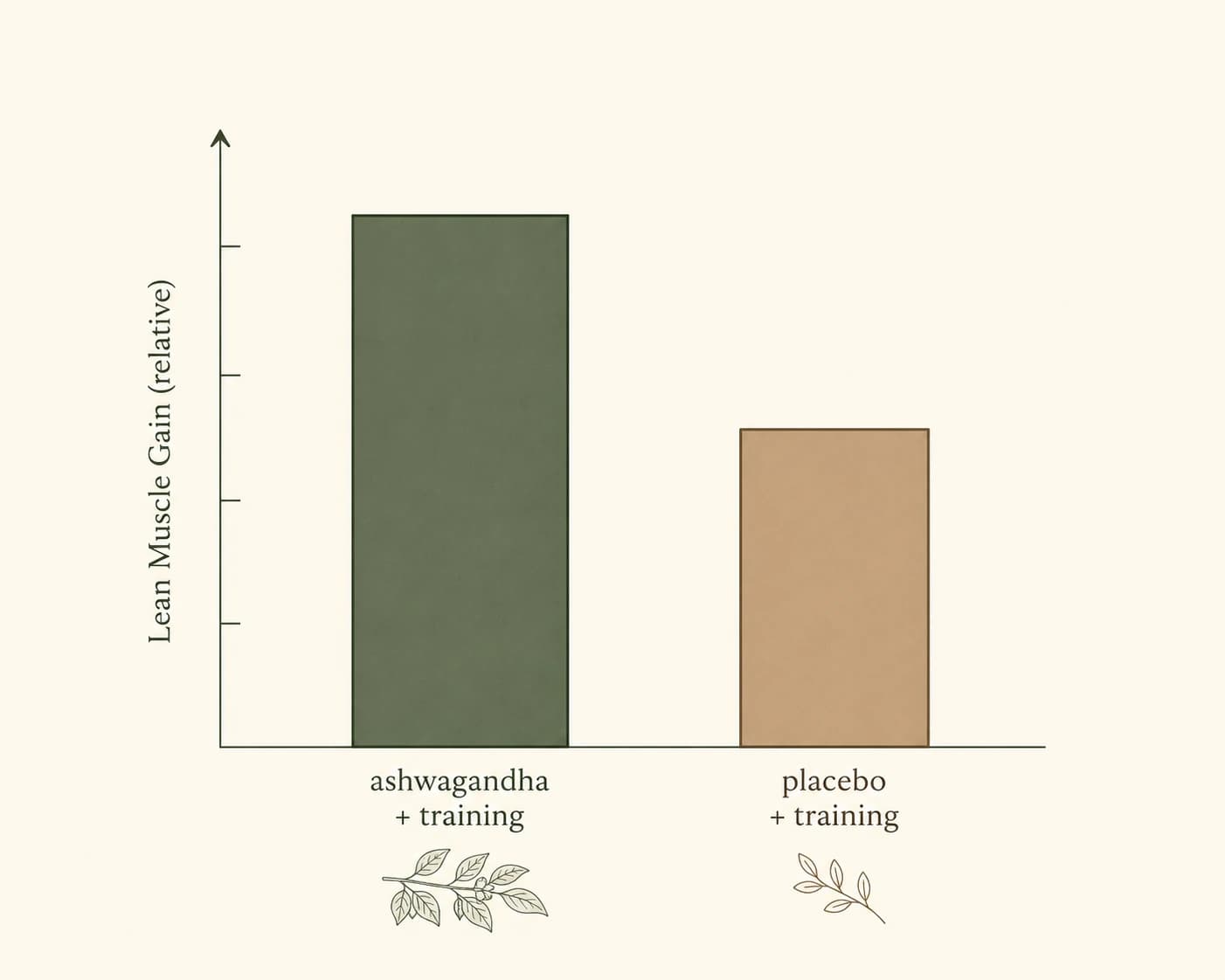
The Wankhede 2015 trial above is the most-cited strength study in this space: 57 young men, 300mg of a root extract twice daily, alongside 8 weeks of structured resistance training. The ashwagandha group added nearly twice the bench-press strength of the placebo-plus-training group (+46.0kg versus +26.4kg), alongside the larger testosterone rise noted above (Wankhede et al., 2015). A more recent trial tested 600mg/day alongside 8 weeks of resistance training in both men and women (80 enrolled, 73 completing) and found strength and VO2max improved in both sexes, with no adverse events (Verma et al., 2024).
The detail worth being explicit about: every strength trial here paired ashwagandha with a structured resistance-training program. None tested it as a stand-alone intervention without exercise. Treat it as a possible training aid, not a substitute for lifting.
Sperm Quality and Male Fertility
This is arguably the most mature category of genuinely male-specific evidence, and it splits into two real populations: men with diagnosed fertility problems, and healthy men without one.
In men with low sperm counts (oligospermia), a 90-day trial using a comparatively low 675mg/day of a full-spectrum root extract (in three divided doses) found sperm concentration rose 167%, semen volume rose 53%, and motility rose 57%, versus minimal change on placebo (all differences highly significant) (Ambiye et al., 2013). Two further trials, documented in a phytotherapy reference textbook rather than independently re-opened by us on PubMed, used a considerably higher dose — 5g/day of root powder — over 3 months in infertile men: one found significant improvements in sperm motility and concentration across three infertility subgroups, alongside rising LH and testosterone and falling FSH and prolactin (Ahmad et al., 2009, as reported in Bone & Mills, Principles and Practice of Phytotherapy, 2013, pp. 956–957); a second, in infertile smokers, stressed men, and men with unexplained infertility, found similar sperm improvements plus a 36–48% afternoon cortisol reduction (Mahdi et al., 2011, as reported in Bone & Mills, 2013, p. 957).
In healthy men without a fertility diagnosis, a more recent trial using 300mg twice daily over 8 weeks (100 enrolled, 93 completing) found semen volume rose 25.56%, sperm count rose 47.72%, and sperm vitality rose 18.70%, with improved morphology, versus placebo — smaller percentage changes than the oligospermic-men trials above, which makes sense given the healthy-baseline starting point (Mutha et al., 2025).
Sexual Performance in Aging Men
The longest-duration trial in this entire cluster's evidence base is also one of the oldest, and it's specifically about men. A double-blind trial gave 101 healthy men aged 50–59 either 3g/day of ashwagandha root or 3g/day of starch for a full year. Alongside real secondary findings — increased hemoglobin and red blood cell count, less hair greying, decreased cholesterol — about 71% of the ashwagandha group reported improved sexual performance, versus the starch group (Kuppurajan et al., 1980, as reported in Bone & Mills, 2013, p. 956). We haven't found this trial cited on any competitor page we reviewed for this topic, despite it being the only trial in this space with a full year of follow-up rather than 8 to 12 weeks. It measured general self-reported sexual performance, not a diagnosed condition like erectile dysfunction specifically — a distinction worth keeping in mind if that's what you're looking for evidence on.
Separately, in modern phytotherapy practice, Withania is commonly formulated alongside herbs like Tribulus terrestris, Panax ginseng, and saw palmetto (Serenoa repens) specifically for andropause — age-related testosterone decline — though this reflects practitioner formulation tradition rather than a dedicated clinical trial testing that combination (Bone & Mills, 2013, pp. 329–330). We're noting it as context, not as evidence equivalent to the RCT above.
A Necessary Caveat: More Is Not Better
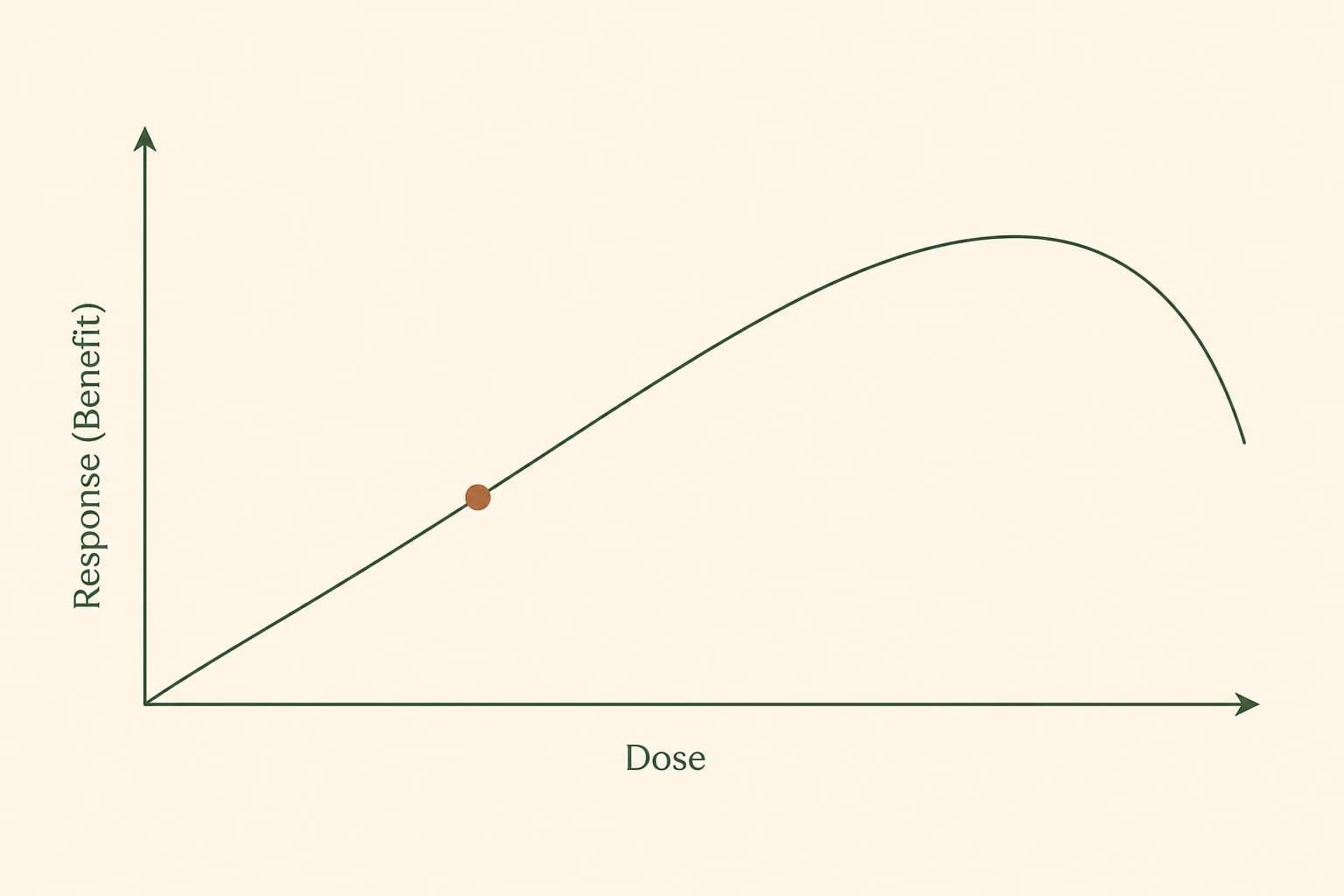
Every positive finding above came from what the source literature considers a normal therapeutic dose. A contrasting animal finding is worth knowing before assuming more would be better: male rats given a supratherapeutic dose — 3g/kg, described in the source as "much greater than the human therapeutic dose" — failed to ejaculate and showed reduced libido and sexual performance that was only partly reversible, with incomplete recovery still observed 30 days after treatment stopped (Ilayperuma, Ratnasooriya & Weerasooriya, 2002, as reported in Bone & Mills, 2013, p. 958). This is an animal study at a dose far outside anything used in the human trials above, not a reason for concern at normal doses — but it's a genuine dose-response lesson: pushing well past studied amounts isn't a reliable way to get more benefit, and the one data point we have suggests the opposite is possible.
Which Extract Form Was Actually Used in These Trials
"Ashwagandha" covers genuinely different products, and the trials above used different ones. The testosterone-and-DHEA-S trial used Shoden, a highly concentrated extract standardized to 35% withanolide glycosides, at a comparatively low 240mg/day (Lopresti et al., 2019). The strength trial used a root extract at 300mg twice daily (Wankhede et al., 2015) — a dose and pattern similar to KSM-66, though the trial itself doesn't name that specific brand. The fertility trials in infertile men used two different forms and doses of the herb: Ambiye et al. (2013) used a comparatively low 675mg/day of a full-spectrum root extract (Ambiye et al., 2013), while the Ahmad (2009) and Mahdi (2011) trials cited above used a considerably higher 5g/day of root powder — and the healthy-men fertility trial used 300mg twice daily of a standardized extract (Mutha et al., 2025). These aren't interchangeable milligram-for-milligram — a comparative pharmacokinetic study found standardized extracts can differ in withanolide bioavailability by more than an order of magnitude at comparable doses (comparative PK study, IJBCP). For the full extract-form comparison and dosing guidance, see our dosage and timing guide.
Safety Notes Specific to Men
We didn't find a safety concern in the research for this post that's specifically about being male beyond what applies to anyone — liver injury, thyroid effects, and medication interactions are covered in full in our side effects guide and our medication interactions guide, and apply the same way regardless of sex. Worth repeating from the fertility section above, though: dose and form varied considerably across the fertility trials, from 675mg/day of a concentrated root extract up to 5g/day of root powder — and it was actually the lower-dose extract trial that produced the largest percentage improvements in this evidence base. That's a reason to match your dose and form to your actual goal, rather than assuming a larger raw-herb dose is automatically more effective.
Every Trial in This Guide, Compared
The human trials cited above, side by side. The rat study on supratherapeutic dosing is a separate line of evidence and isn't included here since it isn't a human trial.
| Study | Population | Dose & Form | Duration | Key Result | Significance |
|---|---|---|---|---|---|
| Lopresti et al., 2019 | 60 adults (37 men, 23 women), ages 18–65 | 240mg/day Shoden extract (35% withanolides) | 60 days | Testosterone +11.4% in men; DHEA-S −8% vs. +2.5% placebo | Testosterone: significant within-group (p=.038), not significant vs. placebo (p=.158). DHEA-S: significant vs. placebo (p=.004) |
| Wankhede et al., 2015 | 57 young men | 300mg twice daily root extract + resistance training | 8 weeks | Testosterone +96.2 ng/dL vs. +18.0 ng/dL placebo; bench press +46.0kg vs. +26.4kg | Significant vs. placebo (p=.004 testosterone, p=.001 bench press) |
| Verma et al., 2024 | 80 enrolled/73 completing, men and women | 600mg/day root extract + resistance training | 8 weeks | Improved strength and VO2max in both sexes; no adverse events | Reported significant |
| Ambiye et al., 2013 | 46 oligospermic men (21 treatment/25 placebo) | 675mg/day root extract (225mg 3x/day) | 90 days | Sperm concentration +167%, semen volume +53%, motility +57% | All significant (p<0.0001) |
| Ahmad et al., 2009 | Infertile men, 3 subgroups | 5g/day root powder | 3 months | Improved sperm motility/concentration; rising LH & testosterone; falling FSH & prolactin | Reported significant (secondary source) |
| Mahdi et al., 2011 | Infertile smokers, stressed men, unexplained infertility | 5g/day root powder | 3 months | Improved sperm parameters; 36–48% afternoon cortisol reduction | Reported significant (secondary source) |
| Mutha et al., 2025 | 100 enrolled/93 completing, healthy men | 300mg twice daily root extract | 8 weeks | Semen volume +25.56%, sperm count +47.72%, sperm vitality +18.70% | Significant (p=.005/.006/.007) |
| Kuppurajan et al., 1980 | 101 healthy men, ages 50–59 | 3g/day root powder vs. 3g/day starch | 1 year | ~71% reported improved sexual performance; also ↑hemoglobin/RBC, less hair greying, ↓cholesterol | Reported significant (secondary source; no independently accessible primary record) |
Frequently Asked Questions (FAQ)
Does ashwagandha really increase testosterone? In the male participants of a 2019 trial, testosterone rose 11.4% from baseline — a statistically significant within-group change, though the comparison against placebo didn't reach statistical significance on its own (Lopresti et al., 2019). A separate trial pairing ashwagandha with resistance training did find a statistically significant testosterone difference versus placebo (Wankhede et al., 2015). The first trial also found DHEA-S, a related hormone, actually decreased — worth knowing rather than only citing the flattering number.
Does ashwagandha affect the prostate or PSA levels? We could not find a human clinical trial that measured prostate size, PSA, or BPH symptoms as an outcome in men taking ashwagandha. None of the male-specific trials covered in this guide report prostate-related data. If you have a personal or family history of prostate issues, treat this as an open question and discuss ashwagandha use with your doctor rather than assuming the hormone research here says anything about prostate safety specifically.
Does ashwagandha improve sperm count or fertility? In men with existing fertility problems, yes, across several trials — significant increases in sperm concentration, motility, and semen volume (Ambiye et al., 2013). In healthy men without a fertility diagnosis, one trial found improvements too, though the percentage changes were smaller (Mutha et al., 2025).
Is it safe to take ashwagandha alongside testosterone replacement therapy (TRT)? We couldn't find a trial testing ashwagandha specifically in men already on TRT. Given that ashwagandha has measurable hormonal effects on its own — including the DHEA-S decrease noted above — combining it with TRT is exactly the kind of situation to discuss with the prescribing doctor rather than self-combining. See our medication interactions guide for the general interaction picture.
What's the best ashwagandha dosage for men? Trials showing the strongest strength and hormone results used 300mg twice daily of a standardized extract. Fertility-specific trials varied by form: the trial with the single largest sperm-parameter improvements used just 675mg/day of a root extract (Ambiye et al., 2013), while two other infertility trials used a considerably higher 5g/day of root powder. See our full dosage guide for the complete picture by extract type.
Can ashwagandha increase DHT or cause hair loss in men? We didn't find a human trial measuring DHT (dihydrotestosterone) specifically in men taking ashwagandha, so this hasn't been directly studied in the trials covered here. The male-specific evidence available covers total testosterone and DHEA-S, not DHT, so any claim about ashwagandha and hair loss via DHT is not something we can currently back with trial evidence.
Can ashwagandha help with erectile dysfunction? We couldn't find a trial testing ashwagandha specifically against a diagnosed erectile dysfunction. The closest evidence is a year-long trial in men aged 50–59 where 71% reported improved general sexual performance versus placebo (Kuppurajan et al., 1980, as reported in Bone & Mills, 2013, p. 956) — a broader, older, and real finding, but not the same as an ED-specific trial.
How long does it take for ashwagandha to raise testosterone in men? Based on the two controlled trials with male-specific data in this guide, a measurable rise showed up by 60 days in one trial (Lopresti et al., 2019, 240mg/day) and by 8 weeks in another (Wankhede et al., 2015, 300mg twice daily paired with resistance training). Neither trial tested shorter timeframes, so we can't say whether an effect appears sooner than that.
Does ashwagandha build muscle on its own, or only with exercise? Every strength trial in this evidence base paired ashwagandha with structured resistance training — none tested it as a stand-alone muscle-building intervention. Treat it as a possible training aid, not a substitute for training.
How we made this guide: Researched, written, and fact-checked by The Wellness Voyage editorial team, with every health claim backed by a citable source — recognised health authorities and peer-reviewed studies are linked throughout and listed in full below. We fact-check and review this article periodically and update it as the evidence changes; the last reviewed and updated date is shown with this article. It is written to inform, not to replace personalised advice from a qualified healthcare professional.
Medical disclaimer: This article is for informational purposes only. Always consult a qualified healthcare provider before making changes to your health routine.
Sources
- Lopresti AL, Smith SJ, Malvi H, Kodgule R. An investigation into the stress-relieving and pharmacological actions of an ashwagandha extract. Medicine (Baltimore), 2019 — PMC. https://pmc.ncbi.nlm.nih.gov/articles/PMC6750292/
- Wankhede S, Langade D, Joshi K, Sinha SR, Bhattacharyya S. Examining the effect of Withania somnifera on muscle strength and recovery: a randomized controlled trial. J Int Soc Sports Nutr, 2015 — PubMed. https://pubmed.ncbi.nlm.nih.gov/26609282/
- Verma N, Gupta SK, Patil S, Tiwari S, Mishra AK. Effects of Ashwagandha standardized root extract on physical endurance and VO2max in healthy adults performing resistance training. F1000Research, 2024 — PMC. https://pmc.ncbi.nlm.nih.gov/articles/PMC11234080/
- Ambiye VR, Langade D, Dongre S, Aptikar P, Kulkarni M, Dongre A. Clinical Evaluation of the Spermatogenic Activity of the Root Extract of Ashwagandha in Oligospermic Males: A Pilot Study. Evid Based Complement Alternat Med, 2013 — PMC. https://pmc.ncbi.nlm.nih.gov/articles/PMC3863556/
- Bone K, Mills S. Principles and Practice of Phytotherapy: Modern Herbal Medicine (2nd ed.). Churchill Livingstone, 2013 — Book. pp. 956–958.
- Mutha AS, Mutha SA, Tejuja AH, Beldar AS, Mulay AM, Langade D. Efficacy and safety of eight-week therapy with Ashwagandha root extract in improvement of sexual health in healthy men. J Ayurveda Integr Med, 2025 — PMC. https://pmc.ncbi.nlm.nih.gov/articles/PMC12266485/
- Comparative pharmacokinetic study of standardized Withania somnifera (ashwagandha) extracts. IJBCP. https://www.ijbcp.com/index.php/ijbcp/article/view/4930
Sources 1–6 accessed 17 July 2026; source 7 accessed 24 July 2026.

Emily Johnson, MSc, RH (AHG)
A registered herbalist who separates real male-specific trial data from shared evidence with a gendered headline.