If you take a prescription medication and you're considering ashwagandha, "ask your doctor" is true but not very useful on its own — it doesn't tell you what you're actually asking about. This guide names the specific medication classes with a real interaction concern, the mechanism behind each one, and how strong the underlying evidence actually is, so that conversation is an informed one rather than a shot in the dark. For the full benefits and safety picture, start with our guide to ashwagandha's benefits and evidence.
Quick Answer
Ashwagandha has real, mechanism-based interaction potential with five medication categories: sedatives and benzodiazepines (additive drowsiness), thyroid medication (effect depends heavily on which thyroid condition you have), antidepressants (a 2023 pharmacovigilance signal, not yet a randomized trial), immunosuppressants (a direct mechanistic contradiction — ashwagandha stimulates immune activity that these drugs are meant to suppress), and diabetes or blood pressure medication (additive lowering effect). Most of the 478 interactions flagged by drug-checker tools are theoretical or rated moderate/minor rather than dangerous. Still: tell your doctor or pharmacist before combining ashwagandha with any prescription medication, and don't stop a prescribed drug to add a supplement instead.
Why This Matters More Than a Generic "Ask Your Doctor" Line
Drugs.com's own interaction-checker tool — worth checking directly with your specific medications, since it updates as new reports come in — currently lists 478 medications with a documented interaction against ashwagandha: 7 rated major, 285 moderate, and 186 minor. That number sounds alarming until you look at its shape: the overwhelming majority are moderate or minor, and "interacts" on a checker tool like this usually flags a theoretical or mechanism-based caution worth knowing about, not a guaranteed problem. What actually matters is which specific classes carry a real, explainable mechanism, and how strong the evidence behind each one is — which is what the rest of this guide walks through, class by class.
At a Glance: Interaction Risk by Medication Class
| Medication Class | Interaction Type | Strength of Evidence | What to Do |
|---|---|---|---|
| Benzodiazepines, Z-drugs, barbiturates | Additive sedation | Animal research + clinical herb-database consensus (MSKCC) | Discuss before combining |
| Thyroid medication (levothyroxine) | Can shift TSH/T3/T4 in either direction depending on condition | 1 small RCT (subclinical hypothyroidism) + 3 human case reports (hyperthyroidism) | Prescriber should monitor thyroid labs |
| Antidepressants / SSRIs | Possible CYP450 / P-glycoprotein–mediated interaction; a documented serotonin syndrome case with escitalopram | Retrospective pharmacovigilance review (30 linked cases) + 1 published case report (2025) | Discuss before combining |
| Immunosuppressants | Immune-stimulating herb vs. immune-suppressing drug — direct mechanistic contradiction | Animal research only; no human case report yet | Avoid without medical guidance |
| Diabetes medication | Additive blood-sugar lowering | 1 small open-label study (n=6) | Monitor glucose closely, especially at first |
| Blood pressure medication | Additive blood-pressure lowering | Secondary finding in 1 human trial + older animal data | Watch for dizziness, especially at first |
This table summarizes the evidence covered in detail below — see each section for full sourcing.
Sedative and Anti-Anxiety Medications
Ashwagandha has real, if incompletely understood, sedative and GABA-active properties, and this is the interaction category with the clearest biological plausibility.
In laboratory research, a Withania extract enhanced the binding of a benzodiazepine drug (flunitrazepam) to its receptor, and oral Withania potentiated diazepam's calming effect in rats even at a dose that did nothing on its own. The source textbook is careful to flag this finding as speculative and based on relatively high experimental doses, not a settled human-relevant mechanism (Bone & Mills, Principles and Practice of Phytotherapy, 2013, p. 953). A separate compiled data table notes ashwagandha may potentiate barbiturates (Duke, Handbook of Medicinal Herbs, Vol. 1, 2002, p. 42). Memorial Sloan Kettering's clinical herb database independently reaches a similar, plainer conclusion: possible additive effects with benzodiazepines (such as diazepam, alprazolam, and clonazepam), Z-drug sleep medications (zolpidem, eszopiclone), and barbiturates (MSKCC, About Herbs).
The same logic extends to over-the-counter sedating supplements people commonly stack with ashwagandha for sleep or stress — kava, valerian, and melatonin — even though no medical-authority source we found names these explicitly. If ashwagandha's own sedative mechanism is additive with prescription sedatives, there's no biological reason it would behave differently around other sedating supplements. Combining several sedating substances at once, prescription or not, is worth flagging to a doctor or pharmacist rather than stacking casually.
Thyroid Medications
Thyroid is the category where the evidence genuinely points in different directions depending on which thyroid condition you have — and lumping "thyroid condition" into one caution, as most competitor content does, actually loses real information.
Hypothyroidism. A randomized trial in 50 adults with subclinical hypothyroidism (mildly elevated TSH, no full diagnosis) found 600mg/day of ashwagandha for 8 weeks moved TSH, T3, and T4 significantly toward normal versus placebo (Sharma et al., 2018). That's a real, positive signal specific to subclinical hypothyroidism — not evidence that ashwagandha combines freely with levothyroxine (Synthroid) in people with a full hypothyroid diagnosis. Anyone on prescribed thyroid replacement should treat a thyroid-active supplement as something to discuss with their prescriber, since shifting TSH in either direction changes how much medication someone actually needs.
Hyperthyroidism and Graves' disease. Here the evidence points the other way, hard. Real case reports describe ashwagandha triggering thyrotoxicosis — an overactive-thyroid state — generally in people without a hypothyroid diagnosis or who'd recently changed their thyroid medication. A 73-year-old woman developed thyrotoxicosis and a fast heart rhythm after self-administering ashwagandha two years after stopping levothyroxine (Kamal et al., 2022). A 47-year-old man developed painless thyroiditis after two months' use (Hayashi et al., 2024). The first published case, from 2005, was a 32-year-old woman whose thyrotoxicosis resolved after she stopped (van der Hooft et al., 2005). Ashwagandha alongside active hyperthyroidism, Graves' disease, or medications like methimazole or propylthiouracil that manage an overactive thyroid is genuine contraindication territory, not a mild caution.
Hashimoto's thyroiditis. A real gap in the evidence, worth being honest about rather than guessing. Hashimoto's is autoimmune — the immune system attacks the thyroid — and separately, ashwagandha has documented immune-stimulating effects in animal research, including reversing drug-induced immune suppression (Bone & Mills, 2013, pp. 950–952, 957). That's a plausible mechanistic reason for caution in any autoimmune condition, Hashimoto's included, but we could not find a published case report of ashwagandha specifically triggering a Hashimoto's flare. Treat this as a theoretical concern worth raising with your endocrinologist, not a documented risk.
Diabetes Medications
Ashwagandha has shown real, if modest, blood-sugar-lowering effects in at least one small study: an open-label trial gave six people with type 2 diabetes 3g/day of root for 30 days and found blood sugar fell about 12%, comparable to a glibenclamide (a sulfonylurea diabetes drug) control group (Andallu & Radhika, 2000, as reported in Bone & Mills, 2013, p. 957). That's a small, dated, open-label study — not strong evidence on its own — but it's a plausible mechanism for an additive effect alongside metformin, sulfonylureas, or insulin: stacking two things that can each lower blood sugar raises the real, if generally modest, risk of it dropping too low. Anyone on diabetes medication adding ashwagandha has a reasonable case for closer glucose monitoring, at least initially, rather than a reason to avoid it outright.
Blood Pressure Medications
A similar additive-effect logic applies to blood pressure. Early alkaloid research from the 1960s found ashwagandha's alkaloids reduced blood pressure and heart rate in animal studies (Chevallier, Natural Health Encyclopedia of Herbal Medicine, 2000, p. 155), and a human chronic-stress trial found small but statistically significant reductions in both pulse rate and blood pressure alongside its primary stress and cortisol findings (Auddy et al., 2008, as reported in Bone & Mills, 2013, pp. 956–957). Neither finding is a dedicated blood-pressure trial, and the human effect was modest and secondary to the study's main purpose — but combined with ACE inhibitors, beta-blockers, ARBs, calcium channel blockers, or diuretics, an additive blood-pressure-lowering effect is a real, biologically reasonable possibility worth mentioning to whoever prescribes your blood pressure medication, especially if you notice dizziness after starting ashwagandha.
Blood Thinners and Anticoagulants
This category isn't on most interaction lists, but there's a real laboratory signal worth knowing about. Withaferin A, one of ashwagandha's active withanolide compounds, showed antiplatelet, anticoagulant, and clot-dissolving (profibrinolytic) activity in cell and animal research — it lengthened clotting time markers (aPTT, PT), reduced platelet aggregation, and affected clot-breakdown proteins in laboratory testing (Ku & Bae, 2014). That's isolated-compound, non-human research, not a clinical trial or case report, and drug-interaction checkers do not currently list a major documented human interaction between ashwagandha and warfarin specifically. Still, stacking a supplement with laboratory-demonstrated anticoagulant activity alongside warfarin, a DOAC (apixaban, rivaroxaban, dabigatran), or daily aspirin is worth mentioning to your prescriber — particularly before any surgery or dental procedure where bleeding risk is already a live concern.
Immunosuppressants
This is one of the more mechanistically well-supported cautions on this list, even without a human case report to point to. Animal research found Withania reversed the immune-suppressing effects of three different immunosuppressive drugs — cyclophosphamide, azathioprine, and prednisolone — restoring white-blood-cell counts those drugs had suppressed (Bone & Mills, 2013, pp. 950–952). That's directly counter to what immunosuppressant medications like cyclosporine, tacrolimus, mycophenolate, and corticosteroids such as prednisone are prescribed to do, which is usually to prevent organ-transplant rejection or control an overactive immune response. Taking an immune-stimulating herb alongside a drug meant to suppress immune activity isn't a theoretical mismatch — it's a direct mechanistic contradiction, and one of the clearer reasons here to involve a doctor before combining the two.
Antidepressants and SSRIs: An Under-Discussed Interaction
This is the interaction category almost no competitor content addresses, despite real overlap — people take ashwagandha for stress and mood, and a meaningful share of them are also on an antidepressant.
The most direct evidence is a 2023 retrospective pharmacovigilance chart review that screened 1,816 adverse-event reports involving adaptogens and found 30 causally linked to interactions between adaptogens and antidepressant medications. Ashwagandha was among 11 adaptogens implicated, and these interactions accounted for roughly 9% of adverse events reported alongside concurrent antidepressant use. The proposed mechanism involved interference with liver enzymes (CYP450) and a drug-transport protein (P-glycoprotein); reported effects resolved once the herb or drug was stopped (Siwek et al., 2023). It's worth being precise about what kind of evidence this is: a retrospective chart review of reported adverse events, not a randomized trial, which can't establish that ashwagandha caused those events — only that it was present when they occurred and causality was judged plausible on review.
A specific published case adds a concrete illustration to that statistical signal. A case report presented at the American Academy of Neurology's 2025 annual meeting describes a 22-year-old woman on escitalopram (Lexapro), 10mg/day for two years, who developed serotonin syndrome — limb myoclonus, eyelid flutter, tachycardia, fever, vomiting, dilated pupils, and a cardiac arrhythmia — two days after taking a high combined dose of ashwagandha (a 600mg pill plus 1,520mg of tea). She was treated by stopping the serotonergic medication, benzodiazepines, and supportive care (Hanly-Jorda et al., 2025). Two caveats matter here: this is a single case, published as a conference abstract rather than a peer-reviewed full paper, and the ashwagandha dose involved — a pill plus a large amount of tea, stacked on top of an existing prescription — was well above typical single-source dosing. It doesn't establish that a standard 300–600mg/day dose carries the same risk, but it's a real, dated, named example of what this interaction can look like at the more extreme end.
For balance: a separate in-vitro study testing Withania extract alone against CYP450 liver enzymes found no significant inhibitory effect in that specific assay (Kasarla et al., 2022). The honest synthesis is that a real-world pharmacovigilance signal — now with one specific, dated case behind it — exists even though the isolated-compound laboratory data doesn't fully explain why, worth saying plainly rather than forcing a tidy mechanistic story the evidence doesn't actually support. If you take an SSRI or other antidepressant (escitalopram/Lexapro, sertraline/Zoloft, bupropion/Wellbutrin, and similar medications), this combination deserves a specific conversation with your prescriber rather than an assumption either way.
Other Hepatotoxic Drugs and Supplement Stacking
Ashwagandha carries a rare but real, well-documented liver-injury signal, covered in full — with the actual case reports — in our guide to ashwagandha side effects. The relevant point here: stacking it with other drugs that carry their own liver-injury risk, like acetaminophen (especially at higher doses) or high-dose NSAIDs, adds a second variable on top of an already-documented signal. Bupropion (Wellbutrin) belongs on that same list specifically — NIH's LiverTox database classifies it as a "probable rare cause of clinically apparent liver injury" (likelihood category C), with onset typically 1 to 3 months after starting and most cases resolving after the drug is stopped, though rare instances of acute liver failure have been documented (LiverTox, NIH). That's an independent, rare risk from bupropion alone, not a reported ashwagandha interaction — but it's a reason someone taking both has a second, unrelated cause to watch the same warning signs for. Neither drug is off-limits with ashwagandha, but routinely combining several substances with independent hepatotoxicity potential isn't a habit worth defaulting into without a reason.
Alcohol fits the same logic from a different angle. It hasn't been tested directly against ashwagandha in a dedicated human trial, but ashwagandha's sedative, GABA-active properties (covered above) and alcohol's central-nervous-system depressant effect work through overlapping pathways, so combining them can increase drowsiness beyond what either produces alone — and given the liver-injury signal just described, regular or heavy alcohol use alongside ashwagandha is an added reason for caution rather than a routine combination.
Extract Form and Why "Ashwagandha" Isn't One Fixed Interaction Risk
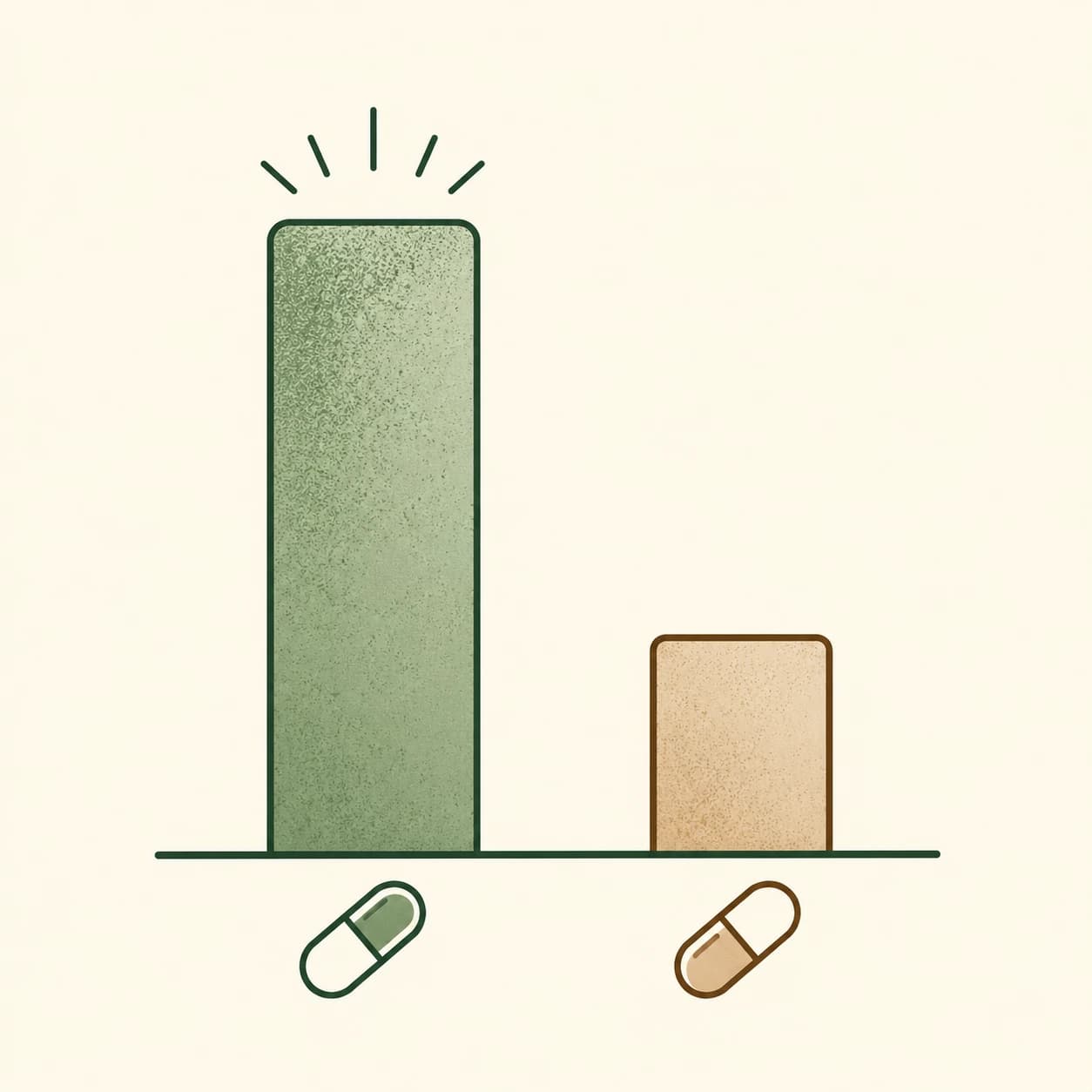
Every caution on this page assumes a meaningful, active dose reached your bloodstream — and that's not automatic. A 2023 crossover pharmacokinetic study gave 16 healthy adults two different standardized ashwagandha extracts and measured actual withanolide absorption: the higher-glycoside extract produced 18.2 times greater total drug exposure and 280.7 times greater bioavailability per milligram than the lower-glycoside extract, despite both being sold as "ashwagandha" (Kim et al., 2023). In plain terms, interaction risk isn't a fixed property of "ashwagandha" as a single substance — a low-potency, unstandardized root-powder product and a high-potency standardized extract at the same milligram number aren't delivering the same amount of active compound, and so aren't necessarily carrying the same interaction risk either. For the full KSM-66-versus-Sensoril-versus-root-powder picture, see our dosage and timing guide.
Before Surgery
We could not find a study testing ashwagandha specifically against surgical outcomes, so a precise "stop ashwagandha exactly two weeks before surgery" rule, despite being repeated widely online, doesn't appear to trace back to ashwagandha-specific research. What is verifiable: its sedative, GABA-active properties (covered above) have plausible additive effects with anesthesia-related drugs (MSKCC), and general perioperative research has long recommended discontinuing herbal supplements broadly — not this one by name — before elective surgery, due to bleeding, sedation, and drug-interaction concerns (Ang-Lee et al., 2001). Tell your surgical team every supplement you take, ashwagandha included, and follow their specific guidance rather than a number you saw online.
How to Talk to Your Doctor About Ashwagandha and Your Medications
None of this means ashwagandha is unusually dangerous — most interactions on this page are theoretical, mechanism-based, or drawn from small or early-stage evidence, not large randomized trials showing real harm. A few practical steps cover almost everything above:
- Tell your doctor or pharmacist you're taking, or considering, ashwagandha — especially if you're on a sedative, thyroid medication, antidepressant, immunosuppressant, blood thinner, or diabetes or blood pressure medication. The same conversation is worth having about anything else you take daily: our guide to herbal tea and medication interactions covers the beverage side, organised by drug class.
- Don't stop a prescribed medication in order to add a supplement instead.
- If you're taking both, space them by a couple of hours where practical — a general pharmacy practice for supplement-medication combinations, not an ashwagandha-specific proven protocol.
- Watch for new symptoms — new drowsiness, a racing heart, dizziness, or unusual fatigue — in the weeks after adding ashwagandha to an existing medication.
- If you notice a new symptom, call your prescriber rather than waiting it out.
Frequently Asked Questions (FAQ)
Can I take ashwagandha with thyroid medication like levothyroxine? It depends heavily on which thyroid condition you have. It may offer modest benefit in subclinical hypothyroidism specifically (Sharma et al., 2018), but real case reports link it to thyrotoxicosis, mostly in people without a hypothyroid diagnosis or who'd recently changed thyroid medication (Kamal et al., 2022). Check with your prescriber before adding it.
Can I take ashwagandha with blood thinners like warfarin? Use caution. In-vitro research on withaferin A, one of ashwagandha's active compounds, found antiplatelet, anticoagulant, and clot-dissolving (profibrinolytic) activity (Ku & Bae, 2014). Drugs.com's checker does not currently list a documented major human interaction between ashwagandha and warfarin specifically, but given this lab-level anticoagulant signal, anyone on warfarin, a DOAC (apixaban, rivaroxaban), or daily aspirin should mention ashwagandha to their prescriber — especially before surgery or dental work where bleeding risk matters.
Does ashwagandha interact with antidepressants or SSRIs? Possibly — a 2023 pharmacovigilance review found adaptogens including ashwagandha causally linked to 30 adverse events among people also taking antidepressants, though this is chart-review evidence, not a randomized trial (Siwek et al., 2023). A 2025 case report adds a specific, dated example: a woman on escitalopram (Lexapro) developed serotonin syndrome after taking a high combined dose of ashwagandha (Hanly-Jorda et al., 2025) — a single case at a high dose, not proof of risk at standard doses, but a real illustration of why this combination is worth a specific conversation. Talk to your prescriber before combining ashwagandha with any antidepressant, SSRI included.
Is ashwagandha safe with blood pressure or diabetes medication? Use caution rather than assuming it's fine. Ashwagandha has shown modest blood-sugar- and blood-pressure-lowering effects in some research, which could add to what those medications already do and increase the risk of levels dropping too low. Monitor closely, especially when starting.
Does ashwagandha interact with alcohol? Likely additive sedation, though this hasn't been tested directly in a dedicated human trial. Ashwagandha's GABA-active, sedative properties and alcohol's central-nervous-system depressant effect work through overlapping pathways, so combining them can increase drowsiness and impairment beyond what either produces alone. Given ashwagandha's rare but documented liver-injury signal, heavy or regular alcohol use alongside it is an added reason for caution rather than a routine combination.
Does ashwagandha interact with sleep medication or melatonin? Likely additive. Ashwagandha has its own sedative, GABA-active properties, so combining it with sleep medications, benzodiazepines, or OTC sedating supplements like melatonin, kava, or valerian could increase drowsiness beyond what either produces alone.
How many medications does ashwagandha interact with? Drugs.com's interaction-checker tool lists 478 medications with a documented interaction, most rated moderate or minor rather than major. That reflects theoretical and mechanism-based cautions across a huge range of drugs, not 478 proven dangerous combinations — check your specific medications directly rather than relying on the aggregate count alone.
Does ashwagandha affect birth control or hormonal contraceptives? There's no documented case of ashwagandha reducing contraceptive effectiveness, and it isn't established to significantly induce or inhibit the liver enzyme (CYP3A4) that metabolizes most hormonal contraceptives. That said, this specific interaction hasn't been directly studied in a clinical trial, so "no evidence of a problem" isn't the same as "proven safe" — mention it to your prescriber if you're starting both.
How long before surgery should I stop taking ashwagandha? There's no ashwagandha-specific study establishing a precise cutoff, so a specific "stop exactly two weeks before" rule repeated online doesn't trace back to ashwagandha research. General perioperative guidance recommends discontinuing herbal supplements broadly before elective surgery due to sedation, bleeding, and drug-interaction concerns (Ang-Lee et al., 2001). Tell your surgical team you take it and follow their specific timeline rather than a number you saw online.
Can I take ashwagandha with stimulant or ADHD medication? This hasn't been directly studied — there's no published case report or clinical trial testing ashwagandha alongside stimulant ADHD medications like methylphenidate or amphetamine salts. Because ashwagandha's documented effects are calming/sedative, the theoretical concern actually runs the opposite direction from most items on this page: it could blunt rather than compound a stimulant's effect. Treat this as an open question to raise with a prescriber rather than an established caution.
How we made this guide: Researched, written, and fact-checked by The Wellness Voyage editorial team, with every health claim backed by a citable source — recognised health authorities and peer-reviewed studies are linked throughout and listed in full below. We fact-check and review this article periodically and update it as the evidence changes; the last reviewed and updated date is shown with this article. It is written to inform, not to replace personalised advice from a qualified healthcare professional.
Medical disclaimer: This article is for informational purposes only. Always consult a qualified healthcare provider before making changes to your health routine.
Sources
- Drugs.com. Ashwagandha (Ashwaganda) Drug Interactions Checker. https://www.drugs.com/drug-interactions/ashwaganda.html
- Bone K, Mills S. Principles and Practice of Phytotherapy: Modern Herbal Medicine (2nd ed.). Churchill Livingstone, 2013 — Book. pp. 950–958.
- Duke JA. Handbook of Medicinal Herbs, Vol. 1 (2nd ed.). CRC Press, 2002 — Book. p. 42.
- Chevallier A. Natural Health Encyclopedia of Herbal Medicine (2nd American ed.). DK Publishing, 2000 — Book. p. 155.
- Memorial Sloan Kettering Cancer Center. About Herbs: Ashwagandha. https://www.mskcc.org/cancer-care/integrative-medicine/herbs/ashwagandha
- Sharma AK, Basu I, Singh S. Efficacy and Safety of Ashwagandha Root Extract in Subclinical Hypothyroid Patients: A Double-Blind, Randomized Controlled Trial. J Altern Complement Med, 2018 — PubMed. https://pubmed.ncbi.nlm.nih.gov/28829155/
- Kamal HI, Patel K, Brdak A, Heffernan J, Ahmad N. Ashwagandha as a Unique Cause of Thyrotoxicosis Presenting With Supraventricular Tachycardia. Cureus, 2022 — PMC. https://pmc.ncbi.nlm.nih.gov/articles/PMC9035336/
- Hayashi M, Hamada H, Azuma S, Hayashi K. Painless Thyroiditis by Withania somnifera (Ashwagandha). Cureus, 2024 — PMC. https://pmc.ncbi.nlm.nih.gov/articles/PMC10981964/
- van der Hooft CS, Hoekstra A, Winter A, de Smet PAG, Stricker BHCh. Thyrotoxicosis following the use of ashwagandha [Dutch]. Ned Tijdschr Geneeskd, 2005 — PubMed. https://pubmed.ncbi.nlm.nih.gov/16355578/
- Siwek M, Woroń J, Wrzosek A, Gupało J, Chrobak AA. Harder, better, faster, stronger? Retrospective chart review of adverse events of interactions between adaptogens and antidepressant drugs. Front Pharmacol, 2023 — PMC. https://pmc.ncbi.nlm.nih.gov/articles/PMC10565488/
- Kasarla SS, Borse SP, Kumar Y, Sharma N, Dikshit M. In vitro effect of Withania somnifera, AYUSH-64, and remdesivir on the activity of CYP-450 enzymes. Front Pharmacol, 2022 — PMC. https://pmc.ncbi.nlm.nih.gov/articles/PMC9597875/
- Kim SK, Venkatesan J, Rathi P, Antony B. Pharmacokinetics and bioequivalence of Withania somnifera extracts — a double blind, crossover study in healthy adults. Heliyon, 2023 — PMC. https://pmc.ncbi.nlm.nih.gov/articles/PMC10746415/
- Ang-Lee MK, Moss J, Yuan CS. Herbal medicines and perioperative care. JAMA, 2001 — PubMed. https://pubmed.ncbi.nlm.nih.gov/11448284/
- Ku SK, Bae JS. Antithrombotic and profibrinolytic activities of withaferin A. Vascular Pharmacology, 2014 — PubMed. https://pubmed.ncbi.nlm.nih.gov/24534482/
- Hanly-Jorda F, Bilik SM, Patel N, Bilik AJ. Serotonin Syndrome Induced by the Pharmacological Interaction of Withania Somnifera and Escitalopram: A Case Report (P12-2.009). Neurology, 2025;104(7_Supplement_1) — American Academy of Neurology 2025 Annual Meeting abstract. https://www.neurology.org/doi/10.1212/WNL.0000000000210450
- LiverTox: Clinical and Research Information on Drug-Induced Liver Injury. Bupropion. National Institute of Diabetes and Digestive and Kidney Diseases, NIH — NCBI Bookshelf. https://www.ncbi.nlm.nih.gov/books/NBK548836/
Sources 1–14 accessed 24 July 2026; sources 15–16 accessed 9 September 2026.

Emily Johnson, MSc, RH (AHG)
A registered herbalist who checks the mechanism behind an interaction warning, not just the warning itself.