Our ashwagandha benefits guide covers what the herb is claimed to do. This guide answers a different question: how good is the evidence behind those claims, really? Not benefit by benefit, but evidence tier by evidence tier — because "is ashwagandha backed by science" doesn't have one honest answer. Some claims rest on meta-analyses pooling hundreds of participants across independent trials. Others rest on a single small study, or nothing beyond traditional use. Both are true about the same herb, and conflating them is exactly what most ashwagandha content does.
Quick answer:
- Strong evidence: stress/cortisol reduction and sleep quality — each backed by a full meta-analysis pooling multiple independent trials (15 RCTs/873 people for stress; 5 RCTs/400 people for sleep).
- Real but narrower evidence: menopause and perimenopause symptom relief — two genuinely positive RCTs, but not yet independently replicated by a different research team or product.
- Thin or absent evidence: weight loss and "women over 50" as a distinct category — inconsistent or no dedicated trials exist.
- NCCIH's own verdict: the NIH's research center calls the evidence sufficient only for insomnia, stress, and male fertility markers; everything else, including weight loss, menopause, and cognitive function, it lists as "not enough evidence yet."
The rest of this guide walks through why, tier by tier.
Why "Is There Science Behind This?" Deserves a More Precise Answer Than Yes or No
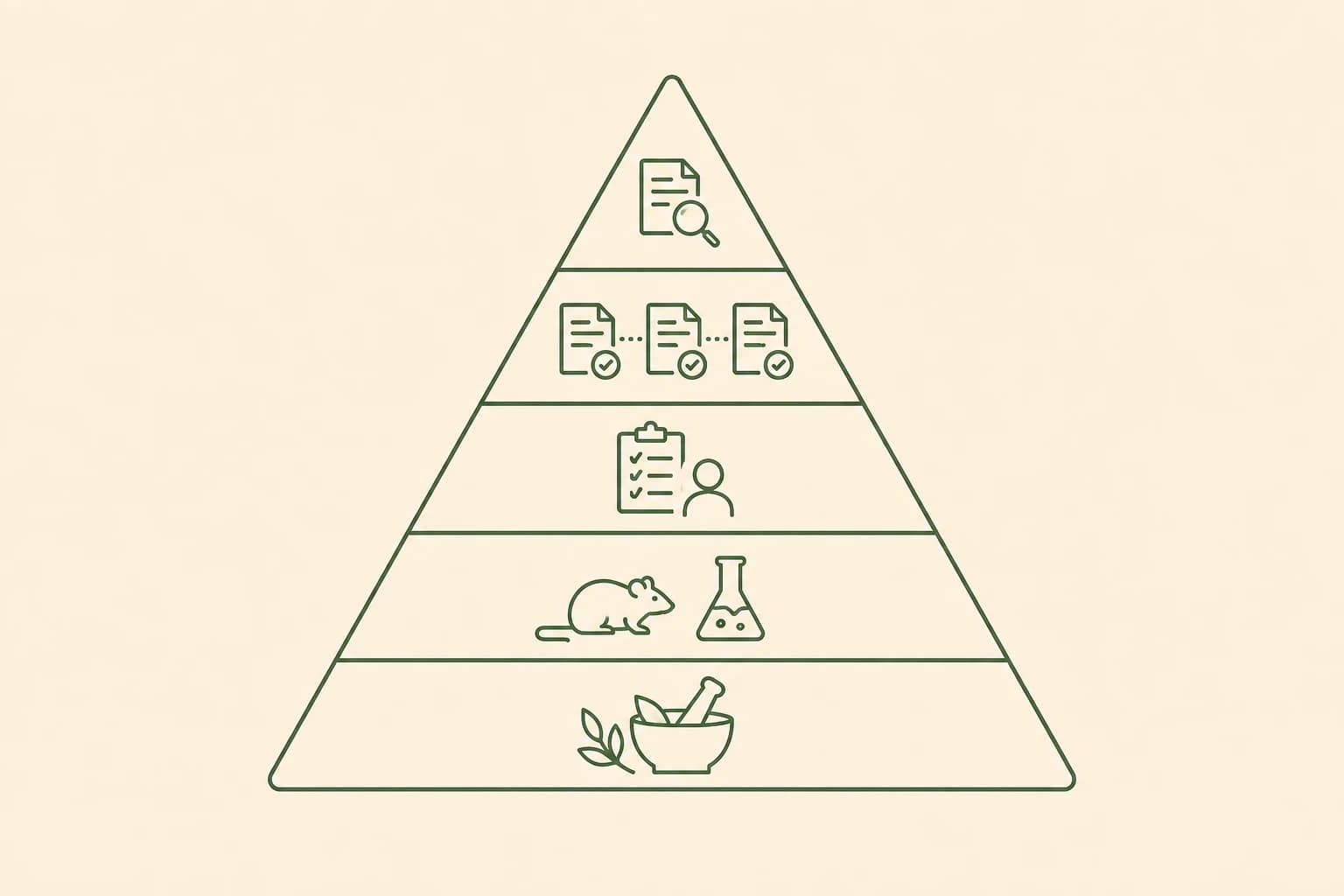
Not all evidence is equal, and there's a widely used hierarchy for ranking it, roughly from weakest to strongest: traditional or anecdotal use, then animal and lab (in-vitro) studies, then a single controlled human trial, then multiple independent controlled trials reaching similar conclusions, then systematic reviews and meta-analyses that formally pool several trials into one statistical estimate. Each tier up means more people studied, more researchers involved, and more protection against one trial's fluke result or one lab's bias driving the conclusion.
Ashwagandha's evidence base doesn't sit at one tier. Stress and sleep claims reach the top of that hierarchy. Menopause evidence is real but sits one tier down, for reasons this guide explains. Weight loss and some other claims barely clear the bottom. A single yes/no verdict flattens all of that into something misleading in both directions — understating the strong claims, overstating the weak ones.
This informal hierarchy mirrors the logic behind two more formal quality-appraisal frameworks readers may encounter elsewhere: the GRADE system, which assigns each pooled finding a certainty rating (high, moderate, low, or very low), and the Cochrane risk-of-bias tool (RoB2), which appraises individual trials for methodological flaws like inadequate blinding or selective outcome reporting. This guide's "strong," "real but narrower," and "thin" language is doing the same job in plainer terms.
How Ashwagandha Is Thought to Work
Most of the human trials in this evidence base measure outcomes — perceived stress scores, cortisol levels, sleep quality — rather than mechanism. The commonly proposed explanation involves ashwagandha's withanolide compounds, its main active constituents, acting on the body's stress-hormone (HPA-axis) signaling, and, in some preclinical work, on GABA-related pathways in the nervous system. That mechanistic research sits on the lower rungs of the hierarchy above — animal and lab (in-vitro) studies — and isn't a substitute for the clinical outcome data covered in the rest of this guide. It explains a plausible "why," not proof of effect in humans.
What Sits at the Top: Systematic Reviews and Meta-Analyses
A meta-analysis doesn't run a new experiment — it statistically pools the results of multiple existing trials into one combined estimate, which cancels out some of the noise and bias any single trial carries. For ashwagandha, exactly two claim areas have a published meta-analysis behind them.
Stress and cortisol: a 2025 systematic review and meta-analysis pooled 15 randomized controlled trials covering 873 participants total. It found a statistically significant reduction in Perceived Stress Scale scores (a pooled difference of −4.88 points, 95% CI −7.84 to −1.91, p=0.0013) and in morning cortisol (p<0.0001) at 8 weeks versus placebo. Quality of life, notably, did not improve significantly across the pooled trials (p=0.37) — a genuine null result inside an otherwise positive meta-analysis, and a detail worth knowing rather than smoothing over (Bachour et al., 2025). It also found a statistically significant improvement in anxiety, measured by the Hamilton Anxiety Rating Scale — worth flagging alongside NCCIH's more cautious "evidence is unclear" framing on anxiety specifically, since this is part of the same evidence base NCCIH draws its overall assessment from.
Sleep: a 2021 meta-analysis pooled 5 randomized controlled trials covering 400 participants, finding a small but statistically significant benefit (standardized mean difference −0.59, 95% CI −0.75 to −0.42). The authors specifically noted the effect was more pronounced in people with diagnosed insomnia, at doses of 600mg/day or more, over 8 weeks or longer — not a blanket "helps everyone sleep better" finding (Cheah et al., 2021).
A third, safety-specific systematic review pooled 23 randomized trials and 2,317 participants across doses of 125–600mg/day and durations from a single dose up to 180 days. It found liver, kidney, blood, hormone, and cardiovascular biomarkers stayed within normal ranges, with only mild, infrequent gastrointestinal discomfort, headache, and drowsiness reported — but the review's own authors flagged limited data beyond 180 days as a real gap (Coope et al., 2026).
What NCCIH's Own Evidence Review Actually Says
NCCIH, the NIH's research center for complementary health, is the most useful calibration anchor available for this whole topic, precisely because it isn't trying to sell anything. Its own stated position: research shows some ashwagandha preparations may be effective for insomnia and stress specifically, and separately, limited evidence suggests it may increase testosterone and improve sperm quality in men over two to four months. For nearly everything else routinely claimed — weight loss, general anxiety, athletic performance, cognitive function, diabetes, menopause — NCCIH states there isn't enough evidence yet to draw a conclusion (NCCIH). That maps closely onto the meta-analysis picture above: the two areas with published meta-analyses are the same two areas NCCIH is willing to call sufficiently evidenced. For the general anxiety and overthinking NCCIH still calls unclear, a non-pharmacological approach has a solid evidence base of its own — our mindfulness for beginners guide covers a practice that can be used alongside or instead of a supplement, with no dosing or interaction questions attached to it.
Multiple Independent RCTs: The Stress/Cortisol Evidence as a Case Study
Real replication means more than "a second paper exists" — ideally, different research teams, different specific products, and different institutions reaching a similar conclusion independently. The stress and cortisol evidence is the best example of this in the entire ashwagandha literature.
Four separate randomized, placebo-controlled trials, using four genuinely different standardized extracts, all found significant reductions in perceived stress: a 2019 trial using Shoden (240mg, 60 days, n=60) found cortisol fell 23% versus a 0.5% placebo change (Lopresti et al., 2019); a 2019 trial using KSM-66 (250mg and 600mg arms, 8 weeks, n=58 completing) found both doses reduced stress and cortisol, with the higher dose also improving anxiety scores (Salve et al., 2019); a 2023 trial using a Sabinsa-formulated extract with added piperine (500mg, 60 days, n=50 completing) found improved stress, anxiety, and quality-of-life scores alongside lower morning cortisol (Majeed et al., 2023); and a 2026 trial using a newer sustained-release formulation called AshwaSR (150mg and 300mg arms, 60 days, n=126 completing) found stress scores fell 38.6% and 41.6% at the two doses, with cortisol dropping significantly at the higher dose (Thanawala et al., 2026). Four different products, four different author teams, converging on the same broad finding — that's what real replication looks like, and it's a genuinely strong pattern.
One related fact deserves equal billing: three of these four trials had a direct industry connection, detailed in full below. That doesn't erase the replication — different companies, with competing products, independently finding similar results is arguably a point in favor of the effect being real. But it does narrow what "independent" means here. These trials are independent in their research teams and products. They are not independent from the supplement industry as a whole.
When Evidence Is Thinner Than It Looks: The Menopause Case Study
Contrast that with our menopause guide's evidence base, which is genuinely positive but sits one tier lower on the hierarchy, and it's worth being precise about why. Two real, randomized, placebo-controlled trials — Gopal et al., 2021 (n=100, 91 completing) and Vani et al., 2026 (n=60) — both found significant reductions in menopause symptom scores. But both were conducted in India, both used the same branded extract (KSM-66), both had that extract supplied free by the same manufacturer (Ixoreal Biomed), and both ran for a similarly short window (8 weeks and 56 days). That's two genuine positive trials, not two independent replications in the stricter sense the stress evidence demonstrates — a different research group, in a different country, using a different product, hasn't yet tested this specific claim. The findings are real. The confidence you should place in "settled science" language around them should be more measured than the stress evidence above, until that broader replication happens.
A Genuine Null Finding, Featured Honestly
A trustworthy summary of any evidence base has to include the trials that didn't confirm the hypothesis, not just the ones that did. Here's a real one.
A 2023 randomized, placebo-controlled trial gave 120 adults (111 completing) a standardized extract called Witholytin, at an unspecified dose, for 12 weeks — the longest duration of any stress trial in this evidence base. Its primary outcome, Perceived Stress Scale score, improved in both groups (38.59% with ashwagandha, 35.63% with placebo) with no statistically significant difference between them (p=0.867) — a genuine null result on the trial's main hypothesis. Two secondary outcomes did reach significance: fatigue scores improved significantly more with ashwagandha (p=0.016), and heart rate variability, a marker of physiological stress recovery, improved with ashwagandha while it worsened with placebo (p=0.003) (Smith et al., 2023). We're featuring this trial specifically because a genuinely balanced evidence base includes results like this one — positive on some measures, flatly non-significant on its own primary measure — and any summary that only cites the positive stress trials above without this one is quietly cherry-picking.
Industry Funding and Transparency
This is a transparency point, not an accusation — funding source doesn't automatically mean a result is wrong, but it's exactly the kind of thing a rigorous reader deserves to know plainly rather than have buried in a methods section.
Looking across the trials cited in this guide: the Vani 2026 and Salve 2019 trials both had KSM-66 extract supplied free by Ixoreal Biomed, with study authors declaring no direct financial conflict of interest beyond the free product. The Lopresti 2019 trial was funded by Arjuna Natural (maker of the Shoden extract used), though the study was independently managed by two principal investigators who declared no competing interests, with a third author disclosing prior unrelated funding from the same company. Two trials go further: the Majeed 2023 trial's authors are directly employed by Sabinsa Corporation, the company that manufactured the extract tested, and the Thanawala 2026 trial's authors are directly employed by the two companies that supplied and managed the study (Laila Nutra and Nutriventia). All of these relationships were disclosed by the authors themselves in each paper — that disclosure is exactly the system working as intended, and it's why we can report this pattern accurately at all. Why it matters: funding source and author employment can subtly shape study design, outcome selection, or reporting emphasis even without any deliberate misconduct, which is a well-documented pattern across clinical research generally, not something specific to ashwagandha. None of this means these trials' findings are false. It means treating "an industry-funded trial found X" with the same scrutiny you'd apply to any single study, industry-funded or not — and knowing which is which.
Sample Sizes in Context: How Big Are These Studies, Really
"Small studies" is vague enough to mean almost anything. Here are real numbers. Across the trials cited throughout this cluster: the male fertility trial enrolled 46 men; the sexual-function trials in women enrolled 50 and 80; the perimenopause trials enrolled 100 and 60; the sleep trials ranged from 52 to 200; the stress trials ranged from 50 to 135 enrolled. Typical completion, after dropouts, lands most individual RCTs in the 50-to-150-participant range, running 6 to 12 weeks. The safety-focused systematic review above pooled 23 such trials into 2,317 total participants specifically because individual trials of this size aren't large enough to catch rare events on their own.
That's the real, practical limit of a 50-to-150-person, 8-to-12-week trial: it has a reasonable chance of detecting a moderate-to-large effect if one genuinely exists, but it has essentially no power to detect something that happens in 1 in 1,000 or 1 in 10,000 users. That's precisely why the liver injury cases covered in our full case-report breakdown of ashwagandha's side effects come from individual case reports rather than showing up as a flagged finding in any RCT — a rare adverse event needs either a very large trial or, more realistically, years of real-world use and case-report surveillance to surface at all. Absence of a signal in a 100-person trial is not the same as absence of risk.
What This Means for How Confident You Should Be
Ranking the cluster's major claim categories honestly, from strongest evidence to weakest:
| Claim category | Evidence tier | Trials / participants | Key source |
|---|---|---|---|
| Stress & cortisol reduction | Meta-analysis (top tier) | 15 RCTs / 873 | Bachour et al., 2025 |
| Sleep quality | Meta-analysis (top tier) | 5 RCTs / 400 | Cheah et al., 2021 |
| Male fertility markers (testosterone, sperm quality) | NCCIH: limited but positive, 2–4 months | Individual RCTs, no meta-analysis yet | NCCIH · guide for men |
| Menopause / perimenopause symptoms | Two positive RCTs, same extract, not yet independently replicated | 2 RCTs / ~160 total | Gopal et al., 2021; Vani et al., 2026 · menopause guide |
| Weight loss | Inconsistent, conflicting single trials | Few RCTs | See our weight loss guide |
| "Women over 50" as a category | No dedicated trial exists | 0 dedicated RCTs | See our guide for women over 50 |
| General anxiety (beyond the stress-trial designs above) | NCCIH: unclear | Mixed / not yet resolved | NCCIH |
Frequently Asked Questions (FAQ)
Is ashwagandha actually backed by science, or is it mostly hype? Both, depending on the claim. Stress, cortisol, and sleep are backed by systematic reviews pooling hundreds of participants across multiple independent trials — genuinely strong evidence (Bachour et al., 2025; Cheah et al., 2021). Weight loss and "women over 50" as a category rest on much thinner, sometimes single-trial or no-trial evidence. Treating ashwagandha as one uniform level of "backed by science" misrepresents both ends.
What does NCCIH (the NIH's own research center) say about ashwagandha evidence? NCCIH states the evidence is sufficient specifically for insomnia and stress, and separately for male infertility. For nearly everything else commonly claimed — including weight loss, general anxiety, cognitive function, and menopause — it says there isn't enough evidence yet to draw a conclusion (NCCIH).
Has ashwagandha been tested head-to-head against a prescription anti-anxiety or stress medication, not just placebo? No confirmed head-to-head randomized trial comparing ashwagandha directly against a prescription medication (such as an SSRI or benzodiazepine) was found in this evidence base. Every trial referenced in this guide compares ashwagandha to a placebo, not to an active pharmaceutical comparator, which means claims about ashwagandha being "as effective as" any specific drug aren't supported by the trial data covered here. If you're already taking a prescription medication, our guide to ashwagandha's drug interactions covers what's actually known about combining the two.
Is there a meta-analysis specifically on ashwagandha and anxiety, separate from stress? The Bachour et al. 2025 meta-analysis already cited throughout this guide for stress and cortisol also measured anxiety (via the Hamilton Anxiety Rating Scale) and found a statistically significant improvement. A separate 2024 systematic review and meta-analysis (PubMed ID 39348746) addressed ashwagandha's effect on stress and anxiety together as well. That said, NCCIH's own evidence review still describes the anxiety evidence specifically as unclear — a case where recent pooled-trial data shows a more positive signal than NCCIH's more cautious sufficiency framing, which is worth knowing if you're weighing the two.
What's the strongest scientific evidence for ashwagandha? Stress and cortisol reduction, based on a 2025 meta-analysis pooling 15 randomized trials and 873 participants, and sleep, based on a 2021 meta-analysis of 5 trials and 400 participants (Bachour et al., 2025; Cheah et al., 2021). These are the only two areas with published meta-analyses in this evidence base.
How does ashwagandha actually work in the body, according to the research? Most of the human trials in this evidence base measure outcomes — perceived stress scores, cortisol levels, sleep quality — rather than mechanism. The commonly proposed mechanism involves ashwagandha's withanolide compounds acting on the body's stress-hormone (HPA-axis) signaling and, in some preclinical work, GABA-related pathways. That mechanistic research sits on the lower rungs of the evidence hierarchy this article describes (lab and animal studies) and isn't a substitute for the clinical outcome data covered above — it explains a plausible "why," not proof of effect in humans.
Are ashwagandha studies funded by supplement companies? Frequently, yes, and the pattern is worth knowing rather than hiding. Several trials had extract supplied free by manufacturers (Ixoreal Biomed, Arjuna Natural), and at least two had study authors who were direct employees of the supplement company involved (Sabinsa, Laila Nutra/Nutriventia) (Majeed et al., 2023; Thanawala et al., 2026). This doesn't automatically invalidate the findings, but it's a real transparency pattern readers should know about.
How big are the clinical trials behind ashwagandha's claims? Mostly modest. Individual RCTs in this evidence base typically enroll 50 to 150 participants and run 6 to 12 weeks. That's enough to detect a reasonably large effect but not enough to catch rare side effects, which is why liver injury cases come from individual case reports, not trial data — see our side effects guide.
What's the difference between a systematic review and a meta-analysis? A systematic review is a structured, criteria-based summary of all the relevant studies on a question. A meta-analysis goes further: it statistically pools the numeric results of multiple similar trials into one combined effect estimate. Every meta-analysis involves a systematic review, but not every systematic review includes a meta-analysis — some, like a safety review pooling adverse-event rates across differently designed trials, summarize findings narratively instead. For ashwagandha, only two claim areas (stress/cortisol and sleep) currently have a published meta-analysis behind them; other claims may have narrative systematic reviews without a pooled statistical estimate.
Do any of these ashwagandha trials report how they registered or pre-specified their outcomes? This guide doesn't currently detail each trial's registration status, and it's a real gap worth being upfront about: pre-registration (declaring a primary outcome before the trial starts, as the Smith et al. 2023 Witholytin trial did) makes a null result like that trial's harder to explain away after the fact, and is one more marker of trial quality beyond sample size alone. Readers who want this level of detail should check each trial's original registry entry, linked from its PubMed page.
How we made this guide: Researched, written, and fact-checked by The Wellness Voyage editorial team against primary sources — the peer-reviewed trials, meta-analyses, and NCCIH's own evidence review are linked throughout and listed in full below. This article has not yet been reviewed by a licensed physician or pharmacist; it reflects editorial fact-checking against cited primary literature, not a clinical review. We recheck and update it periodically as new evidence publishes; the last-updated date is shown with this article. It is written to inform, not to replace personalised advice from a qualified healthcare provider.
Medical disclaimer: This article is for informational purposes only. Always consult a qualified healthcare provider before making changes to your health routine.
Sources
- National Center for Complementary and Integrative Health (NCCIH). Ashwagandha. https://www.nccih.nih.gov/health/ashwagandha
- Bachour G, et al. Effects of Ashwagandha Supplements on Cortisol, Stress, and Anxiety Levels in Adults: A Systematic Review and Meta-Analysis. BJPsych Open, 2025 — PMC. https://pmc.ncbi.nlm.nih.gov/articles/PMC12242034/
- Cheah KL, Norhayati MN, Yaacob LH, Rahman RA. Effect of Ashwagandha (Withania somnifera) extract on sleep: A systematic review and meta-analysis. PLoS One, 2021 — PubMed. https://pubmed.ncbi.nlm.nih.gov/34559859/
- Coope OC, Willems MET, Levington A, Tallon MJ, Roman-Viñas B, Spurr TJ. Back to the Roots: Safety and Tolerability of Standardised Ashwagandha Root Extract in Healthy Adults — A Systematic Review of Biomarkers and Adverse Events. Pharmaceuticals (Basel), 2026;19(5):725 — PubMed. https://pubmed.ncbi.nlm.nih.gov/42198398/
- Lopresti AL, Smith SJ, Malvi H, Kodgule R. An investigation into the stress-relieving and pharmacological actions of an ashwagandha extract. Medicine (Baltimore), 2019 — PMC. https://pmc.ncbi.nlm.nih.gov/articles/PMC6750292/
- Salve J, Pate S, Debnath K, Langade D. Adaptogenic and Anxiolytic Effects of Ashwagandha Root Extract in Healthy Adults: A Double-blind, Randomized, Placebo-controlled Clinical Study. Cureus, 2019 — PMC. https://pmc.ncbi.nlm.nih.gov/articles/PMC6979308/
- Majeed M, Nagabhushanam K, Mundkur L. A standardized Ashwagandha root extract alleviates stress, anxiety, and improves quality of life in healthy adults by modulating stress hormones. Medicine (Baltimore), 2023 — PubMed. https://pubmed.ncbi.nlm.nih.gov/37832082/
- Thanawala S, Shah R, Alluri KV, et al. Efficacy and safety of Ashwagandha root extract sustained-release (AshwaSR) capsules in healthy adult, stressed subjects. Medicine (Baltimore), 2026 — PubMed. https://pubmed.ncbi.nlm.nih.gov/41824889/
- Smith SJ, Lopresti AL, Fairchild TJ. Exploring the efficacy and safety of a novel standardized ashwagandha root extract (Witholytin) in adults experiencing high stress and fatigue: a randomized, double-blind, placebo-controlled trial. J Psychopharmacol, 2023 — PMC. https://pmc.ncbi.nlm.nih.gov/articles/PMC10647917/
- Gopal S, Ajgaonkar A, Kanchi P, et al. Effect of an ashwagandha root extract on climacteric symptoms in women during perimenopause: a randomized controlled trial. J Obstet Gynaecol Res, 2021 — PubMed. https://pubmed.ncbi.nlm.nih.gov/34553463/
- Vani I, Muralidhar G, Rao BS. A prospective, randomized, double-blind, placebo-controlled study on efficacy and safety of Ashwagandha root extract for managing menopausal symptoms in women. Front Reprod Health, 2025/2026 — PubMed. https://pubmed.ncbi.nlm.nih.gov/41561822/
All sources accessed 17 July 2026.

Emily Johnson, MSc, RH (AHG)
A registered herbalist who sorts evidence by study design rather than treating every citation as equally strong.