Most "ashwagandha benefits for women" pages blend two different kinds of evidence without saying so: general-population stress and sleep research re-labeled with a female headline, and real, separately-run trials in women specifically. Both exist. This guide draws that line clearly, the same way our guide for men does for the parallel evidence in men. For the shared evidence and full safety picture, start with our ashwagandha benefits guide.
Key takeaways:
- Sexual function has the strongest female-specific evidence: two placebo-controlled trials in women only, using the validated Female Sexual Function Index, both showing significant improvement over 8 weeks.
- Perimenopause and menopause symptoms improved significantly in two separate RCTs (300mg twice daily), including reduced hot flashes and shifts in estradiol, FSH, and LH.
- Thyroid hormones improved in a subclinical hypothyroidism trial, but rare thyrotoxicosis case reports also exist — both resolved after stopping.
- Pregnancy and breastfeeding: avoid — modern guidance (NCCIH) and the traditional record converge on this, for different reasons.
- PMS, PCOS, and women over 50 as dedicated study populations: no dedicated trial found for any of the three. Treat claims about these as unproven inference, not tested findings.
What's Actually Female-Specific Evidence, and What's Shared
The stress, cortisol, and sleep research covered in our main benefits guide comes from mixed-sex or sex-unspecified adult populations — real evidence, but not evidence about women specifically, whatever a headline implies. What's truly female-specific: two trials measuring sexual function on a validated scale in women only, two placebo-controlled trials in perimenopausal and menopausal women, and thyroid case reports that happened to occur in female patients. Those are the sections below, and we're naming which is which as we go.
Stress, Mood, and the Menstrual Cycle
The stress and cortisol trials covered in depth in our main guide were conducted in general adult populations — none in this evidence base were run exclusively or predominantly in women. One of the most-cited, for instance, enrolled 60 adults, 37 men and 23 women, and measured cortisol and anxiety across the whole group rather than analyzing women as a separate cohort (Lopresti et al., 2019); a larger, more recent trial of 126 people showed a similar pattern (Thanawala et al., 2026). That doesn't make the findings less real; it means they're evidence about stress in adults generally, not a female-specific mechanism. We want to be equally direct about a gap: we could not find a trial testing ashwagandha specifically for PMS or menstrual-cycle-related symptoms. It's plausible that general stress and mood effects would extend there, but that's an inference on our part, not a tested finding — treat any site that states this as settled with real skepticism.
The same honesty applies to PCOS, one of the most common reasons people search for ashwagandha and women's hormones together. A 2026 narrative review examined both questions directly and concluded that clinical evidence for PCOS specifically is currently limited, drawing mainly on preclinical data and on studies conducted in people without PCOS rather than dedicated PCOS trials — and it notes that current PCOS management guidelines don't recommend herbal supplements like ashwagandha, given the lack of high-quality clinical evidence (Namysł et al., 2026). That's a considered summary from researchers who reviewed the evidence in depth, not just our own read of an absence.
Sexual Function
This is the strongest, most female-specific evidence in this whole article, and it's worth leading with rather than a vaguer claim.
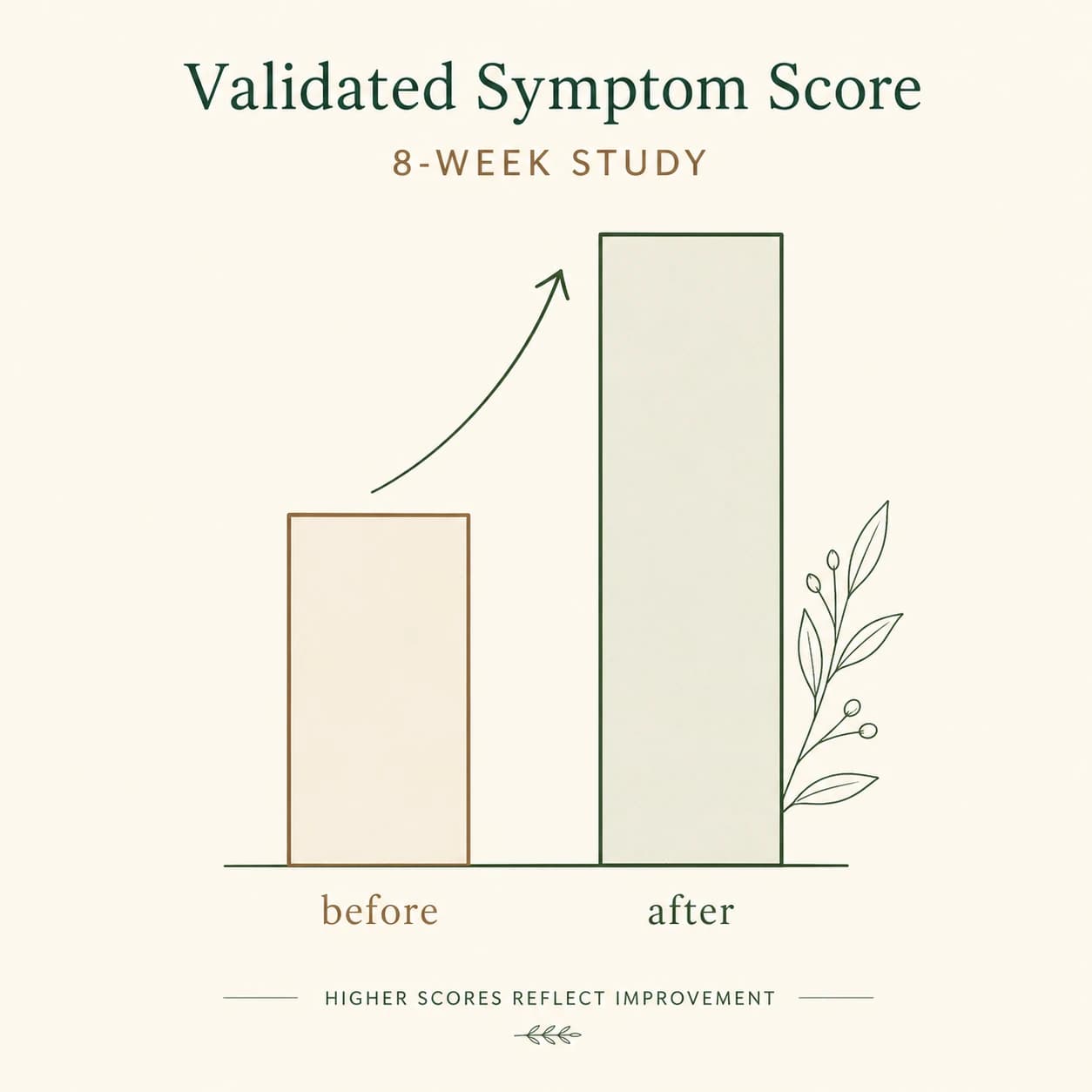
A registered clinical trial (CTRI/2015/07/006045) gave 50 women 300mg twice daily for 8 weeks and measured outcomes on the Female Sexual Function Index (FSFI) and Female Sexual Distress Scale — validated clinical measures, not a self-report survey invented for marketing. Scores improved significantly versus placebo across domains including arousal, lubrication, orgasm, and satisfaction (Dongre et al., 2015). A second trial, in 80 women diagnosed with hypoactive sexual desire disorder (HSDD) (72 completing) over 8 weeks, found FSFI scores rose from 14.20 to 22.62 with ashwagandha, versus 14.17 to 19.25 with placebo — a significant difference (Ajgaonkar et al., 2022). Both trials are in fact female-only studies with a validated outcome measure, not general-population data repurposed with a gendered headline.
Hormones and the Thyroid
A randomized trial in 50 adults with subclinical hypothyroidism (mildly elevated TSH, no full diagnosis) found 600mg/day for 8 weeks moved TSH, T3, and T4 significantly toward normal versus placebo (Sharma et al., 2018) — real, positive evidence, though the trial wasn't restricted to women. On the other side, real thyrotoxicosis case reports exist, and it's worth noting the two most detailed published cases happened to be women: a 73-year-old who self-administered ashwagandha after stopping her prescribed levothyroxine (Kamal et al., 2022), and the first published case overall, a 32-year-old whose thyrotoxicosis developed as her dose increased (van der Hooft et al., 2005). Both resolved after stopping. For the full hypothyroid-versus-hyperthyroid-versus-Hashimoto's picture, see our side effects and medication interactions guides rather than the shorter version here.
Perimenopause and Menopause: A Brief Look (Full Guide Linked)
This is genuinely one of the stronger evidence categories in the whole cluster, so it's worth flagging even briefly here. An 8-week trial in 100 women (91 completing) taking 300mg twice daily found a significant reduction in total Menopause Rating Scale score, plus increased estradiol and decreased FSH and LH, versus placebo (Gopal et al., 2021). A newer trial, published in early 2026, tested KSM-66 at the same dose in 60 women aged 45–55 over 56 days and found a highly significant reduction in symptom scores, with fewer hot flashes — though its hormone shifts, while statistically significant, were numerically small (Vani et al., 2026).
Long before these trials, practitioner case histories described the same use. One published account follows a 47-year-old woman with 18 months of hot flushes, sweating, depression, and disrupted sleep, treated with a blended tincture that included Withania alongside St. John's wort, false unicorn root, wild yam, and hawthorn. Little changed in the first month, but by month two her hot flushes and irritability had eased considerably, and after a year of treatment the formula was stopped with no relapse (Bone & Mills, 2013, pp. 300–301). That's a single case history using Withania in combination with four other herbs, not a controlled trial of Withania alone — informative as long-standing practitioner context, not equivalent evidence to the RCTs above.
For the full picture on hot flashes, hormone shifts, and dosage specifically for menopause, see our guide to ashwagandha for menopause.
Weight and Metabolism: A Brief, Honest Look (Full Guide Linked)
Weight-related findings exist in this evidence base, but the picture is mixed, and we're not going to overstate it here. Some trials measured weight as a secondary outcome in stress research and found modest differences; one more recent, larger trial reported a substantially bigger effect that we think deserves real scrutiny rather than uncritical citation, given how unusually large it is for an herbal supplement and that the extract was industry-supplied. Other research has found no significant weight change at all. For the full breakdown of which trials found what, and why some numbers deserve more skepticism than others, see our guide to ashwagandha for weight loss.
Women Over 50: A Brief Look (Full Guide Linked)
Worth being honest about upfront: we did not find a dedicated clinical trial testing ashwagandha specifically in women over 50 as its own study population. The relevant evidence for this age group comes from the perimenopause trials above (which center on women roughly 45–55) and general adult research, not a dedicated 50-plus trial. Our guide to ashwagandha for women over 50 covers this distinction, and what the adjacent evidence does and doesn't support, in full.
Which Extract Form Was Actually Used in These Trials
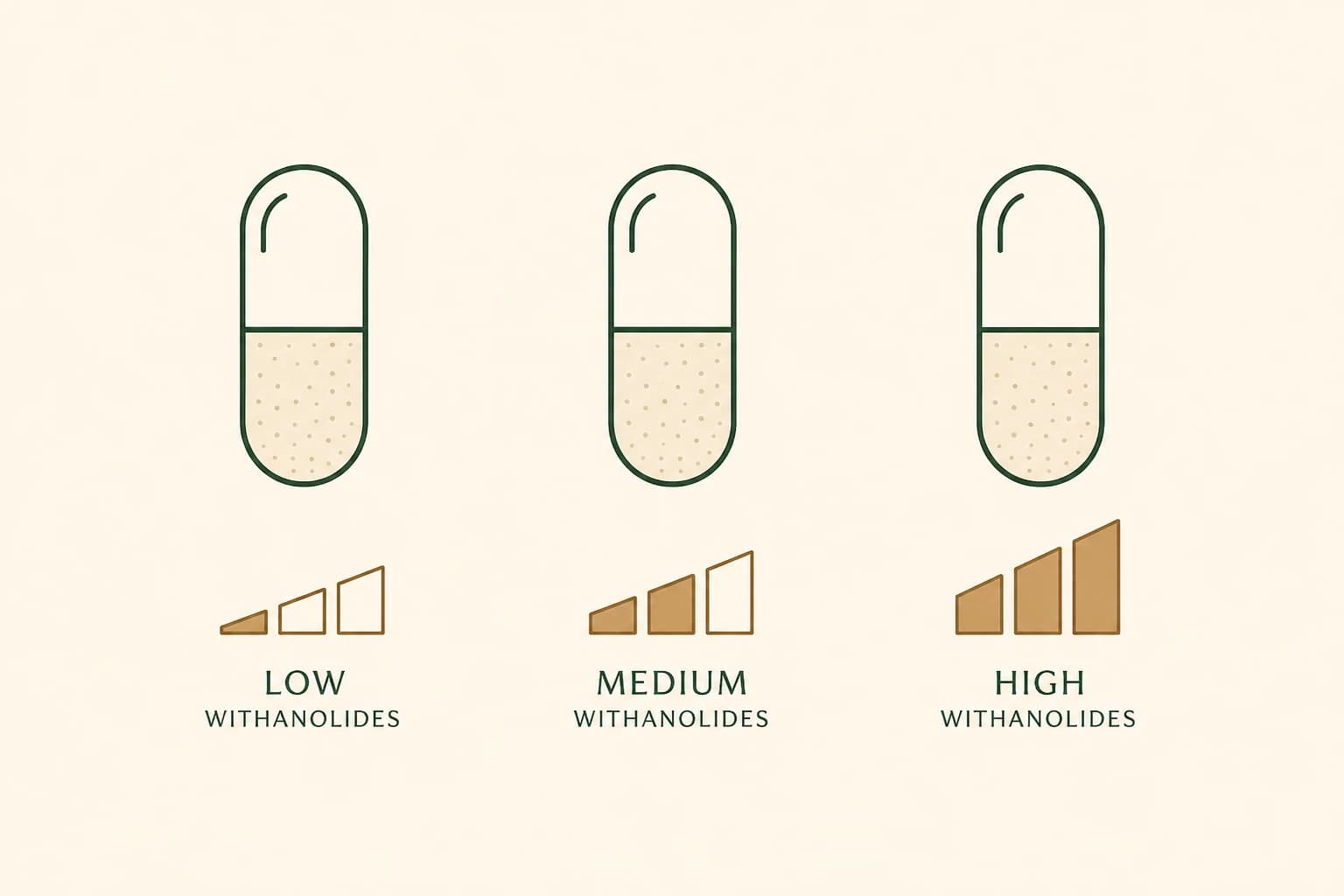
The women's trials above used different forms and doses, the same way the general and men's evidence does. The newer menopause trial used KSM-66 specifically at 300mg twice daily (Vani et al., 2026); the sexual-function and earlier menopause trials used the same 300mg-twice-daily pattern without naming a specific brand in the source we reviewed (Dongre et al., 2015; Gopal et al., 2021). These aren't interchangeable with every other "ashwagandha" product on the shelf — a crossover pharmacokinetic study gave 16 healthy adults two different standardized extracts and found the higher-glycoside extract produced 18.2 times greater total drug exposure and 280.7 times greater bioavailability per milligram than the lower-glycoside one, despite both being sold under the same name (Kim et al., 2023). For the full extract-form comparison and dosing guidance, see our dosage and timing guide.
Trials at a Glance
For quick reference, here's how the human trials discussed above compare side by side:
| Trial | Population | Dose | Duration | Primary result |
|---|---|---|---|---|
| Dongre et al., 2015 | 50 women | 300mg twice daily | 8 weeks | FSFI and Female Sexual Distress Scale scores significantly improved vs. placebo across arousal, lubrication, orgasm, and satisfaction |
| Ajgaonkar et al., 2022 | 80 women with HSDD (72 completing) | Standardized extract; dose not specified in the source reviewed | 8 weeks | FSFI rose 14.20→22.62 vs. 14.17→19.25 with placebo (significant) |
| Sharma et al., 2018 | 50 adults with subclinical hypothyroidism (not restricted to women) | 600mg/day (300mg twice daily) | 8 weeks | TSH, T3, and T4 moved significantly toward normal vs. placebo |
| Gopal et al., 2021 | 100 perimenopausal women (91 completing) | 300mg twice daily | 8 weeks | Significant reduction in Menopause Rating Scale score; estradiol increased, FSH/LH decreased vs. placebo |
| Vani et al., 2026 | 60 women aged 45–55 (KSM-66) | 300mg twice daily | 56 days | Highly significant reduction in symptom scores and hot flashes; hormone shifts significant but numerically small |
| Kim et al., 2023 | 16 healthy adults (mixed sex), crossover design | Two standardized extracts compared | Crossover pharmacokinetic study | Higher-glycoside extract: 18.2× greater total drug exposure, 280.7× greater bioavailability per mg |
Safety Notes Specific to Women
Pregnancy and breastfeeding. Modern guidance is straightforward: NCCIH states ashwagandha should be avoided during pregnancy and not used while breastfeeding. The traditional record is genuinely more nuanced than that single line suggests, and worth knowing rather than flattening. One major phytotherapy textbook assigns it a "Category B1" safety rating (no increase in malformations seen in limited human or animal data) — but a review of traditional Ayurvedic sources found Withania listed as an abortifacient in three of five texts checked, with specific historical use for that purpose documented in some regions. The textbook suggests this confusion may stem from conflating leaf and root, which differ chemically (Bone & Mills, Principles and Practice of Phytotherapy, 2013, p. 958). Old evidence and new evidence arrive at the same caution — avoid it in pregnancy — for different reasons, which is itself worth knowing rather than just the bottom-line recommendation.
Breastfeeding sits in a similar tension. Modern guidance says not to use it while breastfeeding, full stop. But in traditional Ayurvedic and Southeast Asian use, Withania is described as compatible with breastfeeding and was historically used to promote lactation, typically half a gram of powder twice daily with milk (Bone & Mills, 2013, p. 958). We're not aware of a modern safety trial that resolves this tension one way or the other, and we're not going to pretend there is one. The responsible position with the evidence currently available is to follow the modern guidance and avoid it.
Traditional practice also documents a formula specifically for postnatal depression, built on the theory that it stems from a combination of hormonal shifts and adrenal depletion following pregnancy and childbirth: Withania combined with Panax ginseng, St. John's wort, licorice root, and rhodiola, plus chaste-tree given separately (Bone & Mills, 2013, p. 301). We're not aware of a clinical trial testing this formula, or Withania alone, for postnatal depression — it's practitioner material, not tested evidence, and postnatal depression is a condition that warrants professional care rather than self-treatment with any herb.
Autoimmune conditions, including Hashimoto's thyroiditis. A theoretical caution rather than documented harm — animal research shows Withania can stimulate immune activity, plausibly good for general immune function but the kind of effect that could theoretically aggravate an autoimmune flare (Bone & Mills, 2013, pp. 950–952, 957). Since autoimmune thyroid conditions and several other autoimmune diseases are more common in women, this is worth raising with a specialist rather than assuming either way. For the fuller safety picture, including liver injury and the specific circumstances behind the thyrotoxicosis cases above, see our side effects guide.
Hormone-sensitive conditions, including hormone-receptor-positive breast cancer. This is a theoretical caution rather than documented harm in a woman using ashwagandha, but it deserves a direct answer here given the estradiol changes documented above. Ashwagandha's effect on estrogen-sensitive tissue has produced mixed findings in laboratory research, and we're not aware of a clinical trial that has specifically tested its safety in women with a personal history of hormone-receptor-positive breast cancer or another hormone-sensitive condition. The responsible position is the same one this article takes elsewhere: treat this as an open question, and anyone with this history should raise it with their oncologist before use rather than assuming an herbal origin makes it automatically safe.
Frequently Asked Questions (FAQ)
Can ashwagandha improve female libido or sexual function? In two trials specifically, yes. Both used the validated Female Sexual Function Index and found significant improvement over placebo across domains including arousal, lubrication, and satisfaction, over 8 weeks (Dongre et al., 2015; Ajgaonkar et al., 2022).
Is ashwagandha safe during pregnancy or breastfeeding? Modern guidance says to avoid it in pregnancy and while breastfeeding. The traditional record is in fact more mixed than that single line suggests, but both old and new evidence converge on avoiding it, for different reasons — see the safety section above for the full picture.
Is ashwagandha safe for women with a history of breast cancer or other hormone-sensitive conditions? This is a theoretical caution rather than a settled answer. Trials in perimenopausal women have shown ashwagandha can raise estradiol, and some laboratory research suggests ashwagandha may behave differently in different estrogen-sensitive tissues. We are not aware of clinical trial data specifically evaluating ashwagandha's safety in women with hormone-receptor-positive breast cancer or other hormone-sensitive conditions. Anyone with this history should discuss ashwagandha with their oncologist before use rather than assuming it's safe because it's herbal.
Does ashwagandha affect hormonal birth control or make it less effective? We could not find a clinical trial testing ashwagandha specifically alongside hormonal contraceptives. Current pharmacological review suggests ashwagandha does not strongly affect the CYP3A4 liver enzyme pathway that many drug interactions with hormonal contraceptives depend on, but this hasn't been directly tested in a dedicated interaction study. Because ashwagandha does measurably shift some reproductive hormones in trials of perimenopausal women, treat this as an open question rather than a settled "safe" or "unsafe" answer, and check with your prescriber if you're on hormonal birth control.
What's the best ashwagandha dosage for women? The trials with the strongest female-specific results used 300mg twice daily of a standardized extract, with one recent menopause trial specifying KSM-66 at that dose (Vani et al., 2026). See our full dosage guide for the complete picture by extract type and goal.
Does ashwagandha help balance hormones in women? It has real, measured effects on some hormones — estradiol, FSH, and LH shifted in perimenopause trials (Gopal et al., 2021), though the changes were numerically small in the more recent trial (Vani et al., 2026). There's no evidence it "balances hormones" as a general claim beyond the specific outcomes each trial actually measured.
Does ashwagandha affect the menstrual cycle or PMS? We could not find a trial testing ashwagandha specifically for PMS or menstrual-cycle symptoms. The general stress and mood evidence might plausibly extend there, but that's an inference, not a tested finding — we won't state it as settled.
Does ashwagandha increase estrogen levels in women? In one placebo-controlled trial of perimenopausal women, ashwagandha significantly increased serum estradiol alongside decreasing FSH and LH (Gopal et al., 2021). That's a specific, measured finding in a specific population — perimenopausal women — not a general claim that ashwagandha raises estrogen in all women, and it hasn't been replicated in premenopausal or general-population female trials.
Can ashwagandha help with fertility or trying to conceive? We did not find a dedicated randomized trial testing ashwagandha for fertility outcomes in women trying to conceive. The hormone changes documented in this article come from perimenopausal and sexual-function trials, not from a fertility-focused study population, so they shouldn't be read as evidence for or against conception support. Anyone trying to conceive should treat this as unproven and speak with a fertility specialist before adding any supplement.
Can ashwagandha delay your period or cause irregular cycles? We could not find a trial that tested ashwagandha's effect on menstrual cycle timing or regularity as a primary outcome. The hormone shifts documented in this article are specific to perimenopausal trial populations, not regularly-cycling women, so they don't tell us whether ashwagandha affects normal periods. Treat any claim that it delays or regulates periods as unverified until a dedicated study exists.
How we made this guide: Researched, written, and fact-checked by The Wellness Voyage editorial team, with every health claim backed by a citable source — recognised health authorities and peer-reviewed studies are linked throughout and listed in full below. We fact-check and review this article periodically and update it as the evidence changes; the last reviewed and updated date is shown with this article. It is written to inform, not to replace personalised advice from a qualified healthcare professional.
Medical disclaimer: This article is for informational purposes only. Always consult a qualified healthcare provider before making changes to your health routine.
Sources
- Lopresti AL, Smith SJ, Malvi H, Kodgule R. An investigation into the stress-relieving and pharmacological actions of an ashwagandha extract. Medicine (Baltimore), 2019 — PMC. https://pmc.ncbi.nlm.nih.gov/articles/PMC6750292/
- Thanawala S, Shah R, Alluri KV, et al. Efficacy and safety of Ashwagandha root extract sustained-release (AshwaSR) capsules in healthy adult, stressed subjects. Medicine (Baltimore), 2026 — PubMed. https://pubmed.ncbi.nlm.nih.gov/41824889/
- Namysł M, Matczak S, Dachowska S, Haraj J, Majcherek E, Sobkowiak M, Bieniek M, Woźniak K. Withania somnifera in Women's Hormonal Modulation: A Narrative Review With Implications for Polycystic Ovary Syndrome and Premenstrual Syndrome. Cureus, 2026 — PMC. https://pmc.ncbi.nlm.nih.gov/articles/PMC12895992/
- Dongre S, Langade D, Bhattacharyya S. Efficacy and Safety of Ashwagandha Root Extract in Improving Sexual Function in Women: A Pilot Study. Biomed Res Int, 2015 — PubMed. https://pubmed.ncbi.nlm.nih.gov/26504795/
- Ajgaonkar A, Jain M, Debnath K. Efficacy and Safety of Ashwagandha Root Extract for Improvement of Sexual Health in Healthy Women. Cureus, 2022 — PMC. https://pmc.ncbi.nlm.nih.gov/articles/PMC9701317/
- Sharma AK, Basu I, Singh S. Efficacy and Safety of Ashwagandha Root Extract in Subclinical Hypothyroid Patients: A Double-Blind, Randomized Controlled Trial. J Altern Complement Med, 2018 — PubMed. https://pubmed.ncbi.nlm.nih.gov/28829155/
- Kamal HI, Patel K, Brdak A, Heffernan J, Ahmad N. Ashwagandha as a Unique Cause of Thyrotoxicosis Presenting With Supraventricular Tachycardia. Cureus, 2022 — PMC. https://pmc.ncbi.nlm.nih.gov/articles/PMC9035336/
- van der Hooft CS, Hoekstra A, Winter A, de Smet PAG, Stricker BHCh. Thyrotoxicosis following the use of ashwagandha [Dutch]. Ned Tijdschr Geneeskd, 2005 — PubMed. https://pubmed.ncbi.nlm.nih.gov/16355578/
- Gopal S, Ajgaonkar A, Kanchi P, et al. Effect of an ashwagandha root extract on climacteric symptoms in women during perimenopause: a randomized controlled trial. J Obstet Gynaecol Res, 2021 — PubMed. https://pubmed.ncbi.nlm.nih.gov/34553463/
- Vani I, Muralidhar G, Rao BS. A prospective, randomized, double-blind, placebo-controlled study on efficacy and safety of Ashwagandha root extract for managing menopausal symptoms in women. Front Reprod Health, 2025/2026 — PubMed. https://pubmed.ncbi.nlm.nih.gov/41561822/
- Kim SK, Venkatesan J, Rathi P, Antony B. Pharmacokinetics and bioequivalence of Withania somnifera extracts — a double blind, crossover study in healthy adults. Heliyon, 2023 — PMC. https://pmc.ncbi.nlm.nih.gov/articles/PMC10746415/
- Bone K, Mills S. Principles and Practice of Phytotherapy: Modern Herbal Medicine (2nd ed.). Churchill Livingstone, 2013 — Book. pp. 300–301, 950–958.
All sources accessed 17 July 2026.

Emily Johnson, MSc, RH (AHG)
A registered herbalist who separates real female-specific trial data from shared evidence with a gendered headline.