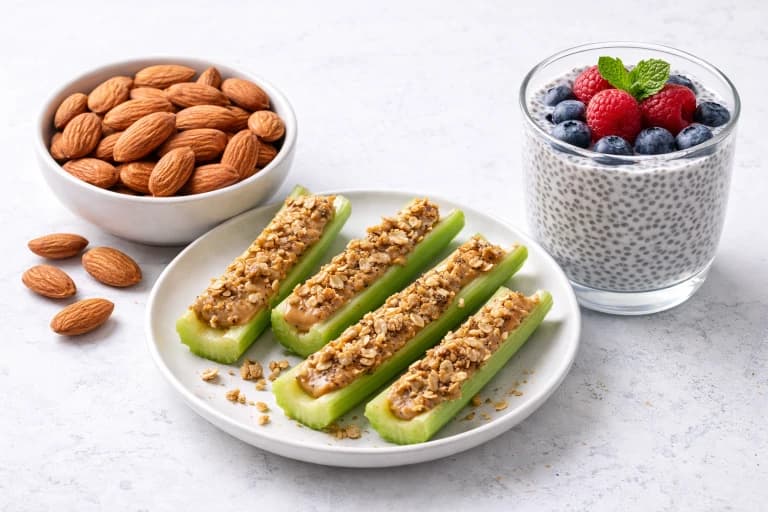

If you have searched for a cortisol diet, you are probably hoping the right foods can take the edge off stress, calm that wired-but-tired feeling, or ease worries about stubborn belly fat. Here is the honest version: no single food resets your cortisol. But your overall eating pattern can genuinely nudge it in the right direction, and it works best alongside good sleep, movement, and steady stress habits.
This guide covers what the science actually supports, what is overhyped, and where food realistically fits.
Key takeaways
- No single food reliably lowers cortisol; what holds up is the overall eating pattern, kept up over months.
- The strongest evidence is for a Mediterranean-style pattern — the 18-month DIRECT-PLUS trial measured small (about 1.6–1.8%) reductions in morning cortisol.
- Omega-3s have one supportive trial (about 19% lower cortisol during a stress test at ~2.5 g/day); magnesium and probiotics have weaker, low-certainty evidence.
- Sleep, regular movement, and stress management move cortisol at least as much as food does.
- Symptoms beyond everyday stress — rapid weight gain, a rounded face, purple stretch marks, muscle weakness — need a doctor, not a diet.
What a "cortisol diet" really is (and what it isn't)
A "cortisol diet" is shorthand for eating in a way that supports a healthy stress-hormone rhythm: more whole foods, steadier meals, and a little less of the things that wind your system up. It is not a detox or a cleanse. Despite what some viral videos suggest, there is no "cortisol cocktail" that flushes the hormone on demand, and no eating plan lowers it overnight.
It also helps to drop the idea that cortisol is the enemy. You need it. The goal is not zero cortisol; it is a healthy daily pattern, higher in the morning and lower at night, and food is one of several levers that shape it.
A 60-second primer on cortisol
What cortisol actually does
Cortisol is a glucocorticoid hormone made by the outer layer of your adrenal glands. Its release is coordinated by a feedback loop between the brain and those glands, called the HPA (hypothalamic-pituitary-adrenal) axis (Physiology, Cortisol — StatPearls). It runs on a daily rhythm: levels rise in the final hours of sleep, peak soon after you wake, and drift down to their lowest point at night. One of its main jobs is raising blood glucose, prompting the liver to make new sugar so you have fuel on hand.
When cortisol becomes a problem
Short bursts of cortisol are useful. The trouble is the steady drip that can come with relentless stress, poor sleep, or illness. At the far end of the spectrum is a medical condition called Cushing's syndrome, where the body sees too much cortisol over a long stretch of time. It can cause weight gain, a rounded face, high blood sugar and blood pressure, and fatigue, and it has to be diagnosed by a doctor (Cushing's Syndrome — NIDDK). Most everyday "high cortisol" worries are not Cushing's, but if your symptoms are persistent or severe, that is a conversation for a clinician, not a grocery list. For the symptom side of this, see our guide on recognising high cortisol symptoms.
Does food actually lower cortisol? What the research shows
Here is where honesty matters. The direct effect of any single food on your cortisol is usually small and short-lived. What holds up better is the overall pattern of how you eat.
The strongest signal comes from the Mediterranean style of eating. The 18-month DIRECT-PLUS randomized trial tested this directly. Adults on a Mediterranean diet, especially a green-Mediterranean version high in polyphenols, showed small but measurable reductions in fasting morning cortisol over the study, on the order of 1.6 to 1.8 percent (DIRECT-PLUS trial). That pattern is built on vegetables, fruit, whole grains, legumes, nuts, olive oil as the main fat, and fish, with little red or processed meat (Mediterranean Diet — Harvard T.H. Chan Nutrition Source). Notice the framing: it is the combination, eaten over months, that seems to matter, not one magic ingredient.
A few specific nutrients have some supporting evidence, with realistic limits:
- Omega-3 fats. In a randomized trial in midlife adults, a higher dose of omega-3 (about 2.5 grams a day) lowered overall cortisol during a stress test by roughly 19 percent versus placebo, though it did not change how sharply cortisol spiked in reaction to the stressor (omega-3 RCT). Oily fish like salmon and sardines, plus walnuts, chia, and flax, are the usual food sources.
- Magnesium. This mineral supports normal nerve and muscle function and blood-sugar regulation, and national surveys show most people fall short of the recommended intake (Magnesium — Harvard T.H. Chan Nutrition Source). It is plentiful in leafy greens, nuts, seeds, legumes, and whole grains. Getting enough from food is sensible; the evidence that magnesium supplements meaningfully lower stress or cortisol in people who are not deficient is limited. We look at the sleep angle separately in magnesium and sleep.
- Fermented foods and probiotics. A 2024 meta-analysis of 46 trials found that probiotics lowered cortisol on average, but the effect was small and the authors rated the certainty as low because results varied widely between studies (probiotics meta-analysis). Yogurt, kefir, and other fermented foods are a reasonable, low-risk addition, just not a guaranteed fix. For the wider picture, see our look at how the gut affects mental health.
If you want this turned into actual meals, see our cortisol-lowering meal plan. For the beverage angle, we cover drinks that may help lower cortisol.
Foods and drinks that can nudge cortisol up
The flip side gets oversimplified too. Most of this is about dose and pattern, not single "forbidden" foods.
Caffeine
Caffeine does raise cortisol; it is one of the more reliable dietary effects (caffeine and cortisol). But if you drink coffee daily, you build partial tolerance. The same study found regular intake blunted the cortisol response without fully erasing it. So you probably do not need to quit. Keeping caffeine earlier in the day and noticing your own sensitivity tends to matter more than the first cup itself.
Sugar and refined carbs
This one surprises people. The popular claim that sugar "spikes cortisol" is, if anything, backwards in the short term. Studies show sugary foods can actually dampen the body's acute cortisol response to stress, which is part of why we reach for them when we are frazzled (sugar and stress). That is not a green light. The real problems with too much added sugar lie elsewhere. One is the reward-driven craving that keeps the cycle spinning. The other is what repeated blood-sugar swings do to your energy and long-term metabolic health. We unpack that loop in cortisol and blood sugar.
Alcohol
Alcohol can feel like it takes the edge off, but many people notice they sleep less soundly after drinking, especially close to bedtime. Since steady sleep is part of a steady cortisol rhythm, moderation and earlier timing are the practical moves if you drink.
For a fuller picture of what to scale back, see foods that increase cortisol.
What about supplements and "cortisol-balancing" products?
Be skeptical here, because this is where marketing runs ahead of the science. Ashwagandha is the most-studied option: some preparations show promise for stress and sleep, the evidence on anxiety is unclear, and there have been rare reports of liver injury linked to ashwagandha supplements. It should be avoided in pregnancy and while breastfeeding (Ashwagandha — NCCIH). Supplements can also interact with medications and existing conditions. So it is worth running any of them past a pharmacist or doctor first. Be wary of any product that promises to "block" or "reset" cortisol.
Diet is one lever; sleep, stress, and movement matter just as much
If you take one thing from this guide, make it this: food is a supporting player. Cortisol's daily rhythm is tied closely to sleep. Severe short sleep, around five and a half hours or less, can push evening cortisol up, though studies are mixed on the overall effect (sleep and cortisol review). Regular physical activity is one of the better-supported stress tools we have, lowering anxiety, lifting mood, and helping you sleep (Benefits of Physical Activity — CDC). Pair a steady, mostly whole-food pattern with decent sleep and some movement, and you are working with your biology rather than against it. The rest of our nutrition guides keep coming back to that same idea.
When to see a doctor about cortisol
Food is not the right tool for a medical problem. Talk to a healthcare professional if you notice signs that go beyond everyday stress: rapid or unexplained weight gain, a flushed and rounded face, purple stretch marks, muscle weakness, very high blood pressure or blood sugar, or fatigue that does not lift. These can point to a hormonal condition that needs proper testing, usually with saliva, urine, or blood samples rather than guesswork (Cushing's Syndrome — NIDDK). A clinician can tell the difference; an eating plan cannot.
Frequently Asked Questions (FAQ)
Can a cortisol diet lower cortisol quickly? Not really. The best dietary evidence, the Mediterranean pattern, played out over 18 months, not days. Expect gradual, modest changes, and treat anything that promises an overnight "reset" with caution.
Is the "cortisol cocktail" worth trying? The viral cortisol cocktail, usually orange juice, coconut water, and a pinch of salt, is harmless in moderation but has no good evidence that it lowers cortisol. It is essentially a flavoured electrolyte drink. Enjoy it if you like it, but do not expect it to fix your stress hormones.
Do I have to give up coffee? For most people, no. Caffeine raises cortisol, but daily drinkers build partial tolerance. Keeping it to earlier in the day and watching your own response usually matters more than quitting.
Does sugar spike cortisol? This is more myth than fact. In the short term, sugary foods can actually blunt the cortisol stress response, which is part of why stress drives sweet cravings. The bigger concerns with added sugar are the craving cycle and blood-sugar swings, not a cortisol spike.
Can food fix cortisol if my levels are medically high? No. If a doctor has flagged genuinely high cortisol, or you have warning signs, that needs medical evaluation and treatment. A supportive diet can sit alongside that care, but it is not a substitute for it.
Medical disclaimer: This article is for informational purposes only. Always consult a qualified healthcare provider before making changes to your health routine.
Sources
- Physiology, Cortisol — StatPearls (NCBI Bookshelf). https://www.ncbi.nlm.nih.gov/books/NBK538239/
- Cushing's Syndrome — National Institute of Diabetes and Digestive and Kidney Diseases (NIDDK). https://www.niddk.nih.gov/health-information/endocrine-diseases/cushings-syndrome
- Long-term green-Mediterranean diet may favor fasting morning cortisol stress hormone; the DIRECT-PLUS clinical trial — PubMed Central. https://pmc.ncbi.nlm.nih.gov/articles/PMC10682947/
- Diet Review: Mediterranean Diet — Harvard T.H. Chan School of Public Health, The Nutrition Source. https://nutritionsource.hsph.harvard.edu/healthy-weight/diet-reviews/mediterranean-diet/
- Caffeine Stimulation of Cortisol Secretion Across the Waking Hours in Relation to Caffeine Intake Levels — PubMed Central. https://pmc.ncbi.nlm.nih.gov/articles/PMC2257922/
- Excessive Sugar Consumption May Be a Difficult Habit to Break: A View From the Brain and Body — PubMed Central. https://pmc.ncbi.nlm.nih.gov/articles/PMC4454811/
- Omega-3 Supplementation and Stress Reactivity of Cellular Aging Biomarkers — PubMed Central. https://pmc.ncbi.nlm.nih.gov/articles/PMC8510994/
- Effect of Probiotics Supplementation on Cortisol Levels: A Systematic Review and Meta-Analysis — PubMed Central. https://pmc.ncbi.nlm.nih.gov/articles/PMC11510182/
- Ashwagandha — National Center for Complementary and Integrative Health (NCCIH). https://www.nccih.nih.gov/health/ashwagandha
- Benefits of Physical Activity — Centers for Disease Control and Prevention (CDC). https://www.cdc.gov/physical-activity-basics/benefits/index.html
- Magnesium — Harvard T.H. Chan School of Public Health, The Nutrition Source. https://nutritionsource.hsph.harvard.edu/magnesium/
- Sleep and Circadian Regulation of Cortisol: A Short Review — PubMed Central. https://pmc.ncbi.nlm.nih.gov/articles/PMC8813037/
All sources accessed 24 May 2026.

Sophia Martinez, MS, CNS
Certified Nutrition Specialist (CNS) focused on balanced diets and science-backed solutions for healthy living.