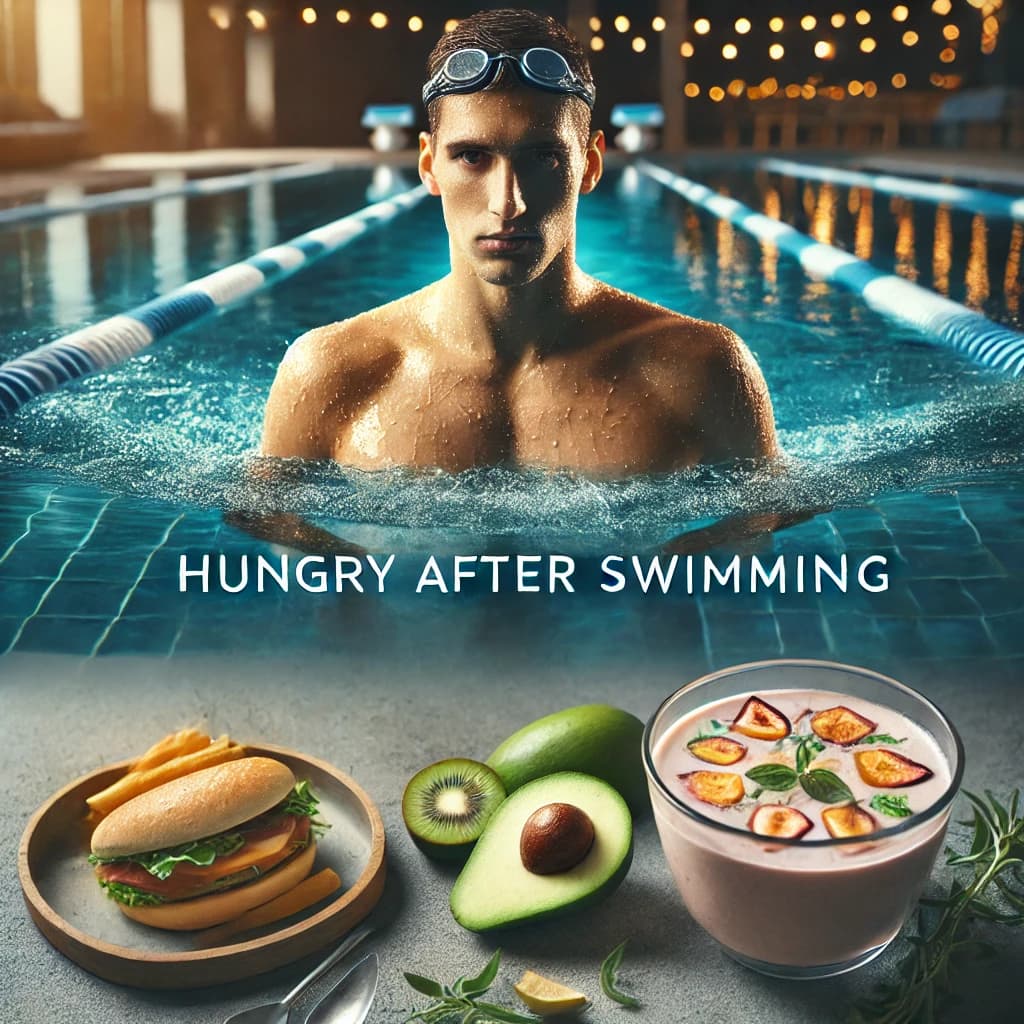
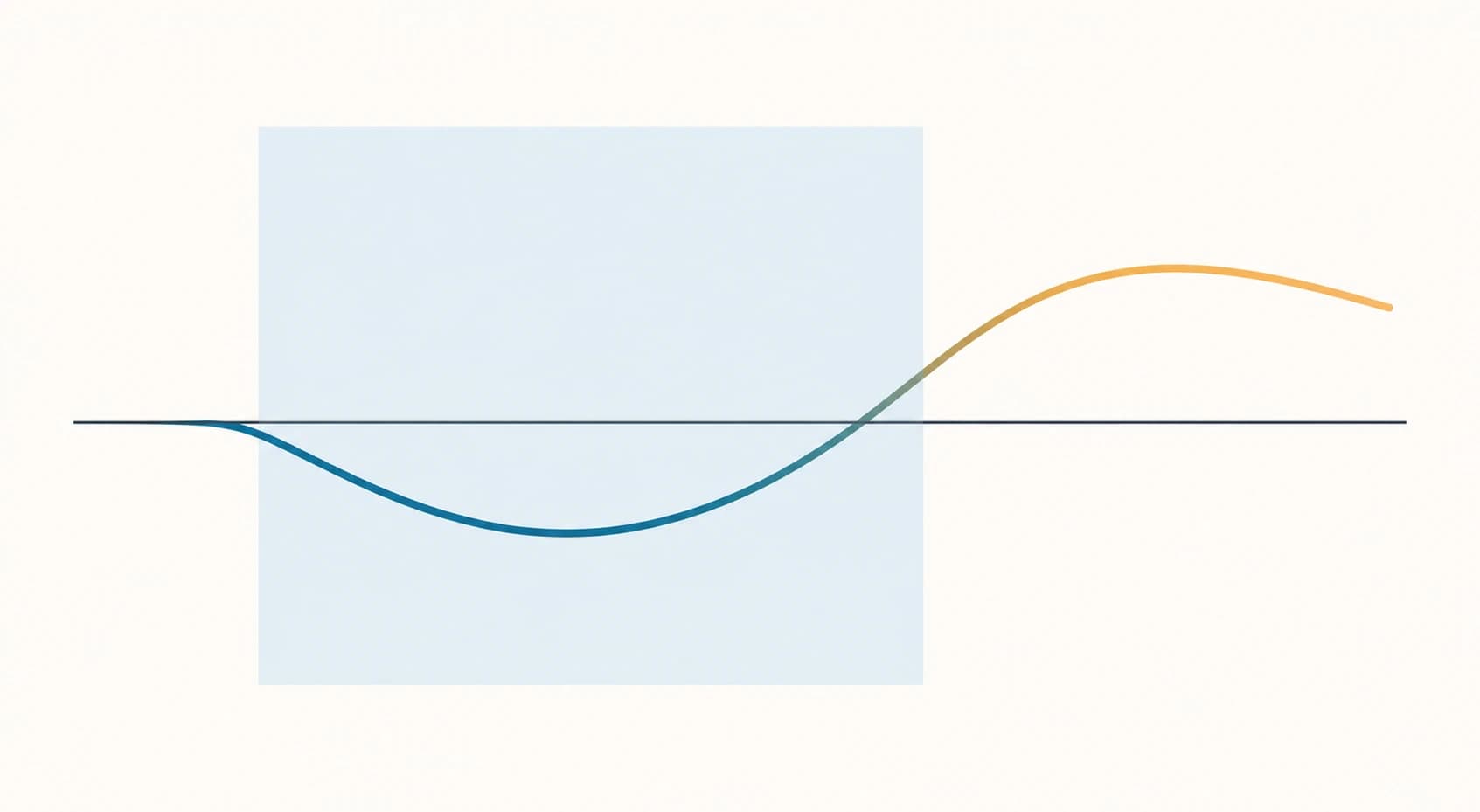
If you're climbing out of the pool already thinking about food, you're catching your body mid-swing, not on a steady climb. The one study that has actually measured swim-specific appetite found that hunger and the hormone ghrelin were both suppressed during a 60-minute swim, then rebounded above resting-day levels in the hours afterward (King, Wasse & Stensel, 2011). Add in the genuine calorie cost of moving through water, a training environment cooler than your core temperature, and fluid loss you can't see or feel the way you can on land, and you get a hunger signal that lands harder than it does after a same-length run.
The calorie math is real — just not the number you've probably seen
Swimming asks a lot of the body in a short time. The American College of Sports Medicine classifies it as a vigorous, whole-body cardiovascular activity, working the legs, core, back, shoulders, and arms in one continuous motion. Harvard Health Publishing's activity-calorie tables put a 155-pound (70 kg) person at roughly 216 calories per 30 minutes of general recreational swimming, and about 360 calories per 30 minutes once it becomes genuine lap swimming at a hard pace:
| Body weight | General swimming (30 min) | Vigorous lap swimming (30 min) |
|---|---|---|
| 125 lb (57 kg) | 180 kcal | 300 kcal |
| 155 lb (70 kg) | 216 kcal | 360 kcal |
| 185 lb (84 kg) | 252 kcal | 420 kcal |
Source: Harvard Health Publishing, "Calories Burned in 30 Minutes for People of Three Different Weights."
At the far end of the training-volume spectrum, a small but striking study of five elite female swimmers logging 17.5 km a day found their total daily energy expenditure averaged 5,593 kcal, while their actual intake averaged only 3,136 kcal — a 43% deficit the researchers flagged as a genuine energy-balance problem (Trappe et al., 1997). Most people swimming a few times a week are nowhere near that volume, but it shows how far post-swim hunger can scale once training gets serious.
What the only swim-specific hunger-hormone study found
Most of what circulates about "swimming and ghrelin" traces back, directly or loosely, to one controlled trial. King, Wasse, and Stensel put 14 healthy men through a 60-minute moderate swim on one day and a matched resting day on another, tracking appetite and acylated ghrelin — the hormone most linked to hunger — for eight hours each time (King, Wasse & Stensel, 2011). During the swim itself, both hunger and ghrelin dropped, and fullness rose. It was only afterward that hunger climbed back above resting-day levels. But acylated ghrelin didn't spike to match that rebound, and when the men later ate freely from a buffet, total intake across the day (9,749 kJ after swimming vs. 9,161 kJ on the resting day) wasn't statistically different. The honest reading: post-swim hunger is a real, measurable sensation, but in this study it didn't automatically translate into eating a lot more.
That disconnect isn't unique to swimming. A 12-week supervised exercise program in overweight and obese adults found a similar dual effect: regular training raised day-to-day hunger while simultaneously improving how satisfying meals felt afterward, a combination the researchers called a "dual-process action" of exercise on appetite (King et al., 2009). Swimming's post-swim rebound looks like a compressed, single-session version of that same broader pattern.
Cold water changes when you get hungry, not just how much you burn
A common claim is that cold water forces the body to burn dramatically more energy to stay warm, and that's what drives the hunger. The most direct test of this, in men cycling on a submerged ergometer for 45 minutes, found energy expenditure was essentially the same in 20°C water as in 33°C water, around 505–517 kcal either way (White et al., 2005). What differed was what happened next: after the cold session, the men ate an average of 877 kcal at a free-choice meal, versus 608 kcal after the neutral-temperature session and 618 kcal after simply resting — 44% and 41% more, respectively. Cold water doesn't obviously burn more fuel; it appears to shift appetite regulation so you eat more once you're out, likely tied to how the drop in skin and core temperature gets processed.
Don't overcorrect into thinking you're just thirsty
Swimming does carry a real, underrated hydration cost. A 2021 field study of young competitive swimmers found they lost an average of roughly 513 mL of fluid over a two-hour session — males losing markedly more than females — and that 67% of swimmers showed up to their very first training session of the day already inadequately hydrated (Wiśniewski et al., 2021), almost certainly because sweat dissolving straight into the pool is easy to underestimate. That's worth fixing on its own terms. But treat it as a hydration problem, not a rebrand of your hunger: the swim-specific research above shows the appetite and hormone changes independent of fluid intake, not as a symptom of it.
Fueling around the rebound
None of this makes post-swim hunger something to fight. It means timing matters more than willpower. The hunger spike documented by King et al. arrives in the hours after you're out of the pool, not during, so a snack with both carbohydrate and protein close to when you finish is working with that pattern, not against a craving. If you train in genuinely cold water, expect the appetite bump to run stronger, per White et al.'s numbers, and plan for it rather than being caught off guard. And if you're training at real volume, closer to Trappe et al.'s swimmers than a recreational lap session, matching intake to output is a real, quantifiable problem worth planning around — not evidence that your hunger cues are lying to you.
See also: Why Am I Always Hungry on Rest Days?, Snacks for Workout Energy: Evidence-Based Pre- and Post-Workout Fueling, Why Am I Hungry After Eating Protein?.
Sources
- King JA, Wasse LK, Stensel DJ. The acute effects of swimming on appetite, food intake, and plasma acylated ghrelin. Journal of Obesity. 2011;2011:351628. PMID: 20953411. https://pubmed.ncbi.nlm.nih.gov/20953411/
- White LJ, Dressendorfer RH, Holland E, McCoy SC, Ferguson MA. Increased caloric intake soon after exercise in cold water. International Journal of Sport Nutrition and Exercise Metabolism. 2005;15(1):38-47. PMID: 15902988. https://pubmed.ncbi.nlm.nih.gov/15902988/
- King NA, et al. Dual-process action of exercise on appetite control: increase in orexigenic drive but improvement in meal-induced satiety. American Journal of Clinical Nutrition. 2009;90(4):921-927. PMID: 19675105. https://pubmed.ncbi.nlm.nih.gov/19675105/
- Trappe TA, Gastaldelli A, Jozsi AC, Troup JP, Wolfe RR. Energy expenditure of swimmers during high volume training. Medicine & Science in Sports & Exercise. 1997;29(7):950-954. PMID: 9243495. https://pubmed.ncbi.nlm.nih.gov/9243495/
- Wiśniewski D, Śliwicka E, Malik J, Durkalec-Michalski K. Evaluation of fluid loss and customary fluid intake among a selected group of young swimmers: a preliminary field study. International Journal of Environmental Research and Public Health. 2021. PMC8003718. https://pmc.ncbi.nlm.nih.gov/articles/PMC8003718/
- Harvard Health Publishing. Calories burned in 30 minutes for people of three different weights. https://www.health.harvard.edu/diet-and-weight-loss/calories-burned-in-30-minutes-for-people-of-three-different-weights
- American College of Sports Medicine. ACSM's Guidelines for Exercise Testing and Prescription. 10th ed. https://www.acsm.org/

Olivia Smith, RDN
Registered Dietitian Nutritionist (RDN) and habit specialist, answering everyday questions about hunger, protein, and sustainable eating.