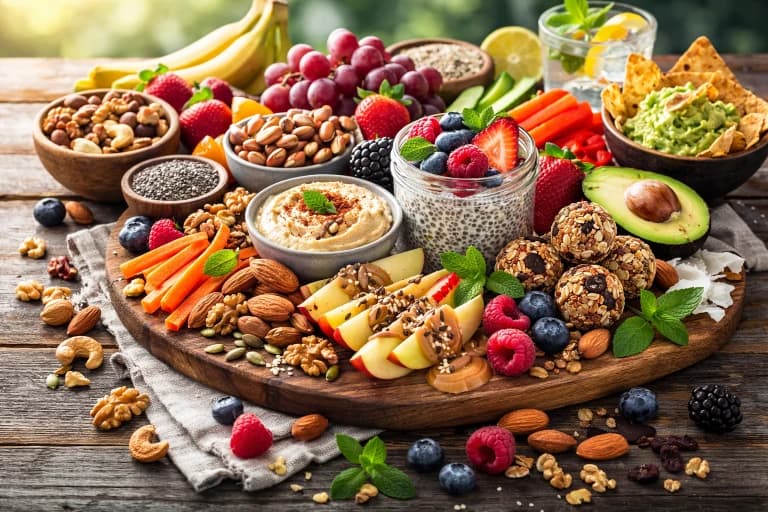
Why this guide exists
People often reach for nuts as a "healthy" snack but still experience afternoon fatigue, tend to overeat, or feel unclear about which nuts are best. The problem is rarely the food category. It is unclear portioning, poor pairing, and claims without cited sources.
This guide explains which nuts have the strongest evidence for supporting sustained energy, why they work at the physiological level, and how to use them in realistic, measured portions every day.
Why nuts can support sustained energy
Nuts combine unsaturated fats, plant protein, fiber, and micronutrients in a compact food matrix. This combination slows gastric emptying and tends to produce a steadier post-meal glucose profile compared with refined snack foods.
The mechanism is not about delivering instant energy. It is about reducing volatility in energy availability: slower digestion and greater satiety translate into fewer hunger spikes and better adherence to consistent eating patterns across the day.
USDA FoodData Central confirms that common nuts deliver meaningful amounts of fat, moderate protein, and fiber in standard one-ounce servings [1].
Portion size and dose-response evidence
Clinical and cohort work commonly uses approximately 28 g (1 oz) per day as the reference serving for nuts. A dose-response meta-analysis published in BMC Medicine found health benefits associated with this intake range, with smaller incremental gains at much higher daily intakes [2].
Practical serving reference:
- 1 oz almonds ≈ 23 whole nuts
- 1 oz walnut halves ≈ 14 halves
- 1 oz pistachios ≈ 49 shelled kernels
These serving sizes are consistent with USDA FoodData Central composition data [1].
Which nuts are most useful for sustained energy
The table below uses a single consistent source — USDA FoodData Central, SR Legacy — for every row, so the numbers can be compared directly rather than pieced together from different manufacturers' labels [8].
| Nut | Everyday measure (≈1 oz / 28 g) | Calories | Protein | Fat | Fiber | Micronutrient that matters here |
|---|---|---|---|---|---|---|
| Almonds | 23 whole nuts | 164 kcal | 6.0 g | 14.2 g | 3.5 g | Magnesium, ≈77 mg — a cofactor in ATP-related enzyme reactions [3] |
| Walnuts | 14 halves | 185 kcal | 4.3 g | 18.5 g | 1.9 g | Alpha-linolenic acid (omega-3) plus vitamin B6, ≈0.15 mg [9] |
| Pistachios | 49 kernels | 159 kcal | 5.7 g | 12.8 g | 3.0 g | Vitamin B6, ≈0.48 mg — a cofactor in amino-acid metabolism [9] |
| Cashews | ≈18 kernels | 157 kcal | 5.2 g | 12.4 g | 0.9 g | Magnesium, ≈83 mg, and iron, ≈1.9 mg — iron supports oxygen transport [10] |
| Pecans | ≈19 halves | 196 kcal | 2.6 g | 20.4 g | 2.7 g | No single standout micronutrient beyond the general fat/fiber matrix |
| Brazil nuts | 1–2 kernels (not a full ounce) | ≈31 kcal per kernel | ≈0.7 g per kernel | ≈3.1 g per kernel | ≈0.35 g per kernel | Selenium, ≈90 µg per kernel — a full 1 oz portion (≈544 µg) exceeds the adult Tolerable Upper Intake Level of 400 µg/day [8] |
Brazil nuts are shown per kernel rather than per ounce because, as the section below explains, a full-ounce daily habit is not the recommended way to eat them.
Almonds
Almonds are a practical daily option due to availability, moderate protein, fiber, and magnesium content. Magnesium is a cofactor in ATP-related enzymatic reactions, meaning that low magnesium intake can contribute to fatigue. The NIH Office of Dietary Supplements confirms magnesium's role in energy-producing reactions and its requirement for hundreds of enzyme systems [3].
Walnuts
Walnuts are notable for alpha-linolenic acid (ALA) and their cardiovascular evidence. A two-year randomized controlled trial in older adults published in Circulation found that daily walnut intake reduced LDL cholesterol [4]. While this measures a cardiovascular marker rather than a direct energy endpoint, improved cardiometabolic status supports long-term vitality and physical capacity. For the fuller lifestyle picture around LDL and cholesterol management, see our how to lower cholesterol guide.
Pistachios
Pistachios provide protein, fiber, and unsaturated fats, with lower energy density per nut than some alternatives. Their in-shell format naturally slows eating pace, which can support better portion adherence compared with pre-shelled varieties eaten quickly.
Cashews and pecans
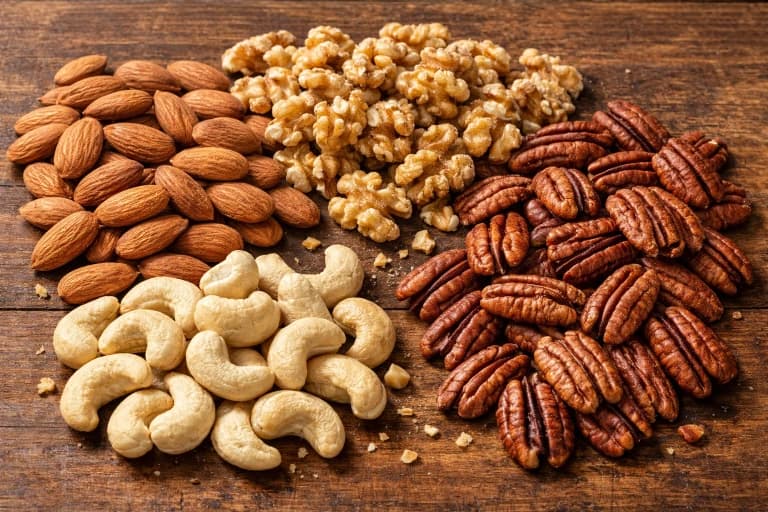
Cashews provide magnesium and iron in a palatable, mild-flavored format. Pecans are higher in fat and typically very satiating. The practical best choice depends on appetite control targets, taste preference, and budget.
Brazil nuts
Brazil nuts contain exceptionally high selenium concentrations: about 90 µg per kernel, against an adult Tolerable Upper Intake Level (UL) of 400 µg/day set by the NIH Office of Dietary Supplements [11]. A full 1 oz serving (roughly six kernels) supplies around 544 µg — above the UL on its own, before counting selenium from any other food that day. One to two kernels per day, not a full ounce, keeps a typical adult comfortably under the UL while still exceeding the 55 µg/day Recommended Dietary Allowance [11].
Raw vs. roasted vs. salted: what changes nutritionally
Dry roasting generally preserves protein and fiber content while altering some heat-sensitive compounds. A Food Chemistry study found that roasting can reduce certain antioxidant fractions but does not meaningfully change macronutrient composition [5].
Salted nuts remain nutritionally useful, but individuals with sodium-sensitive hypertension should monitor their total daily sodium load. Oil-roasted and sugar-coated nut products add calories quickly without improving satiety signals, reducing their net value as an energy snack.
Micronutrient profiles and energy metabolism
Different nuts emphasize different micronutrients:
- Almonds: stronger in vitamin E and magnesium
- Cashews: provide copper and magnesium
- Walnuts: provide plant-based omega-3 ALA
- Pumpkin seeds (not a tree nut, but commonly paired): high in magnesium and zinc
These nutrients participate in oxidative metabolism, antioxidant defense, and cell membrane function. However, no single nut or micronutrient determines daily energy perception in isolation — dietary pattern consistency matters more than any one food.
Using nuts around workouts and workdays
Before workouts
Avoid large nut portions within 30–60 minutes of exercise because higher fat slows gastric emptying. If training starts soon, a carbohydrate-forward snack is better tolerated and more rapidly available as fuel — see Fruit Snacks for Quick Energy for specific options.
During workdays
For sustained desk work and long meetings, pair nuts with fruit or yogurt. This improves carbohydrate quality and distributes protein more evenly across the day. For a fuller list of what to keep at your desk, see Office Snacks for Energy.
Practical pairings:
- Almonds + apple
- Walnuts + plain yogurt + berries
- Pistachios + pear
- Cashews + cottage cheese
These combinations provide faster carbohydrate alongside the slower-digesting fat and protein in nuts, creating a more balanced energy curve.
Avoiding the most common mistakes
Treating nuts as free calories
Nuts are energy dense. A handful directly from a large bag can easily exceed 400–500 kcal without registering as a meal. Pre-portioning into 1 oz servings is the most reliable control strategy.
Choosing sugar-coated mixes marketed as "energy" snacks
Many commercial nut mixes labeled as energy or performance products contain significant added sugar. These behave more like confectionery than a whole-food snack in terms of glycemic effect and calorie density.
Using nuts as the sole post-workout food after high-intensity sessions
After hard training, the body primarily needs carbohydrates to restore glycogen and protein to support muscle repair. Nuts alone do not supply adequate carbohydrate for this context. See Snacks for Workout Energy for session-specific fueling guidance.
Label-reading guide for nuts and nut mixes
When selecting packaged nuts, check these four fields first:
- Serving size — confirm nutritional values are listed per 28 g / 1 oz
- Added sugars — prefer minimal or zero
- Sodium — watch salted and flavored mixes, especially in kidney-sensitive individuals
- Added oils — dry-roasted is preferable to oil-fried products
This reduces the risk of purchasing products that are technically nut-based but function more like dessert snacks in calorie and glycemic terms.
Weekly implementation plan
A simple, repeatable approach for most adults:
- Pre-portion 7 × 1 oz servings on Sunday
- Pair each serving with a planned companion food (fruit, yogurt, or vegetables)
- Use a fixed snack time for one week and note hunger stability and concentration
- Adjust total intake based on weight trend and appetite stability week to week
Safety and contraindications
- Tree nut allergy is a serious contraindication; substitute seeds where needed
- Dysphagia risk exists in some older adults — whole nuts may require modification
- Sodium-sensitive hypertension requires caution with salted varieties
- In chronic kidney disease, phosphorus and potassium loads may require personalized clinical guidance
Limitations of this information
- Most nut evidence addresses cardiometabolic markers, satiety, and dietary patterns — not direct hour-by-hour energy outcomes
- Individual gastrointestinal tolerance, dental status, allergy risk, and budget will change the practical best option
- Effect sizes from observational studies may not fully translate to all populations
Conclusion
For sustained energy, consistency beats novelty. Use a measured 1 oz serving, pair with protein or fruit, and avoid sugar-coated formats. Almonds and pistachios are practical daily defaults; walnuts carry the strongest cardiovascular trial support. For broader snacking strategies, see Healthy Snacks for Energy and Low-Carb Snacks for Energy.
Frequently Asked Questions (FAQ)
Which nuts give the most sustained energy?
No single nut delivers a jolt of energy — the mechanism is a slower, steadier release, not a spike. Almonds and walnuts have the most consistent evidence: almonds pair fiber with magnesium, a cofactor in ATP-related energy reactions [3], and walnuts carry the strongest cardiovascular trial support of any tree nut [4]. Pistachios and cashews are close alternatives with their own micronutrient strengths (vitamin B6 and iron, respectively) [9][10].
How many nuts count as one serving?
The reference serving used in almost all clinical and cohort research is about 28 g (1 oz) per day — roughly 23 whole almonds, 14 walnut halves, or 49 shelled pistachios [1][2]. Pre-portioning a week's servings in advance is the most reliable way to stay near this amount rather than eating straight from a large bag.
Are nuts a good breakfast food?
Yes, in a measured portion alongside other food. Their fat, protein, and fiber slow gastric emptying, which supports a steadier post-meal glucose profile than a carbohydrate-only breakfast [1]. Nuts alone are not a complete breakfast; the pairings in this guide (nuts with fruit or yogurt) apply just as well in the morning as at any other time of day.
Do nuts give you an energy boost?
Not in the caffeine sense. Nuts contain no stimulant compounds, and no study cited in this guide measures an acute energy spike from eating them. What the evidence supports is the opposite: fewer energy dips, because slower digestion and steadier satiety reduce the hunger-driven crashes that a fast-digesting snack can cause. If a fast, immediate lift is what's needed — for example, right before a workout — a carbohydrate-forward snack is better suited to that job than nuts.
Is it better to eat nuts raw or roasted for energy?
Either can work; the practical difference is small. Dry roasting preserves most of the protein and fiber and only modestly reduces some heat-sensitive antioxidant compounds [5]. The bigger factor for an "energy snack" is what else is added: oil-roasted and sugar-coated versions add calories quickly without improving satiety, which works against the goal of steady energy regardless of whether the base nut was raw or roasted.
See also: Healthy Snacks for Energy: The Ultimate Guide to Sustained, Natural Fuel, Low-Carb Snacks for Energy: Evidence-Based Guide for Stable Glucose and Focus, Homemade Energy Bar Recipes: 3 No-Bake Bars for Daily Fuel.
Sources
- USDA FoodData Central. https://fdc.nal.usda.gov/
- Aune D et al. Nut consumption and risk of cardiovascular disease, total cancer, all-cause and cause-specific mortality: a systematic review and dose-response meta-analysis of prospective studies. BMC Med. 2016;14:207. PMID: 27916000. https://pubmed.ncbi.nlm.nih.gov/27916000/
- NIH Office of Dietary Supplements. Magnesium Fact Sheet for Health Professionals. 2024. https://ods.od.nih.gov/factsheets/Magnesium-HealthProfessional/
- Rajaram S et al. Effects of Walnut Consumption for 2 Years on Lipoprotein Subclasses Among Healthy Elders: Findings From the WAHA Randomized Controlled Trial. Circulation. 2021;144(13):1083-1096. PMID: 34455809. https://pubmed.ncbi.nlm.nih.gov/34455809/
- Schlormann W et al. Influence of roasting conditions on health-related compounds in different nuts. Food Chemistry. 2015;180:77-85. https://www.sciencedirect.com/science/article/abs/pii/S0308814615001867
- U.S. FDA. Qualified Health Claims — Nuts and Reduced Risk of Heart Disease. https://www.fda.gov/food/food-labeling-nutrition/qualified-health-claims-letters-enforcement-discretion
- U.S. HHS/USDA. Dietary Guidelines for Americans 2020–2025. https://www.dietaryguidelines.gov/sites/default/files/2021-03/Dietary_Guidelines_for_Americans-2020-2025.pdf
- USDA FoodData Central, SR Legacy. Nuts, almonds (fdcId 170567); Nuts, walnuts, english (170187); Nuts, pistachio nuts, raw (170184); Nuts, cashew nuts, raw (170162); Nuts, pecans (170182); Nuts, brazilnuts, dried, unblanched (170569). https://fdc.nal.usda.gov/
- NIH Office of Dietary Supplements. Vitamin B6 Fact Sheet for Health Professionals. https://ods.od.nih.gov/factsheets/VitaminB6-HealthProfessional/
- NIH Office of Dietary Supplements. Iron Fact Sheet for Health Professionals. https://ods.od.nih.gov/factsheets/Iron-HealthProfessional/
- NIH Office of Dietary Supplements. Selenium Fact Sheet for Health Professionals. https://ods.od.nih.gov/factsheets/Selenium-HealthProfessional/
Medical Disclaimer: This article is educational only and does not replace medical advice. If you have a nut allergy, chronic kidney disease, uncontrolled hypertension, or a medically prescribed sodium restriction, discuss snack selection with your clinician or registered dietitian.

Sophia Martinez, MS, CNS
Certified Nutrition Specialist (CNS) focused on balanced diets and science-backed solutions for healthy living.