
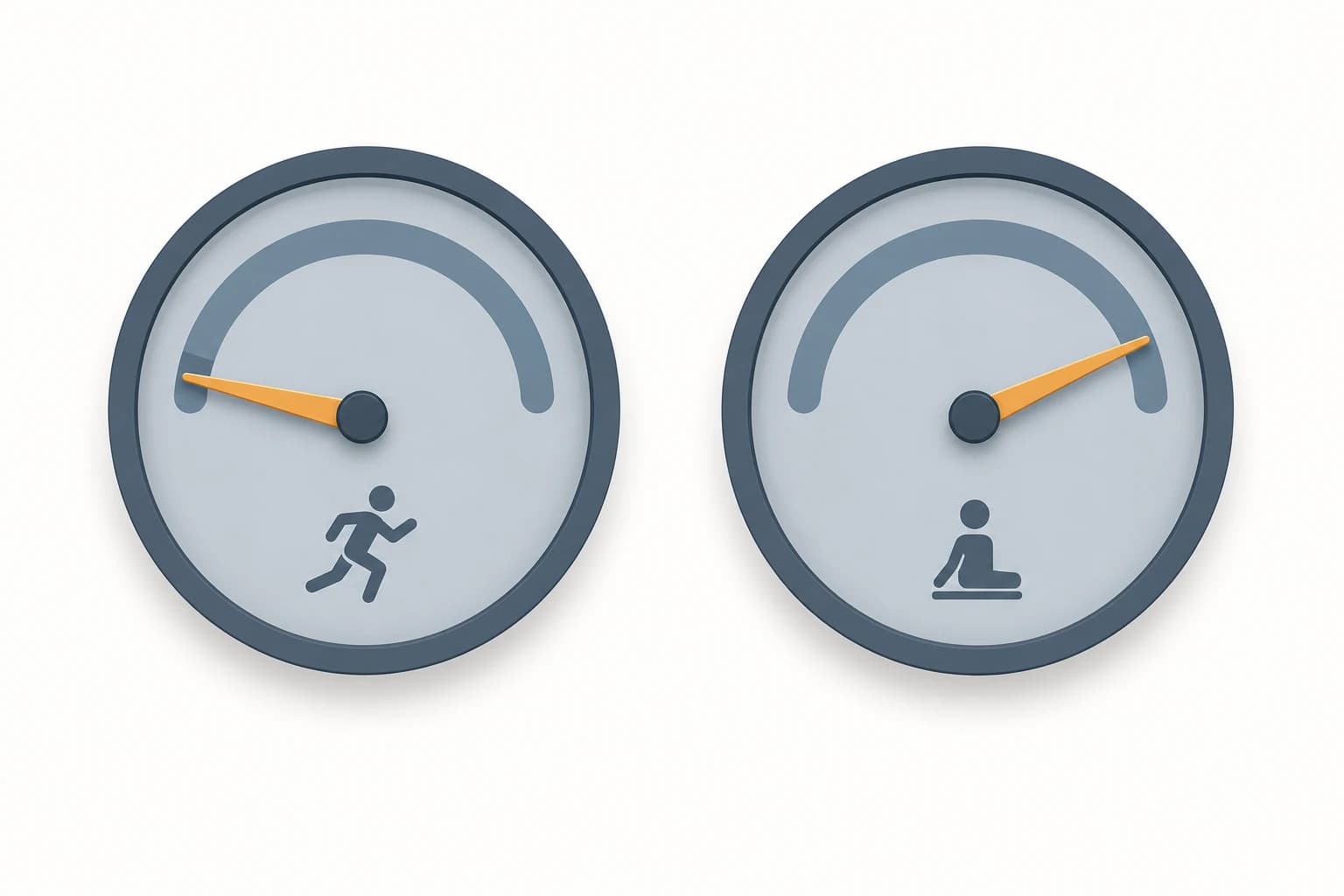
Exercise does not just burn calories, it temporarily turns your hunger down. A hard training session suppresses acylated ghrelin, the hormone that drives hunger, for hours afterward (Broom et al., 2007). On a rest day, that suppression simply is not happening, so the appetite signals your workout was quietly muting come through at full volume. Add to that the fact your body is still metabolically busy repairing muscle up to a day after a hard session (MacDougall et al., 1995), and rest-day hunger stops looking like a mystery. It looks like your body asking for the fuel it did not get around to asking for yesterday.
Exercise mutes hunger. Rest days remove the mute.
Hunger itself is governed by a network of interacting appetite hormones as part of the body's broader energy-balance system, and ghrelin is one of the hormones in that system most responsive to exercise (Heymsfield & Wadden, 2017, New England Journal of Medicine). In a controlled trial, nine men ran for 60 minutes at a hard pace, then had their blood drawn over the next 9 hours. Acylated ghrelin, the "go eat" signal, was measurably suppressed for the entire 9-hour window compared with a non-exercise control day, and the men reported less hunger for the first 3 hours after the run (Broom et al., 2007, Journal of Applied Physiology).
That suppression is not all-or-nothing. A follow-up trial from the same research group found it is dose-dependent on intensity: vigorous running suppressed acylated ghrelin more than moderate-intensity running at the same energy cost, though both beat doing nothing (Broom et al., 2017, Journal of Endocrinology). A full rest day, with none of that exercise-induced suppression at all, is the one day of your week with the least hormonal brake on appetite. That is not a flaw in your recovery, it is the mechanism working as described in the literature.
It is worth being precise here, because the popular version of this story often gets the direction backwards: the claim that "ghrelin spikes right after you exercise" is not what these studies show. Ghrelin goes down during and after a workout, then your hunger simply returns to baseline once that temporary suppression wears off, which is exactly why the change is so noticeable on a day when nothing was suppressing it in the first place.
A 2024 review in Physiological Reports also found the effect on actual eating behaviour is genuinely inconsistent between people: across the studies it examined, a bout of exercise was linked to eating roughly 10-15% less at the next meal in some trials, 18-31% more in others, and no measurable change in many (McCarthy, Tucker & Hazell, 2024). If your rest-day hunger feels stronger than a training partner's, that variability is a documented part of the picture, not a sign anything is wrong with you.
Your body is still working today, even at rest
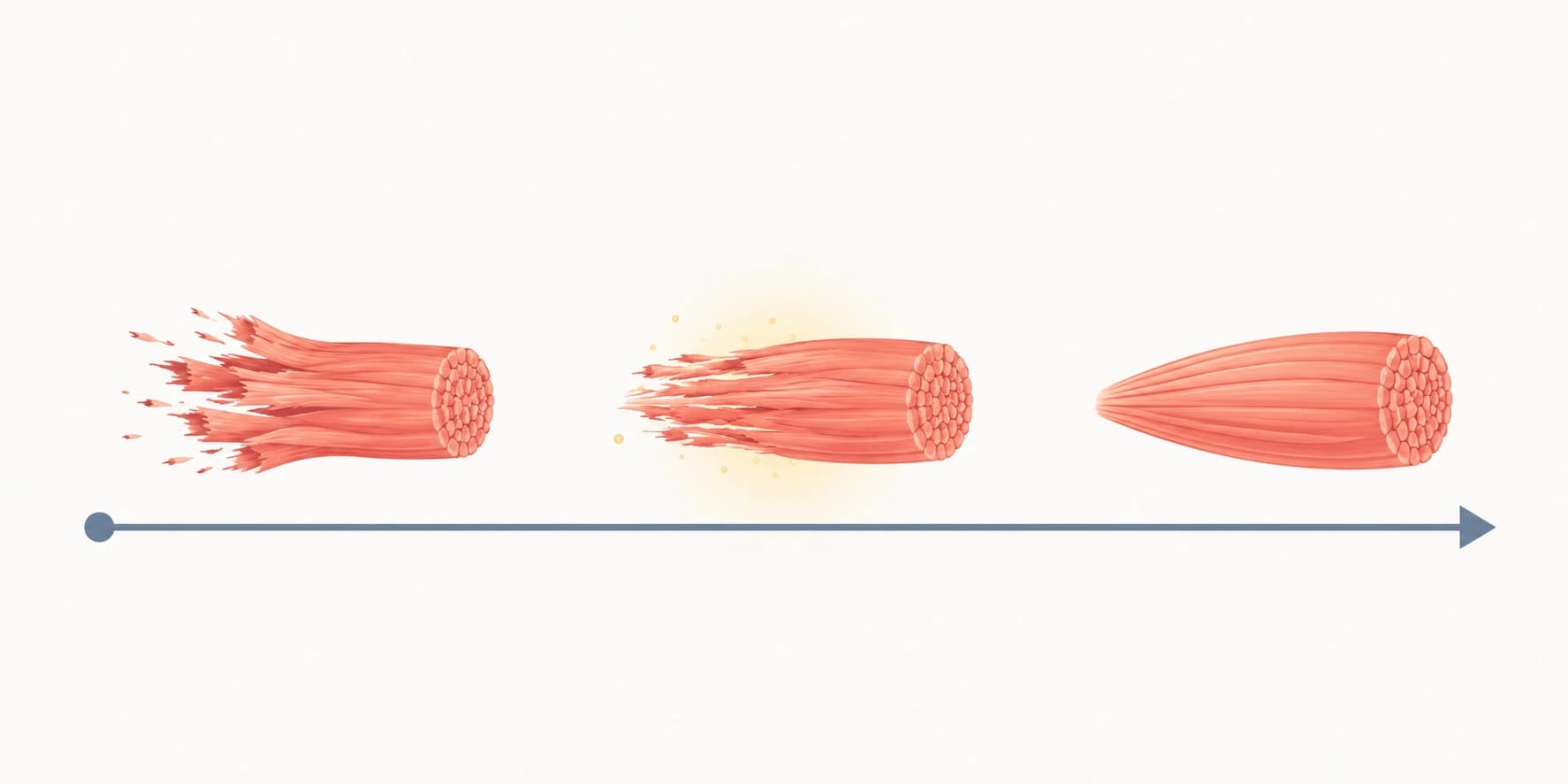
Muscle repair does not stop when the workout does. In a classic time-course study, muscle protein synthesis was elevated 50% above baseline four hours after a heavy resistance session, and still up 109% at 24 hours, before settling back close to baseline by around 36 hours (MacDougall et al., 1995, Canadian Journal of Applied Physiology). That repair work, along with glycogen restocking, has a real energy cost. Your rest day is not a metabolic pause, it is the second half of yesterday's workout, and your appetite is responding to that ongoing demand rather than to what you did in the previous few hours.
The under-eating trap
A common mistake is cutting food intake on rest days on the assumption that "no workout" means "no fuel needed." That logic misreads what recovery actually requires, and it can backfire into exactly the ravenous feeling you are trying to avoid.
Protein intake in particular should not swing much between training and rest days. The joint position statement from the Academy of Nutrition and Dietetics, Dietitians of Canada, and the American College of Sports Medicine puts daily protein needs for athletes at roughly 1.2 to 2.0 grams per kilogram of body weight (about 0.55 to 0.9 grams per pound), a range meant to hold steady across both hard training days and lighter or rest days to support ongoing repair (Thomas, Erdman & Burke, 2016). Protein also has a documented satiety effect of its own, meaning under-eating it is doubly counterproductive on a day your body is already asking for more (Leidy et al., 2015, American Journal of Clinical Nutrition). Carbohydrate and fat intake can taper down modestly on lower-activity days, but slashing them aggressively just adds a second hunger driver on top of the hormonal one.
Habits, not just hormones
Some of this is behavioral rather than biological. If your training days are built around a fixed eating rhythm, pre-workout snack, recovery shake, a big post-gym meal, that structure disappears on a rest day, and an unstructured day makes it easier to notice hunger, or mistake boredom and unstructured time for it. Training sessions that eat up an hour or two of your day, plus travel time, also simply remove hours in which you could otherwise be thinking about food; give those hours back on a rest day and it is unsurprising food crosses your mind more often. None of this requires abandoning structure on rest days, it just means recognizing that some of the "hunger" is really routine disruption, and can be managed the same way you would manage any other habit: with a plan for meals and snacks rather than leaving the day unstructured.
The dehydration idea does not hold up as cleanly as you'd think
A frequent claim in rest-day advice is that thirst gets "mistaken" for hunger, so if you feel hungry you should drink water first. It is a tidy idea, but the neuroscience behind it is thinner than the claim suggests. A 2020 review in Cell on the brain circuits controlling thirst, sodium appetite, and hunger describes these as largely separate systems, each with its own dedicated neurons and its own timescale, rather than one signal blurring into another (Augustine, Lee & Oka, 2020). That does not make hydration irrelevant on a rest day, fluid and electrolyte replacement is still part of finishing recovery from your last session, but treating a glass of water as a reliable fix for rest-day hunger is not something the evidence clearly supports. If you are thirsty, drink. If you are still hungry afterward, that is probably genuine.
A little movement helps more than none
Because ghrelin suppression scales with exercise intensity rather than switching on only at a hard threshold, light activity on a rest day, an easy walk, a swim, a yoga session, produces some of that same appetite-modulating effect that moderate-intensity exercise showed in the Broom 2017 intensity trial, just less of it than a hard session would (Broom et al., 2017). This is a reasonable case for gentle active recovery if you want to take the edge off rest-day hunger, but it is a small effect on top of the bigger picture above, not a substitute for eating enough.
Managing it in practice
- Keep protein roughly consistent day to day, using the 1.2-2.0 g/kg range as a guide, and let carbohydrate and fat flex modestly instead.
- Build rest days around the same meal structure you use on training days rather than leaving them unplanned.
- Keep a few balanced, satiating snacks on hand (Greek yogurt, nuts, fruit — see Fruit Snacks for Quick Energy for specific options) so unplanned hunger does not turn into unplanned overeating.
- Track how you feel across a week if the pattern is confusing you: a simple log of meals, training, and hunger levels will usually show whether the hunger tracks your training load or something else, like sleep or stress.
The bottom line
Rest-day hunger is not your body malfunctioning, it is the exercise-induced brake coming off. Ghrelin suppression fades, muscle repair keeps running the metabolic bill for a day or more, and if you have also cut calories or protein because "today doesn't count," you have added a second reason to feel ravenous on top of the first. Fuel the rest day like it is still part of training, because physiologically, it is.
For related reading, see Why Do I Get Hungry After Swimming?, Why Am I Hungry After Eating Protein?, and Why Do I Feel Weak After Eating Sugar?.
Sources
- Broom DR, Stensel DJ, Bishop NC, Burns SF, Miyashita M. Exercise-induced suppression of acylated ghrelin in humans. Journal of Applied Physiology. 2007;102(6):2165-2171. PMID: 17347386. https://pubmed.ncbi.nlm.nih.gov/17347386/
- Broom DR, Miyashita M, Wasse LK, Pulsford R, King JA, Thackray AE, Stensel DJ. Acute effect of exercise intensity and duration on acylated ghrelin and hunger in men. Journal of Endocrinology. 2017;232(3):411-422. PMID: 27999089. https://pubmed.ncbi.nlm.nih.gov/27999089/
- McCarthy SF, Tucker JAL, Hazell TJ. Exercise-induced appetite suppression: An update on potential mechanisms. Physiological Reports. 2024;12(16):e70022. https://pmc.ncbi.nlm.nih.gov/articles/PMC11347021/
- MacDougall JD, Gibala MJ, Tarnopolsky MA, MacDonald JR, Interisano SA, Yarasheski KE. The time course for elevated muscle protein synthesis following heavy resistance exercise. Canadian Journal of Applied Physiology. 1995;20(4):480-486. PMID: 8563679. https://pubmed.ncbi.nlm.nih.gov/8563679/
- Thomas DT, Erdman KA, Burke LM. American College of Sports Medicine Joint Position Statement: Nutrition and Athletic Performance. Medicine & Science in Sports & Exercise. 2016;48(3):543-568. PMID: 26891166. https://pubmed.ncbi.nlm.nih.gov/26891166/
- Leidy HJ, et al. The role of protein in weight loss and maintenance. American Journal of Clinical Nutrition. 2015;101(6):1320S-1329S. PMID: 25926512. https://pubmed.ncbi.nlm.nih.gov/25926512/
- Heymsfield SB, Wadden TA. Mechanisms, pathophysiology, and management of obesity. New England Journal of Medicine. 2017;376(3):254-266. PMID: 28099824. https://pubmed.ncbi.nlm.nih.gov/28099824/
- Augustine V, Lee S, Oka Y. Neural control and modulation of thirst, sodium appetite, and hunger. Cell. 2020;180(1):25-32. https://pmc.ncbi.nlm.nih.gov/articles/PMC7406138/
All sources verified 10 July 2026.

Olivia Smith, RDN
Registered Dietitian Nutritionist (RDN) and habit specialist, answering everyday questions about hunger, protein, and sustainable eating.