Quick answer: Calcium and vitamin D adequacy has a specific, time-limited reason to matter during the menopause transition — bone density falls fastest in a roughly three-year window around the final period. The herbal supplements sold for hot flashes are a different question with a different answer: The Menopause Society's 2023 review assessed fifteen of them and recommended none, a verdict about hot flashes and night sweats specifically, not about nutrition generally.
"Perimenopause supplements" is really two aisles side by side, and most pages collapse them into one. The first holds nutrients with a measurable rationale for this life stage. The second holds botanicals sold to fix a symptom, most of which have been tested and have not beaten placebo.
Nutrients that genuinely matter during this window
Bone is the reason, and the timing is specific. SWAN, the Study of Women's Health Across the Nation, tracked bone mineral density in 862 women over ten years. Lumbar spine density fell 10.6% in total — but 7.38% of that went during what the researchers called the transmenopause, from one year before the final period to two years after it. The femoral neck followed the same shape: 9.1% overall, 5.8% inside that window (Greendale et al., 2012).
Three years accounting for most of a decade's loss is what turns calcium and vitamin D from generic good advice into something worth checking now. That window straddles the end of perimenopause rather than sitting after it: under the STRAW+10 criteria the transition ends 12 months after the final period, so the first postmenopausal year is still inside it (Harlow et al., 2012) — explained in what perimenopause actually is.
| Nutrient | Recommended intake for women | What changes when it comes from a bottle |
|---|---|---|
| Calcium | 1,000 mg/day at 19–50; 1,200 mg/day at 51–70 | Absorption is best in amounts of no more than 500 mg at a time. Carbonate is absorbed better with food; citrate is taken up well on a full or empty stomach — which matters if you take acid-reducing medication |
| Vitamin D | 600 IU (15 mcg)/day to age 70, rising to 800 IU (20 mcg) after | Vitamin D helps the body absorb calcium, so the two go together. The Bone Health and Osteoporosis Foundation recommends 800 to 1,000 IU daily from age 50 — above the reference intake, and a real disagreement between credible bodies |
Intakes from the Food and Nutrition Board, via MedlinePlus: calcium and MedlinePlus: vitamin D.
That 500 mg detail changes what a label means: a single 1,000 mg tablet is not the same as 1,000 mg spread across a day. Food counts toward the totals first — 8 oz of milk, 1.5 oz of cheese and 6 oz of yoghurt each supply about 300 mg of calcium, and 3 oz of sardines with bones 325 mg — so a supplement closes a measured gap rather than adding insurance on top of an adequate diet. Whether you have a gap is a conversation with a clinician, and the food side is covered in our guide to eating during perimenopause.
Black cohosh: the most-bought, and the most-studied
Black cohosh is, in the position statement's own words, "the most purchased botanical for menopause symptoms." It is also one of the most tested — and two credible assessments reach different conclusions, which is why you will find confident claims in both directions.
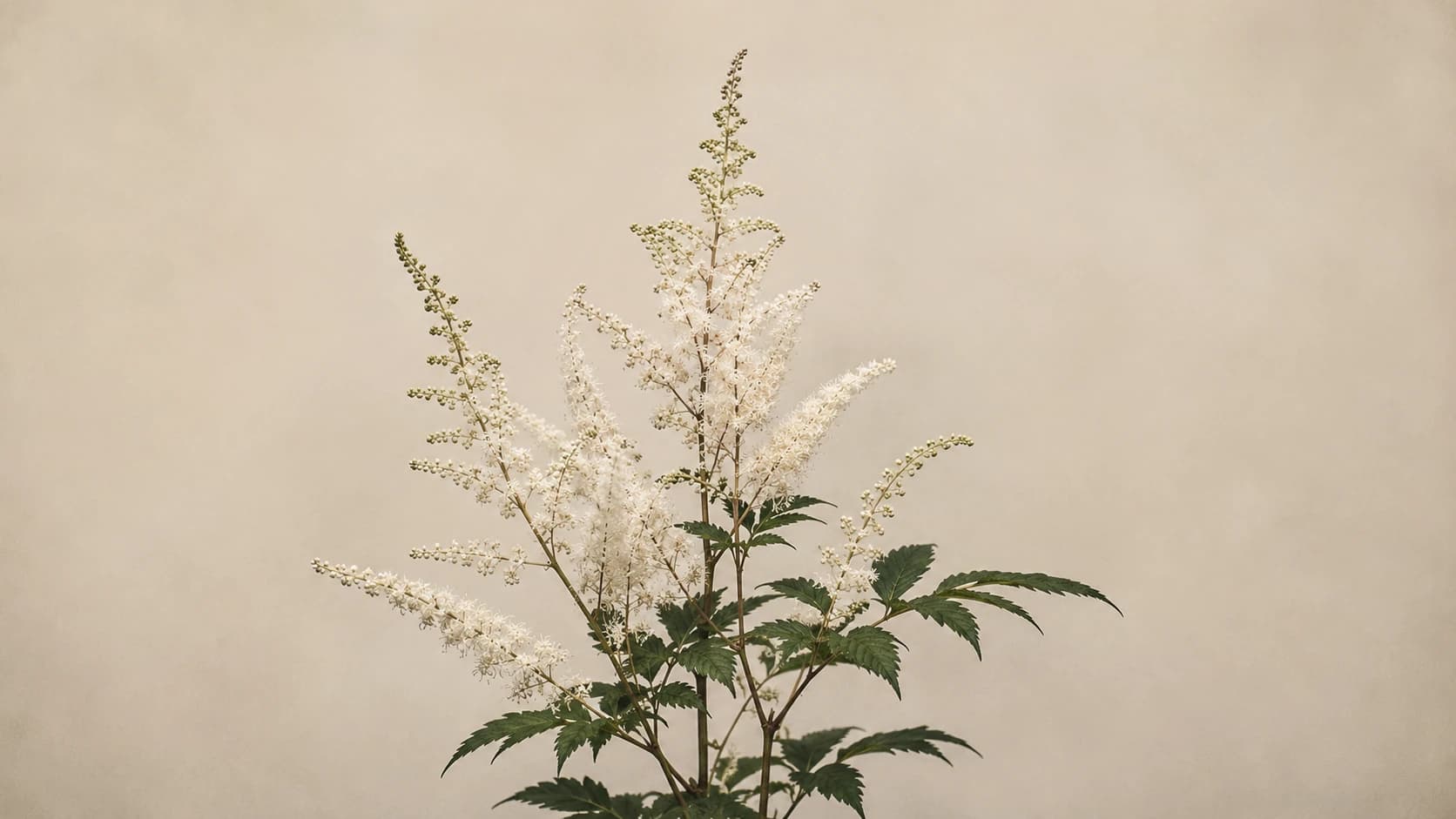
The stricter of the two is a September 2012 Cochrane review by Leach and Moore, pooling 16 randomised trials of 2,027 perimenopausal and postmenopausal women at a median of 40 mg a day over a mean of 23 weeks. The result was not a small benefit but no benefit: a mean difference of 0.07 hot flushes per day against placebo, confidence interval −0.43 to 0.56, straddling zero. The authors found "currently insufficient evidence to support the use of black cohosh for menopausal symptoms" (Leach & Moore, 2012). The Menopause Society rates it Level I — good and consistent evidence — and does not recommend it for vasomotor symptoms (The Menopause Society, 2023).
The other side exists too. NCCIH, the federal complementary-health research centre, points to a 2023 review of 22 studies of black cohosh products — alone or combined with other herbs — that found them "potentially beneficial for overall menopause symptoms," with improvements in hot flashes but not in anxiety or depressive symptoms (NCCIH). That is a real finding from a credible body, newer than Cochrane's.
So why do serious reviews land in different places on the same plant? Three documented reasons:
- The trials are hard to compare. Cochrane's own assessment was that "the quality of included trials was generally unclear, owing to inadequate reporting." Doses and extract types varied, and the review NCCIH cites included products combining black cohosh with other herbs — so the two are not weighing the same thing.
- Nobody knows what the active ingredient is. The position statement is blunt: "The active ingredients in black cohosh extract are unknown, and its mechanism of action is unclear." It was once thought oestrogenic; other work suggests activity resembling a selective oestrogen-receptor modulator, or an effect on serotonergic pathways. Without a mechanism there is no way to standardise what is tested.
- The reputation predates the trials. Black cohosh has been used medicinally in Germany since the late 19th century, and by Native Americans before that (NCCIH). More than a century of use built a reputation, and reference works from that period — long before the 2012 pooling — still circulate. Traditional use is a good reason to study a plant, not a substitute for the result.
Then the part supplement listicles rarely carry. Reports of possible liver toxicity began appearing after 2000. The US Pharmacopeial Convention's Dietary Supplements-Botanicals Expert Committee examined all reported cases, found 30 possibly related to black cohosh, and directed that products carry this warning:
"Discontinue use and consult a healthcare practitioner if you have a liver disorder or develop symptoms of liver trouble, such as abdominal pain, dark urine, or jaundice."
Hold NCCIH's framing alongside it: black cohosh has been used safely in studies lasting as long as a year and is generally well tolerated, the reported liver injuries are rare, and it is uncertain whether black cohosh caused them. The warning exists because those cases were serious enough to act on, not because the risk is common. NCCIH separately notes it is uncertain whether black cohosh is safe for women who have had a hormone-sensitive condition such as breast or uterine cancer.
Soy, isoflavones and equol
Soy foods, soy extracts and the soy metabolite equol all sit on the not-recommended list for vasomotor symptoms at Level II — limited or inconsistent evidence. The mechanism explains the inconsistency better than the verdict does.
The compound that binds oestrogen receptors is not the isoflavone you eat. It is equol, which your gut bacteria may or may not produce from the soy isoflavone daidzein — and only about 35% of North American women can make that conversion. In the study behind that figure, 129 of 365 women were equol producers; among them, the highest quartile of dietary daidzein intake was associated with 76% lower odds of above-average hot flash frequency (odds ratio 0.24, 95% CI 0.07–0.83), while among non-producers there was no association (Newton et al., 2015). Average an effect only a third of women can experience across a whole trial population and you get the mixed results the literature shows.
Then the dead end, in the position statement's next sentence: tests for equol-producer status "are not commercially available to the public or healthcare professionals." Even if the mechanism is real, neither you nor your doctor can find out whether it applies to you.
None of which is a safety finding. Soy is an ordinary food with separate, better-measured effects on blood cholesterol — covered in our perimenopause diet guide.
The rest of the supplement aisle
The 2023 statement reviewed fifteen supplements under its dietary supplements heading and recommended none of them for vasomotor symptoms. Here is what was measured, with the grade attached — Level I is good and consistent evidence, Level II limited or inconsistent.
| Supplement | Commonly sold for | What the review found | Grade (vasomotor symptoms) |
|---|---|---|---|
| Black cohosh | Hot flashes | 2012 Cochrane review, 16 trials, 2,027 women: no significant difference from placebo in hot flush frequency | Level I — not recommended |
| Wild yam cream | "Natural progesterone" | Diosgenin converts to progesterone in a test tube, but "there is no biochemical pathway for this conversion in vivo." Tested creams often contain no yam extract, and many have been adulterated with undisclosed steroids including oestrogens, progesterone and medroxyprogesterone acetate | Level II — not recommended |
| Dong quai | Hot flashes | Trial of 71 women, 4.5 g/day for 24 weeks: no difference on any measure, from hot flash frequency and symptom scores to FSH, LH and oestradiol. Safety concerns include photosensitisation, anticoagulation and carcinogenicity | Level II — not recommended |
| Evening primrose oil | Hot flashes | Single trial, 56 women, 500 mg/day for 6 months: hot flashes fell 1.0 a day on evening primrose oil and 2.6 a day on placebo | Level II — not recommended |
| Vitamin E | Hot flashes | Two crossover trials (120 and 50 women) showed only limited reduction versus placebo | Level I — not recommended |
| Ginseng | Hot flashes, energy | 384 postmenopausal women, 16 weeks: no greater reduction than placebo; two further studies found no effect | Level I — not recommended |
| Maca | Hot flashes, energy | Four studies showed symptom-score improvements, but quality, design, sample size and reporting limits mean "existing evidence is not strong enough" | Level II — not recommended |
| Chasteberry (Vitex) | Hot flashes | Four trials tested it inside mixed supplements, so "it is not possible to conclude that Vitex alone improves VMS" | Level II — not recommended |
All rows from The Menopause Society, 2023.
Read the evening primrose row again: in the only trial that exists, placebo did more than two and a half times as much as the supplement. The panel notes that trials of non-hormone treatments for hot flashes carry "a placebo improvement rate of 20% to 66%" — which is why uncontrolled testimonials are weak evidence, and why a supplement can feel like it is working without being what worked.
One botanical is absent because the panel did not assess it: ashwagandha appears nowhere in the 2023 statement. Two placebo-controlled trials in perimenopausal and menopausal women have measured it directly, and we go through them — limitations included — in ashwagandha for menopause, with a wider view in ashwagandha for women over 50. Absence from a guideline is not evidence in either direction.
Why supplement labels are a weak guarantee
Two findings here make the same point.
Wild yam creams were found adulterated with the very hormones a buyer choosing a plant-based cream is trying to avoid, and products labelled as black cohosh "have been found to contain the wrong herb or to contain mixtures of black cohosh and other herbs that are not listed on the label" — which NCCIH notes might possibly, though unprovenly, explain some of the liver injury cases.
The regulatory reason is checkable. Unlike drugs, dietary supplements are not approved by the FDA before sale; the agency is not authorised to review them for safety and effectiveness in advance, and can act against an adulterated or misbranded product only once it is on the market. NCCIH puts the consequence plainly: "What's on the label may not be what's in the product" (NCCIH).
The usual advice here is to look for a third-party quality mark, and the US Pharmacopeial Convention behind the black cohosh warning is a real standards body. But we could not verify, from any federal source we could open, how much a quality mark improves label accuracy — and the one direct statement we found cuts the other way: NCCIH says a manufacturer's use of "standardized," "verified" or "certified" "does not necessarily guarantee product quality or consistency." Preferring a verified product is reasonable. It is not a guarantee.
If you're going to take something anyway
Plenty of readers will, and a page that pretends otherwise is less useful. Four points, all from sources already cited:
- Tell your doctor and pharmacist what you take, herbal products included, and mention it well before any surgery. The interaction risk is not theoretical: dong quai's documented concerns include anticoagulation, and the FDA has found drugs such as warfarin and phenytoin in products sold as supplements.
- If you take black cohosh, know the liver-warning symptoms quoted above — abdominal pain, dark urine, jaundice — plus the fatigue NCCIH adds, and treat them as a reason to stop and call someone.
- Pregnancy is still possible throughout perimenopause, even after missing periods for a month or several (Office on Women's Health) — and many supplements have never been tested in pregnancy. NCCIH notes black cohosh may not be safe during pregnancy or breastfeeding.
- A supplement that isn't working is worth stopping, not escalating. Given the size of the placebo response in hot flash trials, months of no clear change is information, and the answer is rarely a higher dose or a second bottle.
What the evidence does support
The same statement that recommends no supplement for hot flashes does recommend several other things, and the top of the list surprises most people. Cognitive behavioural therapy and clinical hypnosis are graded Level I — the same grade as SSRIs and SNRIs, gabapentin and fezolinetant. Oxybutynin sits at Levels I-II, weight loss and stellate ganglion block at Levels II-III.
One caveat travels with fezolinetant: it holds a Level I recommendation from the 2023 statement, and on 16 December 2024 the FDA added a boxed warning — its most prominent — for the known risk of rare but serious liver injury (FDA). The recommendation predates the warning, so the two belong together.
Be precise, finally, about what the not-recommended verdicts cover: vasomotor symptoms, and nothing else. They say nothing about bone, cardiovascular risk, mood, sleep or muscle, where the evidence for diet, exercise and nutrient adequacy is separate and much stronger — weight loss sitting on the recommended side of the same document makes the point. Our page on treatment options ranked by evidence works through the full list, and what perimenopause symptoms are actually linked to it covers what you may be trying to treat. Body composition gets its own page.
Frequently asked questions about perimenopause supplements (FAQ)
What vitamins should I take during perimenopause? Calcium and vitamin D are the two with a reason specific to this window: spine bone density falls fastest in the roughly three years around the final period. Recommended intakes for women are 1,000 mg of calcium a day to age 50 and 1,200 mg from 51, alongside 600 IU of vitamin D. Food counts toward those totals first; a supplement closes a gap a clinician has helped you identify.
Does black cohosh work for hot flashes? The largest independent review found it did not: a 2012 Cochrane review of 16 randomised trials in 2,027 women found no significant difference between black cohosh and placebo in how often hot flushes occurred, and The Menopause Society does not recommend it for vasomotor symptoms (Level I). On safety, the US Pharmacopeial Convention's expert committee reviewed reports of possible liver injury and directed that black cohosh products carry this warning: "Discontinue use and consult a healthcare practitioner if you have a liver disorder or develop symptoms of liver trouble, such as abdominal pain, dark urine, or jaundice."
Are perimenopause supplements safe? Safety cannot be read off the label: the FDA is not authorised to review dietary supplements for safety and effectiveness before sale, and can act only once a product is on the market. Two documented examples — tested wild yam creams often contain no yam extract and many have been adulterated with undisclosed steroids, and some products labelled as black cohosh contained the wrong herb. Tell your doctor and pharmacist about anything you take, since supplements can interact with prescribed medication.
Do soy supplements help perimenopause symptoms? Not reliably. The Menopause Society does not recommend soy foods, soy extracts or the soy metabolite equol for vasomotor symptoms (Level II). Only about 35% of North American women carry the gut bacteria that convert the soy isoflavone daidzein into equol, and tests for equol-producer status are not commercially available to the public or to healthcare professionals — so the mechanism cannot be matched to an individual. This is not a safety finding; soy remains an ordinary food.
What actually works for hot flashes if supplements don't? The Menopause Society's 2023 statement recommends cognitive behavioural therapy and clinical hypnosis at Level I, its highest grade — the same it gives SSRIs and SNRIs, gabapentin and fezolinetant — plus oxybutynin at Levels I-II and weight loss at Levels II-III. Fezolinetant carries an FDA boxed warning for rare but serious liver injury, added on 16 December 2024. These are decisions for a healthcare provider; our treatment options guide sets out the full list.
Medical disclaimer: This article is for informational purposes only. Always consult a qualified healthcare provider before making changes to your health routine.
Sources
- The North American Menopause Society. The 2023 nonhormone therapy position statement of The North American Menopause Society. Menopause 2023;30(6):573-590 — Clinical position statement (PDF). https://menopause.org/wp-content/uploads/professional/2023-nonhormone-therapy-position-statement.pdf
- Leach MJ, Moore V. Black cohosh (Cimicifuga spp.) for menopausal symptoms. Cochrane Database of Systematic Reviews 2012, Issue 9. Art. No.: CD007244 — Systematic review. https://www.cochrane.org/evidence/CD007244_black-cohosh-cimicifuga-spp-menopausal-symptoms
- National Center for Complementary and Integrative Health (NIH). Black Cohosh — Federal research centre health topic page. https://www.nccih.nih.gov/health/black-cohosh
- National Center for Complementary and Integrative Health (NIH). Using Dietary Supplements Wisely — Federal research centre consumer guidance. https://www.nccih.nih.gov/health/using-dietary-supplements-wisely
- Greendale GA, Sowers M, Han W, et al. Bone mineral density loss in relation to the final menstrual period in a multiethnic cohort: results from the Study of Women's Health Across the Nation (SWAN). Journal of Bone and Mineral Research 2012;27(1):111-118 — Peer-reviewed longitudinal cohort analysis. https://pubmed.ncbi.nlm.nih.gov/21976317/
- Newton KM, Reed SD, Uchiyama S, et al. A cross-sectional study of equol producer status and self-reported vasomotor symptoms. Menopause 2015;22(5):489-495 — Peer-reviewed observational study. https://pubmed.ncbi.nlm.nih.gov/25380274/
- MedlinePlus, US National Library of Medicine. Calcium in diet — Medical encyclopedia. https://medlineplus.gov/ency/article/002412.htm
- MedlinePlus, US National Library of Medicine. Vitamin D — Medical encyclopedia. https://medlineplus.gov/ency/article/002405.htm
- US Food and Drug Administration. FDA adds warning about rare occurrence of serious liver injury with use of Veozah (fezolinetant) for hot flashes due to menopause. Boxed Warning update 16 December 2024 — Federal regulator drug safety communication. https://www.fda.gov/drugs/drug-safety-communications/fda-adds-warning-about-rare-occurrence-serious-liver-injury-use-veozah-fezolinetant-hot-flashes-due
- Office on Women's Health, US Department of Health and Human Services. Menopause basics — Government health information. https://womenshealth.gov/menopause/menopause-basics
- Harlow SD, Gass M, Hall JE, et al. Executive summary of the Stages of Reproductive Aging Workshop +10: addressing the unfinished agenda of staging reproductive aging. 2012 — Consensus staging criteria, via PMC. https://pmc.ncbi.nlm.nih.gov/articles/PMC3340903/
All sources accessed 4 August 2026.

Olivia Smith, RDN
A registered dietitian more interested in what a supplement was tested against than in what its label promises.