
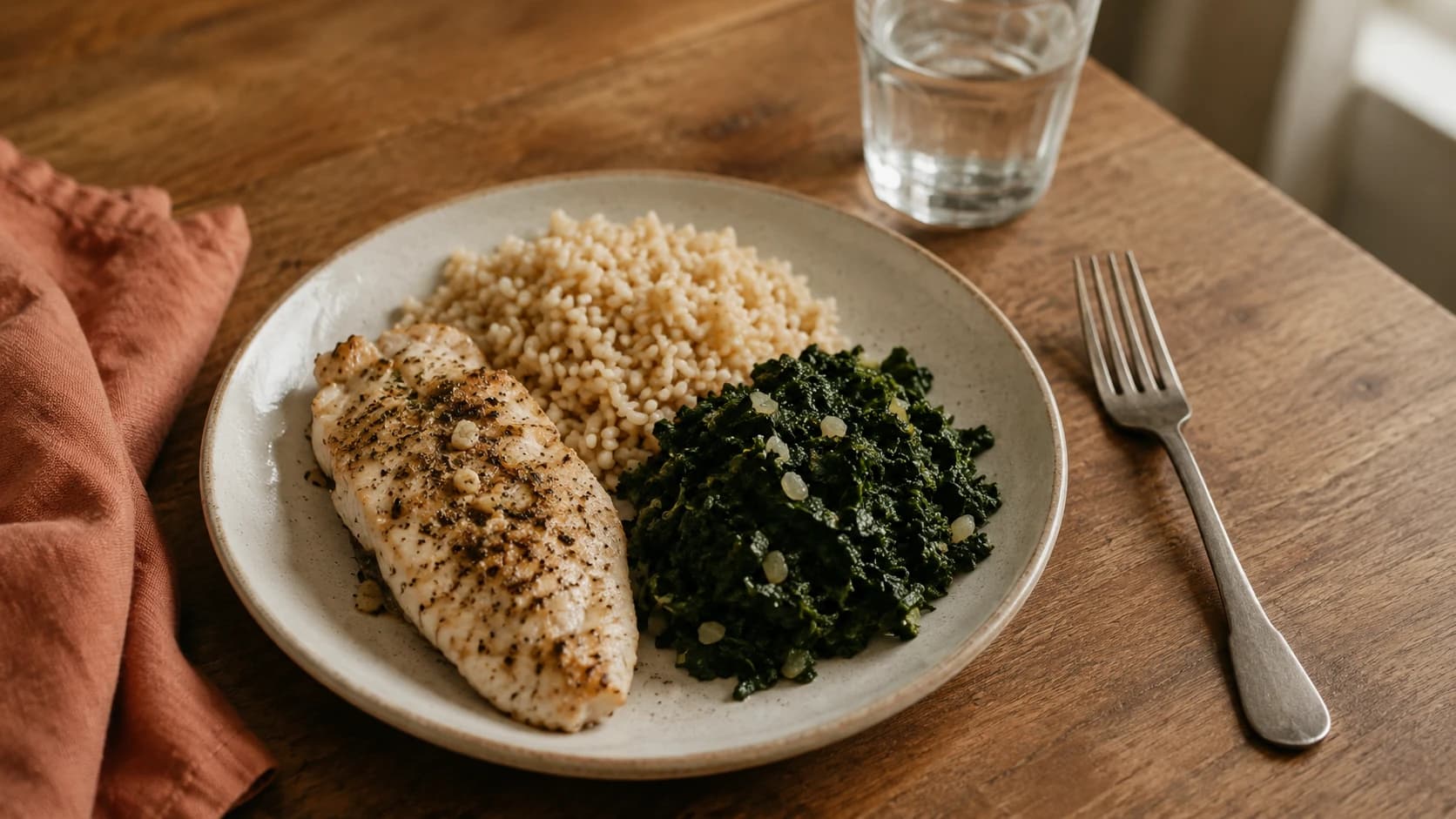
Quick answer: No eating pattern has been shown to reliably reduce hot flashes, and the Menopause Society's 2023 position statement does not recommend dietary modification for them. What food genuinely moves during these years is bone density, blood cholesterol and muscle — all three of which change on a measurable schedule around the final period.
Both halves are true at once, and most pages on this subject pick one. The 2023 nonhormone therapy position statement of The Menopause Society places dietary modification on its not-recommended list at Level III — its lowest grade, consensus and expert opinion — specifically for treating vasomotor symptoms, the hot flashes and night sweats that bring most women to a page like this (The Menopause Society, 2023). The same panel writes, in its key points, that "a healthy diet is important for health promotion and chronic disease prevention." A narrow negative finding about one symptom, sitting beside a broad affirmative one about everything else. This article holds both.
What a perimenopause diet can and can't do
It can't be relied on to stop hot flashes — the panel's own wording is that "there is limited evidence from clinical trials to support the use of dietary modification for improving VMS." How it got there is more interesting than the verdict. The statement reports a randomised study of 84 postmenopausal women assigned either to a low-fat, plant-based diet plus half a cup of cooked soybeans daily or to no dietary change, in which moderate-to-severe symptoms fell 88% against 34%, alongside survey findings linking more vegetables and fruit to fewer symptoms. And it still graded the evidence Level III, because a handful of small or non-randomised studies — in a field where the placebo response in hot-flash trials runs between 20% and 66% — is not a foundation for a recommendation. If a page tells you some way of eating is proven to fix hot flashes, that 88% is usually where it came from, minus the grading.
What food does here is not symptom treatment. It is risk management during a tight window: bone loss, the lipid shift and the change in body composition all cluster within a couple of years either side of the last period. For where diet sits among the options that do have Level I evidence for symptoms, see perimenopause treatment options, ranked by evidence. And under STRAW+10, perimenopause does not end at the final period — it ends 12 months later (Harlow et al., 2012), as explained in what perimenopause actually is.
What actually changes in your body, and why food matters here
Three things change that nutrition can plausibly influence, and each has been measured directly rather than inferred — all three in SWAN, the long-running Study of Women's Health Across the Nation.
| What shifts | What the measurement shows | Source |
|---|---|---|
| Blood lipids | Total cholesterol, LDL cholesterol and apolipoprotein B show substantial increases within the year either side of the final period — a menopause-linked jump, not ordinary ageing | SWAN, 1,054 women (Matthews et al., 2009) |
| Bone density | Loss begins about 1 year before the final period and slows 2 years after it; 7.38% of spine bone density is lost in that interval alone | SWAN, 862 women (Greendale et al., 2012) |
| Body composition | Fat gain roughly doubles from 1.0% to 1.7% a year while lean mass flips from +0.2% to −0.2% a year — with no change in the rate of total weight gain | SWAN, 1,246 women (Greendale et al., 2019) |
The lipid finding is worth reading twice. SWAN tested whether 1,054 women's cardiovascular risk factors changed steadily with age or jumped around menopause. Most followed age; total cholesterol, LDL cholesterol and apolipoprotein B did not, and the authors concluded that monitoring lipids in perimenopausal women should improve prevention of coronary heart disease. If you have never had a lipid panel, this is the life stage where the number starts to matter — our guides to normal cholesterol levels and to the foods with gram amounts behind them cover what to do with the result.
One correction to the version that circulates: the line that HDL falls at menopause is not what SWAN measured. In its HDL ancillary study of 471 women, HDL cholesterol increased across the transition while HDL subclasses, lipid content and cholesterol efflux capacity per particle changed for the worse (El Khoudary et al., 2021) — quality down, reported number up. We could not verify the plain "HDL falls" claim, so we are not making it.
Bone is the most time-sensitive of the three. Across ten years of measurements in 862 women, spine bone density fell 10.6% — but 7.38% of that went in the roughly three years from one year before the final period to two years after it, which the researchers named the transmenopause. Femoral neck loss had the same shape: 9.1% overall, 5.8% inside that window. And the body-composition finding reframes the usual advice, because total weight gain does not accelerate — only its composition changes. That is a case for defending muscle rather than eating less, covered properly in a dedicated page on perimenopause weight gain.
Protein, and why it matters more now
Protein becomes more relevant during this window for one specific reason: lean mass switches from slowly accumulating to slowly declining, and protein is the raw material for the tissue being lost.
Here is where this article stops short of what you may have read elsewhere. The general adult Recommended Dietary Allowance for protein is 46 g a day for women, derived from 0.8 g per kilogram of body weight (Food and Nutrition Board DRI summary tables). That is an adequacy floor for healthy adults, not an optimum for holding onto muscle while it is actively being lost.
Higher targets exist, but for a different population: the PROT-AGE study group, convened by the European Union Geriatric Medicine Society, recommends 1.0 to 1.2 g per kilogram per day for people over 65 to maintain and regain lean body mass and function, and at least 1.2 g/kg for those also exercising (Bauer et al., 2013). Women in their forties and early fifties are not that population, and we could not verify any protein target set specifically for the menopause transition — so this page does not give you one. The floor is checkable; the case for sitting above it while lean mass is being lost is reasonable; the number that would be right for you has not been established by anyone we can cite. The same applies to resistance training, which follows logically from the lean-mass data but was not tested for that outcome in it.
Calcium and vitamin D: the bone window
Because bone loss concentrates into roughly three years around the final period, calcium and vitamin D adequacy stop being generic good advice and become time-sensitive — and the calcium requirement for women steps up inside exactly this age band.
| Nutrient | Women 19–50 | Women 51–70 | Level considered safe |
|---|---|---|---|
| Calcium | 1,000 mg/day | 1,200 mg/day | up to 2,500 mg/day to age 50; 2,000 mg/day after |
| Vitamin D | 600 IU (15 mcg)/day | 600 IU (15 mcg)/day — rising to 800 IU (20 mcg) after age 70 | 4,000 IU (100 mcg)/day |
Dietary Reference Intakes from the Food and Nutrition Board, via MedlinePlus: calcium and MedlinePlus: vitamin D.
Three practical details that generic "get enough calcium" advice leaves out, all from the same MedlinePlus references:
- Absorption is best in amounts of no more than 500 mg at a time. A single 1,000 mg dose is not the same as 1,000 mg spread across a day.
- Calcium carbonate is absorbed better with food; calcium citrate is taken up well on a full or empty stomach. That matters most if you take acid-reducing medication.
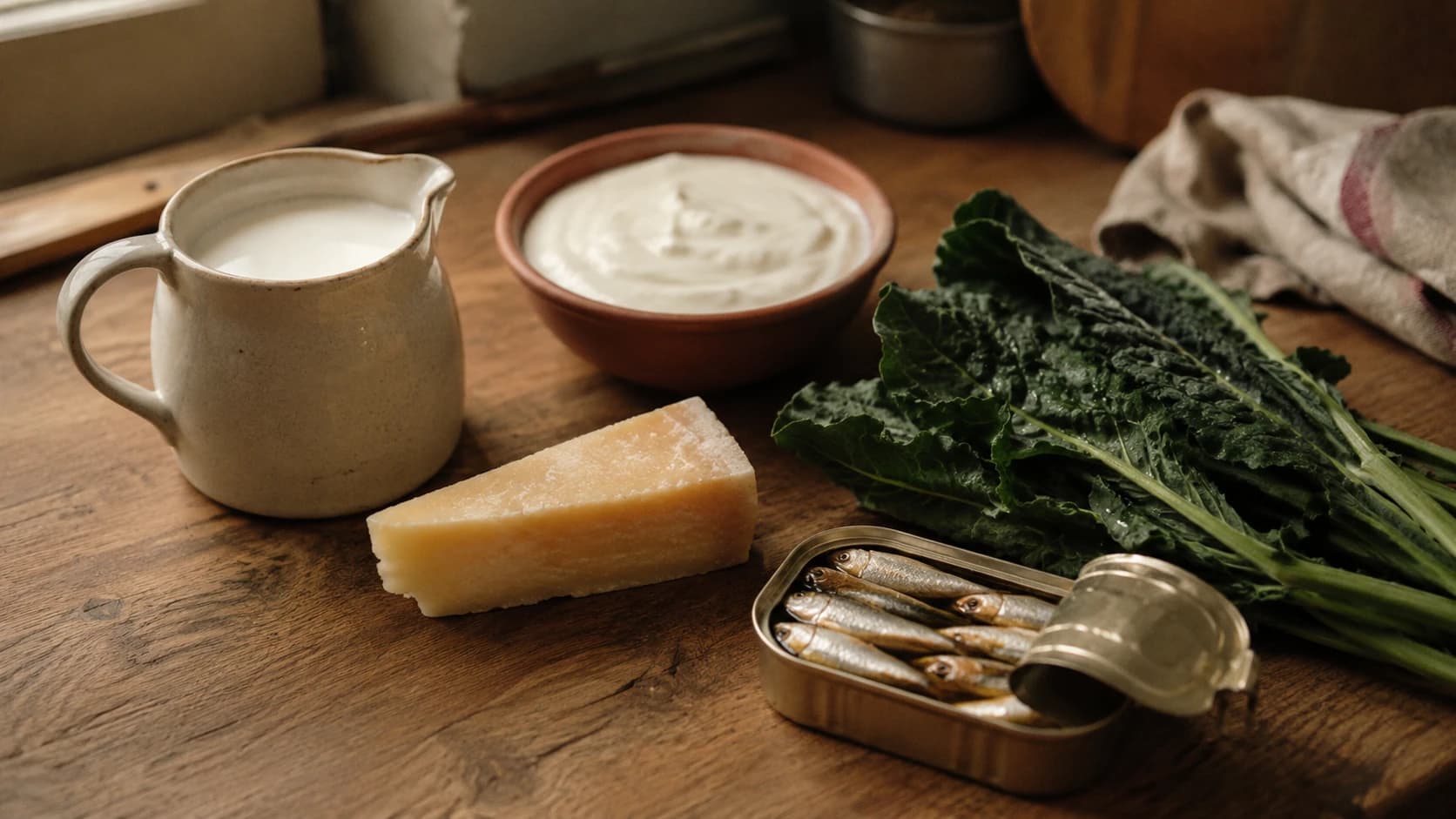
- Food first is realistic here. A glass of milk or fortified soy milk, 45 g of cheese or 170 g of yoghurt runs roughly 300 mg each, and 85 g of sardines with bones 325 mg — which puts 1,200 mg in reach without a supplement.
MedlinePlus also notes that the Bone Health and Osteoporosis Foundation recommends more vitamin D for people aged 50 and over than the DRI does, 800 to 1,000 IU daily — a real disagreement between two credible bodies, and one to raise with your clinician rather than settle from a website. Supplement forms and quality get their own page on perimenopause vitamins and supplements.
Soy and phytoestrogens: the honest answer
Soy foods, soy extracts and the soy metabolite equol are all on the Menopause Society's not-recommended list for vasomotor symptoms at Level II — limited or inconsistent evidence. The reason is worth knowing, because it explains why soy trials keep disagreeing with each other.
The isoflavones are not the active ingredient people assume. Equol — a compound your gut bacteria may or may not make from the soy isoflavone daidzein — binds estrogen receptors with a strong preference for ER-β, and whether you produce it depends on your gut flora. In the cross-sectional study the position statement cites, 129 of 365 women (35%) were equol producers; among them, the highest quartile of dietary daidzein intake was associated with 76% lower odds of above-average hot flash frequency (odds ratio 0.24, 95% CI 0.07–0.83), while among non-producers there was no association at all (Newton et al., 2015). That is observational rather than a trial, and the trend across intake levels did not reach significance (P = 0.06).
Then the part that settles it practically: "tests to ascertain whether women are equol producers are not commercially available to the public or healthcare professionals." Even if the mechanism is real, neither you nor your doctor can find out whether it applies to you — and averaging a benefit only a third of women can experience across a whole trial population reliably produces mixed results.
None of which makes soy a food to avoid. It is an ordinary food with an ordinary place in a diet, and it has a separate, better-measured role in the lipid picture above: a meta-analysis of the 46 controlled trials the FDA used to review its soy heart-health claim found that soy protein lowers LDL and total cholesterol in adults (Blanco Mejia et al., 2019), an effect we cover with the gram amounts in our cholesterol diet guide. Eat tofu because you like it, and because soy protein does something small and real to your LDL — not because it will stop the night sweats.
Foods and drinks people are told to avoid
This is the most confidently repeated advice on the topic and the least supported. The Menopause Society addresses it directly: "Women are often told to avoid 'triggers' such as alcohol, caffeine, spicy foods, or hot foods or liquids." Its assessment is one sentence, and it is the sentence nobody quotes — "There are no clinical trials assessing the effects of avoiding triggers for the alleviation of VMS." Not weak trials. None. Avoiding triggers is graded Level II and not recommended. The observational picture is thin too: the statement cites a cross-sectional study of 4,595 Chinese women linking alcohol intake to vasomotor symptoms, then notes this was not reproduced elsewhere, including in the Melbourne Women's Midlife Health Project.
So be fair to both sides. If you notice that a glass of wine reliably precedes a bad night, that observation is yours and it costs nothing to act on. What is not supported is the standard printed list — caffeine, alcohol, spicy food, sugar — presented as a strategy that will predictably reduce your symptoms. It has never been tested as one.
Alcohol does carry separate health considerations, and they belong in a separate argument. The National Cancer Institute lists breast cancer among the cancers linked to alcohol, and reports that women having one drink a day are at higher risk than those having less than one drink a week — light drinkers 1.04 times as likely, moderate drinkers 1.23, heavy drinkers 1.6 (National Cancer Institute, reviewed May 2025). That is a real reason some women drink less in midlife. It is not a hot flash argument.
What a genuinely useful eating pattern looks like
There is no meal plan on this page, and the omission is deliberate: a day-by-day plan implies a precision the evidence does not have. What it supports is a short list of priorities following from the three measured changes above.

- Protein at a level you actually hit, because lean mass is declining rather than accumulating. Whether you sit above the 46 g floor is a conversation with a clinician or dietitian, not a number this page can hand you.
- Calcium to the age-appropriate target, food first, with vitamin D alongside it, because that 7.38% of spine density goes in about three years and the interval does not come back.
- An overall pattern aimed at LDL cholesterol, the number SWAN found jumping at the final period rather than drifting with age. The specifics are the same for anyone lowering LDL, and are covered in our cholesterol diet guide.
Notice what is not on that list: no named diet claimed as proven for perimenopause, no superfood, no supplement stack, no elimination list. We are not aware of any eating pattern with verified evidence for treating this transition's symptoms, and saying so beats filling the gap with something plausible. Symptoms are a separate question — see what's actually linked to perimenopause.
What weight loss does and doesn't mean here
Weight loss is one of the few lifestyle interventions the 2023 statement affirmatively recommends for vasomotor symptoms, at Levels II-III, and its reasoning is specific to this stage: adiposity acts as a risk factor for symptoms earlier in the transition — perimenopause and early postmenopause — but not later, so weight loss may do more when women are earlier in it. If you are reading this while still having periods, that is the window the evidence describes.
The complication is that the scale is a poor instrument here. SWAN's data shows fat rising and lean mass falling on an unchanged total-weight trajectory — so an approach that sheds muscle alongside fat works against the bone and metabolic picture this article is about. That argument gets its own page: why weight changes in perimenopause.
Frequently asked questions about eating in perimenopause (FAQ)
What is the best diet for perimenopause? No eating pattern has been shown to reliably treat hot flashes and night sweats; The Menopause Society's 2023 statement grades dietary modification Level III and does not recommend it for those symptoms. Nutrition still matters here for three measured changes: total and LDL cholesterol rise around the final period, spine bone density falls about 7.4% in the three years surrounding it, and lean mass shifts from gaining to losing.
What foods should I avoid during perimenopause? The Menopause Society examined the standard advice to avoid alcohol, caffeine, spicy foods and hot drinks, and found that no clinical trials have assessed whether avoiding triggers relieves hot flashes at all — Level II, not recommended. Noticing your own patterns costs nothing; treating a printed trigger list as reliable treatment is not supported.
Does soy help with hot flashes? Not dependably: soy foods, soy extracts and the soy metabolite equol are not recommended for vasomotor symptoms at Level II. Only about 35% of North American women carry the gut bacteria that convert the soy isoflavone daidzein into equol, and tests for equol-producer status are not commercially available to the public or to healthcare professionals.
Should I eat more protein in perimenopause? Protein adequacy matters more once lean mass starts declining, which SWAN measured happening during the transition. The general adult RDA is 46 g a day for women, based on 0.8 g per kilogram of body weight. We could not verify a protein target set specifically for perimenopausal women, so this article publishes none; the 1.0 to 1.2 g/kg figure that circulates was written for adults over 65.
Can changing my diet stop hot flashes? On current evidence, no — dietary modification sits at Level III, consensus and expert opinion, on The Menopause Society's not-recommended list for vasomotor symptoms. That verdict covers hot flashes and night sweats only, and says nothing about bone, cholesterol and muscle.
Medical disclaimer: This article is for informational purposes only. Always consult a qualified healthcare provider before making changes to your health routine.
Sources
- The North American Menopause Society. The 2023 nonhormone therapy position statement of The North American Menopause Society. Menopause 2023;30(6):573-590 — Clinical position statement (PDF). https://menopause.org/wp-content/uploads/professional/2023-nonhormone-therapy-position-statement.pdf
- Matthews KA, Crawford SL, Chae CU, et al. Are changes in cardiovascular disease risk factors in midlife women due to chronological aging or to the menopausal transition? Journal of the American College of Cardiology 2009;54(25):2366-2373 — Peer-reviewed longitudinal cohort analysis (SWAN). https://pmc.ncbi.nlm.nih.gov/articles/PMC2856606/
- El Khoudary SR, Chen X, Nasr AN, et al. HDL (high-density lipoprotein) subclasses, lipid content, and function trajectories across the menopause transition: SWAN-HDL study. Arteriosclerosis, Thrombosis, and Vascular Biology 2021;41:951-961 — Peer-reviewed longitudinal cohort analysis (SWAN). https://pmc.ncbi.nlm.nih.gov/articles/PMC8105263/
- Greendale GA, Sowers M, Han W, et al. Bone mineral density loss in relation to the final menstrual period in a multiethnic cohort: results from the Study of Women's Health Across the Nation (SWAN). Journal of Bone and Mineral Research 2012;27(1):111-118 — Peer-reviewed longitudinal cohort analysis. https://pubmed.ncbi.nlm.nih.gov/21976317/
- Greendale GA, Sternfeld B, Huang M, et al. Changes in body composition and weight during the menopause transition. JCI Insight 2019;4(5):e124865 — Peer-reviewed longitudinal cohort analysis (SWAN). https://insight.jci.org/articles/view/124865
- Newton KM, Reed SD, Uchiyama S, et al. A cross-sectional study of equol producer status and self-reported vasomotor symptoms. Menopause 2015;22(5):489-495 — Peer-reviewed observational study. https://pubmed.ncbi.nlm.nih.gov/25380274/
- Blanco Mejia S, Messina M, Li SS, et al. A meta-analysis of 46 studies identified by the FDA demonstrates that soy protein decreases circulating LDL and total cholesterol concentrations in adults. The Journal of Nutrition 2019;149(6):968-981 — Peer-reviewed meta-analysis. https://pubmed.ncbi.nlm.nih.gov/31006811/
- Bauer J, Biolo G, Cederholm T, et al. Evidence-based recommendations for optimal dietary protein intake in older people: a position paper from the PROT-AGE Study Group. Journal of the American Medical Directors Association 2013;14(8):542-559 — Expert group position paper. https://pubmed.ncbi.nlm.nih.gov/23867520/
- Food and Nutrition Board, Institute of Medicine, National Academies. Dietary Reference Intakes: Recommended Dietary Allowances and Adequate Intakes, Total Water and Macronutrients — Summary table via NCBI Bookshelf. https://www.ncbi.nlm.nih.gov/books/NBK56068/table/summarytables.t4/
- MedlinePlus, US National Library of Medicine. Calcium in diet — Medical encyclopedia. https://medlineplus.gov/ency/article/002412.htm
- MedlinePlus, US National Library of Medicine. Vitamin D — Medical encyclopedia. https://medlineplus.gov/ency/article/002405.htm
- National Cancer Institute. Alcohol and Cancer Risk — Federal cancer institute fact sheet, reviewed 2 May 2025. https://www.cancer.gov/about-cancer/causes-prevention/risk/alcohol/alcohol-fact-sheet
- Harlow SD, Gass M, Hall JE, et al. Executive summary of the Stages of Reproductive Aging Workshop +10: addressing the unfinished agenda of staging reproductive aging. 2012 — Consensus staging criteria, via PMC. https://pmc.ncbi.nlm.nih.gov/articles/PMC3340903/
All sources accessed 5 August 2026.

Olivia Smith, RDN
A registered dietitian who would rather give you a principle with a source than a number without one.