

Quick answer: The staging system specialists actually use splits the menopausal transition into two stages — early and late — and both are defined by what your cycles are doing, not by your age or your symptoms. Perimenopause spans those two stages plus the 12 months after your final period. The "4 stages" you have probably seen come from a different model by a different research group, and a third set of pages is counting the stages of menopause rather than the stages within perimenopause.
Why you'll see "two", "three" and "four" stages
Because three different schemes are in circulation, and they are not counting the same thing. One counts life stages around menopause, one counts stages inside the transition, and one is a research centre's alternative model. None of them is a misprint, and only one is the consensus.
The life stages — where "three" usually comes from
This is the scheme most consumer pages mean. Cleveland Clinic frames it as a question and answers it directly: menopause "happens in three stages: Perimenopause or 'menopause transition'," then menopause, then postmenopause (Cleveland Clinic, last updated 24 June 2024). Mayo Clinic Press uses the same count — "The menopause transition typically has three stages: perimenopause, menopause and postmenopause" (Mayo Clinic Press).
Notice what has happened: in this scheme, perimenopause is one of the three stages. It has no stages of its own. So a page answering "the stages of menopause" and a page answering "the stages of perimenopause" can both be correct and still share no numbers.
Merck Manual Professional lists four names rather than three — reproductive stage, perimenopause, menopausal transition, postmenopause — and this is where a lot of "4 stages" confusion starts. Read the definitions and they turn out to overlap rather than run in sequence. Merck defines the menopausal transition as a period that "occurs during the perimenopause stage," covering "the typically 4 to 8 years that lead up to the final menstrual period," while perimenopause itself refers to "several years … before and the 1 year after the last menses" (Merck Manual Professional, full review August 2025, last updated June 2026). Four labels, two of which sit inside each other. Counting them as four consecutive phases misreads the page.
The clinical staging system — where "two" comes from
The reference framework is the Stages of Reproductive Aging Workshop +10, usually written STRAW+10, published in 2012 after a decade of data had accumulated on the original 2001 system. Its own executive summary describes the STRAW approach as "widely considered the gold standard for characterizing reproductive aging through menopause" (Harlow et al., 2012).
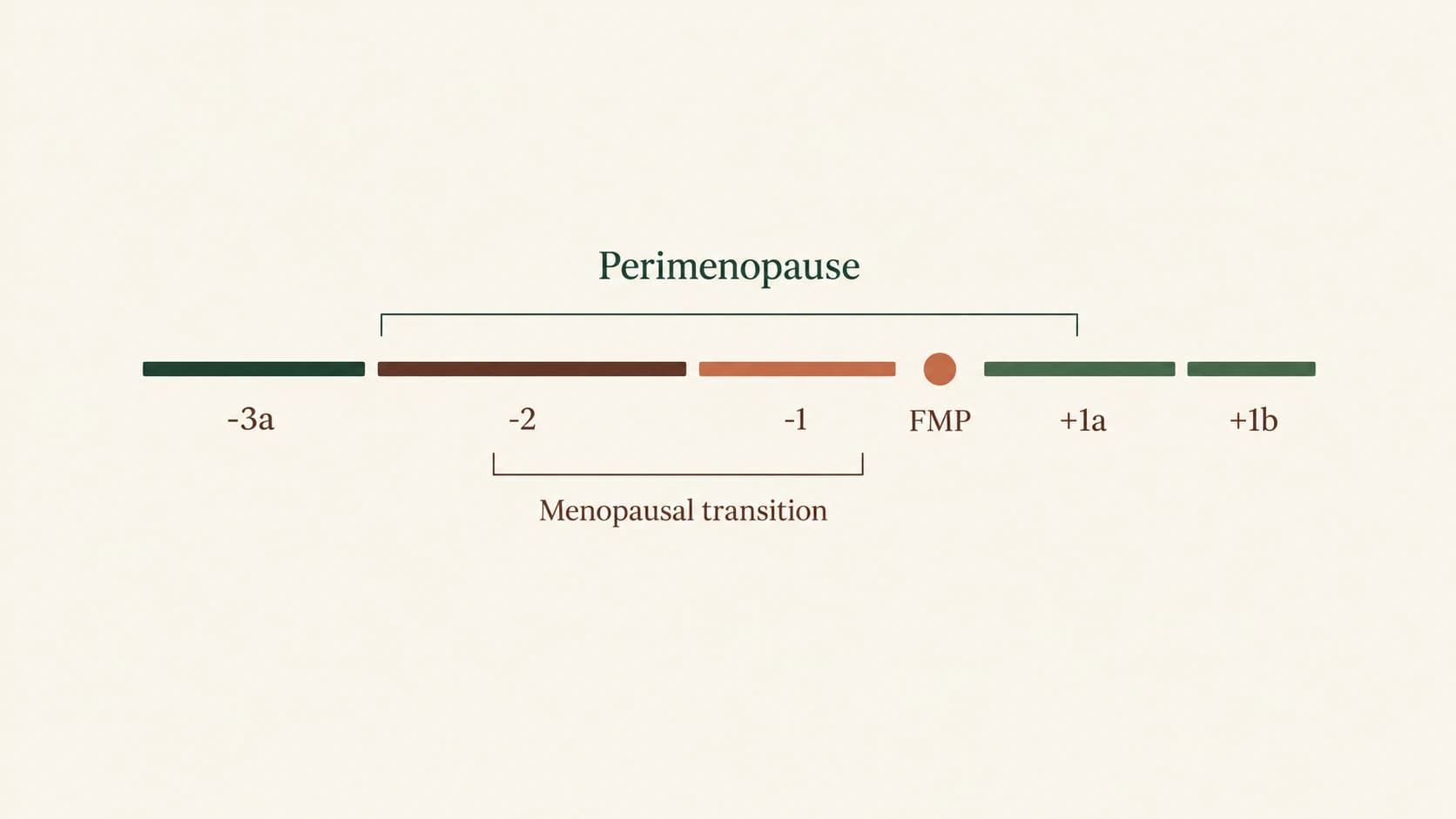
STRAW+10 numbers its stages from −5 up to +2, centred on the final menstrual period at Stage 0, and subdivides two of them — the late reproductive stage into −3b and −3a, and early postmenopause into +1a, +1b and +1c. Within all of that, the menopausal transition has exactly two stages: −2, early, and −1, late.
Perimenopause is a slightly wider span than the transition, and STRAW+10 is unusually precise about it. The paper defines perimenopause as "a term still in common usage that means the time around menopause and begins at Stage –2 and ends 12 months after the FMP" (Harlow et al., 2012). So perimenopause covers Stage −2, Stage −1 and Stage +1a — three STRAW stages, with two of them being the transition proper and the third being the first postmenopausal year.
Three principles of the system are worth knowing before you try to place yourself in it, because they rule out most of what gets sold as staging. STRAW+10 says menstrual cycle criteria "remain the most important criteria"; that biomarkers are "supportive criteria … to be used only as necessary and should not be interpreted as required for diagnosis"; and that the criteria are deliberately "independent of age, symptoms, and pathology" (Harlow et al., 2012). The paper states flatly that "the STRAW + 10 model does not use age as a criterion." Any page that tells you which stage you are in because you are 44 is not using this system.
The four-phase model — where "four" comes from
The four-phase version is published by the Centre for Menstrual Cycle and Ovulation Research (CeMCOR) at the University of British Columbia, which names four phases: Very Early Perimenopause, Early Perimenopause, Late Perimenopause and Very Late Perimenopause.
Its distinguishing move is the first phase. CeMCOR holds that perimenopause can begin while cycles are still regular, and offers a self-assessment for it: a woman in midlife with regular cycles of normal length (21–35 days apart) may identify "Very Early Perimenopause" if she has any three of nine listed changes, among them new heavy or longer flow, shorter cycles of 25 days or less, new sore or swollen breasts, new mid-sleep waking, and night sweats clustering around her period (CeMCOR). It maps its later phases onto the familiar thresholds: early perimenopause is "officially called 'Early Menopause Transition'," late perimenopause starts "when one cycle is skipped or it is 60 days from the start of one flow to the start of the next," and the year after the last flow is "Very Late Perimenopause."
CeMCOR is explicit that this is not the consensus position. Its own page says, of counting a woman with regular cycles as perimenopausal: "In saying this we differ from the official, current consensus" (CeMCOR). So the four-phase model is a named alternative from a university research centre, published alongside its own disagreement with the mainstream — not something the guidelines overlooked, and not interchangeable with STRAW+10.
The stages at a glance
Everything below is from STRAW+10's running text unless another source is named. One caution before you read the durations: these are population estimates from menstrual-calendar and hormone studies, not a schedule.
| STRAW stage | Name | What marks it | Typical length | What's common |
|---|---|---|---|---|
| −3a | Late reproductive | "Subtle changes in menstrual cycle characteristics, specifically shorter cycles, begin." In the stage just before it, −3b, cycles "remain regular without change in length" | No length given in STRAW+10's text | Early follicular FSH "increases and becomes more variable"; no symptom descriptor at this stage |
| −2 | Early menopausal transition — perimenopause starts here | "A persistent difference of 7 days or more in the length of consecutive cycles." Persistence means "recurrence within 10 cycles of the first variable length cycle" | Listed simply as variable by Merck | FSH "elevated but variable"; STRAW+10 attaches no symptom descriptor here |
| −1 | Late menopausal transition | "The occurrence of amenorrhea of 60 days or longer" | "Estimated to last, on average, 1 to 3 years" | "Extreme fluctuations in hormonal levels, and increased prevalence of anovulation." Vasomotor symptoms "likely to occur" |
| 0 | Final menstrual period | A single point in time, confirmed only 12 months later | A day, not a phase | — |
| +1a | Early postmenopause — perimenopause ends at the close of this stage | "The end of the 12-month period of amenorrhea required to define that the FMP has occurred" | 1 year | Vasomotor symptoms "most likely to occur" |
| +1b | Early postmenopause, continued | The rest of the period of rapid change in mean FSH and estradiol | 1 year; +1a and +1b together "estimated to last, on average, 2 years" | Vasomotor symptoms "most likely to occur" |
Stage criteria and all quoted phrases from Harlow et al., 2012, except the Stage −2 duration. The full research version of the system also uses anti-Müllerian hormone, antral follicle count and inhibin B as supportive criteria.
For the length of the whole transition rather than its individual stages, the most detailed figures come from SWAN, the Study of Women's Health Across the Nation. Its adjusted median duration ranged from 4.37 years among women in the oldest age-at-onset quartile to 8.57 years among the youngest — so an earlier start was associated with a longer transition, not a shorter one (Paramsothy et al., 2017). There is more on how long each phase and its symptoms last, which are genuinely different clocks.
How to tell which stage you're in
Two numbers do almost all the work, and you get both from a calendar rather than a laboratory.
What to record
Cycle length, defined as the first day of bleeding to the first day of the next bleed. Not the number of bleeding days — the gap between starts. STRAW+10's criteria compare consecutive cycles, so a single recorded length tells you nothing; you need a run of them.
Record the date each period starts, how many days it lasts, and anything that would send you to a clinician regardless of staging. The Menopause Society makes the same practical suggestion, noting that it is useful to track bleeding on a calendar or app "so that it can be easily reviewed and assessed" (The Menopause Society).

The two thresholds
A persistent difference of 7 days or more between the lengths of consecutive cycles marks the early menopausal transition — Stage −2, the start of perimenopause. A 26-day cycle followed by a 34-day one clears the threshold on size. What it does not yet clear is persistence, and STRAW+10 defines that term too: "recurrence within 10 cycles of the first variable length cycle" (Harlow et al., 2012). One irregular month is not a stage change. The same swing happening again within the next ten cycles is.
A stretch of 60 days or more with no period marks the late menopausal transition, Stage −1 (Harlow et al., 2012).
Neither number is confined to the research literature. Mayo Clinic gives patients the same pair in plain language: "If the length of your menstrual cycle is consistently different by seven days or more, you may be in early perimenopause. If you go 60 days or more between periods, you're likely in late perimenopause" (Mayo Clinic, 22 August 2026), and The Menopause Society describes the same progression (The Menopause Society).
What the thresholds will not tell you is how you feel. That is deliberate: the system is built to be independent of symptoms, which is also why symptoms are better ranked by how much they actually tell you than counted.
What 12 months without a period means
Twelve consecutive months with no period marks the final menstrual period as having happened — retroactively, a year after the fact. That is Stage +1a in STRAW+10, and reaching the end of it is the point at which perimenopause is over and postmenopause has begun (Harlow et al., 2012). The terms around that boundary trip people up constantly, which is why perimenopause, menopause and postmenopause are worth setting out side by side.
One safety point belongs here rather than at the end. Any bleeding after those 12 months is not a late stage of anything and should be assessed. Mayo Clinic puts it without hedging: "If you go 12 months without a period and then start bleeding, talk to your healthcare professional right away" (Mayo Clinic).
When period-based staging doesn't work
For a substantial number of women the two thresholds simply do not apply, and no amount of careful tracking changes that. STRAW+10 names most of these groups itself, and this is the part of the system that consumer stage pages almost always leave out.
- If you use hormonal contraception or have a hormonal coil. The NHS lists the progestogen-only pill, the IUS (hormonal coil), the implant and the injection as methods that "can make periods irregular or stop completely," and notes that the combined pill produces monthly bleeds for as long as you take it (NHS). A bleed on the combined pill is not a cycle you can stage. Nor does bloodwork rescue the situation: NICE instructs clinicians, "Do not use a follicle-stimulating hormone (FSH) blood test to identify menopause in people using combined oestrogen and progestogen contraception or high-dose progestogen" (NICE NG23, 1.3.5, last updated 15 April 2026).
- If you've had a hysterectomy or endometrial ablation. STRAW+10 is unambiguous: "Women who have undergone hysterectomy or endometrial ablation cannot be staged by menstrual bleeding criteria." It adds that reproductive stage in these women "can only be assessed using the supportive criteria, that is, the endocrine markers of ovarian aging" (Harlow et al., 2012). NICE covers the clinical consequence from the other direction, telling clinicians to identify menopause in people who have had a hysterectomy "based on the type and combination of symptoms they have" (NICE NG23, 1.3.1).
- If you have PCOS. "Women with PCOS frequently experience oligomenorrhea that is not attributable to ovarian aging. Therefore, the current menstrual cycle criteria used to stage reproductive aging are not applicable to this population" (Harlow et al., 2012). Infrequent periods are already a feature of the condition, so they cannot be read as a signal of the transition.
- If you have hypothalamic amenorrhoea. The same paper: "menstrual cycle criteria are not applicable in women with hypothalamic amenorrhea."
- If you're under 40. STRAW+10 states that women meeting the criteria for "POI/premature ovarian failure" — which it defines as being under 40 with four months of amenorrhoea and two serum FSH levels in the menopausal range, taken at least a month apart — "do not easily fit into this model" (Harlow et al., 2012). This is not a staging problem to work out at home; it is a reason to be assessed. NICE advises diagnosing premature ovarian insufficiency in people under 40 from menopause-associated symptoms together with "elevated follicle stimulating hormone (FSH) levels on 2 blood samples taken 4 to 6 weeks apart," and adds separately: "Do not diagnose premature ovarian insufficiency on the basis of a single blood test" (NICE NG23, 1.7.2 and 1.7.3).
If you are in one of these groups, the useful conversation is about symptoms and history rather than about which stage you occupy. Our guide to whether a blood test can stage you covers what the testing can and cannot settle.
Which stage tends to feel worst
For hot flashes and night sweats, the evidence points at late perimenopause and the first year or two after the final period — later than most people expect, and later than the "stormy middle years" framing implies.
Three independent lines of evidence converge. In SWAN, "the transition to late perimenopause exhibited the strongest association with vasomotor symptoms," with an adjusted odds ratio of 6.64 (95% CI 4.80–9.20), and after adjustment symptoms "were reported most often in all racial/ethnic groups in late perimenopause and nearly as often in postmenopause" (Gold et al., 2006). A meta-analysis of 10 studies covering 35,445 participants found that the share of women with symptoms "increased sharply in the 2 years before final menstrual period, peaked 1 year after final menstrual period, and did not return to premenopausal levels until about 8 years after final menstrual period"; symptoms rated bothersome rather than merely present "peaked about 1 year earlier" (Politi et al., 2008). And STRAW+10 itself assigns its symptom descriptors accordingly: vasomotor symptoms are "likely to occur" in the late transition and "most likely to occur" across Stages +1a and +1b (Harlow et al., 2012).
Now the caveat, because a population peak is not a forecast for one person. When SWAN modelled individual trajectories in 1,455 women, it found four distinct patterns rather than one shared curve: early onset roughly 11 years before the final period with decline afterwards (18.4% of women), onset near the final period with later decline (29.0%), early onset with persistently high frequency (25.6%), and persistently low frequency throughout (27.0%) (Tepper et al., 2016). Duration varies on the same scale. Among the 1,449 SWAN participants who did have frequent symptoms — defined as six or more days in the previous two weeks — the median total duration was 7.4 years, and among the 881 of those with an observable final period, symptoms persisted a median of 4.5 years past it (Avis et al., 2015).
If symptoms are the reason you are trying to locate yourself on a timeline, the treatment options and what has changed in them recently will be more use than the staging.
Do the stages always run in order?
No. The stages describe a general direction of travel, not a ratchet, and periods can return after a long gap.
CeMCOR makes the point with its own clinical data and the literature it cites: asked whether progress through the phases is regular, it answers that "the truth is much more complex," pointing to a Manitoba study in which 324 menstruating women over 45 produced "100 different menstrual cycle patterns" across three years, with women going "without flow for six months and then have regular flow again for six months" (CeMCOR). CeMCOR also states that the final 12-month count "can become longer if we get another period, as 10-20% of us normally do," and that this is likelier the younger you are. We have not read the underlying studies CeMCOR cites for either figure, so both are reported here as CeMCOR's position rather than as independently verified numbers.
The mechanism behind the backsliding is ovulation becoming intermittent rather than stopping. ACOG describes it plainly: during perimenopause, "Some months, the ovaries may release an egg. Other months, they do not release an egg" (ACOG).
Worth flagging that sources disagree on exactly this point. Cleveland Clinic's perimenopause page tells readers: "If you're still getting a period, even an irregular one, you're still ovulating" (Cleveland Clinic). ACOG's framing is the more cautious of the two, and STRAW+10 independently describes "increased prevalence of anovulation" as a feature of the late transition. The practical upshot is the same either way and is not in dispute anywhere: an irregular cycle is not a reliable sign that you have stopped ovulating, and it is not contraception.
One thing that does not run backwards is the 12-month line. Bleeding that starts after a full year without periods is not a return to an earlier stage, and both bodies treat it as a reason to be assessed rather than watched: Mayo Clinic says to talk to a healthcare professional "right away" (Mayo Clinic), and ACOG lists bleeding after menopause as abnormal, adding that "if you have any bleeding after menopause … it's important to see your ob-gyn to find out the cause," since the causes it names include polyps, endometrial hyperplasia and endometrial cancer (ACOG).
If what you actually want to know is when all this is likely to begin, when perimenopause usually starts handles the age question, and what perimenopause is, from start to finish is the overview this page sits under.
Common questions about the stages of perimenopause (FAQ)
What are the 4 stages of perimenopause? No consensus clinical body defines four. STRAW+10, the reference staging system, gives the menopausal transition two stages — early (−2) and late (−1) — and spans perimenopause across those plus the 12 months after the final period (Harlow et al., 2012). The four-phase version comes from CeMCOR at the University of British Columbia, which adds a "very early" phase before cycles turn irregular and says this "differ[s] from the official, current consensus" (CeMCOR). Other pages count three stages of menopause, in which perimenopause is one stage with no sub-stages (Cleveland Clinic).
How can I tell what stage of perimenopause I'm in? From your cycle lengths, measured first day of bleeding to first day of the next. A persistent difference of 7 days or more between consecutive cycles marks the early transition; a gap of 60 days or more marks the late one. "Persistent" means recurrence within 10 cycles of the first variable-length cycle (Harlow et al., 2012). Neither your age nor your symptoms place you — STRAW+10 "does not use age as a criterion."
Can a blood test tell me what stage of perimenopause I'm in? Not reliably. STRAW+10 treats hormone measurements as "supportive criteria … to be used only as necessary and should not be interpreted as required for diagnosis," and its FSH figure above 25 IU/L applies to the late transition only, with laboratories needing to "carefully evaluate the appropriate FSH value, depending on the assay they use" (Harlow et al., 2012). NICE goes further, telling clinicians not to use AMH, inhibin A or B, oestradiol, antral follicle count or ovarian volume at all in people aged 45 or over (NICE NG23, 1.3.4).
How long does each stage of perimenopause last? STRAW+10 estimates the late transition at "on average, 1 to 3 years," and Stages +1a and +1b at a year each (Harlow et al., 2012). It gives no fixed length for the early transition; Merck lists that stage's duration as variable (Merck). Across the whole transition, SWAN's adjusted median ran from 4.37 years in the oldest age-at-onset quartile to 8.57 in the youngest (Paramsothy et al., 2017).
Which stage of perimenopause is the worst? For hot flashes and night sweats, the odds are highest in late perimenopause and the year or two after the final period. In SWAN the transition to late perimenopause carried the strongest association with them (adjusted OR 6.64, 95% CI 4.80–9.20) (Gold et al., 2006), and a meta-analysis found reporting "peaked 1 year after final menstrual period" (Politi et al., 2008). That is a population average, not a prediction: SWAN found four distinct trajectories, with 27.0% of women persistently low throughout (Tepper et al., 2016).
Medical disclaimer: This article is for informational purposes only. Always consult a qualified healthcare provider before making changes to your health routine.
Sources
- Harlow SD, Gass M, Hall JE, Lobo R, Maki P, Rebar RW, Sherman S, Sluss PM, de Villiers TJ. Executive summary of the Stages of Reproductive Aging Workshop + 10: addressing the unfinished agenda of staging reproductive aging. Menopause, 2012;19(4):387–395 — Peer-reviewed journal article via PMC. https://pmc.ncbi.nlm.nih.gov/articles/PMC3340903/
- National Institute for Health and Care Excellence. Menopause: identification and management (NG23) — Clinical guideline, published 12 November 2015, last updated 15 April 2026. https://www.nice.org.uk/guidance/ng23/chapter/Recommendations
- NHS. Menopause and perimenopause — Symptoms — Government health information. https://www.nhs.uk/conditions/menopause-and-perimenopause/symptoms/
- The Menopause Society. Menopause Topics: Perimenopause — Professional society patient education. https://menopause.org/patient-education/menopause-topics/perimenopause
- American College of Obstetricians and Gynecologists. Perimenopausal Bleeding and Bleeding After Menopause (FAQ162) — Professional society patient FAQ. https://www.acog.org/womens-health/faqs/perimenopausal-bleeding-and-bleeding-after-menopause
- Mayo Clinic. Perimenopause — Symptoms and causes — Health system disease reference, dated 22 August 2026. https://www.mayoclinic.org/diseases-conditions/perimenopause/symptoms-causes/syc-20354666
- Merck Manual Professional Edition. Menopause — Clinical reference, full review August 2025, last updated June 2026. https://www.merckmanuals.com/professional/gynecology-and-obstetrics/menopause/menopause
- Cleveland Clinic. Menopause — Health system disease reference, last updated 24 June 2024. https://my.clevelandclinic.org/health/diseases/21841-menopause
- Cleveland Clinic. Perimenopause — Health system disease reference, last updated 29 July 2024. https://my.clevelandclinic.org/health/diseases/21608-perimenopause
- Mayo Clinic Press. Explaining the stages of menopause — Consumer health publication. https://mcpress.mayoclinic.org/menopause/explaining-the-stages-of-menopause/
- Centre for Menstrual Cycle and Ovulation Research (University of British Columbia). How Can I Tell I Am in Perimenopause? — University research centre resource. https://cemcor.ubc.ca/resources/how-can-i-tell-i-am-perimenopause/
- Gold EB, Colvin A, Avis N, Bromberger J, Greendale GA, Powell L, Sternfeld B, Matthews K. Longitudinal analysis of the association between vasomotor symptoms and race/ethnicity across the menopausal transition: study of women's health across the nation. American Journal of Public Health, 2006;96(7):1226–1235 — Peer-reviewed journal article. https://pubmed.ncbi.nlm.nih.gov/16735636/
- Politi MC, Schleinitz MD, Col NF. Revisiting the duration of vasomotor symptoms of menopause: a meta-analysis. Journal of General Internal Medicine, 2008;23(9):1507–1513 — Peer-reviewed meta-analysis. https://pubmed.ncbi.nlm.nih.gov/18521690/
- Tepper PG, Brooks MM, Randolph JF, Crawford SL, El Khoudary SR, Gold EB, et al. Characterizing the trajectories of vasomotor symptoms across the menopausal transition. Menopause, 2016;23(10):1067–1074 — Peer-reviewed journal article (SWAN). https://pubmed.ncbi.nlm.nih.gov/27404029/
- Paramsothy P, Harlow SD, Nan B, Greendale GA, Santoro N, Crawford SL, et al. Duration of the menopausal transition is longer in women with young age at onset: the multiethnic Study of Women's Health Across the Nation. Menopause, 2017;24(2):142–149 — Peer-reviewed journal article (SWAN). https://pubmed.ncbi.nlm.nih.gov/27676632/
- Avis NE, Crawford SL, Greendale G, Bromberger JT, Everson-Rose SA, Gold EB, et al. Duration of menopausal vasomotor symptoms over the menopause transition. JAMA Internal Medicine, 2015;175(4):531–539 — Peer-reviewed journal article (SWAN). https://pmc.ncbi.nlm.nih.gov/articles/PMC4433164/
All sources accessed 1 October 2026.

Claire Whitfield
A women's health specialist who would rather read the actual staging criteria than a summary of a summary of them.