

Quick answer: For most women over 45, no blood test confirms perimenopause. It is diagnosed clinically — from your age, your symptoms and what your cycles have been doing. Testing has a genuine role at the younger end, and a separate role in ruling out other conditions.
That is an unsatisfying answer when you want to know what is happening to your own body, so this page does not stop there. What actually works is cheap, and more use to a doctor than any hormone level.
Is there a test for perimenopause?
No — not in the sense of one result that settles it. Cleveland Clinic states it plainly: "Hormone testing isn't necessary to diagnose perimenopause. Hormone levels fluctuate so much that the tests aren't reliable." A provider instead determines that you're transitioning to menopause "based on a physical exam and your symptoms, age and medical history" (Cleveland Clinic).
Nor is there a scan: "There aren't any imaging tests that can confirm perimenopause," though a provider "may order tests to rule out other conditions" — a different job, covered further down (Cleveland Clinic). The NIA is equally blunt about the difficulty: "It may be difficult for you and your doctor to tell whether you are in the menopausal transition" (NIA).
Why a hormone test can't tell you
This is not a matter of test quality or lab accuracy. The lab can measure your follicle-stimulating hormone perfectly well. The problem is what that measurement means in a process defined by instability.
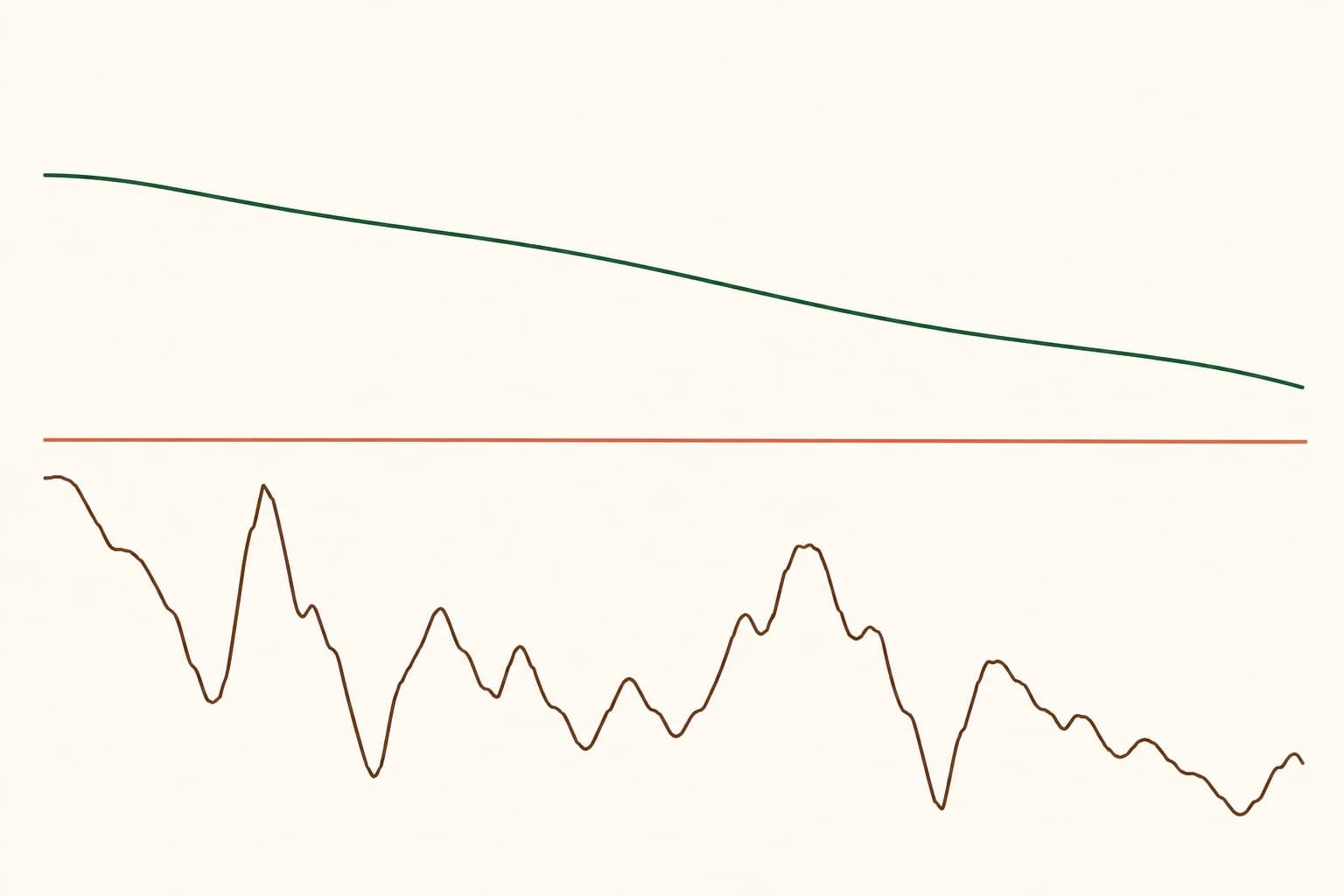
The staging system specialists use — the Stages of Reproductive Aging Workshop +10, or STRAW+10 — describes early-transition FSH as "elevated but variable" (Harlow et al., 2012). Variability isn't noise around the signal. It is the signal. And it grows more pronounced later, not less: in the late transition, FSH levels are "sometimes elevated into the menopausal range and sometimes within the range characteristic of the earlier reproductive years" (Harlow et al., 2012).
The same woman, in the same stage, can produce a menopausal-looking result or an unremarkable one depending on the morning you catch her. Cleveland Clinic makes the point clinically: a consistently high FSH can indicate you're getting near menopause, "but FSH tests can be misleading because during perimenopause, your hormones rise and fall erratically" (Cleveland Clinic). Note the word consistently — one test cannot demonstrate it.
Other things move these numbers — "certain medications and health conditions interfere with hormone levels," hormonal contraception being the obvious one at this age (Cleveland Clinic).
Where the age line falls
Age changes the answer, because it changes what the test is asked to settle. Three bands, from US federal sources:
| Your age | What the question really is | Where testing sits |
|---|---|---|
| Under 40 | Is this premature menopause? | Testing is part of a real diagnostic workup |
| 40–45 | Is this early menopause? | A clinician's call; a blood test may be part of it |
| 45 and over | Which part of a normal transition is this? | Not necessary; diagnosis is clinical |
The Office on Women's Health sets the terms: "Menopause that happens before age 40 is called premature menopause (which is also medically called primary ovarian insufficiency [POI])," while "menopause that happens between 40 and 45 is called early menopause" — which affects about 5% of women naturally. For both, a provider "may give you a blood test to measure estrogen and related hormones" (OWH).
Above 45 you are in the ordinary window — most women begin the transition between ages 45 and 55 (NIA) — and that is precisely where a hormone level stops earning its keep. The perimenopause age range covers the timing question properly. One point of honesty: we could not verify a US federal source setting a testing rule for the 40-to-45 band.
When testing genuinely is worth doing
Under 40 the picture changes completely, and this is the part worth acting on. Periods that stop early point at a different diagnosis with different consequences: OWH notes a higher risk of "serious health problems, such as heart disease and osteoporosis," alongside the early loss of fertility (OWH).
The NIA flags the trigger: "in some cases, for example if a woman's periods stopped at an early age, a doctor may suggest a blood test to check hormone levels" (NIA). For a woman under 40 with irregular periods, or none for four months or longer, NICHD describes a workup including a pregnancy test, a physical exam and bloods (NICHD).
Then the detail that reframes it all: even where FSH is diagnostic, it is not read once. "The healthcare provider may do two FSH tests, at least a month apart," NICHD explains, with POI likely only if both come back as high as in women who have been through menopause (NICHD). ACOG's committee opinion on primary ovarian insufficiency — July 2014, reaffirmed 2025 — specifies the same shape, and adds that if FSH returns in the menopausal range, "a repeat FSH measurement is indicated in 1 month" (ACOG, Committee Opinion 605).
The one situation where an FSH result carries diagnostic weight is also the one where the guidance insists you repeat it. That tells you what a lone reading is worth.
Tests that rule something else out are a different question
Diagnosing perimenopause and excluding other explanations are two separate investigations, and conflating them is why "my doctor ran bloods" gets misremembered as "there's a test for it." The second is often the more useful one, because the alternatives are treatable. Cleveland Clinic puts it simply: "Because some of these symptoms resemble symptoms of other conditions, it's a good idea to talk to your healthcare provider about what you're experiencing," so they can confirm the symptoms are perimenopause "and not another health condition" (Cleveland Clinic).
What it contains depends on your age and symptoms, which is why choosing it is a clinician's job rather than a web page's. For irregular or absent periods in younger women, ACOG names pregnancy, polycystic ovary syndrome, hypothalamic amenorrhoea, thyroid abnormalities and hyperprolactinaemia among causes to evaluate (ACOG, Committee Opinion 605). For abnormal bleeding at any age, Cleveland Clinic lists infection, fibroids, blood clotting disorders, polyps and cancer (Cleveland Clinic) — a reason to book an appointment rather than keep tracking. The perimenopause symptoms guide sets out which patterns count.
At-home menopause tests: what they measure, and what they don't
These are urine FSH tests, and the fairest thing to say is that they do the job they were built for. The FDA's guidance on home-use menopause tests rates them as accurate: "These tests will accurately detect FSH about 9 out of 10 times." The very next sentence is the one that matters: "This test does not detect menopause or perimenopause" (FDA).
That is the whole problem, from the regulator rather than a competitor: accuracy and relevance are different properties. What you are buying is "a qualitative test — you find out whether or not you have elevated FSH levels, not if you definitely are in menopause or perimenopause" (FDA).
One warning has real consequences: a positive result is not a contraceptive decision. "Do not stop taking contraceptives based on the results of these tests because they are not foolproof and you could become pregnant" (FDA). Pregnancy remains possible throughout perimenopause, and the NIA advises continuing birth control for a full 12 months after your last period (NIA) — the same 12 months that, under STRAW+10, still count as part of perimenopause (Harlow et al., 2012).
The FDA's closing observation is the useful one: some home tests are identical to your doctor's, but "doctors would not use this test by itself" (FDA). That page is dated 27 September 2018; the products have changed since, the limitation has not. An ACOG piece from November 2024 adds a shopping note, flagging "hormone balance or imbalance" as a marketing phrase to watch and advising you check who is selling, since a financial interest in the product recommended is a conflict of interest (Santoro, ACOG).
What actually helps you find out
Track your cycles. It produces the evidence a lab test can't, and STRAW+10 gives two thresholds you can check against your own calendar: the early menopausal transition is marked by "a persistent difference of 7 days or more in the length of consecutive cycles" — persistence defined precisely, as "recurrence within 10 cycles of the first variable length cycle" — and the late transition by "amenorrhea of 60 days or longer" (Harlow et al., 2012).

Cycle length — first day of bleeding to first day of the next — is the number the criteria are built on, so a date is enough. Alongside it, note what has changed and how often: sleep, hot flashes or night sweats, mood, bleeding much heavier or lighter than before. App or paper; what matters is keeping it up for several months.
Then bring it to an appointment. A documented pattern across six or twelve cycles is diagnostically useful in a way a one-off hormone level isn't, and it converts I think something's changing into something a clinician can work with. For what the stages mean, what perimenopause actually is covers the staging picture; how long perimenopause lasts answers what usually comes next.
One group can't use this method: STRAW+10 notes that women who have had a hysterectomy or endometrial ablation "cannot be staged by menstrual bleeding criteria," leaving hormone markers as the only route — and even then, "a single sample for measurement of FSH and estradiol may be ambiguous or misleading, and at least one repeated measurement is often required" (Harlow et al., 2012).
What to ask your doctor
Five questions worth raising:
- Does this pattern fit the menopausal transition, given my age? The actual diagnostic question, answerable from your cycle record and history.
- Is there anything else worth ruling out? The separate investigation described above — and the one more likely to change your treatment.
- Would a hormone test change what we do next? Worth asking directly. If the answer is no, that is useful information about the test.
- What are the options if symptoms are affecting daily life? Perimenopause being normal doesn't mean the symptoms have to be endured untreated.
- Do I still need contraception, and for how long? Yes — for 12 months past your last period (NIA), though worth confirming against your own circumstances.
For a clinician with specific training here, ACOG points to the letters MSCP after a provider's name — Menopause Society Certified Practitioner (Santoro, ACOG).
Common questions about perimenopause testing (FAQ)
Is there a blood test for perimenopause? Not a reliable one for women over 45. Cleveland Clinic states that "hormone testing isn't necessary to diagnose perimenopause" because "hormone levels fluctuate so much that the tests aren't reliable" (Cleveland Clinic). Diagnosis is made from your age, symptoms and cycle history instead.
Do at-home menopause tests work? They measure what they claim to, which is not the same as answering your question. The FDA's guidance on home-use menopause tests says these tests "will accurately detect FSH about 9 out of 10 times," then states directly: "This test does not detect menopause or perimenopause" (FDA).
What FSH level indicates perimenopause? There is no FSH number you can apply to yourself. STRAW+10 publishes a level "greater than 25 IU/L in a random blood draw" as characteristic of the late transition only, and the same paper cautions that the appropriate value depends on the assay a lab uses and still requires empirical confirmation (Harlow et al., 2012). It is a research staging criterion applied to populations, not a threshold to read your own result against.
How do doctors diagnose perimenopause? Clinically. Cleveland Clinic describes a provider determining that you're transitioning to menopause "based on a physical exam and your symptoms, age and medical history" (Cleveland Clinic), and the NIA describes a doctor asking about your age, symptoms and family history (NIA).
Should I ask for a hormone test? Over 45 with typical symptoms, it is unlikely to change anything, and tests to rule out other causes are the more useful question to raise. Under 40, or if your periods have stopped early, that is a different clinical situation: the NIA notes a doctor may suggest a blood test in that case (NIA), and it warrants proper assessment.
Medical disclaimer: This article is for informational purposes only. Always consult a qualified healthcare provider before making changes to your health routine.
Sources
- Cleveland Clinic. Perimenopause — Health system disease reference. https://my.clevelandclinic.org/health/diseases/21608-perimenopause
- Harlow SD, Gass M, Hall JE, et al. Executive summary of the Stages of Reproductive Aging Workshop +10: addressing the unfinished agenda of staging reproductive aging. Menopause, 2012;19(4) — Peer-reviewed journal article via PMC. https://pmc.ncbi.nlm.nih.gov/articles/PMC3340903/
- National Institute on Aging (NIH). What Is Menopause? — Government health information. https://www.nia.nih.gov/health/menopause/what-menopause
- Office on Women's Health, US Department of Health and Human Services. Early or premature menopause — Government health information. https://womenshealth.gov/menopause/early-or-premature-menopause
- US Food and Drug Administration. Home Use Tests: Menopause — Federal regulator device information, content current as of 27 September 2018. https://www.fda.gov/medical-devices/home-use-tests/menopause
- Eunice Kennedy Shriver National Institute of Child Health and Human Development (NICHD, NIH). How do healthcare providers diagnose POI? — Government health information. https://www.nichd.nih.gov/health/topics/poi/conditioninfo/diagnosed
- American College of Obstetricians and Gynecologists. Primary Ovarian Insufficiency in Adolescents and Young Women. Committee Opinion No. 605, July 2014, reaffirmed 2025 — Clinical guidance. https://www.acog.org/clinical/clinical-guidance/committee-opinion/articles/2014/07/primary-ovarian-insufficiency-in-adolescents-and-young-women
- Santoro N. Menopause Misinformation Is Everywhere. Here's How to Detect It. American College of Obstetricians and Gynecologists, November 2024 — Expert commentary. https://www.acog.org/womens-health/experts-and-stories/the-latest/menopause-misinformation-is-everywhere-heres-how-to-detect-it
All sources accessed 6 August 2026.

Claire Whitfield
A women's health specialist who checks what a test actually measures before asking what it can prove.