

Quick answer: The code is N95.1, "Menopausal and female climacteric states." But no ICD-10-CM code is named perimenopause — which is why the answers you find contradict each other.
N95.1 at a glance
| Field | Value |
|---|---|
| Code | N95.1 |
| Official descriptor | Menopausal and female climacteric states |
| Status | Valid for submission — billable and specific |
| Parent category | N95, "Menopausal and other perimenopausal disorders" — a header, not reportable |
| Code set | ICD-10-CM, FY2026 |
| Effective dates | 1 October 2025 – 30 September 2026 |
| Never report alongside | Z78.0 · E28.310 · E89.41 (all Excludes1) |
Every code and descriptor in this block was read from the CDC/NCHS official FY2026 code file, where the "valid for submission" flag is what makes N95.1 billable and N95 not.
If the record documents something else, the code changes:
| If the documentation says | Report | Relationship to N95.1 |
|---|---|---|
| Menopausal status, no symptoms | Z78.0 Asymptomatic menopausal state | Excludes1 under N95.1 |
| Symptoms of premature menopause | E28.310 Symptomatic premature menopause | Excludes1 under N95.1 |
| Symptoms following a procedure | E89.41 Symptomatic postprocedural ovarian failure | Excludes1 under N95.1 |
| Heavy or irregular bleeding in the transition | N92.4 Excessive bleeding in the premenopausal period | Excludes1 at the N95 category level |
| A specified disorder of the transition with no code of its own | N95.8 Other specified menopausal and perimenopausal disorders | Residual code; N95.1 is the general symptomatic state |
Why the Excludes1 line is the part worth checking. The guidelines say the excluded code "should never be used at the same time as the code above the Excludes1 note," so reporting N95.1 with Z78.0, E28.310 or E89.41 asserts two contradictory things about a single encounter. At least some payers also act on it in claim editing: UnitedHealthcare's Diagnosis Code Requirement Policy lists "Mutually Exclusive Diagnosis Codes defined by Exclude1" among its diagnosis requirements, and the Community Plan version of that policy sets out state-by-state exemptions from it (UnitedHealthcare, policy 2026R5034A; policy 2026R7131H). That is one payer's published policy, cited as a documented example — we have not surveyed payers generally, and policies differ.
Which classification this page covers. ICD-10-CM is the clinical modification maintained for the United States by CDC/NCHS, and it is the code set used wherever ICD-10-CM is the applicable standard rather than a purely national one. Other countries apply their own modifications of ICD-10 — France the CIM-10, Germany the ICD-10-GM — and their descriptors and exclusion notes are not identical to the ones below. The French and German versions of this page cover those two classifications on their own terms.
The short answer: N95.1
N95.1 is reported for symptoms attributed to natural, age-related menopause. Its inclusion term reads: "Symptoms such as flushing, sleeplessness, headache, lack of concentration, associated with natural (age-related) menopause" (CDC/NCHS FY2026 tabular list). It is a valid, billable, specific code (AAPC).
Now the part that causes the confusion. Search this term and you will find "perimenopause" attached to N95.1, and pages insisting no such code exists. Both describe something real. N95.1 sits inside category N95, headed "Menopausal and other perimenopausal disorders," whose inclusion term is broader still: "Menopausal and other perimenopausal disorders due to naturally occurring (age-related) menopause and perimenopause." The word lives at the category level. It is not in the descriptor of N95.1, which reads "menopausal and female climacteric states."
One further precision, since precision is the point here. The adjective perimenopausal does appear in two descriptors: N95.8, "Other specified menopausal and perimenopausal disorders," and N95.9, "Unspecified menopausal and perimenopausal disorder." Both are residual codes for disorders occurring in that period. Neither names perimenopause as a state in its own right, and no code does.
The related codes, and when each one applies
Every descriptor below was checked individually against the official CDC/NCHS FY2026 tabular list, because exclusion-note wording and the excluded code's own descriptor are frequently not the same.
| Code | Official descriptor | When it applies | Relationship to N95.1 |
|---|---|---|---|
| N95.1 | Menopausal and female climacteric states | Symptoms associated with natural, age-related menopause | — |
| Z78.0 | Asymptomatic menopausal state | Menopausal status with no associated symptoms. Inclusion terms: "Menopausal state NOS," "Postmenopausal status NOS" | Excludes1 under N95.1 |
| E28.310 | Symptomatic premature menopause | The same symptom picture, arising from premature rather than age-related menopause | Excludes1 under N95.1 |
| E89.41 | Symptomatic postprocedural ovarian failure | Symptoms "associated with postprocedural menopause" — menopause following a procedure | Excludes1 under N95.1 |
| N92.4 | Excessive bleeding in the premenopausal period | Heavy or irregular bleeding in the transition. Inclusion terms include "Perimenopausal bleeding" | Excludes1 at the N95 category level |
That second column is where published tables go wrong. E89.41's descriptor is "Symptomatic postprocedural ovarian failure," not "symptoms associated with artificial menopause" — the latter is the wording of the exclusion note under N95.1, not the code's own title. E28.310 has the same mismatch.
N92.4 matters for a different reason: it is where "perimenopausal" appears as an inclusion term. Heavy bleeding in the transition is not an N95.1 encounter by default — it has its own code, excluded from N95 at the category level.
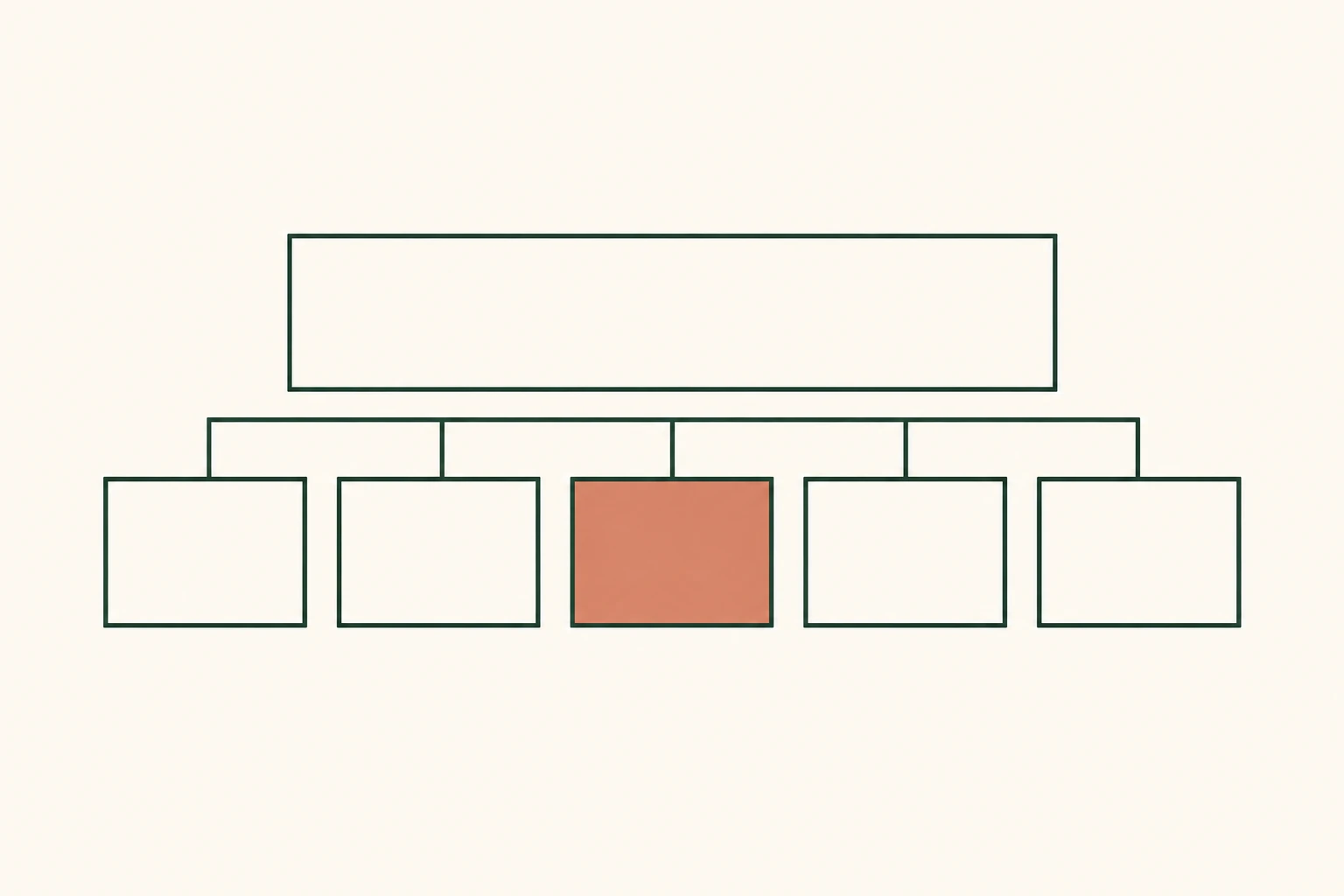
The N95.1 / Z78.0 / E28.310 split maps onto the underlying terminology — symptomatic versus asymptomatic, natural versus premature. The four-stage terminology map sets out how premenopause, perimenopause, menopause and postmenopause differ.
What the Excludes1 notes mean here
The ICD-10-CM Official Guidelines define the two note types, and the difference decides whether two codes can appear on the same encounter.
Excludes1 is described in the guidelines as "a pure excludes note. It means 'NOT CODED HERE!' An Excludes1 note indicates that the code excluded should never be used at the same time as the code above the Excludes1 note. An Excludes1 is used when two conditions cannot occur together, such as a congenital form versus an acquired form of the same condition" (CMS, FY2026 guidelines, §I.A.12.a).
Excludes2 does the opposite. It "represents 'Not included here.' An excludes2 note indicates that the condition excluded is not part of the condition represented by the code, but a patient may have both conditions at the same time. When an Excludes2 note appears under a code, it is acceptable to use both the code and the excluded code together, when appropriate" (same source, §I.A.12.b).
Applied to N95.1, the three Excludes1 entries — Z78.0, E89.41 and E28.310 — are alternatives, not layers. A documented menopausal state is either symptomatic or asymptomatic, and the symptoms are attributed to natural, premature or postprocedural menopause. Picking one is the coding decision; reporting two would assert something contradictory about the same encounter.
The guidelines do carry an exception worth knowing about: "An exception to the Excludes1 definition is the circumstance when the two conditions are unrelated to each other. If it is not clear whether the two conditions involving an Excludes1 note are related or not, query the provider" (same source, §I.A.12.a).
The Excludes2 notes sit at the N95 category level and behave in the opposite way — postmenopausal osteoporosis (M81.0-), the same with current pathological fracture (M80.0-), and postmenopausal urethritis (N34.2). None is part of what N95.1 represents, and a patient can have both, so they can be reported alongside it.
One asymmetry, stated because it is in the official file: N95.1 lists Z78.0 as an Excludes1, while Z78.0 lists "symptomatic menopausal state (N95.1)" as an Excludes2. Two note types, same tabular list, and the classification does not say which governs. We report what the file says rather than resolving it — that question belongs with your organisation's coding guidance.
Why there is no dedicated perimenopause code
The two systems are answering different questions.
ICD-10-CM classifies clinical states for reporting: symptomatic or asymptomatic, natural or premature or postprocedural, bleeding or not bleeding. Those are the distinctions its codes draw.
Perimenopause, as a stage, is defined differently. Under the Stages of Reproductive Aging Workshop +10 criteria, the transition is staged principally on menstrual bleeding patterns: STRAW+10 treats "menstrual cycle criteria" as "the most important criteria" and biomarkers as supportive only, "to be used only as necessary and… not be interpreted as required for diagnosis." The early transition is "marked by increased variability in menstrual cycle length, defined as a persistent difference of 7 days or more in the length of consecutive cycles," and perimenopause "begins at Stage –2 and ends 12 months after the FMP" — the final menstrual period (Harlow et al., 2012).
A classification that codes what is documented at a single encounter and a staging system built on cycle patterns across years are not the same instrument. That is a difference in purpose — not a claim about what the authors of ICD-10 intended, which we cannot establish. The clinical definition is covered in what perimenopause is.
Documentation notes
Only what is verifiable from the code set itself:
- N95.1 is billable and specific. Its parent category, N95, is a header, does not appear in the CDC list of valid codes, and cannot be reported.
- The inclusion terms indicate scope, not a required checklist. The guidelines state that inclusion terms "are not necessarily exhaustive" and that "additional terms found only in the Alphabetic Index may also be assigned to a code" (CMS, FY2026 guidelines). Flushing, sleeplessness, headache and lack of concentration are examples of what N95.1 covers; which symptoms actually present is a separate question, covered in our guide to perimenopause symptoms.
- The attribution in the record drives the code: natural, premature and postprocedural menopause are Excludes1 to one another.
Payer policies, clearinghouse formatting and medical-necessity requirements vary between payers and we have not surveyed them. The one payer policy cited on this page — UnitedHealthcare's, in the block above — is included because it names the Excludes1 convention explicitly and publishes its exemptions; it is an example, not a general rule.
Codes change every October
ICD-10-CM is revised annually, each fiscal year's code set effective 1 October. FY2026 runs 1 October 2025 to 30 September 2026 (CMS, FY2026 guidelines). There is now also a mid-year update effective 1 April, though the April 1, 2026 update made 0 additions, 0 deletions and 0 revisions (CDC/NCHS addenda).
FY2027 takes effect 1 October 2026, and its files are already published. We checked every code on this page against the FY2027 tabular list: N95.1, Z78.0, E28.310, E89.41 and N92.4 are unchanged — same descriptors, same inclusion terms, same Excludes1 and Excludes2 notes — and the FY2027 guidelines carry identical Excludes definitions (CDC/NCHS FY2027 files).
That holds as of publication and is no guarantee about later years. Before relying on any code for billing, check the current official file — CMS maintains the ICD-10 landing page, and CDC/NCHS publishes the tabular list, index and addenda each fiscal year.

For patients: what N95.1 on your paperwork means
If N95.1 appears on an after-visit summary or insurance statement, it records that a clinician documented symptoms associated with natural, age-related menopause. It is a records-and-billing classification — not a severity rating, and not a finding that something is wrong. Z78.0 in the same place means the opposite: menopausal status noted, no symptoms. For the clinical picture rather than the code, start with what perimenopause is.
Common questions about perimenopause ICD-10 coding (FAQ)
What is the ICD-10 code for perimenopause? N95.1, "Menopausal and female climacteric states." No ICD-10-CM code carries "perimenopause" as its descriptor. N95.1 covers symptoms associated with natural, age-related menopause, and sits in category N95, headed "Menopausal and other perimenopausal disorders" (CDC/NCHS FY2026 tabular list).
What is the ICD-10 code for perimenopausal state? There is no code with that descriptor. The phrase comes from the N95 block header, "Menopausal and other perimenopausal disorders," and the category inclusion term beneath it. For a symptomatic patient the code is N95.1; for an asymptomatic menopausal state it is Z78.0.
Is N95.1 a billable code? Yes — a valid, billable and specific code in the FY2026 ICD-10-CM code set (AAPC). Its parent, N95, is a category header, absent from the CDC list of valid codes, and cannot be reported.
What is the difference between N95.1 and Z78.0? N95.1 is the symptomatic menopausal state; Z78.0 is the asymptomatic one ("Menopausal state NOS," "Postmenopausal status NOS"). N95.1 carries an Excludes1 note for Z78.0, meaning "the code excluded should never be used at the same time as the code above the Excludes1 note" (CMS, FY2026 guidelines).
What code is used for premature menopause symptoms? E28.310, "Symptomatic premature menopause." One of three Excludes1 entries under N95.1, alongside Z78.0 and E89.41, "Symptomatic postprocedural ovarian failure."
Medical disclaimer: This article is for informational purposes only. Always consult a qualified healthcare provider before making changes to your health routine.
Sources
- National Center for Health Statistics (CDC). ICD-10-CM FY2026 files — tabular list, index and addenda, effective 1 October 2025. Official code set files. https://ftp.cdc.gov/pub/health_statistics/nchs/publications/ICD10CM/2026/
- Centers for Medicare & Medicaid Services and National Center for Health Statistics. ICD-10-CM Official Guidelines for Coding and Reporting, FY 2026 (1 October 2025 – 30 September 2026). Federal coding guidelines PDF. https://www.cms.gov/files/document/fy-2026-icd-10-cm-coding-guidelines.pdf
- National Center for Health Statistics (CDC). ICD-10-CM April 1, 2026 update files and addenda. Official code set files. https://ftp.cdc.gov/pub/health_statistics/nchs/publications/ICD10CM/2026-update/
- National Center for Health Statistics (CDC). ICD-10-CM FY2027 files — tabular list, index and guidelines, effective 1 October 2026. Official code set files. https://ftp.cdc.gov/pub/health_statistics/nchs/publications/ICD10CM/2027/
- Centers for Medicare & Medicaid Services. ICD-10 — code set landing page and annual release information. Federal agency reference. https://www.cms.gov/medicare/coding-billing/icd-10-codes
- AAPC. ICD-10-CM Code N95.1 — Menopausal and female climacteric states. Coding reference database. https://www.aapc.com/codes/icd-10-codes/N95.1
- Harlow SD, Gass M, Hall JE, et al. Executive summary of the Stages of Reproductive Aging Workshop +10: addressing the unfinished agenda of staging reproductive aging. Menopause, 2012;19(4) — Peer-reviewed journal article via PMC. https://pmc.ncbi.nlm.nih.gov/articles/PMC3340903/
- UnitedHealthcare. Diagnosis Code Requirement Policy, Professional and Facility — Commercial and Individual Exchange, Policy Number 2026R5034A (version history to 1 March 2026). Payer reimbursement policy PDF. https://www.uhcprovider.com/content/dam/provider/docs/public/policies/comm-reimbursement/COMM-IEX-Diagnosis-Code-Requirement-Policy.pdf
- UnitedHealthcare Community Plan. Diagnosis Code Requirement Policy, Professional and Facility, Policy Number 2026R7131H. Payer reimbursement policy PDF, including state-by-state exemptions from Excludes1 editing. https://www.uhcprovider.com/content/dam/provider/docs/public/policies/medicaid-comm-plan-reimbursement/UHCCP-Diagnosis-Code-Requirement-Policy.pdf
Sources 1–7 accessed 4 August 2026; sources 8–9 accessed 3 September 2026. Code descriptors, inclusion terms and exclusion notes were verified directly against the CDC/NCHS official tabular list for FY2026 and FY2027.

Claire Whitfield
A women's health specialist who reads the tabular list rather than the code-lookup summary of it.