

Quick answer: In perimenopause, cycles usually get a little shorter first, then start varying by a week or more, then start skipping altogether — and flow often changes alongside the timing. Most of that is expected. A short list of patterns is not: periods settling in less than 21 days apart, bleeding between periods or after sex, bleeding that soaks through a pad or tampon every hour or two, and any bleeding at all more than 12 months after your last period. Those get reported, however well perimenopause seems to explain them.
The usual pattern: shorter first, then further apart
Most people expect perimenopause to announce itself with missed periods. It usually starts the other way round.
The Menopause Society sets out the sequence plainly: "In the beginning of perimenopause, these changes are often subtle. It's common for cycles to become a little shorter than usual. The number of days of bleeding may be fewer or greater, and blood flow may be heavier or lighter. As perimenopause progresses, cycle length may vary by 7 days or more. In the beginning it may be an occasional skipped period, but in the late menopause transition women may skip 60 days or more" (The Menopause Society).
That matches the research staging system exactly. STRAW+10 describes the stage immediately before the transition as the one in which "subtle changes in menstrual cycle characteristics, specifically shorter cycles, begin". It then sets two thresholds: the early transition is "marked by increased variability in menstrual cycle length, defined as a persistent difference of 7 days or more in the length of consecutive cycles," and the late transition "is marked by the occurrence of amenorrhea of 60 days or longer" (Harlow et al., 2012).
Two details in that sentence do a lot of work. Cycle length means the first day of one bleed to the first day of the next, not the number of bleeding days. And persistent has a definition of its own: "recurrence within 10 cycles of the first variable length cycle." One strange month is not a milestone. The same swing happening again within the next ten cycles is.
Mayo Clinic gives patients the identical pair of numbers without the jargon: "If the length of your menstrual cycle is consistently different by seven days or more, you may be in early perimenopause. If you go 60 days or more between periods, you're likely in late perimenopause" (Mayo Clinic, 22 August 2026). If you want to see how those two thresholds map onto the formal stages, how cycle changes map to the stages takes the staging system apart in full.
Flow changes at the same time, and not in one direction. The Office on Women's Health describes the whole range: "Your periods may be longer or shorter than usual. You might skip a few months or have unusually long or short menstrual cycles. Your period may be heavier or lighter than before" — and, importantly, "Periods might stop for a few months and then start up again" (OWH, updated 2 April 2026). The NHS puts the same thing in one line: "One of the first signs of perimenopause is usually a change to your periods. They may happen more often or less often, and bleeding may get heavier or lighter" (NHS, reviewed 19 May 2026).
The gynaecologist Jen Gunter puts the reassurance more bluntly than any guideline will, describing changes in bleeding, in both amount and regularity, as "a universal experience leading up to the final menstrual period" — one that "may not feel normal" while still being typical (The Menopause Manifesto, 2021). The rest of this page is about the part that isn't.
Normal for perimenopause vs get it checked
Nearly every page on this subject gives you a list of normal changes and a separate list of red flags, and leaves you to work out what to do when a change appears on both. Several of them do appear on both. The table below keeps them side by side, with the source for each column, and the paragraphs underneath work through the three places where good sources genuinely disagree.
| What you notice | Common in perimenopause? | When it needs checking | Source |
|---|---|---|---|
| Cycles getting shorter | Yes — usually the first change | If periods settle at less than 21 days apart, or start happening "very close together" | TMS; Mayo; Cleveland Clinic; NIA |
| Cycle length swinging by a week or more | Yes — this is the early-transition criterion | Not by itself | Harlow et al., 2012 |
| Skipped periods, gaps of 60+ days | Yes — this is the late-transition criterion | If you have missed three in a row, or pregnancy is possible and untested | Harlow et al., 2012; NHS |
| Heavier flow | Yes — 34.5% of women had three or more episodes of heavy bleeding lasting 3+ days | If you soak through a pad or tampon every 1–2 hours, pass clots bigger than about 2.5 cm, or bleed through to clothes or bedding | Paramsothy et al., 2014; NHS |
| Longer periods | Yes — 77.7% had three or more episodes of bleeding lasting 10+ days | If bleeding lasts more than 7 days (see below on the 7-vs-8-day split) | Paramsothy et al., 2014; NIA; Mayo |
| Spotting between periods | Common in the data — 66.8% had three or more episodes of 6+ days of spotting | Always worth reporting: ACOG lists it as "not normal" and the NIA and Mayo both list it as a reason to see a doctor | Paramsothy et al., 2014; ACOG; NIA |
| Lighter or shorter flow | Yes | Not by itself | OWH; ACOG |
| Bleeding or spotting after sex | No — not an expected perimenopausal change | Always | ACOG; NIA; Cleveland Clinic |
| Any bleeding 12+ months after your last period | No — never a perimenopausal pattern | Always, including a single episode of spotting | NHS; ACOG; Mayo |
Where "shorter cycles" stops being reassuring. The Menopause Society says shortening is common and expected. Mayo Clinic and Cleveland Clinic both set a line underneath it: see a clinician if "periods are usually less than 21 days apart" (Mayo) or "your periods occur less than 21 days apart" (Cleveland Clinic). The NIA phrases the same idea without a number — "your periods happen very close together." None of these contradicts the others, and the practical reading is straightforward: some shortening is the expected opening move, while a pattern that has settled at under three weeks is the point at which somebody should look. ACOG's reference range for an ordinary cycle, "typically between 24 and 38 days," tells you how far outside normal 21 days already is (ACOG).
Seven days or eight? ACOG says "a normal period generally lasts up to 8 days." The NIA says see your doctor if "your periods last more than a week," Mayo says if "bleeding lasts longer than seven days," and the NHS counts periods "lasting more than 7 days" among the signs of heavy periods. That is a genuine one-day disagreement between reputable bodies, and we have not found a source that reconciles it. We have written this page to the shorter number, because the cost of mentioning a seven-day period to a clinician is a conversation, and because the SWAN data below show how often prolonged bleeding happens without anyone flagging it.
Common and worth checking are not opposites. The best data on how often these patterns actually occur come from the SWAN menstrual calendar substudy, which followed 1,320 African-American, white, Chinese and Japanese women through daily menstrual calendars from 1996 to 2006. At least three episodes of bleeding lasting 10 or more days were recorded in 77.7% of women (95% CI 56.7–93.2), at least three episodes of six or more days of spotting in 66.8% (95% CI 55.2–78.0), and at least three episodes of heavy bleeding lasting three or more days in 34.5% (95% CI 30.2–39.2) (Paramsothy et al., 2014). The authors' point was that clinicians and women should know this is the expected frequency. It is not a reason to skip the appointment: the same study found these patterns were also associated with uterine fibroids and hormone use, which is exactly the distinction a clinician is there to make.
Heavy or long periods
What counts as heavy
The NHS avoids asking you to measure anything, and lists what heavy periods look like in practice. You may have them if you "need to change your pad or tampon every 1 to 2 hours, or empty your menstrual cup more often than is recommended," need to use two products together, have "periods lasting more than 7 days," pass "blood clots larger than about 2.5cm (the size of a 10p coin)," bleed through to your clothes or bedding, avoid daily activities or take time off work because of your periods, or "feel tired or short of breath a lot" (NHS, reviewed 19 September 2024).
NICE builds its whole guideline on that patient-centred definition rather than on blood volume, instructing clinicians to "recognise that heavy menstrual bleeding (HMB) has a major impact on a woman's quality of life, and ensure that any intervention aims to improve this rather than focusing on blood loss" (NICE NG88, 1.1.1). If your periods are interfering with your life, you meet the definition that matters, and you do not have to justify it with a number.
Heavier bleeding is also genuinely more likely in this window. The NHS notes that periods "can sometimes be heavy at different times, like when you first start your periods, after pregnancy or approaching menopause," and lists conditions affecting the womb or ovaries, clotting disorders, some medicines, and — rarely — womb cancer among the other causes it would want to exclude.
What a clinician actually checks
This is one of the clearest places in menopause care where a hormone test is explicitly not the answer. NICE's guidance on heavy menstrual bleeding is specific about what to do and what to skip:
- Do a full blood count. "Carry out a full blood count test for all women with HMB, in parallel with any HMB treatment offered" (NICE NG88, 1.2.6).
- Don't test female hormones. "Do not carry out female hormone testing for women with HMB" (1.2.9).
- Don't test thyroid routinely. "Do not carry out thyroid hormone testing for women with HMB unless other signs and symptoms of thyroid disease are present" (1.2.10).
- Consider clotting tests if you have had heavy periods since your periods started and there is a personal or family history suggesting a coagulation disorder such as von Willebrand's disease (1.2.7).
- Consider looking inside. NICE recommends outpatient hysteroscopy where the history suggests submucosal fibroids, polyps or endometrial pathology — for instance persistent bleeding between periods — and an endometrial biopsy at the same time for women at higher risk, including "women with persistent intermenstrual or persistent irregular bleeding" (1.3.4, 1.3.10).
Treatment is a separate question from investigation, and the options for bleeding itself are not the same as the options for hot flashes; our guide to what the current treatment options are and what has changed in them covers the wider picture. For bleeding specifically, the NHS lists an intrauterine system or the combined pill, tranexamic acid, and prescription anti-inflammatories such as mefenamic acid or naproxen among the treatments a GP can offer (NHS).
Heavy bleeding and iron
Blood loss and iron are connected, and the full blood count NICE asks for is partly why. The NHS notes that where heavy periods are being investigated, "you may have a series of blood tests to check if you have any underlying conditions, such as iron deficiency anaemia" (NHS).
That connection is worth taking seriously without over-reading it. Fatigue and breathlessness are on the NHS's own list of heavy-period features, and they are also two of the symptoms most easily filed under "perimenopause" and left there. But menstrual loss is one contributing cause among several, and assuming it is the whole explanation is its own mistake — our guide to heavy periods and iron-deficiency anaemia sets out why a clinician may want to look further even when heavy periods are an obvious candidate.
Period symptoms but no period: "ghost" and "phantom" periods
It is not a medical term
The cramps arrive, the bloating arrives, your breasts are sore, your mood does what it always does three days before — and nothing happens. The internet calls this a ghost period or a phantom period. Both phrases describe something real. Neither is a diagnosis.
We checked. The words "ghost" and "phantom" appear zero times across the NHS menopause and periods pages, the National Institute on Aging's menopause page, the Office on Women's Health pages on menopause and PMS, ACOG's FAQs on perimenopausal bleeding and on PMS, The Menopause Society's perimenopause page, NICE NG23 and NG88, MedlinePlus, Mayo Clinic's perimenopause page, Cleveland Clinic's perimenopause page, and the STRAW+10 paper. In PubMed, "ghost period", "ghost periods", "phantom period" and "phantom periods" return no records at all in titles or abstracts; a looser all-fields search turns up only papers about red-blood-cell "ghost" membranes, which is a different sense of the word entirely.
The telehealth companies that rank for the phrase mostly say so themselves. One states that "'Phantom period' isn't a medical diagnosis; it's a term used to describe period-like symptoms that occur without an actual menstrual period" (Midi Health) — quoted here as evidence that the term circulates and how it is used, not as a clinical authority.
None of that makes the experience imaginary. It means the phrase is a description looking for a cause, and the causes are worth going through in order.
What is usually happening: ovulation becomes intermittent
In perimenopause, ovulation stops being a monthly event before periods stop being a monthly event. The Menopause Society attributes the change in periods directly to "the ovaries' erratic production of hormones and less-frequent release of an egg (ovulation)" (The Menopause Society). ACOG describes the same thing from the reader's side: "Some months, the ovaries may release an egg. Other months, they do not release an egg" (ACOG). The Office on Women's Health makes it the explanation for the irregularity itself: "Irregular periods happen during this time because you may not ovulate every month" (OWH). STRAW+10 records "increased prevalence of anovulation" as a defining feature of the late transition (Harlow et al., 2012).
Worth noting that sources are not perfectly aligned on how to say this to patients. Cleveland Clinic tells readers: "If you're still getting a period, even an irregular one, you're still ovulating" (Cleveland Clinic). That is more absolute than the wording ACOG, OWH and The Menopause Society use. The practical conclusion is the same under either version and is not disputed anywhere: an irregular cycle is not evidence that you have stopped ovulating, and it is not contraception.
Premenstrual-type symptoms can also become more prominent rather than less. Cleveland Clinic notes that "some people also notice their premenstrual syndrome (PMS) symptoms get worse." Gunter offers a mechanical explanation for part of it: when cycles shorten, proportionally more of each cycle is spent in the luteal phase, so "multiple short cycles reduce the break a woman might otherwise have between PMS" (The Menopause Manifesto, 2021) — her reasoning rather than a guideline position, and offered here as one plausible account rather than a settled one.
It is also worth knowing that ACOG lists perimenopause itself among the conditions whose symptoms "can mimic PMS or overlap with PMS," alongside depression, anxiety, thyroid disease, chronic fatigue syndrome and IBS (ACOG). The overlap runs in both directions, which is part of why the symptom pattern alone rarely settles anything.
Rule out pregnancy first
Before anything else on this list: a missed period in someone who could be pregnant means a pregnancy test. MedlinePlus is explicit that when periods stop in someone who had been having them normally, "the most common cause of secondary amenorrhea is pregnancy," and that assessment starts with "a physical exam and pelvic exam… to check for pregnancy. A pregnancy test will be done" (MedlinePlus).
Perimenopause does not remove that possibility; it obscures it. The Office on Women's Health states that "you can still get pregnant during perimenopause, the transition to menopause, even if you miss your period for a month or a few months," because "you may still ovulate, or release an egg, on some months" (OWH). The Menopause Society gives the same advice in its own FAQ: "Even when menstrual cycles are irregular, women in perimenopause can still get pregnant" (The Menopause Society). The NHS lists being pregnant first among the common causes of a missed or late period, above both stress and perimenopause (NHS, reviewed 12 June 2026).
The other causes of a late or missing period
The NHS's list of common causes, beyond pregnancy and perimenopause, is: stress; PCOS, which the NHS and MedlinePlus now list under its newer name, polyendocrine metabolic ovarian syndrome; sudden weight loss; being overweight; doing too much exercise; hormonal contraception including the pill, the injection and the IUS; and breastfeeding. It adds that periods can also stop because of a medical condition such as heart disease, diabetes, or an overactive or underactive thyroid (NHS). MedlinePlus covers similar ground and adds pituitary tumours, adrenal disorders, reduced ovarian function, some cancer and antipsychotic medicines, and scarring of the uterine lining after procedures (MedlinePlus).
The NHS's threshold for raising it is useful because it is concrete: see a GP if "you've missed your period 3 times in a row," if you have missed a period alongside other symptoms such as weight change, tiredness, facial hair growth or dry or oily skin, or if your periods have become irregular. MedlinePlus defines secondary amenorrhoea — the formal version of this — as periods stopping "for 6 months or longer" in someone who had been having normal cycles.
When contraception or a coil hides your periods
If something is suppressing your bleeding, the cycle stops being a readable signal, and so do the two thresholds at the top of this page.
The NHS lists the methods that do it: the progestogen-only pill, the IUS (hormonal coil), the implant and the injection "can make periods irregular or stop completely," while "the combined pill causes monthly bleeds like a period for as long as you take it" (NHS). A withdrawal bleed on the combined pill is not a cycle you can read anything into. NICE adds that bloodwork does not rescue the situation either: "Do not use a follicle-stimulating hormone (FSH) blood test to identify menopause in people using combined oestrogen and progestogen contraception or high-dose progestogen" (NICE NG23, 1.3.5, last updated 15 April 2026).
If you have had a hysterectomy or an endometrial ablation, the same applies permanently. STRAW+10 is categorical: "Women who have undergone hysterectomy or endometrial ablation cannot be staged by menstrual bleeding criteria" (Harlow et al., 2012). Which stage you are in and who cannot be staged by periods at all goes through each of these groups and what clinicians use instead.
This is also where the "symptoms without a period" question gets a second answer. If your ovaries are still working but your bleeding is suppressed, cyclical symptoms can carry on with nothing to mark them — the naturopath Lara Briden calls this a "hidden cycle" in Hormone Repair Manual (2021), a useful piece of vocabulary for a situation guidelines don't really name. Her wider hormonal framework sits outside current guidance and is not relied on here.
Two bleeding patterns in this group do need reporting rather than tracking:
- A new hormonal coil. NICE expects bleeding to change after an LNG-IUS is fitted, "particularly in the first few cycles and maybe lasting longer than 6 months," and advises waiting at least six cycles to judge the benefit (NICE NG88, 1.4.3). Changed bleeding early on is anticipated; it is still worth a conversation if it is not settling.
- Bleeding on HRT. The NHS says irregular bleeding or spotting on HRT "should settle within 6 months," and to speak to a GP if it has not (NHS). NICE is more specific, telling clinicians to explain that vaginal bleeding is a common side effect "during the first 6 months of taking systemic HRT" or "within any 3 months of changing the dose or preparation," and to "advise them to seek medical help promptly if they experience unscheduled vaginal bleeding beyond these timeframes" (NICE NG23, 1.8.4, amended 2026).
After 12 months without a period, any bleeding needs checking
This is the one rule on the page with no nuance attached to it.
Menopause is defined by that twelve-month gap — the Office on Women's Health specifies that it means "you have not had any bleeding, including spotting, for 12 months in a row" (OWH). Bleeding after that point is not a late flourish of perimenopause. It is a new finding.
The NHS removes every excuse for waiting on it. Its advice is to see a GP if "you have postmenopausal bleeding, even if":
- "it's only happened once"
- "there's only a small amount of blood, spotting, or pink or brown discharge"
- "you do not have any other symptoms"
- "you're not sure if it's blood"
It adds the reason without alarmism: "Postmenopausal bleeding is not usually serious but can be a sign of cancer. Cancer may be easier to treat if it's found early" (NHS). Mayo Clinic says the same with a time frame attached: "If you go 12 months without a period and then start bleeding, talk to your healthcare professional right away" (Mayo Clinic).
ACOG names what is being looked for. The causes of bleeding after menopause it lists are polyps, endometrial atrophy, endometrial hyperplasia and endometrial cancer, and it notes that "bleeding is the most common sign of endometrial cancer in postmenopausal women. When diagnosed early, most cases of endometrial cancer can be treated successfully" (ACOG). Endometrial atrophy — a lining that has become too thin — is on that list too, which is a reminder that the common explanations are benign. The point of going is not that it is probably serious. The point is that the question is answerable, and only by someone who looks.
Tracking your cycle so it's actually useful
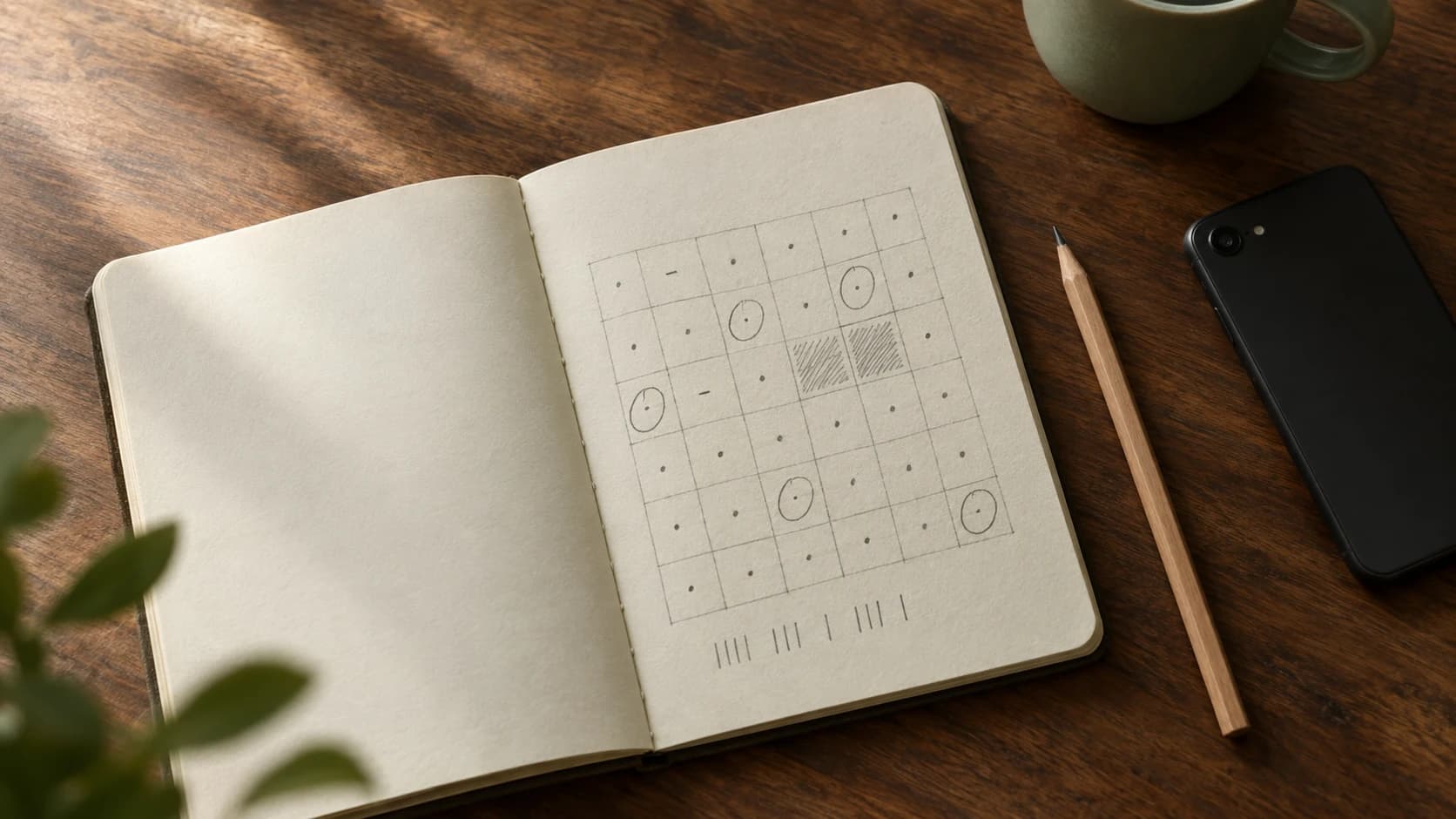
A record beats a recollection, and a useful record is short. The Menopause Society's suggestion is practical: "it can be useful to track the bleeding on a calendar or smartphone app so that it can be easily reviewed and assessed" (The Menopause Society). ACOG's version, written for PMS but equally applicable here, is to write down and rate your symptoms each day "for at least 2 to 3 months" and to "record the dates of your periods as well" (ACOG).
Five things make a record answer the questions a clinician will actually ask:
- The date each period starts. This is what gives you cycle length — first day to first day — which is the number both thresholds are built on.
- How many days bleeding lasts, counted separately from cycle length.
- How heavy it was, in products rather than adjectives. "Changed a soaked pad every hour on day two" is information; "heavy" is not.
- Spotting days, and bleeding after sex, marked distinctly from period days.
- Symptoms and their timing, including the premenstrual ones that arrive whether or not a period follows.
Two cautions about reading your own record. Keep in mind STRAW's persistence rule before you conclude anything from it: a single seven-day swing is not a stage change, while the same swing recurring within ten cycles is (Harlow et al., 2012). And a cycle record answers "what is my pattern", not "why" — it is the input to a conversation, not a substitute for one. If you want the rest of the picture alongside the bleeding, symptoms ranked by how much they actually tell you covers everything that isn't your cycle, and what perimenopause is, from start to finish is the overview this page sits under.
Common questions about perimenopause periods (FAQ)
I haven't had a period for over a year and now I'm bleeding. Is that normal? No, and it should be checked. The NHS asks you to see a GP about any vaginal bleeding more than 12 months after your last period even when it has only happened once, when there is "only a small amount of blood, spotting, or pink or brown discharge", when you have no other symptoms, and when you are not sure it is blood (NHS). Mayo Clinic says to speak to a healthcare professional "right away" (Mayo Clinic). It is usually something benign such as polyps or a thinned uterine lining, but bleeding is "the most common sign of endometrial cancer in postmenopausal women," and that is usually treatable when caught early (ACOG).
Is it normal to have periods every two weeks in perimenopause? Cycles getting shorter is one of the earliest and most ordinary changes — The Menopause Society calls it common for cycles "to become a little shorter than usual" (The Menopause Society). A settled two-week pattern is past that. Mayo Clinic and Cleveland Clinic both list periods less than 21 days apart as a reason to see a clinician, and the NIA lists periods happening "very close together" among the changes to report (Mayo Clinic; Cleveland Clinic; NIA).
Is spotting between periods normal in perimenopause? It is common, and it still gets reported. In SWAN's menstrual calendar substudy, 66.8% of women had at least three episodes of six or more days of spotting across the transition (Paramsothy et al., 2014). ACOG nonetheless lists bleeding or spotting between periods among the patterns that are "not normal," and the NIA and Mayo Clinic both list it as a reason to see a doctor. How common something is across a cohort does not tell you what is causing it in one person, which is why all of them ask you to mention it.
What is a ghost period? A lay term for period-like symptoms — cramps, bloating, sore breasts, mood changes — turning up without any bleeding. It is not a diagnosis and not a clinical term: it appears nowhere in the NHS, NIA, OWH, ACOG, NICE, Menopause Society, Mayo Clinic, Cleveland Clinic or MedlinePlus material on this subject, and "ghost period" and "phantom period" return no results in PubMed titles or abstracts. In perimenopause the usual explanation is intermittent ovulation (OWH; ACOG), but the phrase names the experience rather than the cause.
Why do I have period symptoms but no period? Most often because ovulation has become intermittent, so the hormone pattern that produces premenstrual symptoms can happen in a month when bleeding does not follow on schedule (The Menopause Society). But pregnancy is the first thing to rule out — MedlinePlus names it the most common cause of periods stopping in someone who had been having them (MedlinePlus) — and stress, thyroid disease, PCOS, large weight changes and heavy exercise are all on the NHS's list of causes (NHS). If a hormonal coil, implant, injection or progestogen-only pill is suppressing your bleeding, cyclical symptoms can continue with nothing to mark them at all.
Medical disclaimer: This article is for informational purposes only. Always consult a qualified healthcare provider before making changes to your health routine.
Sources
- NHS. Menopause and perimenopause — Symptoms — Government health information, page last reviewed 19 May 2026. https://www.nhs.uk/conditions/menopause-and-perimenopause/symptoms/
- NHS. Heavy periods — Government health information, page last reviewed 19 September 2024. https://www.nhs.uk/conditions/heavy-periods/
- NHS. Missed or late periods — Government health information, page last reviewed 12 June 2026. https://www.nhs.uk/symptoms/missed-or-late-periods/
- National Institute on Aging. What Is Menopause? — Government health information. https://www.nia.nih.gov/health/menopause/what-menopause
- Office on Women's Health, U.S. Department of Health and Human Services. Menopause basics — Government health information, last updated 2 April 2026. https://womenshealth.gov/menopause/menopause-basics
- MedlinePlus (U.S. National Library of Medicine). Absent menstrual periods — secondary — Government medical encyclopedia. https://medlineplus.gov/ency/article/001219.htm
- American College of Obstetricians and Gynecologists. Perimenopausal Bleeding and Bleeding After Menopause (FAQ162) — Professional society patient FAQ. https://www.acog.org/womens-health/faqs/perimenopausal-bleeding-and-bleeding-after-menopause
- American College of Obstetricians and Gynecologists. Premenstrual Syndrome (PMS) (FAQ057) — Professional society patient FAQ. https://www.acog.org/womens-health/faqs/premenstrual-syndrome
- The Menopause Society. Menopause Topics: Perimenopause — Professional society patient education. https://menopause.org/patient-education/menopause-topics/perimenopause
- National Institute for Health and Care Excellence. Heavy menstrual bleeding: assessment and management (NG88) — Clinical guideline. https://www.nice.org.uk/guidance/ng88/chapter/Recommendations
- National Institute for Health and Care Excellence. Menopause: identification and management (NG23) — Clinical guideline, last updated 15 April 2026. https://www.nice.org.uk/guidance/ng23/chapter/Recommendations
- Mayo Clinic. Perimenopause — Symptoms and causes — Health system disease reference, dated 22 August 2026. https://www.mayoclinic.org/diseases-conditions/perimenopause/symptoms-causes/syc-20354666
- Cleveland Clinic. Perimenopause — Health system disease reference, last updated 29 July 2024. https://my.clevelandclinic.org/health/diseases/21608-perimenopause
- Harlow SD, Gass M, Hall JE, Lobo R, Maki P, Rebar RW, Sherman S, Sluss PM, de Villiers TJ. Executive summary of the Stages of Reproductive Aging Workshop + 10: addressing the unfinished agenda of staging reproductive aging. Menopause, 2012;19(4):387–395 — Peer-reviewed journal article via PMC. https://pmc.ncbi.nlm.nih.gov/articles/PMC3340903/
- Paramsothy P, Harlow SD, Greendale GA, Gold EB, Crawford SL, Elliott MR, Lisabeth LD, Randolph JF. Bleeding patterns during the menopausal transition in the multi-ethnic Study of Women's Health Across the Nation (SWAN): a prospective cohort study. BJOG, 2014;121(12):1564–1573 — Peer-reviewed journal article (SWAN). https://pubmed.ncbi.nlm.nih.gov/24735184/
- Midi Health. Phantom Periods — Commercial telehealth publisher, cited only as evidence of lay usage of the term. https://www.joinmidi.com/post/phantom-periods
All sources accessed 2 October 2026.

Claire Whitfield
A women's health specialist who thinks "that's just perimenopause" is the sentence most likely to delay a diagnosis that mattered.