Quick answer: Iron deficiency is one of the most common nutrient gaps in women, and most of it isn't anemia yet — a 2023 JAMA study found nearly 39% of U.S. females aged 12 to 21 were iron deficient, while only about 6% had progressed to iron-deficiency anemia. Absorption physiology, pregnancy's higher iron demand, dietary pattern, and sometimes an unrelated gastrointestinal cause all contribute alongside menstrual blood loss, which is real but only one part of the picture. A blood test, not a guess, is what should come before supplementing.
Ask why women get iron deficient more often than men, and the answer usually arrives in three words: it's your period. That's true as far as it goes, and it matters — but it's also an incomplete answer that skips past several other mechanisms doing real work, some of which are worth naming to a clinician in their own right. This guide starts with why women are disproportionately affected before it gets to symptoms and testing, because the "why" changes what's actually worth checking.
Why Women Are More Likely to Be Iron Deficient
The scale of this isn't limited to any one age group. The CDC's most recent national survey data puts anemia — of any cause — at 14.0% among U.S. women ages 20 to 59 and 12.4% among women 60 and older, consistently higher than the rate in men at every age measured (CDC/NCHS, 2024); iron deficiency is the single most common cause of anemia generally, though that survey measured hemoglobin rather than iron status specifically. Multiple things stack on top of each other to produce that gap, and menstruation is genuinely just one of them.
Absorption: Why Diet Alone Often Isn't Enough
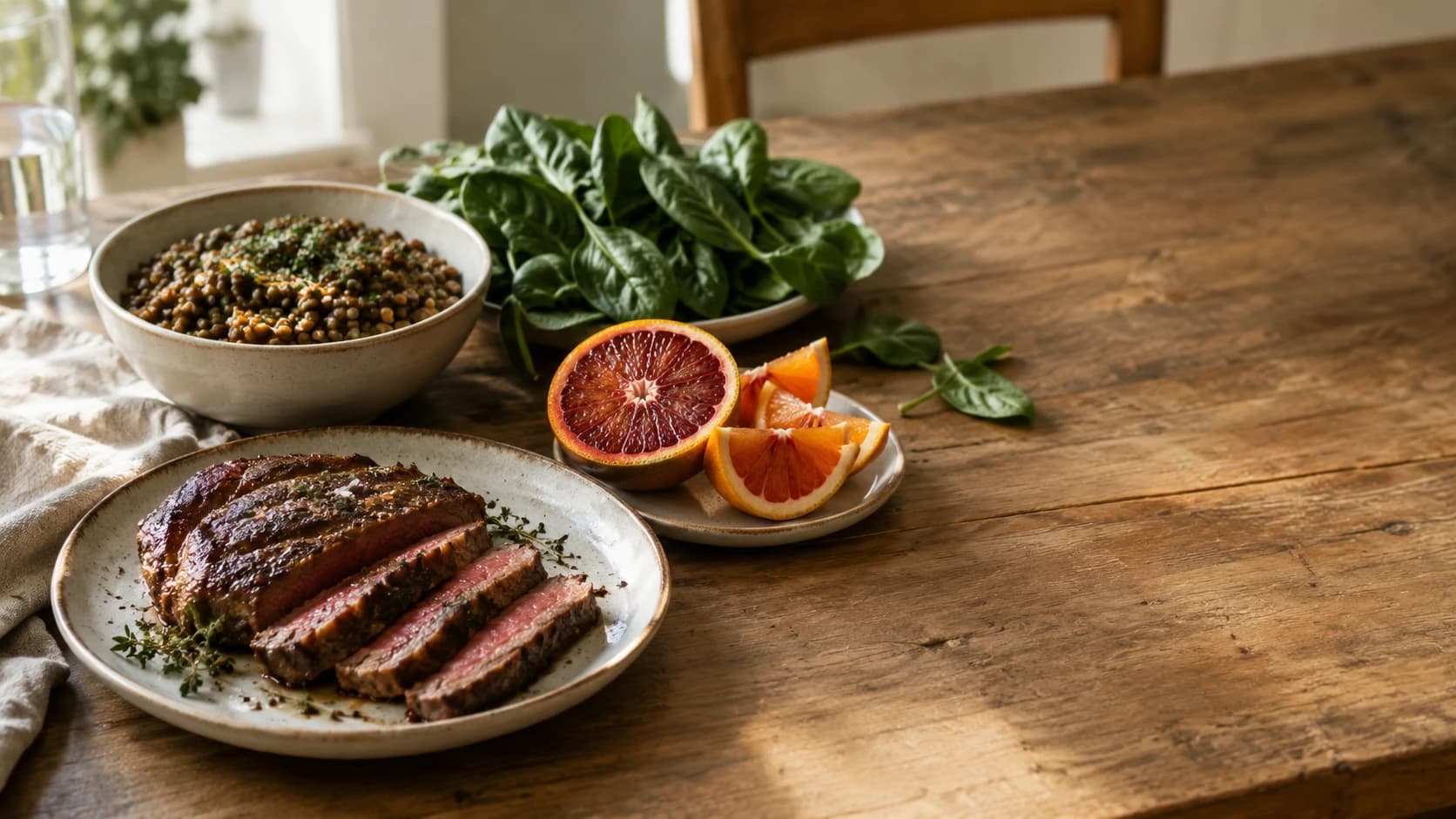
Not all dietary iron is equal, and the gap is bigger than most people expect. Iron in food comes as heme iron, found in meat, poultry, and seafood, and non-heme iron, found in plant foods and fortified products. The National Institutes of Health's Office of Dietary Supplements estimates the body absorbs roughly 14% to 18% of iron from a mixed diet that includes meat, seafood, and vitamin C, compared with only about 5% to 12% from a purely vegetarian diet — a difference driven by how much more efficiently the body takes up heme iron than non-heme iron (NIH Office of Dietary Supplements). Pairing iron-rich plant foods with a vitamin C source at the same meal measurably improves non-heme absorption, while calcium supplements, tea, coffee, and compounds called phytates work against it.
Pregnancy and Increased Iron Demand
Iron requirements roughly increase by half during pregnancy: the NIH's recommended intake rises from 18 mg a day for women 19 to 50 to 27 mg a day during pregnancy, to support expanding blood volume and the developing fetus's iron needs (NIH Office of Dietary Supplements). That jump is large enough that the federal Office on Women's Health states iron-deficiency anemia affects about one in six pregnant women in the United States (womenshealth.gov). Because the demand is driven by pregnancy itself rather than diet quality alone, even a normally adequate diet can fall short during this window, which is part of why prenatal care typically includes iron screening.
Vegetarian and Vegan Diets — A Real, Correctable Risk Factor
Because non-heme iron absorbs less efficiently, the NIH advises that people who don't eat meat, poultry, or seafood need roughly 1.8 times the standard recommended iron intake to end up with the same amount actually absorbed (NIH Office of Dietary Supplements). That's a meaningful gap, but a correctable one — it's a reason to be deliberate about iron-rich plant sources (lentils, beans, tofu, fortified cereals, dark leafy greens) and to pair them with vitamin C, not a reason vegetarian and vegan diets are inherently untenable.
Overlooked GI Causes
This is the part most consumer coverage skips. The American Gastroenterological Association's 2020 clinical practice guideline addresses a scenario that comes up more than people expect: a premenopausal woman with iron-deficiency anemia and no obvious explanation after a careful history. Rather than assuming heavy periods and moving straight to iron replacement, the guideline suggests bidirectional endoscopy (an upper and lower GI exam) be considered when there's no other clear cause (Ko et al., 2020). A related AGA technical review found gastrointestinal malignancy on that workup in about 0.9% of lower-GI exams and 0.2% of upper-GI exams in premenopausal women with unexplained iron-deficiency anemia — a small but real number, not a scare figure (Ko et al., 2020). Cleveland Clinic separately notes that iron deficiency appearing suddenly, rather than developing gradually, can point toward a peptic ulcer, a colon polyp, or, in some cases, gastrointestinal cancer (Cleveland Clinic). Celiac disease and prior bariatric surgery are two other absorption-related causes clinicians look for; the AGA guideline recommends celiac serologic testing when it's a plausible explanation, and testing for H. pylori infection when no other cause turns up after endoscopy (Ko et al., 2020).
Menstrual Blood Loss as One Contributing Factor (Not the Whole Story)
None of this erases menstruation's real role. The Office on Women's Health estimates that up to 5% of women of childbearing age develop iron-deficiency anemia specifically because of heavy menstrual bleeding (womenshealth.gov), and Yale Medicine puts the share of women affected by heavy periods at roughly one in five (Yale Medicine). That's a legitimate, common contributor worth naming to a clinician, particularly if periods have gotten heavier or longer over time. The point isn't that menstruation doesn't matter — it's that treating it as the automatic, only explanation is how the absorption issues, GI causes, and pregnancy-related demand above end up overlooked.
Iron Deficiency Without Anemia — A Distinct, Under-Recognized State
Iron deficiency and iron-deficiency anemia aren't the same thing, and the gap between them is larger than most people realize. Iron deficiency generally means ferritin — the protein that reflects how much iron is stored in the body — has fallen below roughly 30 ng/mL. Iron-deficiency anemia is a later stage, where hemoglobin has also dropped, typically below about 12 g/dL in women, using the threshold cited by Yale Medicine (Yale Medicine).
A 2023 study published in JAMA measured both conditions directly in a nationally representative sample of 3,490 U.S. females aged 12 to 21, drawn from NHANES survey data collected between 2003 and 2020. Using a ferritin cutoff below 25 micrograms per liter, the researchers found iron deficiency in 38.6% of participants (95% CI, 35.8%–40.9%), while iron-deficiency anemia — requiring both low ferritin and low hemoglobin — affected only 6.3% (95% CI, 5.2%–7.4%) (Weyand et al., 2023). In plain terms: about 84% of those who were iron deficient did not have anemia. The study's authors concluded that current screening, which often relies on a standard blood count rather than dedicated ferritin testing, likely misses a large share of iron deficiency because it isn't looking for the earlier, more common stage.
"Women of reproductive age bear most of the burden of iron deficiency," Yale Medicine hematologist Dr. Layla Van Doren has said (Yale Medicine) — and, as the JAMA data shows, most of that burden isn't anemia. It's a real, symptomatic shortage that a standard CBC alone can miss.
Common Symptoms: Fatigue, Hair Loss, and What Else to Notice
Fatigue and weakness are the most consistently reported symptoms across major sources, and they're often the only thing someone notices — mild iron deficiency can be symptom-free entirely (womenshealth.gov). The mechanism is straightforward: without enough iron, the body can't make enough hemoglobin, the protein red blood cells use to carry oxygen, and Mayo Clinic notes that a pink-to-pale shift in the lips, gums, eyelid rims, or nail beds is one of the more visible signs of that shortfall (Mayo Clinic). Beyond that, commonly cited signs include dizziness or lightheadedness, brittle nails, shortness of breath with activity, cold hands and feet, headaches, trouble concentrating, and pica — cravings for ice, dirt, or other non-food items, which the Office on Women's Health flags as a distinctive sign worth mentioning to a clinician (womenshealth.gov).
Hair loss deserves its own note, because the evidence for it is real but more limited in what it actually shows. A 2022 systematic review and meta-analysis in Skin Appendage Disorders, pooling data from 36 studies and more than 10,000 women, found that those with nonscarring hair loss (including telogen effluvium, a diffuse shedding pattern) had significantly lower ferritin levels than women without hair loss (Treister-Goltzman et al., 2022). That's a genuine, statistically significant association — but it comes from studies comparing ferritin levels between groups, not from trials testing whether correcting iron deficiency reverses hair loss. The exact mechanism connecting the two isn't fully established. It's a reasonable thing to mention to a clinician alongside unexplained shedding, not a guarantee that an iron supplement will fix it.
Testing, and Why Self-Supplementing Isn't the Answer
Diagnosis typically starts with a complete blood count, then a ferritin test if iron deficiency is suspected, since ferritin is the most direct available marker of the body's stored iron (Cleveland Clinic). One limitation worth knowing: ferritin also rises during inflammation and infection, which can make it look artificially normal or even elevated in someone who is genuinely iron deficient. Because of that, a clinician may order additional markers, such as transferrin saturation, when the picture isn't clear from ferritin alone.
This is also the main reason testing should come before supplementing, not after. High-dose iron supplements commonly cause constipation, nausea, and stomach upset — side effects worth avoiding if there's no actual deficiency to correct (NIH Office of Dietary Supplements). Taking iron without a confirmed low result can also mask the real question: if fatigue or another symptom isn't actually iron-related, a supplement won't fix it, and if it is iron-related because of an underlying GI source of blood loss, correcting the blood count with a supplement doesn't address what's causing the loss in the first place. There's also a narrower but real risk for people with an undiagnosed genetic predisposition toward iron overload, such as hereditary hemochromatosis, for whom sustained unsupervised supplementation isn't a neutral choice (Cleveland Clinic). The Office on Women's Health is direct about this: don't start iron pills without talking to a doctor or nurse first, and the NIH sets a tolerable upper intake of 45 mg a day for adults without medical supervision (womenshealth.gov). None of this is a reason to avoid iron when it's actually needed — it's a reason to confirm the need first.
When to See a Clinician
Persistent fatigue that doesn't track with sleep or stress, unusual or ongoing hair shedding, heavier or longer periods than usual, a recent lab result flagging low iron or ferritin, or active pregnancy planning are all reasonable reasons to bring iron up with a clinician. So is a sudden or unexplained drop in iron levels, since that pattern is specifically one the AGA guideline above flags as worth investigating further rather than attributing automatically to diet or periods. None of the symptoms or patterns here are meant as a self-diagnosis tool — they're a starting point for a more useful conversation than "I've just been really tired lately."
Iron is far from the only nutrient gap worth checking when fatigue won't resolve — vitamin D deficiency follows a similarly common, often-silent pattern and is worth ruling out alongside it. And if the life stage you're actually navigating is the menopause transition rather than reproductive-age iron demand, our guide to perimenopause vitamins and supplements covers which nutrients have a specific, evidence-based reason to matter there.
Frequently Asked Questions (FAQ)
What is the difference between iron deficiency and iron-deficiency anemia? Iron deficiency means the body's iron stores are low, typically defined as a ferritin level under roughly 30 ng/mL. Iron-deficiency anemia is a further stage, where the shortage has gone on long enough that hemoglobin also drops — below about 12 g/dL in women (Yale Medicine). Every case of iron-deficiency anemia started as plain iron deficiency, but most iron deficiency never progresses that far, or hasn't yet.
Why are women more likely to be iron deficient than men? No single reason. Menstrual blood loss is part of it, but absorption physiology, pregnancy's sharply higher iron requirement, and a greater likelihood of following a lower-iron-bioavailability diet all add up alongside it. As Yale Medicine hematologist Dr. Layla Van Doren has put it, women of reproductive age carry most of the burden of iron deficiency, and it isn't reducible to one cause (Yale Medicine).
Can you be iron deficient without being anemic? Yes, and it's the more common scenario, not the exception. A 2023 JAMA study of U.S. females aged 12 to 21 found 38.6% were iron deficient by ferritin, while only 6.3% had progressed to iron-deficiency anemia — meaning roughly 84% of those with low iron stores were not yet anemic by standard blood-count testing (Weyand et al., 2023).
Should I take an iron supplement without getting tested first? No. Unsupervised iron supplementation can cause constipation, nausea, and stomach upset, and in some people with an undiagnosed genetic predisposition like hereditary hemochromatosis, sustained high intake can contribute to iron overload (Cleveland Clinic). It can also mask fatigue's real cause instead of addressing it. A blood test confirming low iron or ferritin should come first; supplement type and dose are then a conversation with a clinician, not a personal guess.
Does a vegetarian or vegan diet increase iron deficiency risk? It's a real, correctable factor. The National Institutes of Health estimates that people who don't eat meat, poultry, or seafood need roughly 1.8 times the standard iron intake, because the body absorbs non-heme iron from plants markedly less efficiently than the heme iron in animal foods (NIH Office of Dietary Supplements). Pairing iron-rich plant foods with a vitamin C source measurably improves absorption.
The following three questions extend past the site's five-question structured-data limit; they remain fully answered below for readers, just not included in this page's FAQ schema markup.
What foods or habits help iron absorption? Eating vitamin C-rich foods — citrus, peppers, tomatoes, strawberries — alongside iron-rich meals meaningfully improves how much non-heme (plant-based) iron the body takes up. Calcium supplements, high-dose calcium at the same meal, and tea or coffee taken with a meal work in the opposite direction and can blunt absorption (NIH Office of Dietary Supplements).
Can iron deficiency cause hair loss? A 2022 systematic review and meta-analysis of more than 10,000 women found that those with nonscarring hair loss had significantly lower ferritin levels than women without hair loss (Treister-Goltzman et al., 2022). That's a real, statistically significant association from pooled research, not proof that every case of hair thinning is iron-related or that supplementing will reverse it — the underlying mechanism isn't fully understood, and a clinician is best placed to sort out whether iron is actually the driver in an individual case.
How is iron deficiency diagnosed? Usually a complete blood count first, followed by a ferritin test, since ferritin is the most direct marker of how much iron is actually stored in the body. Because ferritin can read artificially normal during inflammation or infection, a clinician may look at additional markers, like transferrin saturation, if the picture isn't clear from ferritin alone.
Medical disclaimer: This article is for informational purposes only. Always consult a qualified healthcare provider before making changes to your health routine.
Sources
- Office on Women's Health, U.S. Department of Health and Human Services. Iron-deficiency anemia. Updated 24 October 2025 — Federal government health agency. https://womenshealth.gov/a-z-topics/iron-deficiency-anemia
- Mayo Clinic. Iron deficiency anemia — Symptoms and causes — Nonprofit academic medical center. https://www.mayoclinic.org/diseases-conditions/iron-deficiency-anemia/symptoms-causes/syc-20355034
- Yale Medicine. Are You Iron Deficient? 8 Things Women Should Know. 12 September 2024 — Academic medical center news article, quoting Dr. Layla Van Doren. https://www.yalemedicine.org/news/are-you-iron-deficient-what-women-need-to-know
- Cleveland Clinic. Iron-Deficiency Anemia. Reviewed 11 December 2024 — Nonprofit academic medical center. https://my.clevelandclinic.org/health/diseases/22824-iron-deficiency-anemia
- Cleveland Clinic. Hemochromatosis (Iron Overload) — Nonprofit academic medical center. https://my.clevelandclinic.org/health/diseases/14971-hemochromatosis-iron-overload
- National Institutes of Health, Office of Dietary Supplements. Iron — Health Professional Fact Sheet — Federal government nutrient reference. https://ods.od.nih.gov/factsheets/Iron-HealthProfessional/
- Weyand AC, Chaitoff A, Freed GL, Sholzberg M, Choi SW, McGann PT. Prevalence of Iron Deficiency and Iron-Deficiency Anemia in US Females Aged 12-21 Years, 2003-2020. JAMA, 2023;329(24):2191–2193 — Peer-reviewed research letter. https://jamanetwork.com/journals/jama/fullarticle/2806540
- Ko CW, Siddique SM, Patel A, et al. AGA Clinical Practice Guidelines on the Gastrointestinal Evaluation of Iron Deficiency Anemia. Gastroenterology, 2020;159(3):1085–1094 — Peer-reviewed clinical practice guideline from the American Gastroenterological Association. https://gastro.org/clinical-guidance/gastrointestinal-evaluation-of-iron-deficiency-anemia/
- Ko CW, Siddique SM, Patel A, Harris A, et al. AGA Technical Review on Gastrointestinal Evaluation of Iron Deficiency Anemia. Gastroenterology, 2020;159(3):1097–1119 — Peer-reviewed technical review via PMC, source of the premenopausal-malignancy figures cited above. https://pmc.ncbi.nlm.nih.gov/articles/PMC10824166/
- Treister-Goltzman Y, Yarza S, Peleg R. Iron Deficiency and Nonscarring Alopecia in Women: Systematic Review and Meta-Analysis. Skin Appendage Disorders, 2022;8(2):83–92 — Peer-reviewed systematic review and meta-analysis. https://karger.com/sad/article/8/2/83/826740/Iron-Deficiency-and-Nonscarring-Alopecia-in-Women
- National Center for Health Statistics, Centers for Disease Control and Prevention. Anemia Prevalence: United States, August 2021–August 2023. NCHS Data Brief No. 519, 2024 — Federal government national survey data. https://www.cdc.gov/nchs/products/databriefs/db519.htm

Claire Whitfield
A women's health specialist who thinks "it's your period" explains less about iron deficiency than most people assume.