Quick answer: Grounding, or earthing, is the idea that direct skin contact with the earth's surface — barefoot, or through a conductive mat, sheet, or patch — produces measurable health benefits, from better sleep to lower inflammation to lower blood pressure. The underlying physics is real: the earth's surface does carry a mild, stable electrical charge. What's thin is the human evidence for the health claims built on top of that fact — a handful of pilot-sized studies, totaling well under 100 people combined, authored overwhelmingly by the same small circle of researchers, several with a disclosed financial stake in a company that sells earthing products. None of that means grounding is fake or risky to try. It means "studies show" is doing more work in the marketing than the studies themselves can support.
The Short Answer
"Mostly untested" is a genuinely different claim than "backed by science," and grounding-mat marketing routinely blurs that difference. Here's what the trials actually measured, in whom, and who ran them — followed by the one thing worth being unambiguous about before anything else: grounding is not a treatment for high blood pressure or any other diagnosed condition.
What the Research Actually Looks Like
The Studies Are Small, and Several Share Overlapping Researchers
Search "grounding studies" and you'll find confident language — "research shows," "studies confirm." What that usually points back to is a short list of pilot-sized trials, several sharing the same lead author:
| Study | Participants | Design | What it measured |
|---|---|---|---|
| Ghaly & Teplitz, 2004 | 12 | Single-arm pilot, no control group | Cortisol rhythm; self-reported sleep, pain, and stress |
| Chevalier, 2010 | 28 | Double-blind, sham-controlled | Skin conductance, respiratory rate, pulse rate, blood oxygenation — not sleep, inflammation, or blood pressure |
| Chevalier et al., 2013 | 10 | Small pilot, word-of-mouth recruitment | Red blood cell clumping ("blood viscosity") |
| Elkin & Winter, 2018 | 10 | Uncontrolled case history series | Blood pressure in existing hypertension patients |
| Chevalier et al., 2019 | 16 | Double-blind RCT, stepped-wedge design | Pain and quality of life in massage therapists |
That's 76 people total across all five studies, and Gaétan Chevalier, a researcher affiliated with the University of California, Irvine, co-authored four of the five (Ghaly & Teplitz, 2004; Chevalier, 2010; Chevalier et al., 2013; Elkin & Winter, 2018; Chevalier et al., 2019) — plus both major reviews discussed below. That doesn't make his findings wrong; a specialist studying one question for two decades is ordinary in science. But it does mean "multiple studies" often means the same small group re-testing a related question, not independent replication.
Why Industry-Adjacent Reviews Need Extra Scrutiny
The two review articles most often cited as the scientific case for earthing are worth naming directly, because both disclose a financial relationship with an earthing-products company:
- A 2012 review in the Journal of Environmental and Public Health states: "G. Chevalier, S. T. Sinatra, and J. L. Oschman are independent contractors for Earthx L. Inc., the company sponsoring earthing research, and own a small percentage of shares in the company" (Chevalier et al., 2012).
- A 2015 review in the Journal of Inflammation Research discloses a near-identical arrangement: "G Chevalier and JL Oschman are independent contractors for EarthFx Inc., the company sponsoring earthing research, and own a small percentage of shares in the company. Richard Brown is an independent contractor for EarthFx Inc." (Oschman et al., 2015).
A disclosed conflict of interest isn't proof a finding is wrong — these authors did the transparent thing by naming it. But a review co-written by people with paid contracts and equity in a company that sells the product under review is a different kind of source than an independent university lab or government health agency with nothing to gain either way. Science-Based Medicine's 2023 appraisal goes further, arguing the broader literature leans on small samples, subjective outcomes like "well-being," and low-impact or alternative-medicine journals — and that some proposed mechanisms don't obviously fit together (grounding is described in places as simultaneously anti-inflammatory and immune-enhancing). Cleveland Clinic's more measured framing lands in a similar place: "There's not much research on the health benefits of earthing. And a lot of the research we do have is of questionable quality."
Important: Grounding Is Not a Substitute for Treating High Blood Pressure or Other Conditions
Before anything else: if you have high blood pressure, an inflammatory condition, or any other diagnosed illness, grounding is not a treatment for it, and it should never replace medication, a treatment plan, or your clinician's advice.
The blood-pressure claim deserves specifics, because it's the one most likely to tempt someone into skipping a treatment that actually works. The entire human evidence base for grounding and blood pressure is a single 2018 case history series: 10 existing hypertension patients in one cardiology practice grounded themselves at home for at least 10 hours a day for several months, and their systolic readings fell by an average of 14.3%, ranging individually from 8.6% to 22.7% (Elkin & Winter, 2018). That's a real result worth further study — described by its own authors as "the first known study measuring the influence of grounding the body on hypertension" — but a case series has no control group, so there's no way to know how much of that change came from grounding itself versus the extra attention of being monitored, other changes made over the same several months, or blood pressure's normal tendency to fluctuate. Cleveland Clinic is direct about the wider risk here: earthing "can't — as some claim — cure diseases or take the place of modern medicine," and some promotional claims about it cross into territory the clinic calls "unscientific (and even dangerous)" (Cleveland Clinic). If you're managing blood pressure, inflammation, or any other diagnosed condition, treat grounding as something to mention to your clinician, not something to try instead of what they've prescribed.
What Grounding/Earthing Actually Is
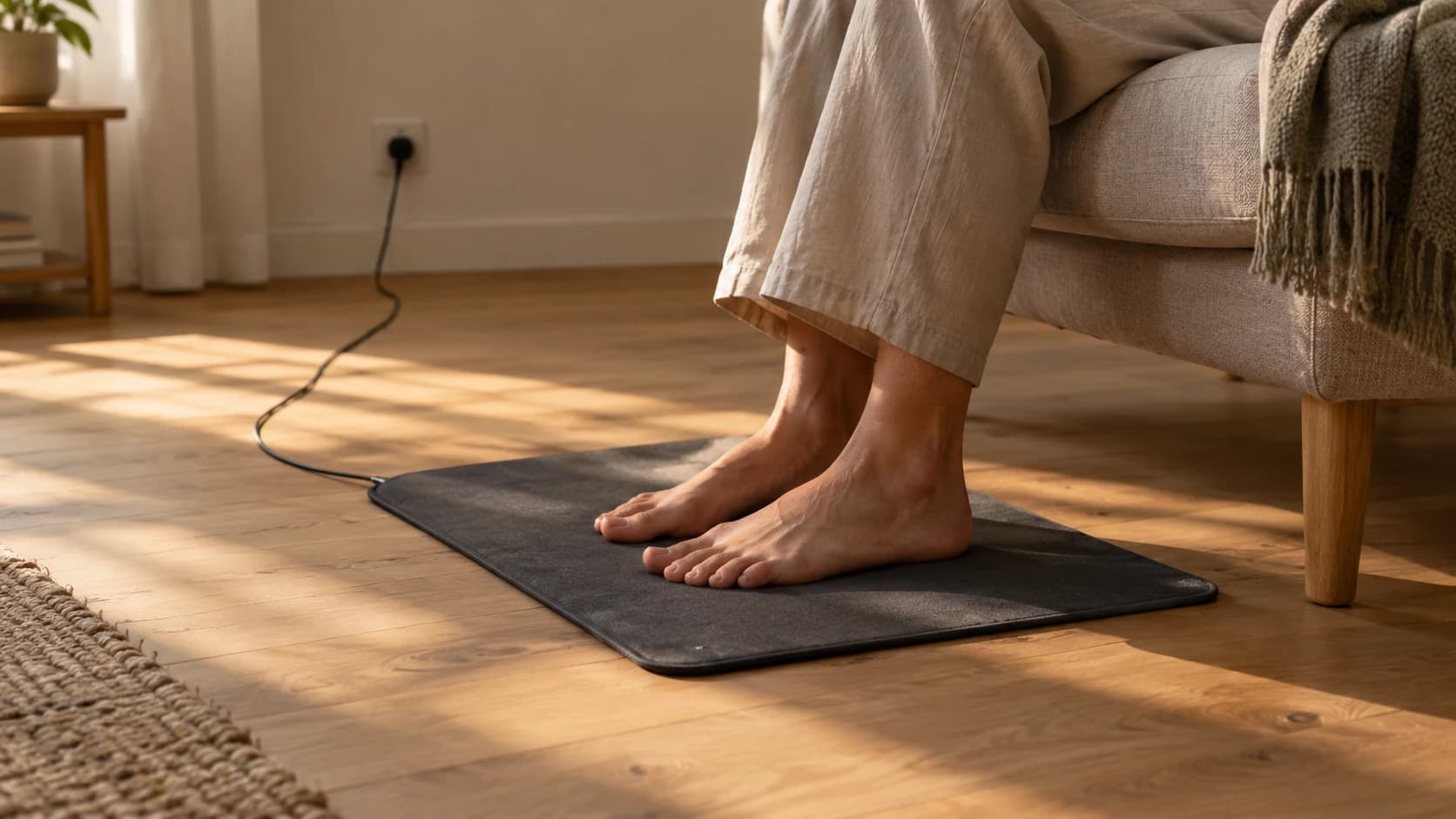
The starting mechanism isn't fringe physics. The earth's surface carries a mild, stable negative charge, and skin conducts electricity well enough for contact to equalize a small voltage difference — measurable with an ordinary multimeter. "Grounding" means maintaining that contact deliberately: barefoot on grass, sand, or soil, or — since most people spend their days indoors and in shoes — using a conductive mat, sheet, or patch wired to a grounded outlet or a rod in the soil outside. The marketing claim is that electrons transferred this way act inside the body as antioxidants, neutralizing the molecules involved in inflammation. That leap, from "the body's charge equalizes with the ground" to "this produces clinically meaningful antioxidant effects," is the part current human evidence doesn't yet establish.
What People Claim It Does
Grounding mats, sheets, and patches are marketed on a fairly consistent list of claims: better sleep, reduced inflammation and pain, faster wound healing, improved immune function, lower blood pressure and other heart-health markers, and general stress reduction (Cleveland Clinic). Some sellers extend that list further, into claims about preventing or treating chronic disease — the kind of claim Cleveland Clinic explicitly flags as unsupported and potentially dangerous. This article focuses on the three claims with the most direct research behind them: sleep, inflammation, and blood pressure.
What the Evidence Actually Supports, Claim by Claim
Sleep
The sleep claim rests almost entirely on one 2004 pilot: 12 people with existing sleep, pain, and stress complaints slept grounded via a conductive mattress pad for 8 weeks. Their cortisol profiles shifted toward a more normal day-night pattern, and nearly all reported improved sleep, less pain, and less stress by the end (Ghaly & Teplitz, 2004) — worth reading alongside our deeper look at how much sleep debt you can actually recover. But the design matters: with no control group, every subject is only compared to their own starting point, which can't rule out people simply sleeping better because eight weeks passed, because they got extra attention as study subjects, or because they expected to feel better. A pilot like this is a reasonable basis for a bigger, controlled follow-up. It isn't yet that trial.
Inflammation
Inflammation is the claim with the most theory behind it and the least direct human-trial data. The core argument, laid out in the 2015 review above, is that the Earth's electrons act as antioxidants and measurably change white blood cell counts, cytokines, and other inflammatory markers (Oschman et al., 2015). Much of what supports it comes from animal studies and an experimental muscle-injury model, rather than a large, independent, controlled human trial measuring inflammatory blood markers directly. The 2019 massage-therapist trial's authors mention, without giving figures, a companion analysis finding improved inflammatory biomarkers too (Chevalier et al., 2019) — a real data point, but from the same small research circle, not independent replication. The honest summary: a plausible mechanism, real preclinical support, and human evidence that's preliminary rather than established.
Blood Pressure
Blood pressure is covered in detail in the safety section above, because it's the claim most likely to matter for someone's actual health decisions: the entire evidence base is the single 10-person, uncontrolled case series described there (Elkin & Winter, 2018). It's the first study of its kind, by its own authors' description — not yet a replicated, controlled finding.
Why the Marketing Outpaces the Evidence
None of this happened through dishonesty. A few genuinely interesting pilot studies exist, and separately from any of the research, many people simply find walking barefoot outside pleasant — a real experience even if it isn't evidence of a specific clinical effect. What turns pilot-sized studies into "the science is settled" marketing copy is more ordinary: a company with a commercial interest funds and co-authors the core research, and that research gets summarized and re-summarized by sellers and wellness blogs until it reads like a large, independent body of proof. In French-language search results specifically, this article's research found almost no independent health-authority voice pushing back at all. It's a pattern TWV has covered before in a similar category: our evidence-check on red light therapy walks through a different wellness device where the same gap opens up between what it plausibly does and what its marketing claims.
Is There Any Harm in Trying It?
For most healthy adults, no significant risk has turned up in the available research. Walking barefoot on natural ground is free and, aside from ordinary outdoor hazards like uneven surfaces or what you might step on, carries no specific concern. For a purchased mat, sheet, or patch, Cleveland Clinic recommends checking with a healthcare provider first if you have a pacemaker or other implanted electronic device, a compromised immune system, are pregnant, or have a foot condition, nerve damage, or skin allergy that prolonged contact with a conductive surface could aggravate (Cleveland Clinic). Beyond that, the realistic expectation to set is a modest one: try it, if you're curious, as a low-stakes, low-cost addition to habits with stronger evidence behind them — not as a replacement for sleep habits that actually work, an anti-inflammatory diet, or, most importantly, a treatment plan for a diagnosed condition.
Frequently Asked Questions (FAQ)
Is there any risk in trying a grounding mat? For most healthy adults, no significant risk has turned up in the research. Check with a provider first if you have a pacemaker or other implanted device, a compromised immune system, are pregnant, or have a foot condition or skin sensitivity that prolonged contact with a conductive surface could aggravate.
Does grounding/earthing actually work? "Mostly untested" is more accurate than "proven" or "debunked." A handful of pilot-sized studies, well under 100 people combined and mostly from the same small research group, report changes in cortisol rhythm, certain blood markers, and self-reported pain and sleep. That's a real but thin evidence base, not the large independent body of proof the marketing implies.
What does the research on earthing and sleep actually show? One 2004 pilot: 12 people with existing sleep, pain, and stress complaints slept grounded for 8 weeks. Cortisol rhythms shifted toward normal and most reported sleeping better. There was no control group, so it can't rule out simpler explanations like time passing or extra attention from being in a study.
Are grounding mats backed by independent science, or mostly industry-linked studies? Largely the latter. The two most-cited reviews on earthing both disclose their lead authors are paid contractors for, and shareholders in, a company that sponsors earthing research. That doesn't make the findings false, but the "evidence base" traces mostly back to a small circle with a financial stake in the outcome, not independent university or government research.
Can grounding replace treatment for high blood pressure or inflammation? No. The blood-pressure evidence is a single small, uncontrolled case series — not a substitute for medication. If you have high blood pressure, an inflammatory condition, or any other diagnosed illness, talk to your clinician about it rather than adjusting treatment based on a grounding mat.
The following two questions extend past the site's five-question structured-data limit; they remain fully answered below for readers, just not included in this page's FAQ schema markup.
Is grounding the same as walking barefoot outside? Same underlying mechanism. Bare feet on grass, sand, or soil give the same kind of skin contact with the earth that a conductive mat or sheet is designed to simulate indoors — and it's free.
What does Science-Based Medicine say about earthing? Considerably more skeptical than this article's own tone. It argues the field leans on small samples, subjective outcomes, and low-impact journals, and that some proposed mechanisms contradict each other. Its verdict: the evidence doesn't support the health claims being made — harder than "unproven," and worth reading directly for the strongest skeptical case.
Medical disclaimer: This article is for informational purposes only. Always consult a qualified healthcare provider before making changes to your health routine.
Sources
- Novella S. Earthing Update. Science-Based Medicine, February 8, 2023. https://sciencebasedmedicine.org/earthing-update/
- Chevalier G, Sinatra ST, Oschman JL, Sokal K, Sokal P. Earthing: Health implications of reconnecting the human body to the Earth's surface electrons. Journal of Environmental and Public Health, 2012 — PubMed Central. https://pmc.ncbi.nlm.nih.gov/articles/PMC3265077/
- Oschman JL, Chevalier G, Brown R. The effects of grounding (earthing) on inflammation, the immune response, wound healing, and prevention and treatment of chronic inflammatory and autoimmune diseases. Journal of Inflammation Research, 2015 — PubMed Central. https://pmc.ncbi.nlm.nih.gov/articles/PMC4378297/
- Ghaly M, Teplitz D. The biologic effects of grounding the human body during sleep as measured by cortisol levels and subjective reporting of sleep, pain, and stress. Journal of Alternative and Complementary Medicine, 2004;10(5):767-776 — PubMed. https://pubmed.ncbi.nlm.nih.gov/15650465/
- Elkin HK, Winter A. Grounding Patients With Hypertension Improves Blood Pressure: A Case History Series Study. Alternative Therapies in Health and Medicine, 2018 — PubMed. https://pubmed.ncbi.nlm.nih.gov/30982019/
- Chevalier G. Changes in pulse rate, respiratory rate, blood oxygenation, perfusion index, skin conductance, and their variability induced during and after grounding human subjects for 40 minutes. Journal of Alternative and Complementary Medicine, 2010 — PubMed. https://pubmed.ncbi.nlm.nih.gov/20064020/
- Chevalier G, Sinatra ST, Oschman JL, Delany RM. Earthing (grounding) the human body reduces blood viscosity — a major factor in cardiovascular disease. Journal of Alternative and Complementary Medicine, 2013 — PubMed. https://pubmed.ncbi.nlm.nih.gov/22757749/
- Chevalier G, Patel S, Weiss L, Chopra D, Mills PJ. The Effects of Grounding (Earthing) on Bodyworkers' Pain and Overall Quality of Life: A Randomized Controlled Trial. Explore, 2019 — PubMed. https://pubmed.ncbi.nlm.nih.gov/30448083/
- Cleveland Clinic. Is Earthing Actually Good for You? Reviewed by Susan Albers, PsyD, April 19, 2024. https://health.clevelandclinic.org/earthing
All sources accessed 19 September 2026.

Marcus Thorne
A wellness tools researcher who checked who funded the earthing studies before writing about them.