This post contains Amazon affiliate links. If you purchase through these links, I may earn a small commission at no extra cost to you.
Yes, air purifiers help with dust — but only the portion that's actually floating in the air at any given moment. They will not reduce how often you need to dust your shelves, because settled dust on a surface doesn't get pulled back into a filter on its own. That distinction, more than any spec sheet, is the honest answer to this question.
What's Actually in Household Dust
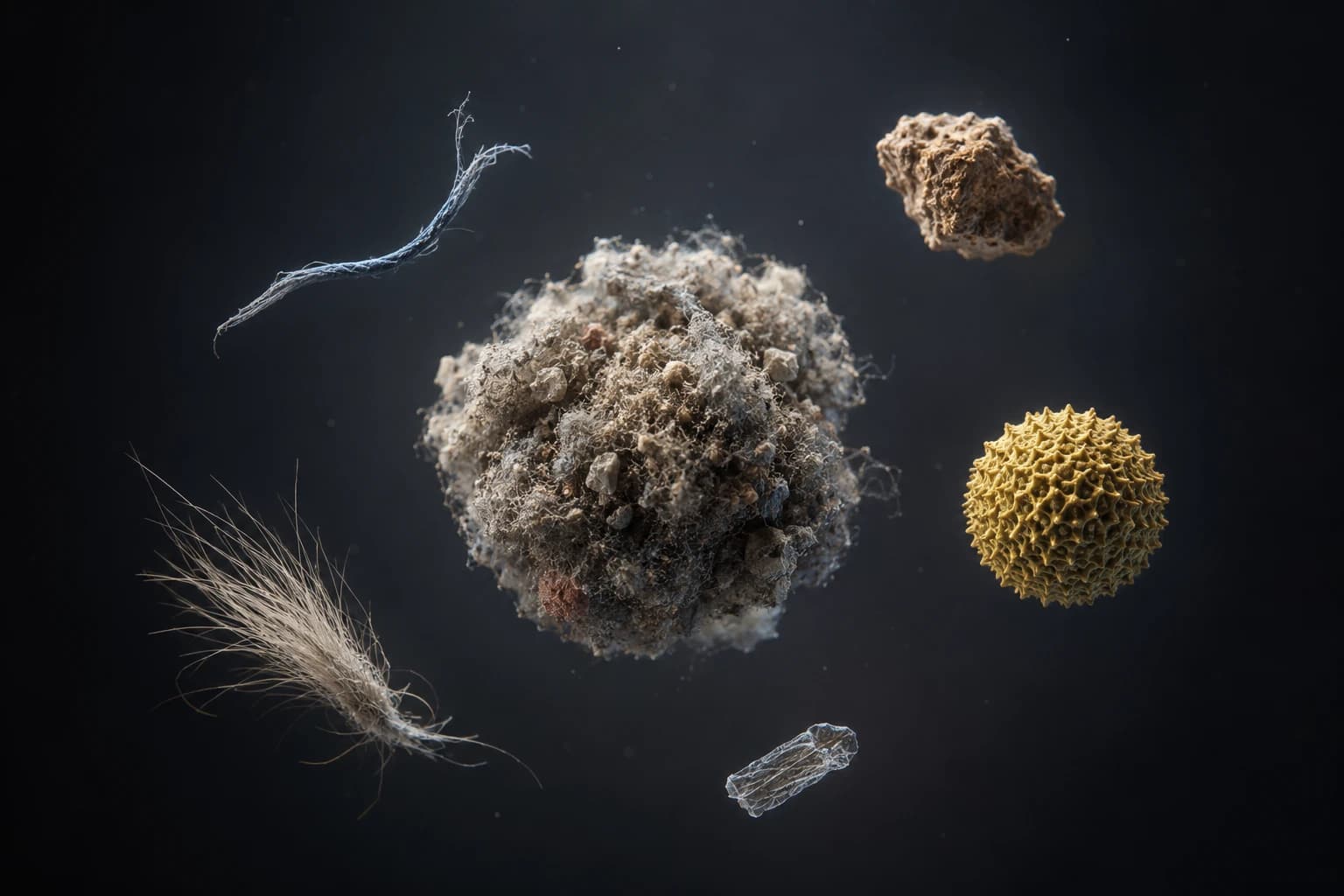
The common assumption that household dust is "mostly dead skin cells" isn't accurate. Real household dust is a genuinely mixed composition: dead skin cells, fabric and carpet fibers, soil tracked in from outside, pollen, pet dander, dust mite matter and waste, combustion byproducts from cooking and candles, and in some studies trace microplastic fragments from textiles and packaging. Skin cells are one ingredient, not the whole recipe.
How Air Purifiers Reduce Airborne Dust — and What They Can't Do for Settled Dust
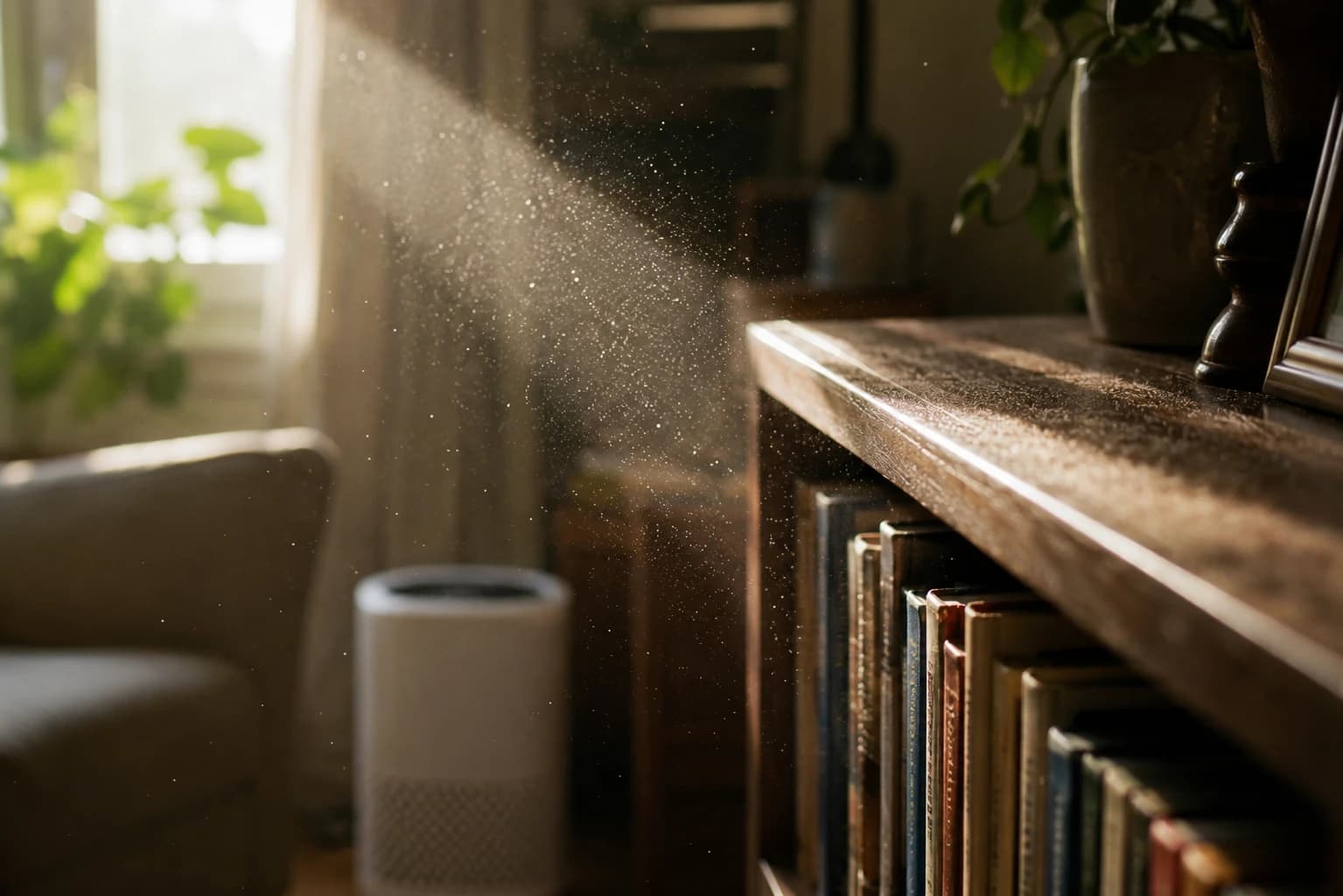
Here's the caveat that deserves to be stated early and plainly rather than buried in an FAQ: an air purifier filters what's currently airborne. It does not clean surfaces. Dust that has already settled onto your shelves, floor, or bedding stays there until you physically clean it — a purifier can't retroactively pull settled particles back into the air to filter them.
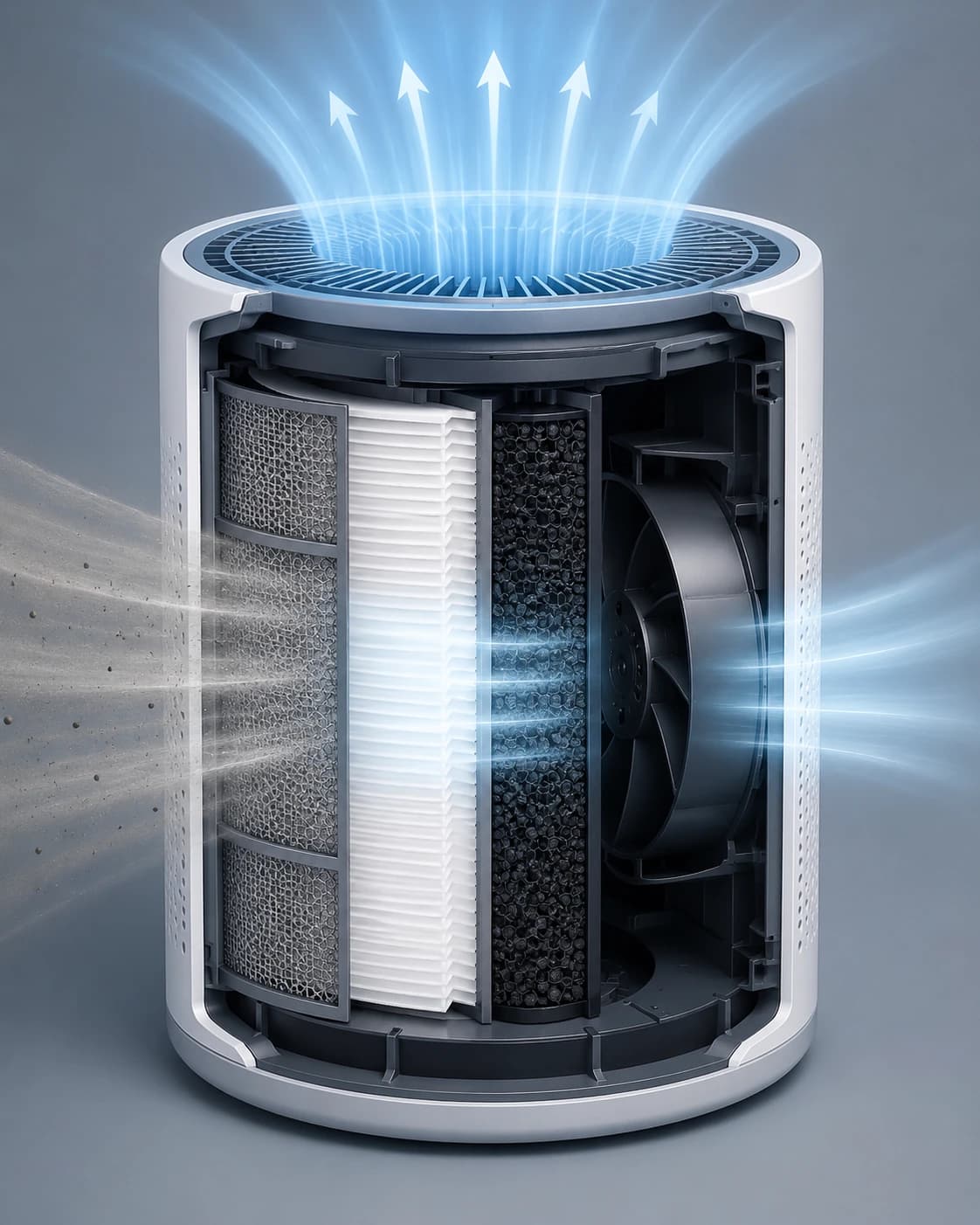
What it can do is reduce how much dust is circulating and resettling in the first place. A True HEPA filter captures at least 99.97% of airborne particles at 0.3 microns — a size range that covers most dust components — so running one continuously in a room genuinely reduces the amount of new dust settling onto surfaces over time, even though it won't touch what's already there. A 2020 study in Environment International measured HEPA purifier performance specifically against particles in the 18–514 nanometer range and found strong but size-dependent removal efficiency, with the lowest efficiency in the 200–250 nanometer range — a useful reminder that even a very good filter's performance isn't perfectly flat across every particle size.
The Dust Mite Connection
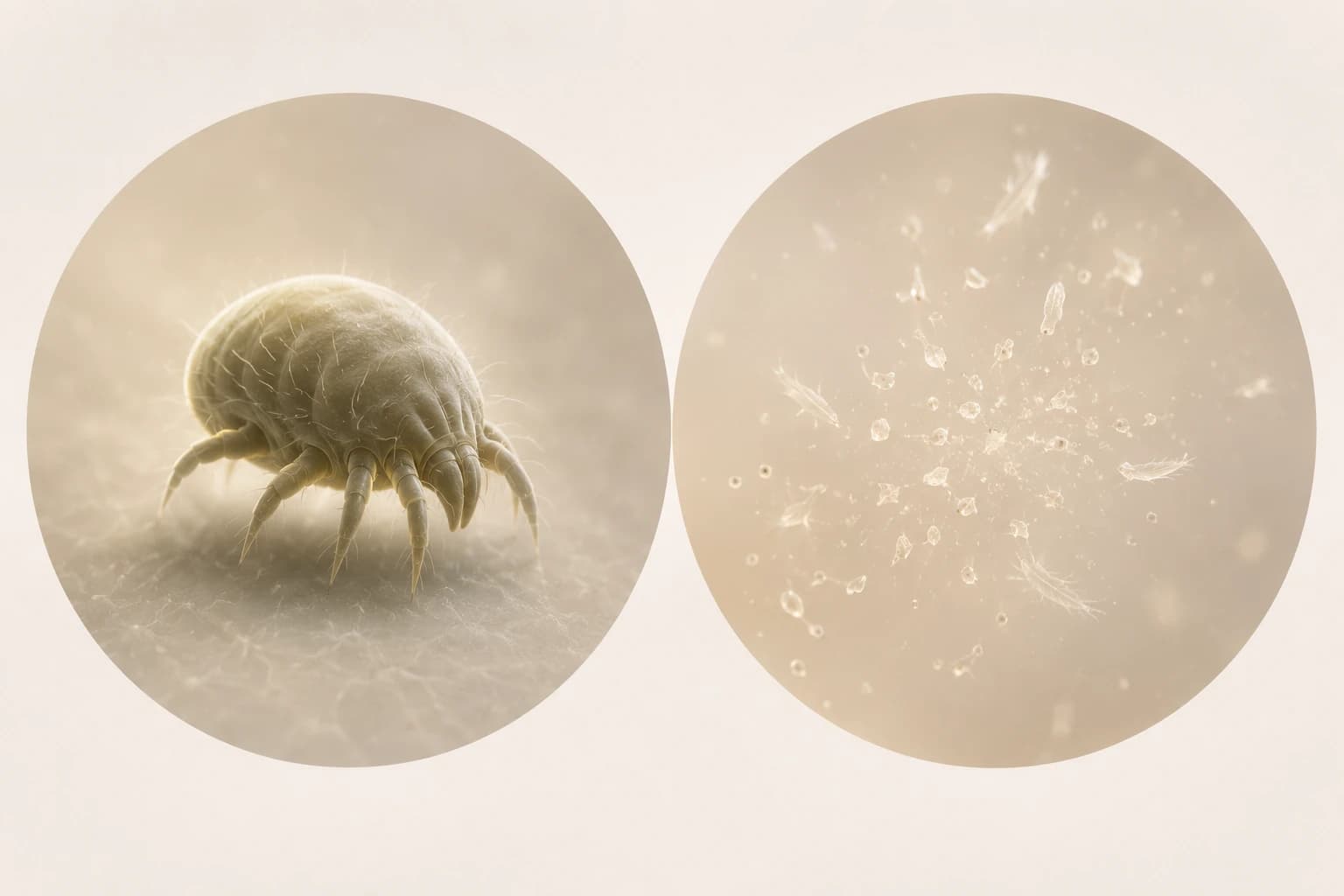
If dust mite allergy is your specific concern, there's a detail that changes how you should think about filtration: the allergen isn't the dust mite itself. It's proteins in dust mite fecal pellets and body fragments, which are considerably smaller and lighter than a live mite and become airborne more easily when disturbed — by walking across a carpet, shaking out bedding, or vacuuming without a sealed HEPA vacuum. That's exactly why filtration helps somewhat (it captures those airborne fragments) while source control — washing bedding in hot water, reducing carpet and soft furnishings, encasing mattresses and pillows — matters at least as much, since it addresses where the fragments come from rather than only what's briefly airborne after disturbance.
What the Research Actually Shows
A 2021 study (n=38) in Allergologia et Immunopathologia followed patients with allergic asthma using HEPA air purifiers for six months and found decreased indoor dust mite allergen levels (specifically Der p1 and Der f1) alongside improved asthma control scores. Worth being precise about the sample size here — 38 people is a real but modest study, not a massive trial — and the same study's secondary marker (exhaled nitric oxide, sometimes used as a proxy for airway inflammation) did not show a statistically significant change, so the finding is best read as "meaningfully suggestive," not definitive.
A broader 2024 systematic review and meta-analysis in Science of the Total Environment, which reviewed 148 field studies of portable air cleaners in detail, found a mean 49% reduction in PM2.5 (fine particulate matter) across 83 studies measuring it — a category that overlaps substantially with fine dust components. The same review found air cleaners had much less measurable effect on gas-phase pollutants, which is a separate issue from dust and covered in our guide to air purifiers and odors.
Getting the Most Out of an Air Purifier for Dust
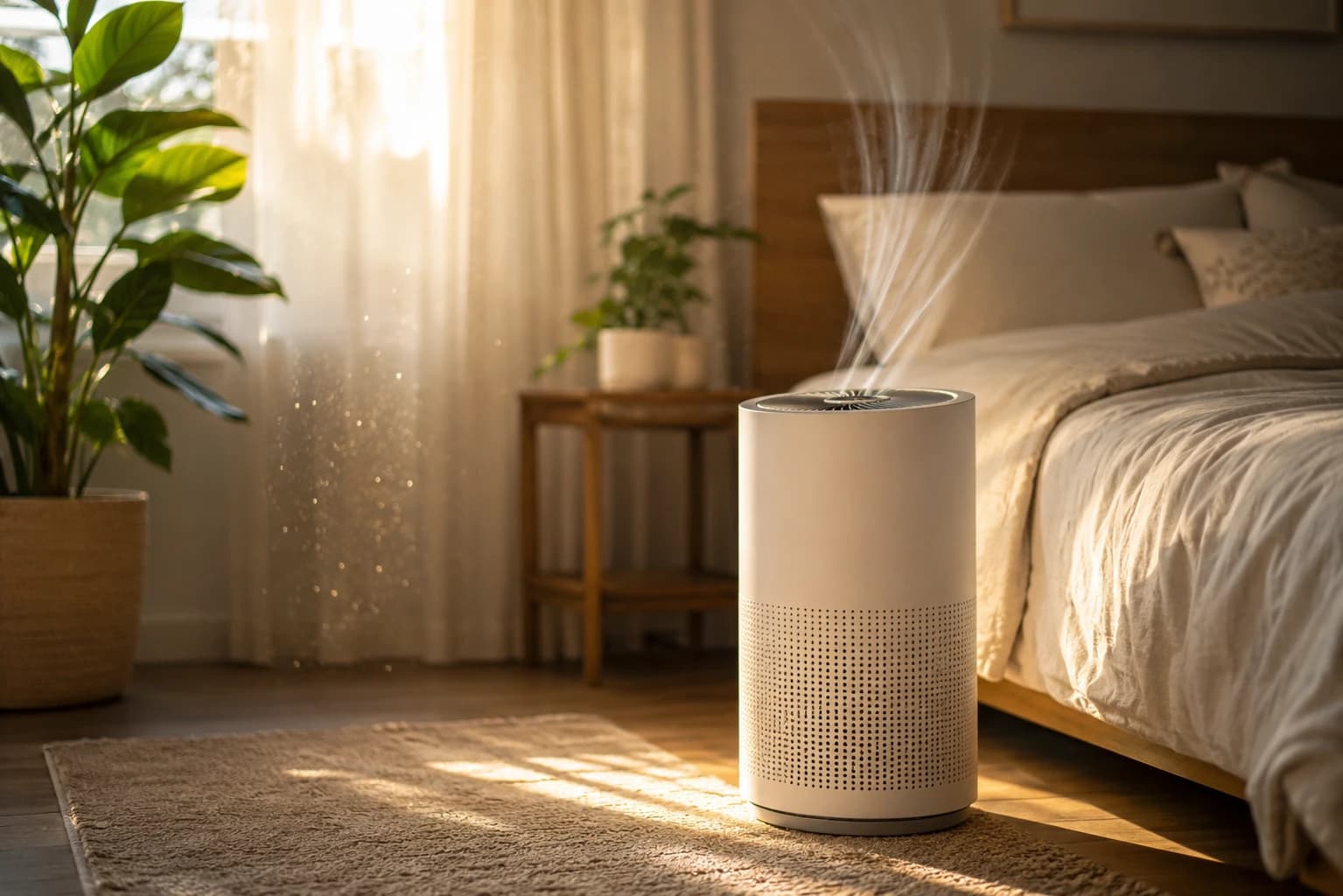
- Placement: run it in the room where dust bothers you most, typically the bedroom, since that's also where you spend the most continuous hours breathing that air.
- Continuous runtime: dust resettles once a unit stops running, so continuous or near-continuous operation outperforms switching it on only when you notice dust.
- Pair it with source control: vacuum with a sealed HEPA vacuum (a standard vacuum can redistribute fine dust into the air rather than removing it), wash bedding in hot water weekly, and keep your HVAC filter changed on schedule — a purifier supplements these habits, it doesn't replace them.
- Size it correctly: see our CADR and room-size explainer for the actual math, and our full allergy purifier roundup for specific picks by room size.
FAQ
Will an air purifier mean I have to dust less often?
Not directly — an air purifier filters airborne dust, not dust that's already settled on surfaces, so it won't reduce how often you need to wipe down shelves or vacuum. What it can do over time is reduce how much new dust resettles, since less of it stays circulating in the air waiting to land.
What size air purifier do I need for a dusty bedroom?
Match the unit's CADR to at least two-thirds of your room's square footage, assuming a standard 8-foot ceiling — for a 300 sq ft bedroom, that's roughly 200 CFM. See our how air purifiers work guide for the full worked example.
Do air purifiers help with dust mite allergies specifically?
Yes, to a real but modest degree. Filtration captures the airborne dust mite fecal matter and body fragments that trigger allergic reactions, and a 2021 study found six months of HEPA purifier use associated with lower indoor dust mite allergen levels and improved asthma control scores. It works best paired with source control — hot-water bedding washes, allergen-proof mattress and pillow covers, and reduced carpet/soft furnishings — rather than as a standalone fix.
Should I run the air purifier all day or just at night?
Continuous operation outperforms running it only at night or only when you notice dust, since particles resettle as soon as filtration stops. If continuous operation isn't practical, prioritize the hours you spend in that room, typically overnight in a bedroom, over daytime hours when the room is empty.
Do I still need to vacuum if I have an air purifier?
Yes. A purifier only affects what's currently airborne — it has no effect on dust and allergens already settled into carpet fibers, upholstery, or bedding. Vacuuming (ideally with a sealed HEPA vacuum, since a standard vacuum can kick fine dust back into the air) and washing bedding regularly both remain necessary alongside filtration, not optional extras.
Written by Marcus Thorne, Wellness Tools Researcher.
Sources
- Lowther SD, Deng W, Fang Z, et al. How efficiently can HEPA purifiers remove priority fine and ultrafine particles from indoor air? Environment International. 2020;144:106001. PMID: 32739515. https://pubmed.ncbi.nlm.nih.gov/32739515/
- Luo J, Ou L, Ma J, Lin X, Fan L, Liu H, Sun B. Efficacy of air purifier therapy for patients with allergic asthma. Allergologia et Immunopathologia. 2021;49(5). https://www.all-imm.com/index.php/aei/article/view/146
- Ebrahimifakhar A, Poursadegh M, Hu Y, Yuill DP, Luo Y. A systematic review and meta-analysis of field studies of portable air cleaners: Performance, user behavior, and by-product emissions. Science of the Total Environment. 2024;912:168786. PMID: 38008326. https://pubmed.ncbi.nlm.nih.gov/38008326/
- U.S. Department of Energy. DOE-STD-3020-2015, Specification for HEPA Filters Used by DOE Contractors. https://www.standards.doe.gov/standards-documents/3000/3020-astd-2015
- U.S. EPA. Guide to Air Cleaners in the Home, 2nd Edition. https://www.epa.gov/sites/default/files/2018-07/documents/guide_to_air_cleaners_in_the_home_2nd_edition.pdf

Marcus Thorne
A wellness tools researcher at The Wellness Voyage, focused on evaluating home health products against independent testing and real specs rather than marketing claims.