This post contains Amazon affiliate links. If you purchase through these links, I may earn a small commission at no extra cost to you.
If you've found a musty smell or a suspicious spot and you're hoping an air purifier fixes it, here's the honest answer up front, because overpromising here can genuinely delay a real fix: a True HEPA air purifier can capture airborne mold spores effectively, but it cannot kill or remove mold that's already growing on a surface, and it does nothing about the moisture problem that let it grow in the first place. If you skip straight to buying a purifier without addressing the source, the mold keeps growing regardless of how clean the air briefly gets.
What a HEPA Air Purifier Actually Captures

Mold spores are typically 2 to 100 microns in size — comfortably within, and mostly well above, the 0.3-micron benchmark that True HEPA filters are tested against. That means a genuine True HEPA filter (99.97% capture at 0.3 microns, per the U.S. DOE standard) is, if anything, more effective at catching mold spores than it is at the hardest particle size it's rated for. So the "airborne spores" half of this question has a straightforwardly positive answer: yes, a properly sized True HEPA purifier reduces the concentration of mold spores currently floating in the room.
What it does not do is address spores or mycelium already colonizing a wall, ceiling tile, or piece of furniture. Those stay exactly where they are, continuing to release new spores, until the surface is actually cleaned or remediated.
Why Your Air Purifier Might Not Fix the Musty Smell — Even While It's Working
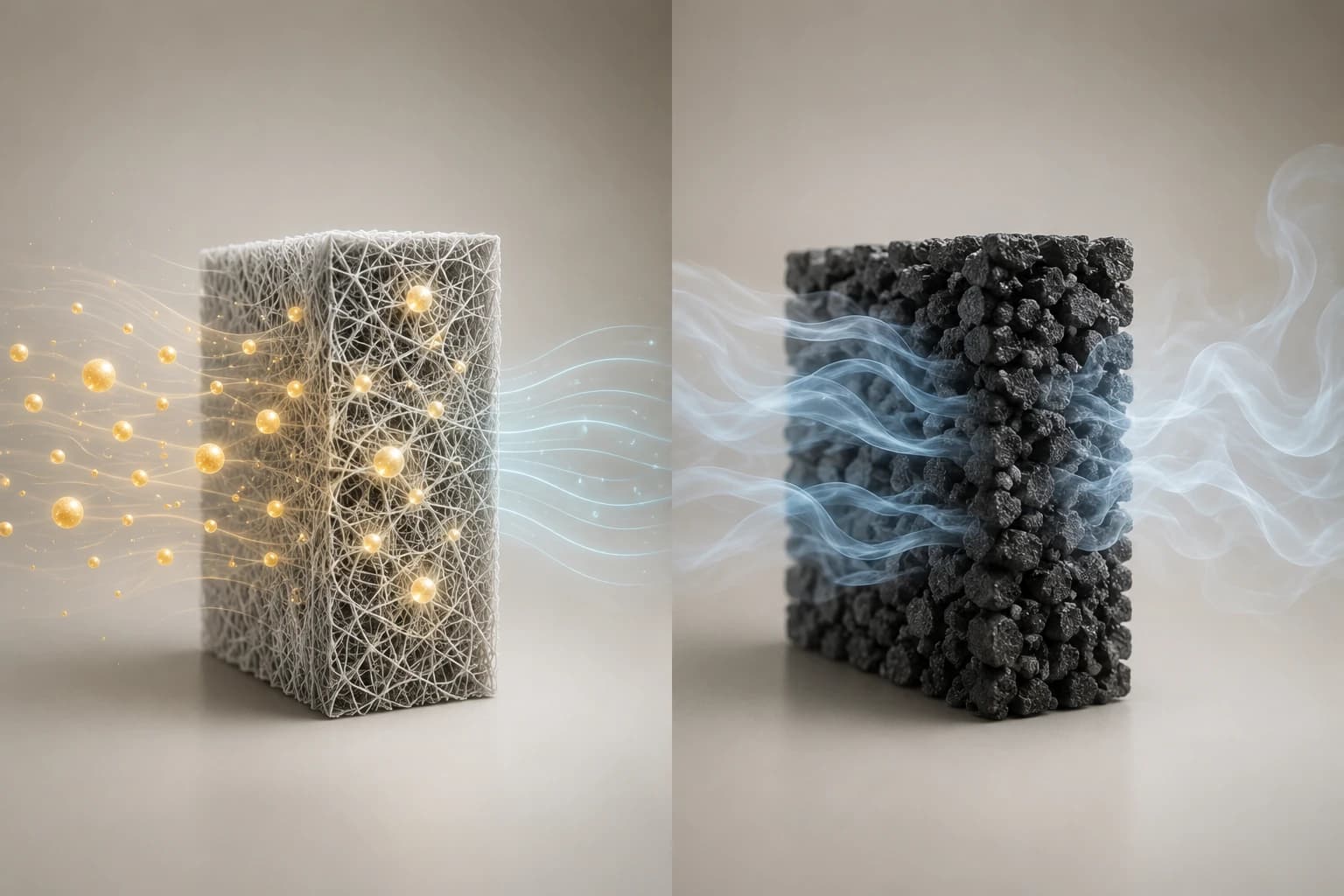
This is the single most useful distinction in this whole topic, and it's the one most articles blur: the musty smell associated with mold and the airborne spores are two different things, captured by two different mechanisms.
The smell comes from mVOCs — microbial volatile organic compounds released as mold grows and metabolizes. These are gas-phase molecules, not particles, and a standard HEPA filter — which works by physically catching particles in a fiber mat — cannot capture a gas molecule at all. Only a purifier with a genuinely substantial activated carbon layer, which captures gases through adsorption rather than mechanical filtration, addresses the smell. HEPA alone handles the spores; carbon handles the smell; neither substitutes for the other. This is the same particle-vs-gas distinction covered in more depth in our guide to air purifiers and odors — so if your purifier is reducing visible dust and allergy symptoms but the musty smell persists, that's not a sign it's broken. It's a sign it doesn't have (or has only a thin) carbon stage.
It's also worth checking whether a purifier's HEPA claim is genuine in the first place. "HEPA-type" and similar unregulated marketing terms don't carry the same tested capture rate as True HEPA or an explicit H13/H14 rating — see our True HEPA explainer for how to tell the difference on a real product listing.
What Actually Gets Rid of Mold
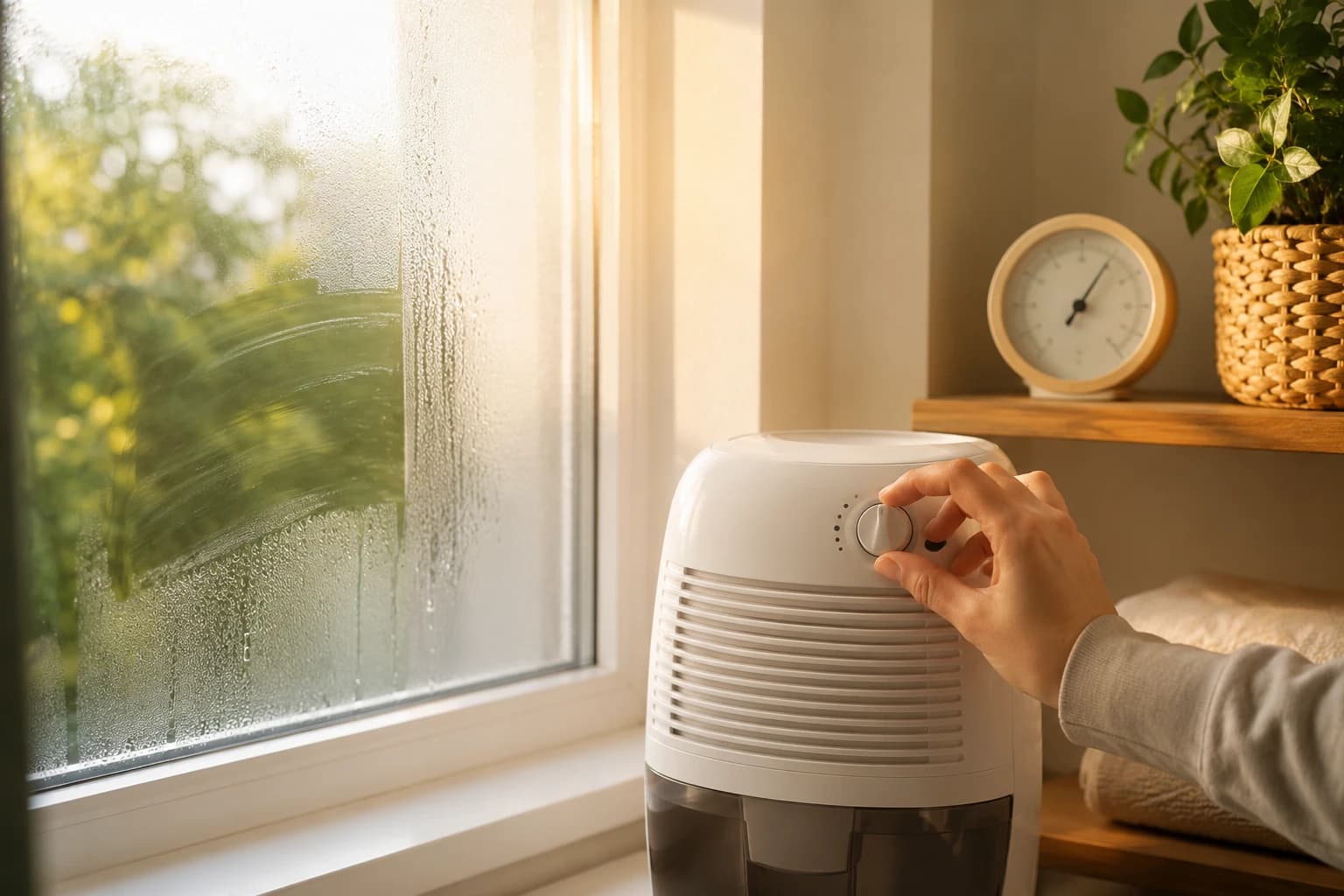
Every authoritative source on this agrees: eliminating mold growth means fixing the moisture source, not just filtering the air around it. The EPA recommends keeping indoor relative humidity between 30% and 50% to inhibit mold growth, and drying any wet materials within 24 to 48 hours of water exposure — beyond that window, mold growth becomes substantially more likely.
For cleanup itself, the EPA draws a clear, practical line: moldy areas smaller than about 10 square feet (roughly a 3-foot by 3-foot patch) can typically be handled by a homeowner using appropriate protective gear (gloves, eye protection, and an N95 or better respirator) and a mold-killing solution. Larger areas, or mold following significant water damage, warrant a professional remediation service rather than a DIY attempt — both because of the physical scope of the job and because larger jobs raise a real risk of spreading spores further during cleanup if not handled correctly.
It's also worth checking your HVAC system if mold has been a recurring issue: the EPA notes that a contaminated central air system can distribute mold spores throughout an entire house, and recommends turning the system off until it's been inspected and, if necessary, remediated, since standard HVAC filters typically aren't rated to capture mold-spore-sized particles effectively.
If You're Using a Purifier During or After Remediation
A purifier is genuinely useful as an exposure-reduction measure while you address the moisture source or during and after a remediation job — reducing how many disturbed spores you're breathing while the real fix happens. Run it continuously in the affected room (or, ideally, a sealed-off area during active remediation work), and treat it as a complement to the cleanup, not a substitute for doing the cleanup at all.
What to Look for If Mold or Musty Odor Is Your Specific Concern
If mold-related air quality is your main reason for buying a purifier, look for two things together: a genuine True HEPA filter (not "HEPA-type") for the spores, and a substantial activated carbon stage — not a thin cosmetic pad — for the mVOC smell. A unit with only one of the two will leave half the problem unaddressed.
FAQ
Can an air purifier get rid of mold on walls?
No. An air purifier filters airborne particles; it has no effect on mold already growing on a wall or other surface. Visible mold growth needs to be physically cleaned or professionally remediated — a purifier can reduce airborne spore exposure in the meantime, but it doesn't remove the growth itself.
Will an air purifier remove the musty smell from mold?
Only if it has a substantial activated carbon stage. The musty smell comes from mVOCs (microbial volatile organic compounds), which are gas-phase molecules that a standard HEPA filter cannot capture, since HEPA works by trapping particles, not gas molecules. A HEPA-only purifier can be genuinely reducing airborne spore counts while doing nothing for the smell — that's not a malfunction, it's a filter-type limitation.
What size room can an air purifier cover for mold spores?
The same CADR/room-size math applies as for any other airborne particle: match the purifier's CADR to at least two-thirds of your room's square footage, assuming an 8-foot ceiling. See our how air purifiers work guide for the full worked example, and our full allergy purifier roundup for specific picks.
Should I run an air purifier in a basement with a mold history?
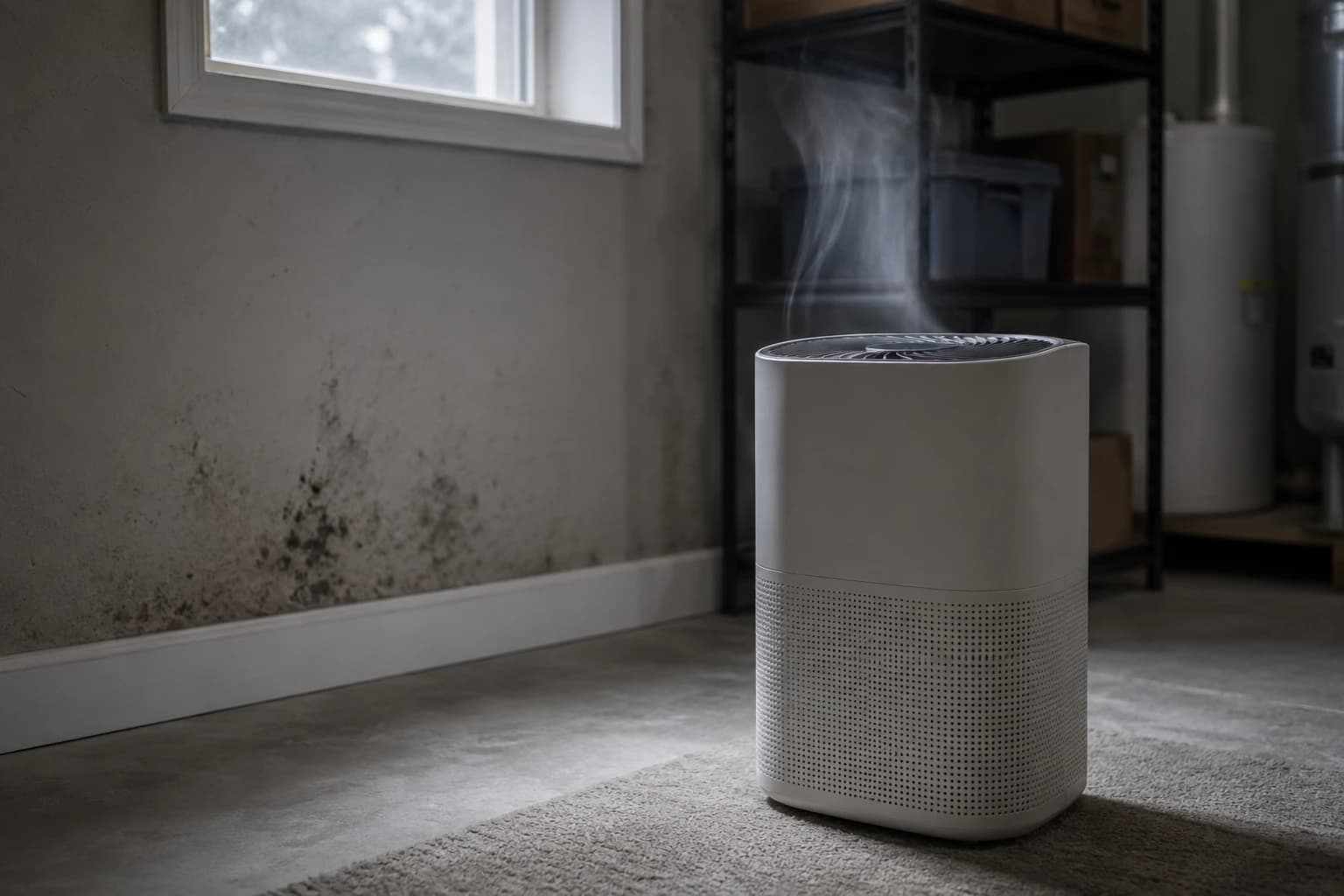
Running a properly sized True HEPA purifier continuously can help manage ongoing spore exposure in a basement, especially one prone to humidity swings — but it's not a substitute for controlling basement humidity (the EPA's 30-50% target) or addressing any recurring moisture source, like a leak or poor drainage. If mold keeps recurring despite humidity control, that points to an unresolved moisture issue that filtration alone won't fix.
When should I call a mold remediation professional instead of relying on a purifier?
Per EPA guidance, moldy areas larger than about 10 square feet, or mold resulting from significant water damage, generally warrant a professional remediation service rather than a DIY approach or reliance on an air purifier alone. Smaller patches (under roughly a 3-foot by 3-foot area) can typically be handled by a homeowner with proper protective gear, but an air purifier should be treated as a supplement to that cleanup, not a substitute for it.
Written by Marcus Thorne, Wellness Tools Researcher.
Sources
- U.S. EPA. A Brief Guide to Mold, Moisture, and Your Home. https://www.epa.gov/mold/brief-guide-mold-moisture-and-your-home
- U.S. EPA. Mold Cleanup in Your Home. https://www.epa.gov/mold/mold-cleanup-your-home
- U.S. EPA. Mold Course Chapter 5 (HVAC systems and mold). https://www.epa.gov/mold/mold-course-chapter-5
- U.S. Department of Energy. DOE-STD-3020-2015, Specification for HEPA Filters Used by DOE Contractors. https://www.standards.doe.gov/standards-documents/3000/3020-astd-2015
- Ebrahimifakhar A, Poursadegh M, Hu Y, Yuill DP, Luo Y. A systematic review and meta-analysis of field studies of portable air cleaners: Performance, user behavior, and by-product emissions. Science of the Total Environment. 2024;912:168786. PMID: 38008326. https://pubmed.ncbi.nlm.nih.gov/38008326/

Marcus Thorne
A wellness tools researcher at The Wellness Voyage, focused on evaluating home health products against independent testing and real specs rather than marketing claims.