This post contains Amazon affiliate links. If you purchase through these links, I may earn a small commission at no extra cost to you.
How we evaluate products → — we do not test products first-hand. This is what we check instead, and what we cannot tell you.
If you've spent another spring blowing through tissues despite vacuuming twice a week, you've probably wondered whether an air purifier would actually help or just become an expensive fan. Short answer: for airborne triggers like pollen, pet dander, and dust, a true HEPA purifier sized correctly for your room can measurably cut particle counts — the research backs that up. It won't touch what's on your couch or growing in your bathroom, and it won't fix a moisture problem. For allergy relief specifically, right now the pick worth buying first is the Levoit Core 400S, which pairs a real 231 CFM CADR with True HEPA filtration at a price that doesn't require a second mortgage.
This guide skips the vague "systematic scoring" language you'll find on a lot of comparison sites. Instead: the CADR and room-size math explained so you can check it yourself, a certification that's actually independently verified, real (not manufacturer-quoted) filter costs where we could confirm them, and straight talk about where these devices fall short.
Quick answer
- Best overall: Rabbit Air A3 — five-stage filtration, Forbes Vetted's top pick for 2026. Modeled cost: ~$1,100–1,120 over 3 years (device + filters — see the math).
- Best specifically for allergies: Levoit Core 400S — 231 CFM CADR, True HEPA, ~$200. Modeled cost: ~$260–275 over 3 years (workings).
- Best objectively certified pick: Alen BreatheSmart 75i — one of the only AAFA-certified purifiers on the market. Modeled cost: ~$990–1,050 over 3 years (workings).
- Do air purifiers actually help with allergies? Yes, for airborne triggers, when sized correctly — see the research below.
- Watch out for: ionizing "air purifiers" that generate ozone — the EPA says no federal agency has approved them for occupied rooms. More on that below.
The three-year figures above are a modeled estimate — device price plus filter replacements at each manufacturer's own stated interval — not a guarantee of what you'll spend. Here's exactly how we calculated them, so you can redo the math with your own numbers.
How we chose these — and what we did not do
We did not test these seven purifiers ourselves. We do not operate a testing laboratory, and nothing below should be read as a hands-on result — we have not run these units side by side in a controlled room.
What we actually did:
- Worked through the CADR-to-room-size math shown above so each pick's coverage claim can be checked against your own room, not just trusted.
- Verified AAFA certification status directly against the certifying body's own product directory, not from a box label.
- Collected filter replacement pricing where a real number existed and modeled it into the three-year running cost in the total cost of ownership table below.
- Read the peer-reviewed research on HEPA filtration and allergy symptoms cited in the research section.
- Recorded every place where a manufacturer's own number is the only figure available, so it reads as a manufacturer claim rather than an independent measurement.
Where a figure below comes from the manufacturer, the text says so. Where an independent tester — Forbes Vetted, Consumer Reports, or the AAFA — is the source, it's named rather than implied. What we genuinely cannot tell you from a desk: how loud a unit actually sounds in your room, how it holds up after two years, and anything else that requires physically owning the device. Where that gap matters to a pick below, we say so.
Three units we reviewed individually rather than ranking here: the AROEVE MK01, the Crane True HEPA line, and the Nordic Hygge M05.
Full methodology: How we evaluate products →.
What Actually Matters for Allergy Relief
Most of the differences between air purifiers that matter for allergies come down to four things: whether the HEPA claim is real, whether the CADR is big enough for your room, whether there's an independent certification behind it, and whether the "extra" features are actually safe.
True HEPA vs. "HEPA-Type": Read the Fine Print
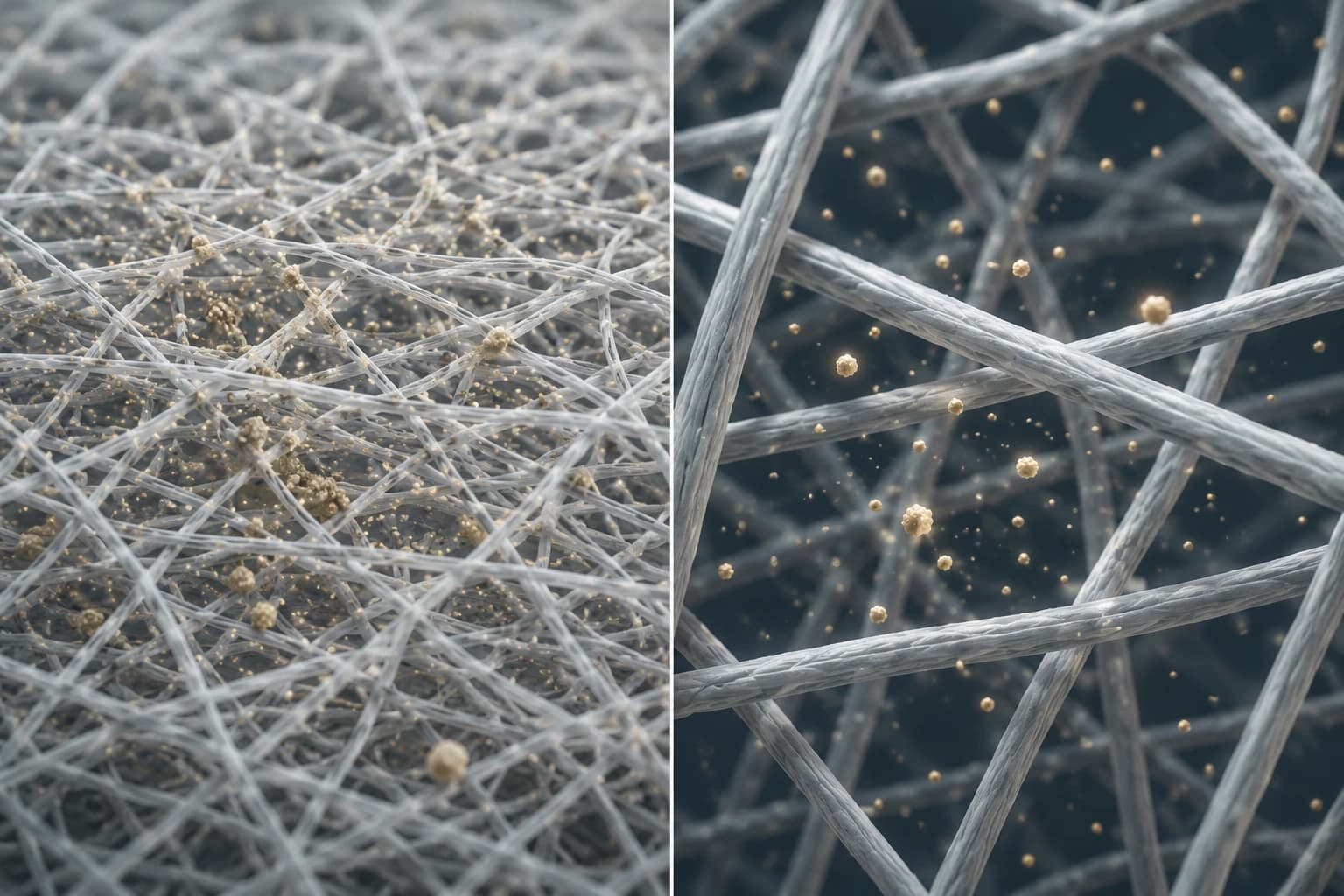
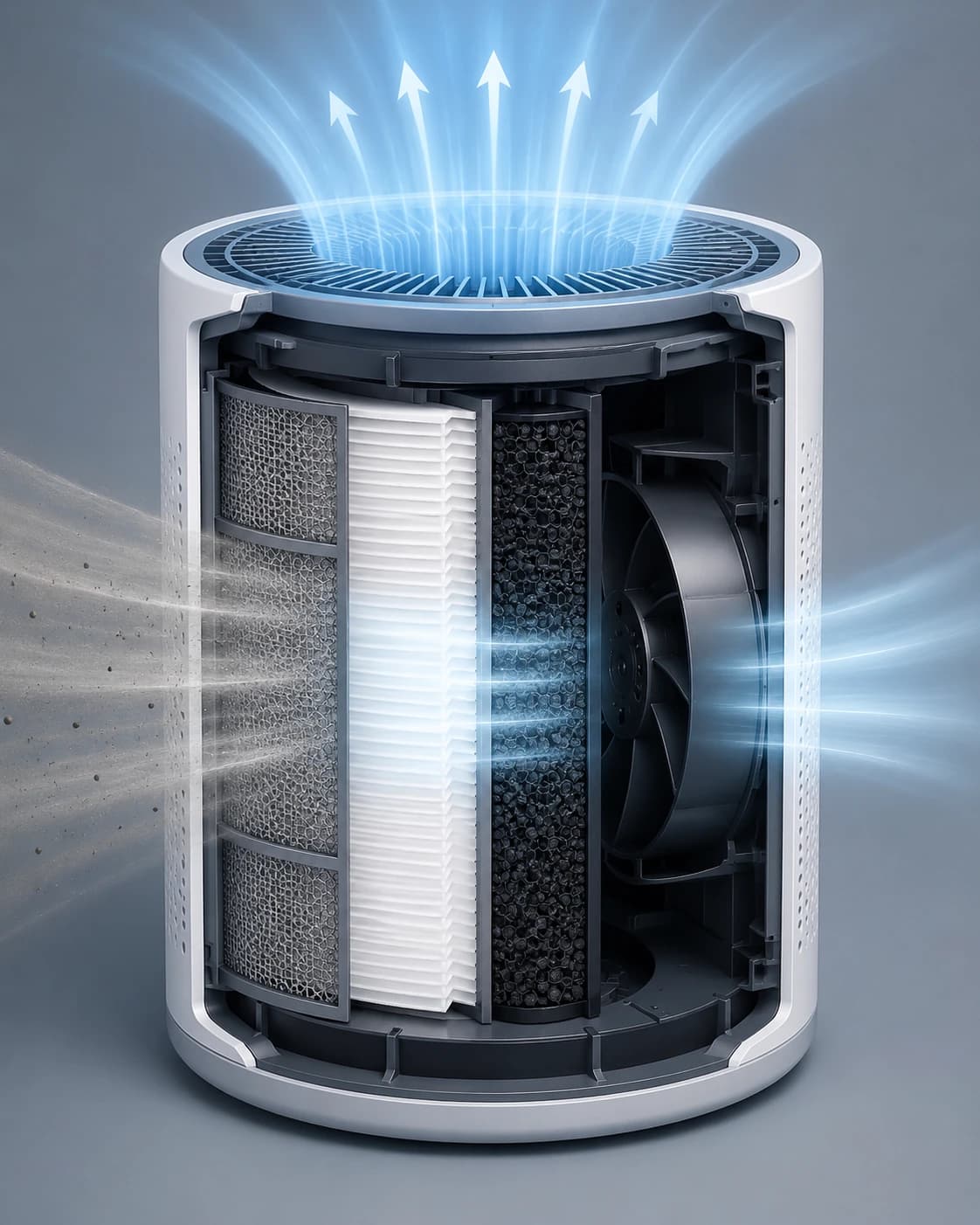
"True HEPA" (sometimes labeled HEPA H13) means the filter is manufactured and tested to capture at least 99.97% of particles down to 0.3 microns — the size range that's hardest to trap, and the range most pollen, mold spore fragments, and pet dander fall into or below. "HEPA-type," "HEPA-like," or "99% HEPA" are marketing terms with no independent testing standard behind them. If a listing doesn't say "True HEPA" or cite an H13/H14 rating explicitly, assume it's the weaker version. Every pick below uses genuine True HEPA media.
Do the CADR/Room-Size Math Yourself
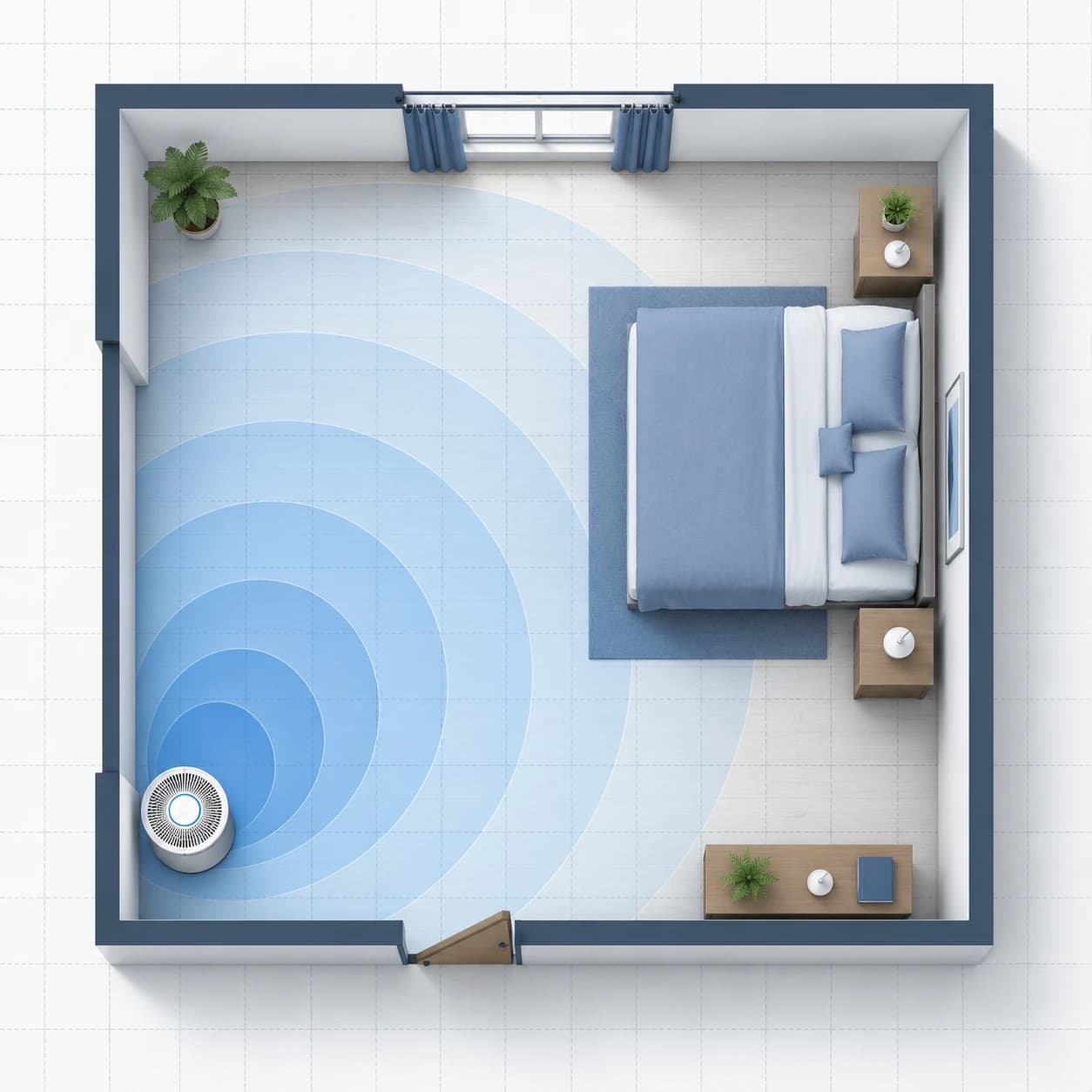
CADR (Clean Air Delivery Rate), tested and published under the AHAM Verifide program, tells you how much filtered air a unit delivers per minute for smoke, dust, and pollen. The widely used rule of thumb from AHAM and repeated by the EPA is to pick a CADR that's at least two-thirds of your room's square footage, assuming an 8-foot ceiling.
Here's a real worked example instead of just a link to a calculator:
- Say your bedroom is 300 sq ft with an 8-foot ceiling → room volume = 2,400 cubic feet.
- For a solid 4–5 air changes per hour (ACH), you need roughly 2,400 × 5 ÷ 60 ≈ 200 CFM of delivered clean air.
- The Levoit Core 400S is independently rated by Forbes Vetted at 231 CFM CADR, covering 403 sq ft at a 4.8 ACH rate — comfortably enough for that 300 sq ft room, with headroom to spare on bad pollen days.
If your space is bigger, don't just buy "the next size up" — redo the math. A 500 sq ft open-plan living room needs roughly 330+ CFM, which is why we've included a large-room pick below instead of just recommending the same bedroom unit for every space.
The AAFA Certification Worth Actually Looking For
Most "hypoallergenic" and "allergy-friendly" claims on air purifier boxes are unverified marketing. One certification isn't: the Asthma and Allergy Foundation of America's asthma & allergy friendly® certification program, run jointly with Allergy Standards Ltd. To earn it, a device has to independently demonstrate it reduces airborne allergen levels by at least 90%, that at least half of what it removes is actually captured in the filter (not just stirred around the room), and that ozone emissions stay under the U.S. federal limit of 0.05 ppm. You can check any product against the live certified-product directory yourself before buying.
The Ozone and Ionizer Warning Almost Nobody Leads With
Some "ionizing" or "ionic" air purifiers work by generating charged ions that make particles clump and fall out of the air — a different mechanism from HEPA filtration. The concern is that some ionizers, and virtually all dedicated "ozone generators" marketed as air cleaners, produce ozone as a byproduct. The EPA is blunt about this: "No agency of the federal government has approved these devices for use in occupied spaces," and ozone "can be harmful to health" even at levels manufacturers describe as safe. California's Air Resources Board goes further, restricting any indoor air cleaner sold in the state to under 0.050 ppm ozone output and maintaining a public list of CARB-certified devices. None of the picks below are marketed as ozone generators, but if you're shopping beyond this list, check for an ionizer or "plasma" mode and look for independent ozone-output data before buying — or simply leave that mode switched off.
The 7 Best Air Purifiers for Allergies in 2026
We picked these from Amazon's current best-sellers and this year's independent testing at Forbes Vetted and Consumer Reports, organized by the situation each one actually fits — not a single "best overall" ranking that ignores room size and budget. Prices and ratings shift constantly; verify them on the product page before buying.
Rabbit Air A3
Forbes Vetted named the A3 its "Best Air Purifier" overall for 2026, and the five-stage filtration is why: a pre-filter, a medium filter, a BioGS True HEPA filter, an activated carbon filter, and a customizable specialty filter you choose based on your main trigger (Pet Allergy, Germ Defense, Toxin Absorber, or Odor Remover) — the filter-stage breakdown is Rabbit Air's own listed specification (manufacturer claim), not something Forbes tested stage-by-stage. Forbes independently rated it for 535 sq ft at a whisper-quiet 20.3–51 dB range.
Honest limitations: At roughly $750–770, it's a serious purchase, not an impulse buy. It also includes an optional negative-ion function — a different mechanism from HEPA filtration and not the same thing as an ozone generator, but given our caution above about ionizing modes generally, the more conservative choice is to leave that feature off and let the filter stack do the work.
Best for: Buyers who want the most thoroughly filtered air in the roundup and are willing to pay for it.
Levoit Core 400S
This is Forbes Vetted's "Best Air Purifier For Allergies Overall" for 2026, and it's the pick we'd suggest first if allergy relief — not general air quality — is your specific goal. It combines a pre-filter, True HEPA filter, and activated carbon layer, delivers the same 231 CFM CADR at 403 sq ft / 4.8 ACH that Forbes Vetted independently rated (see the room-size math above), and runs at a manufacturer-stated 22–52 dB depending on fan speed. It's also one of the most-reviewed HEPA purifiers on Amazon, with a consistently high customer rating — an Amazon customer-review figure, not one we independently verified.
Honest limitations: The app-connected smart features (auto mode, air-quality display) are genuinely useful but add another thing that can occasionally lose Wi-Fi connection — the unit still filters fine in manual mode if that happens.
Best for: Anyone whose primary complaint is seasonal or pet allergies and who wants the best-documented CADR-to-price ratio in this list.
Alen BreatheSmart 75i
The 75i (and its smaller siblings, the 45i and 35i) are among the only air purifiers on the market with an independently earned AAFA asthma & allergy friendly® certification, awarded in May 2025. Testing behind that certification found the line removing up to 99.9% of airborne dust mite, pet dander, pollen, and mold spore particles, while keeping ozone emissions under the federal 0.05 ppm limit. Alen's own site cites a 4.85/5 average across roughly 1,775 reviews — a manufacturer-reported figure, not Amazon's, so treat it as directional.
Honest limitations: At ~$749 and up depending on the filter/panel combination you choose, it's priced similarly to the Rabbit Air A3 without that unit's specialty-filter customization. The 75i is sized for large rooms; if you have a smaller space, the 45i or 35i are the better fit — don't buy the biggest one "just in case."
Best for: Buyers who specifically want a certification-backed claim, not just a marketing one, and are comfortable verifying it themselves at the AAFA directory linked above.
Levoit Core 600S-P
The Core 600S-P is Levoit's large-room flagship, and its real differentiator is a genuinely swappable specialty-filter system: alongside the standard 3-in-1 filter (smoke, pet allergies, dust), Levoit sells dedicated replacement cartridges tuned for pet allergies, heavier smoke removal, and toxin/VOC absorption — so a household juggling more than one trigger can swap in the filter that matches the problem instead of buying a second purifier. It carries an AHAM Verifide-certified 391 CFM CADR and one of the strongest Amazon review records in this roundup: 4.6/5 from over 6,000 ratings — an Amazon customer-review figure, not one we independently verified.
Honest limitations: Levoit's own headline coverage claim (up to 2,933 sq ft) is measured at a low 1 air-change-per-hour rate — their own more meaningful figure, 606 sq ft at roughly 4.8 air changes per hour, is the one to actually size your room against, consistent with the ACH guidance above. At around $260, it's a mid-range price, not a budget pick.
Best for: Multi-trigger households (say, pollen allergies plus a cat) who want one purifier they can reconfigure with a different specialty filter rather than running two separate units.
Coway Airmega AP-1512HH Mighty
The AP-1512HH has been a fixture on Amazon's best-seller lists for years, typically priced between $150 and $230 and frequently discounted. It's worth being precise here: Consumer Reports has tested Coway's premium sibling, the Airmega ProX, and rated its filtration performance highly — that test doesn't cover this specific model. The AP-1512HH has instead built its own long, independent track record on Amazon as a reliable, no-frills True HEPA unit rather than through a named outlet's lab test.
Honest limitations: No app, no auto-mode air-quality sensor on the base model — it's a manual-speed, set-it-and-forget-it purifier. If you want smart automation, look at the Levoit Core 400S instead.
Best for: Budget-conscious buyers who want a proven, widely-owned model rather than the newest features.
Blueair Blue Pure 311i+ Max
Consumer Reports includes the 311i+ Max in its "Best Air Purifiers of the Year" testing, citing high owner-satisfaction and reliability scores and a real, tested maintenance cost of roughly $135 a year — one of the few outlets that actually publishes a number here instead of a vague "affordable filters" claim. It uses Blueair's HEPASilent technology, which combines mechanical HEPA filtration with electrostatic charging, and is built for larger, open-concept rooms.
Honest limitations: HEPASilent's electrostatic stage is a different approach from pure mechanical HEPA, and some allergy-focused reviewers prefer a fully mechanical filter with no electrostatic component involved. Performance in CR's testing has been strong regardless.
Best for: Larger or open-concept living rooms where the math above calls for more CFM than a bedroom-sized unit delivers.
Levoit Core 300-P
The Core 300-P uses the same True HEPA grade as its bigger 400S sibling in a smaller footprint, at roughly $100 — making it one of the most-purchased entry-level HEPA purifiers on Amazon. It's the practical choice for a bedroom, home office, or nursery rather than an open living space.
Honest limitations: Its smaller fan means it covers meaningfully less square footage than the 400S — don't use the CADR-to-room-size math above and assume it scales to a larger room just because it shares a product line with one that does.
Best for: Single rooms, bedrooms, and anyone buying their first air purifier who wants to try True HEPA filtration before spending more.
Total Cost of Ownership: What You'll Actually Pay to Keep These Running
The sticker price is only part of the cost — every one of these needs filter replacements, and that's where a lot of comparison articles go quiet. Below is the same model applied to all seven picks, with the arithmetic shown so you can substitute your own filter price if what you find differs from ours.
The model: three-year total cost = device price + (annual filter cost × 3). Nothing more complex than that, and we stop at three years — filter pricing further out than that is speculation, not modeling.
Worked example — Blueair Blue Pure 311i+ Max, the one pick here where both halves of the equation are independently sourced rather than estimated:
- Device price: ~$225 (Blueair's own current listing, checked September 2026; list price is $299.99 and it's frequently discounted, so verify the current price before buying).
- Annual filter cost: ~$135/year — Consumer Reports' own tested maintenance-cost figure, not a manufacturer projection. Worth flagging the gap: Blueair's own filter pricing (a $49.99 filter rated for up to 9 months) implies a lower ~$65–67/year if replaced exactly on schedule. We use CR's figure because it's a measured result, not a manufacturer's best-case interval.
- Three-year filter cost: $135 × 3 = $405.
- Three-year total: $225 + $405 = ~$630.
| Purifier | Device Price | Annual Filter Cost | 3-Year Total Cost | Confidence / Source |
|---|---|---|---|---|
| Blueair Blue Pure 311i+ Max | ~$225 | ~$135/year | ~$630 | Filter cost verified — Consumer Reports' tested figure. Device price is Blueair's current listing (blueair.com), not independently audited. |
| Levoit Core 300-P | ~$100 | ~$20–25/year | ~$160–175 | Filter-cost estimate from the review site OveReview, not independently re-verified by us |
| Levoit Core 400S | ~$200 | ~$20–25/year (same filter line as the 300-P) | ~$260–275 | Filter-cost estimate from OveReview, not independently re-verified by us |
| Rabbit Air A3 | $750–770 | ~$116/year (one full 4-filter kit, at Rabbit Air's "up to 12 months at 24/7 operation" guidance) | ~$1,100–1,120 | Filter price and interval are Rabbit Air's own published figures (manufacturer claim, rabbitair.com), not independently re-verified by us |
| Alen BreatheSmart 75i | $749 and up | ~$79–99/year (one HEPA-Pure filter at $99, Alen's own spec rates it for 12–15 months) | ~$990–1,050 (using the $749 base price) | Filter price and interval are Alen's own published figures (manufacturer claim, alen.com), not independently re-verified by us |
| Coway Airmega AP-1512HH | $150–230 | Not independently verified | Not calculable | Replacement filters are commonly available (roughly $28–30 at major retailers), but we could not confirm Coway's stated replacement interval — check coway.com |
| Levoit Core 600S-P | ~$260 | Not independently verified | Not calculable | Specialty replacement filters (pet allergy, smoke, toxin) cost more than the standard 3-in-1 filter; check Amazon or levoit.com for current pricing |
What this model assumes, and where it breaks down:
- Continuous operation. Every filter-life figure above (Rabbit Air's 12 months, Alen's 12–15 months) is the manufacturer's guidance at 24/7 running. Run the unit only in the evenings or seasonally and your filters will likely last longer than this model assumes — treat these totals as a ceiling, not a floor.
- Prices move. Every figure above was checked in September 2026 and will drift. Sale pricing especially — Blueair's device price alone swings between $225 and $300 depending on the day you check.
- US pricing only. These are US-dollar figures from US retailers and manufacturer sites. They should not be read across to French or German pricing, which differs by market.
- "Not calculable" isn't zero. Where we couldn't confirm a number, budget for it anyway rather than treating the gap as free.
If a specific filter cost matters to your decision, treat the rows marked "not independently verified" as homework to do on the manufacturer's site before you buy.
Match Your Allergy Trigger to a Feature
If your main trigger is seasonal pollen: prioritize CADR sized to your room (see the math above) and a sealed True HEPA filter — the Levoit Core 400S is built around exactly this.
If you have pets: look for a dedicated pet/dander filter stage plus a strong activated carbon layer for pet odor, not just "pet mode" on the box. The Levoit Core 600S-P's pet-allergy specialty filter and the Rabbit Air A3's Pet Allergy specialty filter are both built specifically for this. For a deeper look at dander specifically, see our guide on whether air purifiers help with dust and pet-related particles.
If dust mites are the issue: dust mite allergens are heavy and settle quickly, so continuous 24/7 operation in the bedroom matters more than raw CADR — run the unit on auto or a low continuous setting overnight rather than only when you remember to switch it on.
If you're dealing with more than one trigger in the same household (pollen for one person, a cat for another), a customizable system like the Levoit Core 600S-P's swappable specialty filters avoids buying and running two separate purifiers.
None of these replace the basics: washing bedding in hot water weekly, keeping pets off furniture in the bedroom, and vacuuming with a HEPA-filtered vacuum still matter alongside whatever purifier you choose.
The Research on Air Purifiers and Allergies
Yes, for airborne allergens specifically, and there's real research behind that answer — but it's not a complete fix on its own. A multicenter, randomized, double-blind, placebo-controlled study published in the Yonsei Medical Journal found that active HEPA purifiers meaningfully reduced indoor particulate concentrations and medication scores in people with allergic rhinitis compared to a placebo device, though the effect on self-reported symptom scores was smaller than the effect on air quality itself. A separate rostrum from the American Academy of Allergy, Asthma & Immunology's Indoor Allergen Committee, published in the Journal of Allergy and Clinical Immunology, reached a similar conclusion: air filtration can reduce airborne allergen load, but it works best as one part of a broader allergen-reduction strategy — not a replacement for it.
The EPA's own guidance is consistent with this: air cleaners can reduce some indoor airborne pollutants, but performance depends heavily on correct sizing and on pairing a purifier with source control (keeping pets out of the bedroom, fixing moisture problems, vacuuming regularly) rather than expecting the purifier alone to solve the problem.
Where an Air Purifier for Allergies Falls Short
An air purifier only filters what's airborne right now. It won't:
- Clean surfaces. Dust and dander that have already settled onto your couch, bedding, or carpet stay there until you clean them — a purifier can't retroactively pull settled allergens back into the air to filter them.
- Replace changing your HVAC filter. If your home has central heating and air, a purifier supplements your HVAC system's filtration; it doesn't substitute for keeping that filter changed on schedule.
- Fix a mold or moisture problem. A purifier can capture some airborne mold spores, but it does nothing about the underlying moisture source growing them. If you're dealing with a musty smell or visible mold, that's a source-control problem first — our guide on whether air purifiers help with mold covers what filtration can and can't do there.
Buying a bigger, more expensive unit doesn't fix any of these three gaps. If your main problem is one of them, the fix is elsewhere, not in a purifier upgrade.
FAQ
Do air purifiers actually help with allergies?
Yes, for airborne triggers like pollen, dust, and pet dander, when the unit has genuine True HEPA filtration and is sized correctly for the room. Peer-reviewed research on allergic rhinitis patients has found measurable reductions in indoor particulate levels and medication use with active HEPA filtration versus a placebo device. It works best alongside source control — keeping pets off furniture, washing bedding, and managing moisture — rather than as a standalone fix. For the deeper mechanics of how filtration actually works, see our guide on how air purifiers work.
What size air purifier do I need for my bedroom or living room?
Use the two-thirds rule: match the purifier's CADR to at least two-thirds of your room's square footage, assuming a standard 8-foot ceiling. For a 300 sq ft bedroom, that means a CADR around 200 CFM; for a 500 sq ft open-concept living room, look for 330+ CFM. Manufacturers publish a "rated room size" alongside CADR — check that it was measured at a reasonably high air-change rate (4–5 ACH), not the loosest possible standard, since a bigger rated coverage at a lower ACH means weaker actual filtration.
Is a more expensive air purifier always better for allergies?
No. Price often tracks extra features — app connectivity, specialty cartridge systems, additional certifications — rather than raw filtration power for your specific room. The $100 Levoit Core 300-P uses the same HEPA grade as pricier siblings; it's simply sized for a smaller space. Buy based on your room's actual CADR requirement and your specific trigger (see the feature-matching section above), not the highest price tag.
Do I need a special pet-allergy air purifier if I have pets?
You don't need a purifier marketed specifically as "for pets," but you do want a dedicated pet/dander filter stage and a genuine activated carbon layer for pet odor — a plain HEPA filter alone handles the particles but not the smell. Look for a swappable pet-specific filter (like the Levoit Core 600S-P's pet-allergy cartridge) or a specialty filter option (like the Rabbit Air A3's Pet Allergy filter) rather than assuming "HEPA" alone covers it.
How do I know if an air purifier's HEPA claim is real?
Look for the specific phrase "True HEPA" or an explicit H13/H14 rating in the product listing, not "HEPA-type," "HEPA-like," or "99% HEPA" — those are unregulated marketing terms with no independent testing standard behind them. For an objectively verified allergy claim beyond HEPA grade alone, check whether the product carries the AAFA asthma & allergy friendly® certification, and confirm it yourself at the live certified-product directory rather than taking a box label's word for it.
Will an air purifier help with pollen allergies?
Yes, indoors — a properly sized True HEPA purifier captures airborne pollen, which falls well within the 99.97%-at-0.3-micron range True HEPA is tested to (see the filtration section above). It only reaches pollen that's actually airborne inside the room it's running in, though: it does nothing for pollen already on your skin, hair, or clothes after you've been outside, or pollen that's settled onto surfaces. See the trigger-matching section above for what to prioritize if pollen specifically is your main trigger.
How long before I notice a difference?
We can't give you a measured answer, since that would require testing we haven't done — but the CADR/room-size math above gives a modeled one. At the 4–5 air changes per hour this guide's sizing rule targets, a correctly sized unit is cycling the room's entire air volume roughly every 12–15 minutes, so a real drop in indoor particle counts is a reasonable expectation within the first hour or so of continuous running. Don't expect your symptoms to track that timeline as closely: the placebo-controlled study cited in the research section above found that self-reported allergy-symptom scores improved by less than the measured air-quality readings did. The air can measurably improve before you personally feel much different.
Should I run it continuously?
For allergy relief specifically, yes — continuous or near-continuous operation is the assumption already built into this guide's advice, from the dust-mite guidance above to every filter-life figure in the cost model. Switching it off between sessions lets the room's allergen level rebuild, which undercuts the CADR/ACH math the sizing section walks through. The trade-off is cost: running 24/7 is exactly what pushes filters toward the shorter end of the replacement intervals in that table, so those totals are closer to a ceiling than a typical result if you only run the unit part-time. One exception worth knowing: continuous filtration will capture some airborne mold spores, but it won't touch the moisture problem generating them — see our guide on whether air purifiers help with mold for what filtration can and can't do there.
Bottom Line
If you only read one section, here it is: for allergy relief specifically, the Levoit Core 400S gives you the best-documented CADR for the price. If budget isn't the constraint and you want the most thorough filtration in this roundup, the Rabbit Air A3 is Forbes Vetted's top overall pick for 2026. If you want a claim you can independently verify rather than trust on faith, the Alen BreatheSmart 75i's AAFA certification is the one to check yourself at the link above.
Prices, ratings, and availability change — verify current figures on the product page before buying. And if you're managing asthma or a diagnosed respiratory condition rather than everyday seasonal allergies, talk to your doctor about where an air purifier fits into your overall treatment plan, since it's a supplement to medical care, not a substitute for it.
Written by Marcus Thorne, Wellness Tools Researcher. All product recommendations are based on independent research, verified Amazon availability, and published testing from Forbes Vetted, Consumer Reports, and the AAFA as of July 2026. No manufacturers paid for inclusion in this guide.
Sources
- Park KH, et al. Effects of Air Purifiers on Patients with Allergic Rhinitis: A Multicenter, Randomized, Double-Blind, and Placebo-Controlled Study. Yonsei Medical Journal. 2020;61(8):689-697. PMID: 32734732. https://pubmed.ncbi.nlm.nih.gov/32734732/
- Sublett JL, Seltzer J, Burkhead R, Williams PB, Wedner HJ, Phipatanakul W. Air filters and air cleaners: Rostrum by the American Academy of Allergy, Asthma & Immunology Indoor Allergen Committee. Journal of Allergy and Clinical Immunology. 2010;125(1):32-38. PMID: 19910039. https://pubmed.ncbi.nlm.nih.gov/19910039/
- U.S. EPA. Guide to Air Cleaners in the Home, 2nd Edition. https://www.epa.gov/sites/default/files/2018-07/documents/guide_to_air_cleaners_in_the_home_2nd_edition.pdf
- U.S. EPA. Residential Air Cleaners: A Technical Summary, 3rd Edition (2018). https://www.epa.gov/sites/default/files/2018-07/documents/residential_air_cleaners_-_a_technical_summary_3rd_edition.pdf
- U.S. EPA. Ozone Generators that are Sold as Air Cleaners. https://www.epa.gov/indoor-air-quality-iaq/ozone-generators-are-sold-air-cleaners
- California Air Resources Board. Hazardous Ozone-Generating Air Purifiers. https://ww2.arb.ca.gov/our-work/programs/air-cleaners-ozone-products/hazardous-ozone-generating-air-purifiers
- Asthma and Allergy Foundation of America / Allergy Standards Ltd. Alen BreatheSmart 35i, 45i, and 75i Air Purifiers Earn Asthma & Allergy Friendly Certification. May 8, 2025. https://aafa.org/alen-breathesmart-35i-45i-and-75i-air-purifiers-earn-asthma-allergy-friendly-certification/
- AAFA / Allergy Standards Ltd. Certified Asthma & Allergy Friendly® Air Cleaners Directory. https://www.asthmaandallergyfriendly.com/USA/certified_products/products_categories/air-cleaners/
- Forbes Vetted. Best Air Purifiers For Allergies 2026: 6 Tested Models To Help Keep Symptoms At Bay. Updated March 30, 2026. https://www.forbes.com/sites/forbes-personal-shopper/article/best-air-purifier-for-allergies/
- Forbes Vetted. Best Air Purifiers 2026: 8 Models That Proved Effective In Our Homes. Updated June 12, 2026. https://www.forbes.com/sites/forbes-personal-shopper/article/best-air-purifier/
- Consumer Reports. Best Air Purifiers of the Year. https://www.consumerreports.org/appliances/air-purifiers/best-air-purifiers-of-the-year-a1197763201/
- GoodRx Health. Do Air Purifiers Actually Reduce Allergies? Yes, Here's How. Medically reviewed by Mera Goodman, MD, FAAP. Updated April 5, 2025. https://www.goodrx.com/conditions/allergies/air-purifier-for-allergies

Marcus Thorne
A wellness tools researcher at The Wellness Voyage, focused on evaluating home health products against independent testing and real specs rather than marketing claims.