This post contains Amazon affiliate links. If you purchase through these links, I may earn a small commission at no extra cost to you.
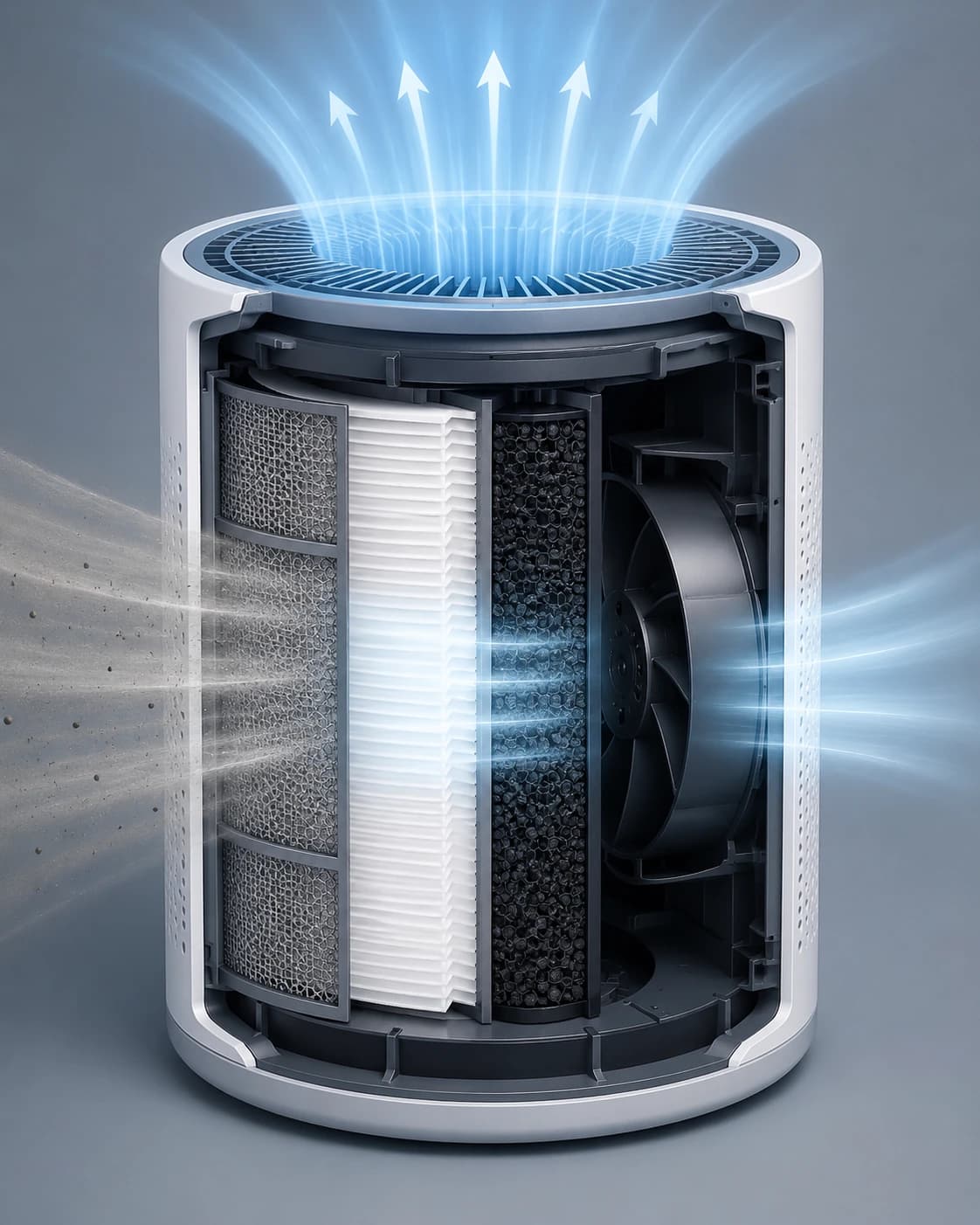
An air purifier works by pulling room air through a fan and passing it across one or more filter media that physically trap particles or chemically bind gas molecules, then pushing the cleaned air back out. The two workhorse technologies are a HEPA filter, which captures solid particles like dust, pollen, and dander, and an activated carbon layer, which captures odor and gas molecules that HEPA physically can't touch. Neither one does the other's job — which is exactly where most people's mental model of "an air purifier" goes wrong.
The Basic Anatomy of an Air Purifier
Strip away the marketing and nearly every air purifier on the market is the same basic stack:
- A fan, which pulls air in and pushes it back out — its strength (measured in CFM, cubic feet per minute) is what ultimately determines CADR.
- A pre-filter, a coarse mesh or foam layer that catches hair, lint, and large debris so the expensive main filter doesn't clog with the easy stuff.
- A main particle filter — ideally True HEPA — that does the actual fine-particle capture.
- An optional activated carbon layer, for odor and gas-phase pollutants.
- Optional extras: UV-C lamps, ionizers, or "plasma" technology, which vary widely in how much they actually add.
If you only remember one thing from this section: the fan and filter combination is what does the real work. Everything after that is either a genuine second capability (carbon for odors) or a feature that needs more scrutiny (ionizers, UV-C).
How a HEPA Filter Catches Particles Smaller Than Its Own Holes
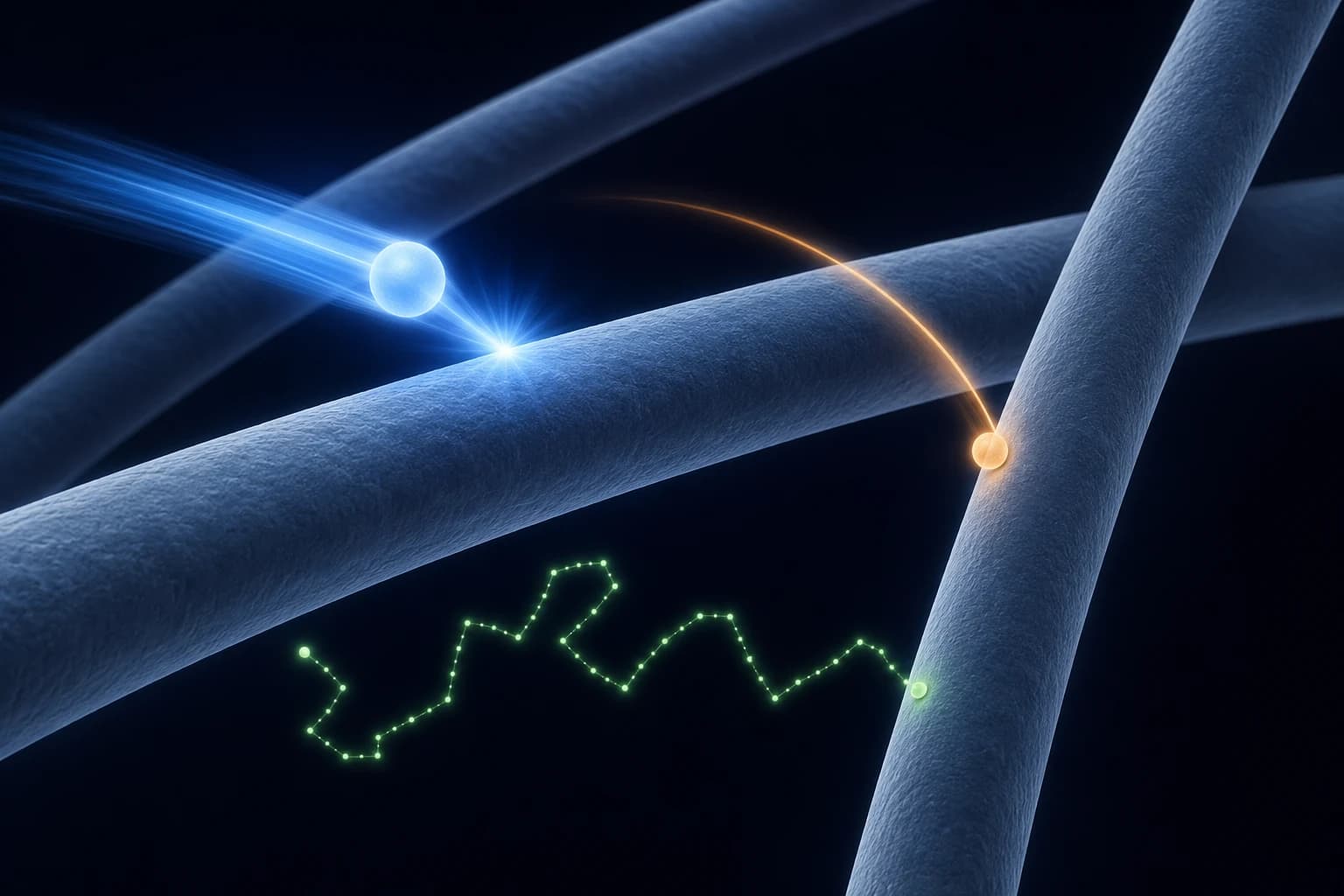
Here's the part almost no one explains correctly. A HEPA filter is not a sieve. If it worked like a sieve — physically blocking anything wider than the gaps between fibers — it would be nearly useless against the smallest, most dangerous particles, since they'd simply slip through gaps sized for something bigger. That's not how it works, and understanding why is the key to trusting the 99.97% number instead of just repeating it.
A HEPA filter is a dense mat of random fibers, and particles get caught through three distinct physical mechanisms depending on their size:
- Impaction: Larger particles (roughly above 1 micron) have enough mass and momentum that they can't follow the air's path as it curves around a fiber — they just slam straight into it.
- Interception: Mid-sized particles follow the airstream closely, but if that path brings them within a particle's own radius of a fiber, they brush against it and stick.
- Diffusion: The smallest particles (under about 0.1 micron) are light enough to be knocked around by collisions with individual air molecules — Brownian motion — which makes their path so erratic that they have a very high chance of randomly colliding with a fiber somewhere in the mat, even though they're moving "with" the airflow overall.
Put those three together and something counterintuitive falls out: HEPA filters are actually worst at an intermediate particle size, roughly 0.3 microns, called the Most Penetrating Particle Size (MPPS) — too small to reliably impact or intercept, not quite small enough to diffuse reliably either. That's exactly why the official capture-rate standard is tested at 0.3 microns: it's the hardest size to catch, not an arbitrary round number. A filter that hits 99.97% at that size is, by definition, even more effective above and below it.
What Activated Carbon Does Differently
HEPA filtration and activated carbon solve two completely different problems, and this is the single most common point of confusion for anyone buying a purifier hoping to fix a smell. HEPA captures solid and liquid particles. Activated carbon captures gas-phase molecules — volatile organic compounds (VOCs), the compounds behind cooking smells, pet odor, and smoke smell — through adsorption: its structure is so porous that a small amount of carbon has an enormous internal surface area, and gas molecules passing through physically bind to that surface as they pass.
A purifier with a genuinely substantial carbon bed handles both particles and smells. A purifier with "HEPA" on the box and a thin, cosmetic carbon pad will filter particles fine and disappoint you on odor. For the full breakdown of what this means for pet odor, cooking smells, and smoke specifically, see our guide on whether air purifiers help with smell and odors.
What CADR and ACH Actually Mean
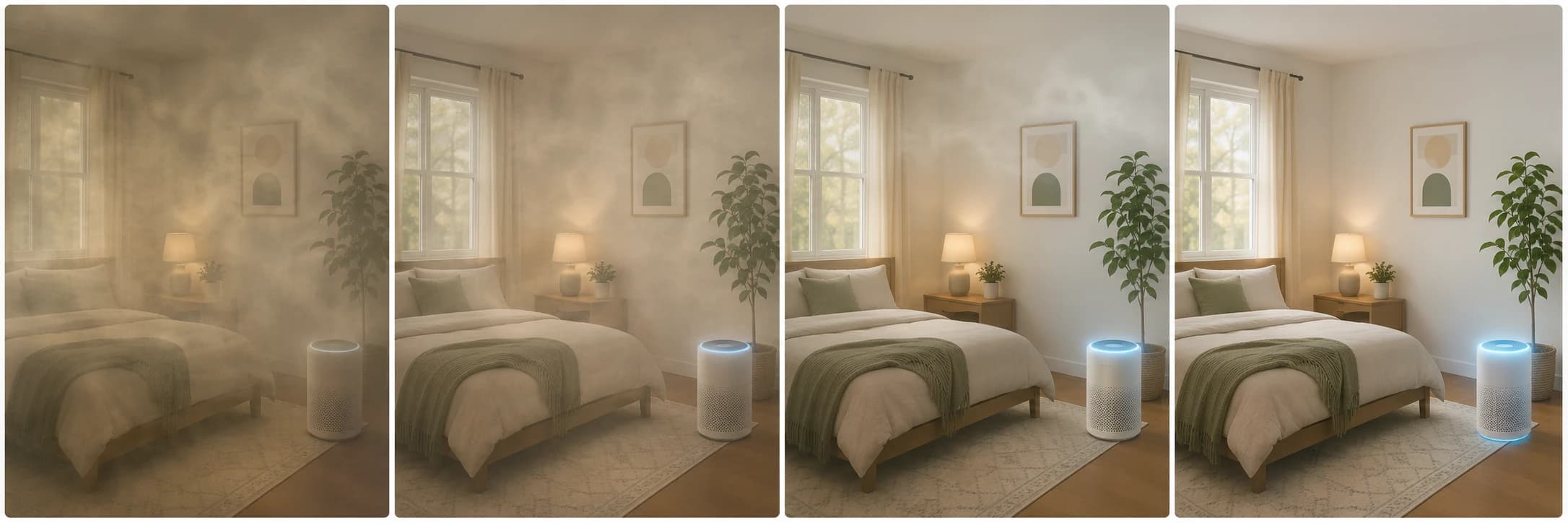
CADR (Clean Air Delivery Rate), tested and published under the AHAM Verifide program, tells you how many cubic feet of fully clean air a unit delivers per minute — measured separately for dust, pollen, and smoke, since they behave slightly differently in filtration. ACH (air changes per hour) tells you how many times a unit can theoretically filter your entire room's air volume in an hour. For allergy or asthma relief, the widely used target is at least 4–5 ACH in the room where you spend the most time — usually the bedroom.
A quick worked example: a 300 sq ft bedroom with an 8-foot ceiling has a volume of 2,400 cubic feet. At 5 ACH, you need roughly 2,400 × 5 ÷ 60 ≈ 200 CFM of delivered clean air. That's the actual math behind the "two-thirds of your room's square footage" rule of thumb you'll see on purifier boxes. For the applied, product-specific version of this — including which real purifiers hit which CADR numbers — see our full allergy purifier roundup and our guide on air purifiers and household dust.
Ionizers, UV-C, and the Ozone Question
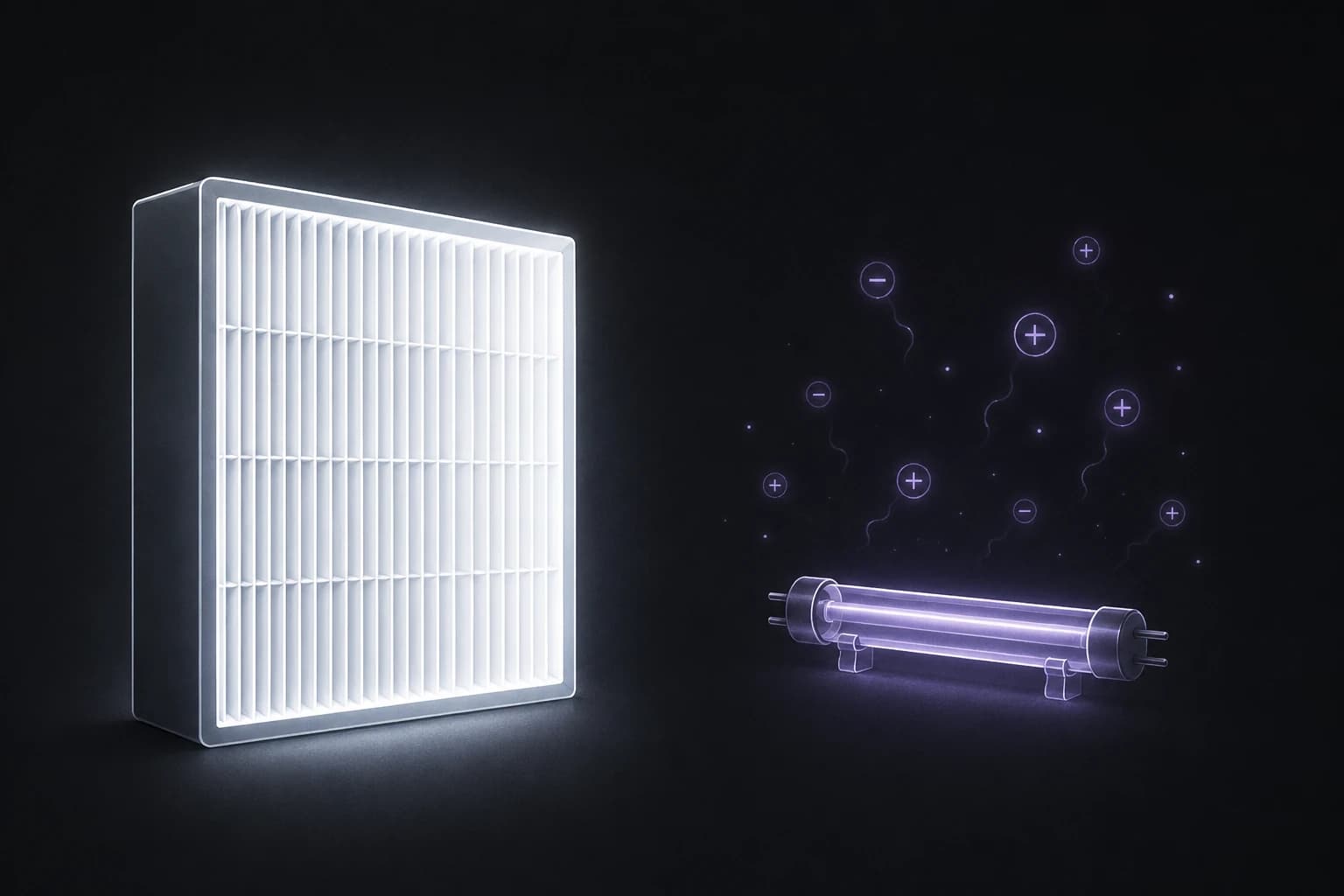
Some purifiers add an ionizer (sometimes called an ionic or electrostatic feature), which charges particles so they clump together and fall out of the air or stick to a plate — a different mechanism from pulling air through a filter. Others add a UV-C lamp intended to damage the DNA of bacteria and viruses as air passes near it.
The catch with ionizers, and especially with dedicated "ozone generators" sold as air cleaners, is ozone: some designs produce it as a byproduct. The EPA states plainly that no agency of the federal government has approved these devices for use in occupied spaces, and that ozone can be harmful to health even at levels manufacturers describe as safe. California's Air Resources Board (CARB) goes further, capping any indoor air cleaner sold in the state at under 0.050 ppm ozone output. If a purifier includes an ionizer mode, check whether it can be switched off — many can, and leaving it off is the more conservative choice.
What an Air Purifier Can't Do
It's worth being direct about the limits, since a lot of marketing quietly implies otherwise:
- It won't replace changing your HVAC filter. A portable purifier supplements central heating/air filtration; it doesn't substitute for keeping that filter changed on schedule.
- It won't clean surfaces. Dust, dander, and allergens that have already settled onto furniture, bedding, or carpet stay there until you clean them — filtration only affects what's currently airborne.
- It doesn't address the pollution source. A purifier reduces exposure while a moisture problem, a pet, or a ventilation issue continues to generate the particles or gases in the first place — it's a mitigation tool, not a fix for the underlying cause.
For what controlled studies actually measured — reliable drops in airborne particle counts, far more mixed results for symptom relief — see do air purifiers work.
FAQ
What do air purifiers actually remove from the air?
A True HEPA filter removes at least 99.97% of airborne particles at 0.3 microns — the hardest size to capture — which covers dust, pollen, pet dander, most mold spores, and many bacteria attached to particles. It does not remove gas-phase odors or VOCs; that requires a separate activated carbon layer. Neither stage removes anything already settled on a surface.
Do air purifiers filter viruses and bacteria?
A True HEPA filter can physically capture particles in the size range of many bacteria and virus-carrying respiratory droplets, since HEPA's tested capture rate applies across particle sizes both above and below its 0.3-micron benchmark. That's a filtration capability, not a medical claim — an air purifier is not a substitute for vaccination, ventilation, or other public-health measures, and its real-world effect depends heavily on correct room sizing and continuous runtime.
How often should I run my air purifier?
For allergy or asthma-relevant filtration, continuous operation in the room you use most (typically the bedroom, run overnight) is more effective than switching it on only occasionally, since particles resettle once the unit stops running. Most manufacturers design their units for continuous use and rate filter lifespan accordingly.
Do air purifiers produce ozone?
Standard HEPA and activated carbon filtration does not produce ozone — the concern is specific to ionizer/ionic modes and dedicated "ozone generator" devices marketed as air cleaners. The EPA states no federal agency has approved ozone-generating devices for occupied spaces. If a purifier has an ionizer feature, check whether it can be disabled.
Is a bigger, more powerful air purifier always better?
No — it needs to match your room, not just be as large as possible. An oversized unit for a small room mostly means unnecessary noise and cost; an undersized one for a large room won't hit a meaningful ACH no matter how good its filter is. Match CADR to your actual square footage using the two-thirds rule above, and check our full allergy purifier roundup for room-size-specific picks.
Written by Marcus Thorne, Wellness Tools Researcher.
Sources
- U.S. Department of Energy. DOE-STD-3020-2015, Specification for HEPA Filters Used by DOE Contractors. https://www.standards.doe.gov/standards-documents/3000/3020-astd-2015
- Institute of Environmental Sciences and Technology (IEST). IEST-RP-CC001, HEPA and ULPA Filters. https://www.iest.org/Standards-RPs/Recommended-Practices/IEST-RP-CC001
- U.S. EPA. Guide to Air Cleaners in the Home, 2nd Edition. https://www.epa.gov/sites/default/files/2018-07/documents/guide_to_air_cleaners_in_the_home_2nd_edition.pdf
- U.S. EPA. Ozone Generators that are Sold as Air Cleaners. https://www.epa.gov/indoor-air-quality-iaq/ozone-generators-are-sold-air-cleaners
- California Air Resources Board. Hazardous Ozone-Generating Air Purifiers. https://ww2.arb.ca.gov/our-work/programs/air-cleaners-ozone-products/hazardous-ozone-generating-air-purifiers

Marcus Thorne
A wellness tools researcher at The Wellness Voyage, focused on evaluating home health products against independent testing and real specs rather than marketing claims.