If you've already cut back on evening screens for better sleep, here's the half of the equation that advice usually skips: what you do in the first hour after waking matters just as much. Morning light is the strongest daily cue your body uses to set its internal clock, and getting it at a roughly consistent time each morning is one of the better-supported, entirely free things you can do for your sleep and alertness.
Here's what the research actually shows about why that's true, how much timing and intensity really matter, and where "get outside in the morning" quietly gets confused with buying a device.
Why morning light matters as much as evening darkness
Your body runs on an internal clock — a cluster of neurons called the suprachiasmatic nucleus (SCN) — that governs when you feel sleepy, alert, and hungry on a roughly 24-hour cycle. Left alone, that clock doesn't run at exactly 24 hours, so it needs a daily reset. Light is the strongest cue it uses for that reset, what circadian biologists call a zeitgeber — German for "time giver."
Here's the part general sleep advice often leaves out: light's effect on the clock depends heavily on when you get it. Per a circadian-biology training reference from the CDC's National Institute for Occupational Safety and Health (NIOSH), bright light in the hour or so around your usual wake time tends to shift the clock earlier — a "phase advance" — while bright light around your usual bedtime shifts it later, a "phase delay" (CDC/NIOSH). That's the same mechanism behind dimming screens in the evening: it helps you avoid an unwanted phase delay. Morning light is the deliberate opposite move — using the same mechanism, on purpose, to anchor your clock rather than simply avoiding a nudge away from it.
What the research actually shows
Circadian phase advances: the core mechanism
The CDC/NIOSH reference gives rough magnitudes: about an hour of light exposure timed around your normal wake time can shift the clock roughly an hour earlier per day, while a similar window of light around bedtime can shift it about two hours later per day. There's also a window that behaves unpredictably — roughly two to four hours before your usual wake time — where light doesn't reliably push the clock in either direction (CDC/NIOSH).
A 2019 systematic review in Chronobiology International backs up the basic mechanism and adds useful nuance: the circadian system is more light-sensitive than most people assume. The studies it reviewed found measurable circadian responses even to fairly dim light (5 to 10 lux, dimmer than most living rooms) reaching closed eyes at night, and even long-wavelength red light triggered some resetting, not only blue light. The same review found that the size of the phase-advancing response to light didn't decline with age, even though older adults' melatonin is suppressed less by the same light exposure — two separate effects of light that don't move together (Tähkämö et al., 2019).
Timing and intensity matter more than duration
If timing is the master variable, how much light — and for how long? Two studies show why there's no single clean answer.
In a controlled trial, healthy adolescents were assigned to one of three weekend-morning light conditions: ordinary room light (about 21 lux), 1.5 hours of bright light (about 5,900–6,200 lux), or 2.5 hours of the same bright light. Only the longer, 2.5-hour condition produced a significantly bigger phase advance (about 1 hour) than ordinary room light; the 1.5-hour condition didn't outperform room light at all in this study (Misiunaite et al., 2020). That's a real caution against assuming any morning light exposure "counts" equally — intensity and duration both matter, just not in a simple, straight-line way.
At the same time, a 2024 daily-diary study of 103 U.S. adults, tracked for up to 70 days, found that simply getting morning sunlight at all — versus none — predicted better sleep quality that night, while the duration of that exposure wasn't linked to better sleep (Anderson et al., 2024). Read together, the honest summary is: getting some morning light, consistently, appears to matter more than optimizing an exact number of minutes — but if you're specifically trying to shift a stubborn sleep schedule rather than maintain a healthy one, brighter and longer both help.
Be honest about the study populations
Two more findings are worth including, but only with their actual populations attached.
A small field study of 12 college students found that 1.5 hours of bright light (about 1,000 lux) each morning for five workdays, compared with their usual dimmer office lighting (about 300 lux), modestly improved objective sleep efficiency (83.8% versus 80.4%) and next-morning alertness (He et al., 2023). It's a real, well-controlled finding — but from a pilot study of 12 healthy young adults, not a large trial.
Separately, a large observational study followed 189 people with Parkinson's disease and 1,101 older adults without it, measuring their real-world daytime light exposure with wearable light meters. People in the highest quarter of exposure to daytime light of 1,000 lux or more had meaningfully better objective sleep than people in the lowest quarter: 8 percentage points higher sleep efficiency and about 37 fewer minutes awake after falling asleep (Obayashi et al., 2024). That's a genuinely useful data point, but it comes from an older-adult and Parkinson's-disease population, observed rather than tested in a trial — a strong association in that specific group, not a guaranteed effect for a healthy general-population reader.
A cross-sectional survey of 301 adults in Malaysia adds a softer, self-reported data point in the same direction: more reported morning light exposure tracked with an earlier circadian phase and better sleep quality (Siraji et al., 2023). It's correlational and self-reported — supporting texture, not proof.
How much light, and for how long
Put together, the evidence points to guidance rather than a prescription:
- Timing: within roughly the first hour after your normal wake time is the window most of this research actually tested.
- Consistency beats precision: getting some morning light most days predicted better sleep in the largest real-world study above; hitting an exact minute count did not add much on its own.
- Brighter and longer help if you're deliberately shifting a schedule — adjusting to a new time zone, correcting a delayed sleep pattern. For simply maintaining a healthy, stable rhythm, the bar appears lower.
- You don't need direct sun. Ordinary outdoor daylight, even under cloud cover, is far brighter than typical indoor lighting, and the systematic review above found that even fairly dim light produced measurable circadian effects.
No source reviewed for this article supports a single, universal "X minutes at Y lux" prescription for a healthy general-population reader, and this article isn't offering one. If you're managing a diagnosed sleep or circadian disorder, that specific number is worth working out with a clinician or sleep specialist.
Morning light vs. light therapy boxes and red-light devices
A lot of consumer content quietly blurs three different things under "morning light": going outside, using a light therapy box, and using a red-light (photobiomodulation) device. They aren't interchangeable.
| What it is | Mainly studied for | Cost | |
|---|---|---|---|
| Ordinary morning daylight | Free natural or window light | The phase-advance effect described in this article | Free |
| Light therapy box | A calibrated device, often around 10,000 lux at a set distance | Seasonal affective disorder and delayed sleep-wake phase disorder, typically under clinical guidance on timing and dose | A purchased device |
| Red-light / photobiomodulation device | Low-level red or near-infrared light — a different wavelength and mechanism | Skin, muscle recovery, and pain claims — a separate evidence base from circadian entrainment | A purchased device |
For a healthy adult without a diagnosed sleep or mood disorder, the research in this article is about the first row: ordinary daylight, not a product. Light therapy boxes are a legitimate clinical tool for specific diagnosed conditions, generally used under professional guidance, not a default upgrade over going outside. Red-light devices target a different biological pathway entirely — being marketed near sleep and wellness content doesn't mean they're supported by the circadian research described here.
A simple, device-free morning routine
None of this requires new equipment. A reasonable, low-effort routine, based on the research above:
- Open the curtains or step outside within the first hour or so after waking, even for a few minutes.
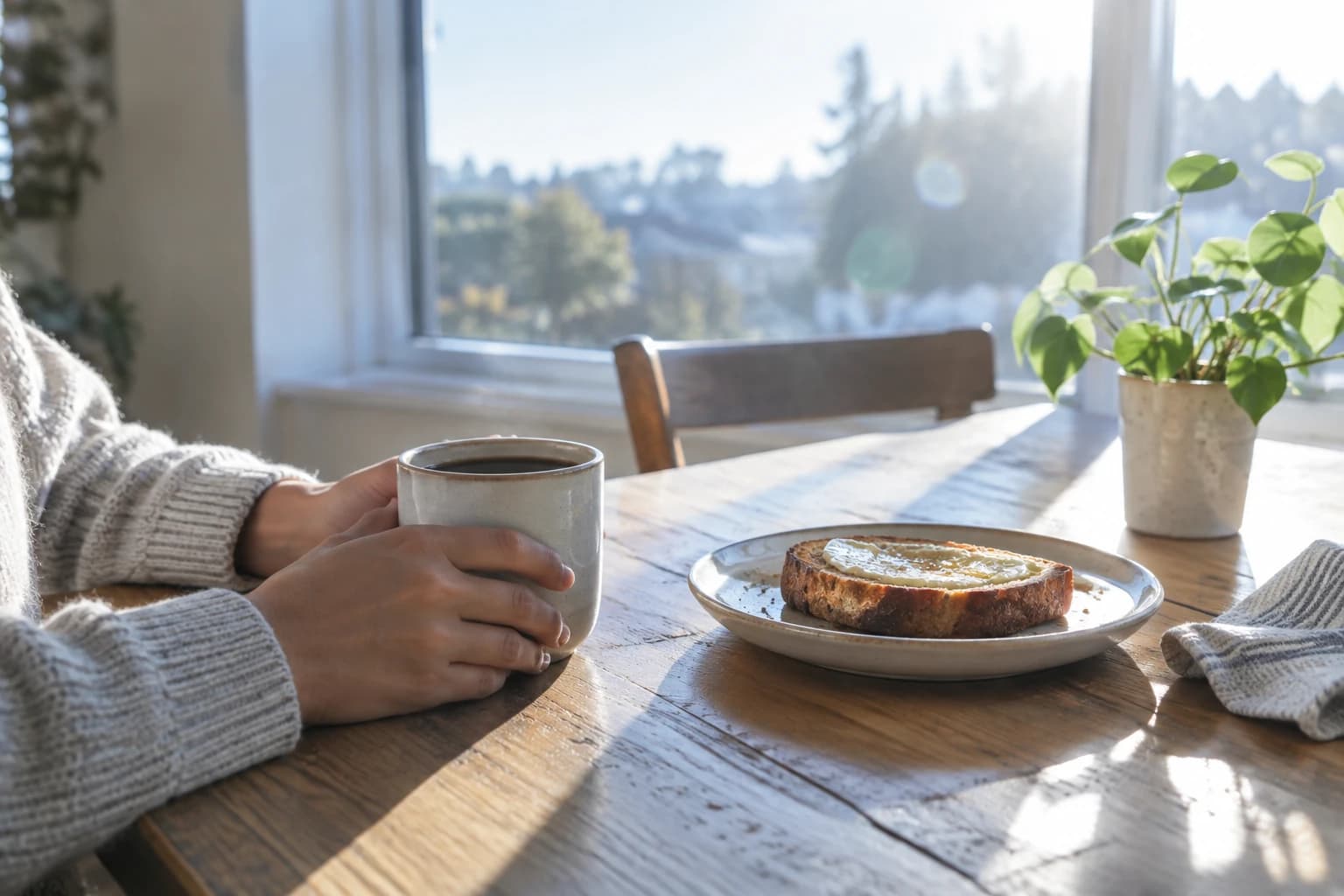
- Eat breakfast, drink your coffee, or take a short walk near a window or outdoors rather than in a dim room.
- Keep the timing roughly consistent, including on weekends — the adolescent study above specifically used weekend mornings because that's when schedules usually drift.
- Treat cloudy days as good enough. Outdoor light without direct sun is still far brighter than most indoor rooms.
Treat this as a habit layered on top of consistent sleep and wake times, not a replacement for them.
Who should pay extra attention
A few situations call for more specific guidance than a general wellness article can responsibly give:
Shift workers. If your work schedule puts your "morning" at an unconventional clock time, the advice above doesn't map cleanly onto your situation, since the goal may be to deliberately shift your clock rather than anchor it to sunrise. The CDC/NIOSH training material cited throughout this piece was written specifically for shift-working nurses for this reason — occupational-health guidance built for shift work fits better than a general morning routine.
Jet lag. Timed light exposure in the phase-advancing direction (bright light at your destination's local morning, particularly eastward) uses the same mechanism described throughout this article. The right protocol depends on the number of time zones and direction of travel, which is beyond a general explainer's scope — treat this as the mechanism behind that advice, not a personalized itinerary.
A diagnosed sleep or mood disorder. If you have a diagnosed condition such as insomnia disorder, delayed sleep-wake phase disorder, seasonal affective disorder, or bipolar disorder, talk to a clinician before making a deliberate, significant change to your light exposure. This matters most for concentrated light therapy, not ordinary daylight: clinical guidance for bipolar disorder specifically flags a small but real risk of triggering hypomania with bright light therapy, which is why it's typically started at a low dose and monitored by a clinician (Geoffroy et al., 2025). That's a reason for medical involvement in that specific case, not a reason to avoid ordinary morning daylight in general.
What we still don't know
A 2026 narrative review in the Journal of Pineal Research asked whether morning light can shift melatonin timing within the same day, rather than needing a full 24-hour cycle to show up. It found that modest same-day shifts (roughly 10 to 30 minutes) look possible under the right conditions, but called the effect "not well characterised" and in need of more targeted research (López-Velasco et al., 2026). In plain terms: even the researchers studying this don't yet have a precise, reliable answer for exactly how fast morning light works.
There's also no large randomized trial establishing one specific "dose" of morning light for a healthy general-population adult. The most precise dose-response data available comes from smaller studies in specific groups — adolescents, older adults, people with Parkinson's disease — not a broad trial in average healthy adults. That's a real limit on how specific this article, or any honest one, can be.
Morning light + evening darkness: the complete picture
This article is deliberately the other half of a pair. If you've already read about evening screens and blue light, you've covered the "avoid an unwanted phase delay at night" side of the clock. Morning light is the "actively reinforce the right phase" side — neither one substitutes for the other; they act on the same clock from opposite ends of the day. For the wider picture of what happens when your clock and your actual sleep schedule fall out of sync, see recovering from sleep debt.
One more distinction worth keeping clear: morning sunlight also triggers vitamin D synthesis in the skin, but that's a different pathway responding to a different part of sunlight (UV-B, absorbed by skin) than the one covered in this article (visible light, detected by the retina and relayed to the brain's circadian clock). Getting morning light for your sleep and getting enough vitamin D are both good reasons to go outside, but they're not the same mechanism, and satisfying one doesn't guarantee the other. For that separate topic, see vitamin D deficiency.
Frequently Asked Questions (FAQ)
How soon after waking should I get morning light, and does timing really matter that much? Yes, quite a bit. Most of the research behind this article specifically tested light in the first hour or so after normal wake time. Getting outside first thing is a reasonable habit to build around, though being an hour or two late on an occasional day won't undo the benefit.
How much morning light do I need, and does duration matter as much as timing? There's no single validated number for a healthy adult. A longer, brighter session shifted the clock more than a shorter one in one study, but a separate diary study found that simply getting morning sunlight at all mattered more for next-night sleep than how long it lasted. In practice, showing up consistently beats hitting an exact duration.
Does morning light exposure work on a cloudy day, or does it have to be direct sun? It doesn't have to be direct sun. Outdoor light on an overcast day is still much brighter than typical indoor lighting, and even fairly dim light has measurable effects on the circadian clock. Being outside matters more than the weather.
What's the difference between getting morning sunlight and using a light therapy box? Morning sunlight is free and is what most of the research in this article actually studied. Light therapy boxes are calibrated devices, typically used under clinical guidance for a specific diagnosed condition like seasonal affective disorder — not a general upgrade for a healthy person who can get outside. See the comparison table above for how the two, plus red-light devices, differ.
If I already limit evening screens, do I still need morning light too? Yes. They act on the same internal clock through different mechanisms, at opposite ends of the day. Limiting evening light mainly avoids an unwanted delay to your clock at night; morning light actively reinforces the earlier timing you want. Neither substitutes for the other — see our evening light and blue-light guide for that half of the picture.
Does morning light help with jet lag or shift work adjustment? The same phase-advancing mechanism underlies standard jet-lag advice about seeking light at your destination's local morning, especially traveling east. Shift work is more complicated, since the goal may be to deliberately shift your clock away from a typical daytime schedule — that's better served by occupational-health guidance for shift workers than a general morning routine.
Can a sunrise-simulating alarm clock substitute for real morning light? There's real trial evidence for simulated dawn light, but it comes from people with seasonal affective disorder, not healthy adults compared against real daylight. That shows dawn simulation is a genuine, studied intervention for seasonal depression — not that a consumer alarm clock replaces going outside for a generally healthy reader. See the "what we still don't know" and mechanism sections above for the underlying research.
Is it possible to get too much bright light exposure in the morning? For ordinary outdoor daylight, no research reviewed for this article points to a harm ceiling for a healthy adult. The relevant caution applies to concentrated light therapy, not daylight: it carries a small, clinically recognized risk of triggering hypomania in people with bipolar disorder, which is why it's introduced gradually and medically supervised in that population. If that applies to you, or to any diagnosed mood or sleep disorder, loop in your prescriber before making a significant, deliberate change to your light exposure.
How we made this guide: Researched, written, and fact-checked by The Wellness Voyage editorial team, with every physiological and clinical claim tied to a citable, peer-reviewed source — full citations are linked throughout and listed below. We review and update this article as new evidence emerges; the last-reviewed date is shown with this article. It is written to inform, not to replace personalised advice from a qualified healthcare professional.
Medical disclaimer: This article is for informational purposes only. Always consult a qualified healthcare provider before making changes to your health routine.
Sources
- Effects of Light on Circadian Rhythms — Work Hour Training for Nurses, National Institute for Occupational Safety and Health (NIOSH), CDC. https://www.cdc.gov/niosh/work-hour-training-for-nurses/longhours/mod2/19.html
- Tähkämö L, Partonen T, Pesonen AK. Systematic review of light exposure impact on human circadian rhythm. Chronobiology International, 2019 — PubMed. https://pubmed.ncbi.nlm.nih.gov/30311830/
- Misiunaite I, Eastman CI, Crowley SJ. Circadian Phase Advances in Response to Weekend Morning Light in Adolescents With Short Sleep and Late Bedtimes on School Nights. Frontiers in Neuroscience, 2020 — PubMed Central. https://pmc.ncbi.nlm.nih.gov/articles/PMC7029701/
- Anderson AR, Ostermiller L, Lastrapes M, Hales L. Does sunlight exposure predict next-night sleep? A daily diary study among U.S. adults. Journal of Health Psychology, 2025 (published online 2024) — PubMed. https://pubmed.ncbi.nlm.nih.gov/39077837/
- He M, Ru T, Li S, Li Y, Zhou G. Shine light on sleep: Morning bright light improves nocturnal sleep and next morning alertness among college students. Journal of Sleep Research, 2023 — PubMed. https://pubmed.ncbi.nlm.nih.gov/36058557/
- Obayashi K, Saeki K, Tai Y, Yamagami Y, Esaki Y, Yoshikawa T, Sugie K, Kataoka H. Daily light exposure profiles and the association with objective sleep quality in patients with Parkinson's disease: The PHASE study. Sleep, 2024 — PubMed Central. https://pmc.ncbi.nlm.nih.gov/articles/PMC11321845/
- Siraji MA, Spitschan M, Kalavally V, Haque S. Light exposure behaviors predict mood, memory and sleep quality. Scientific Reports, 2023 — PubMed. https://pubmed.ncbi.nlm.nih.gov/37528146/
- López-Velasco C, Reichert CF, Cajochen C. Can Morning Light Phase Advance Human Melatonin Rhythms in Less Than 24 h? Journal of Pineal Research, 2026 — PubMed. https://pubmed.ncbi.nlm.nih.gov/41832758/
- Terman M, Terman JS. Controlled trial of naturalistic dawn simulation and negative air ionization for seasonal affective disorder. American Journal of Psychiatry, 2006 — PubMed. https://pubmed.ncbi.nlm.nih.gov/17151164/
- Geoffroy PA, et al., for the International Society for Bipolar Disorders (ISBD) Chronobiology and Chronotherapy Task Force. Light therapy for bipolar disorders: Clinical recommendations. Dialogues in Clinical Neuroscience, 2025 — PubMed Central. https://pmc.ncbi.nlm.nih.gov/articles/PMC12291220/
All sources accessed 15 September 2026.

Sophia Martinez
A wellness researcher focused on what the evidence actually says.