If you've ever tried to meditate while anxious, you know the familiar trap: you sit down to calm your mind, and your mind responds by listing every worry it can find. This leads many people to conclude they "can't meditate." The opposite is closer to the truth. A noisy, overthinking mind isn't a disqualification from meditation — it's precisely the material the practice is designed to work with.
This guide covers what meditation can realistically do for anxiety and rumination, what the research actually shows, three techniques suited to a busy mind, and the clear signs that you need more than a meditation practice.
What meditation does — and doesn't do — for anxiety
Meditation doesn't switch off anxious thoughts. What it trains is your relationship to them. Overthinking runs on a simple loop: a thought appears, you treat it as urgent and true, you chase it, it spawns more thoughts. Mindfulness meditation teaches you to see the first link in that chain — "ah, a thought" — and to let it pass without automatically following it. The thoughts still come; you just stop being dragged behind every one.
That reframing matters because it sets honest expectations. You are not aiming for a silent mind. You are building the capacity to notice a worry, name it as a worry, and return your attention elsewhere. Done repeatedly, that loosens rumination's grip.
What the evidence actually shows
Here the news is encouraging but worth stating precisely.
A 2014 meta-analysis in JAMA Internal Medicine pooled dozens of trials and found mindfulness meditation programmes produced small-to-moderate reductions in anxiety and depression — modest, but real, and on par with what you'd expect from other active treatments (Goyal et al., 2014).
More striking is a 2022 randomised clinical trial published in JAMA Psychiatry. Researchers assigned 276 adults with diagnosed anxiety disorders to either an eight-week Mindfulness-Based Stress Reduction course or escitalopram, a standard first-line anti-anxiety medication. After eight weeks, the mindfulness course was non-inferior to the drug — that is, it worked about as well — for reducing anxiety symptoms (Hoge et al., 2022, JAMA Psychiatry).
Two cautions keep this in proportion. First, that was a structured, teacher-led, eight-week programme, not a few minutes on an app — the dose matters. Second, it doesn't mean meditation should replace medication; it means a serious mindfulness practice can be a legitimate option worth discussing with a clinician. The U.S. National Center for Complementary and Integrative Health reaches a similar balanced view: helpful for anxiety, not a cure-all (NCCIH).
Three techniques for a racing mind
Standard "watch your breath" advice can feel impossible when thoughts are flooding in. These approaches are gentler on an overactive mind.
1. Noting
Instead of fighting thoughts, label them. As each one arrives, quietly note its type — "planning," "worrying," "remembering" — then return to your breath. Naming a thought creates a sliver of distance between you and it, which is exactly the skill that weakens rumination. It also gives a busy mind a job, so it feels less like white-knuckling silence.
2. Anchoring in the body
When thoughts are too loud to observe, drop beneath them into the body. Feel the soles of your feet on the floor, your hands in your lap, the weight of your body on the chair. The body is always in the present tense, so it's a reliable anchor when the breath feels too subtle. This is also a good option for anyone who finds breath-focus makes anxiety worse.
3. The "and then?" question
Overthinking thrives on vague catastrophe. When you catch a spiralling worry, ask it plainly: "And then what?" Often the feared chain either resolves into something manageable or reveals itself as a loop with no real endpoint. This isn't classical meditation, but it's a mindful way to meet rumination with curiosity instead of fuel.
For in-the-moment physical calm to pair with these, our breathing exercises for stress guide gives you fast, body-level tools.
A simple practice to start
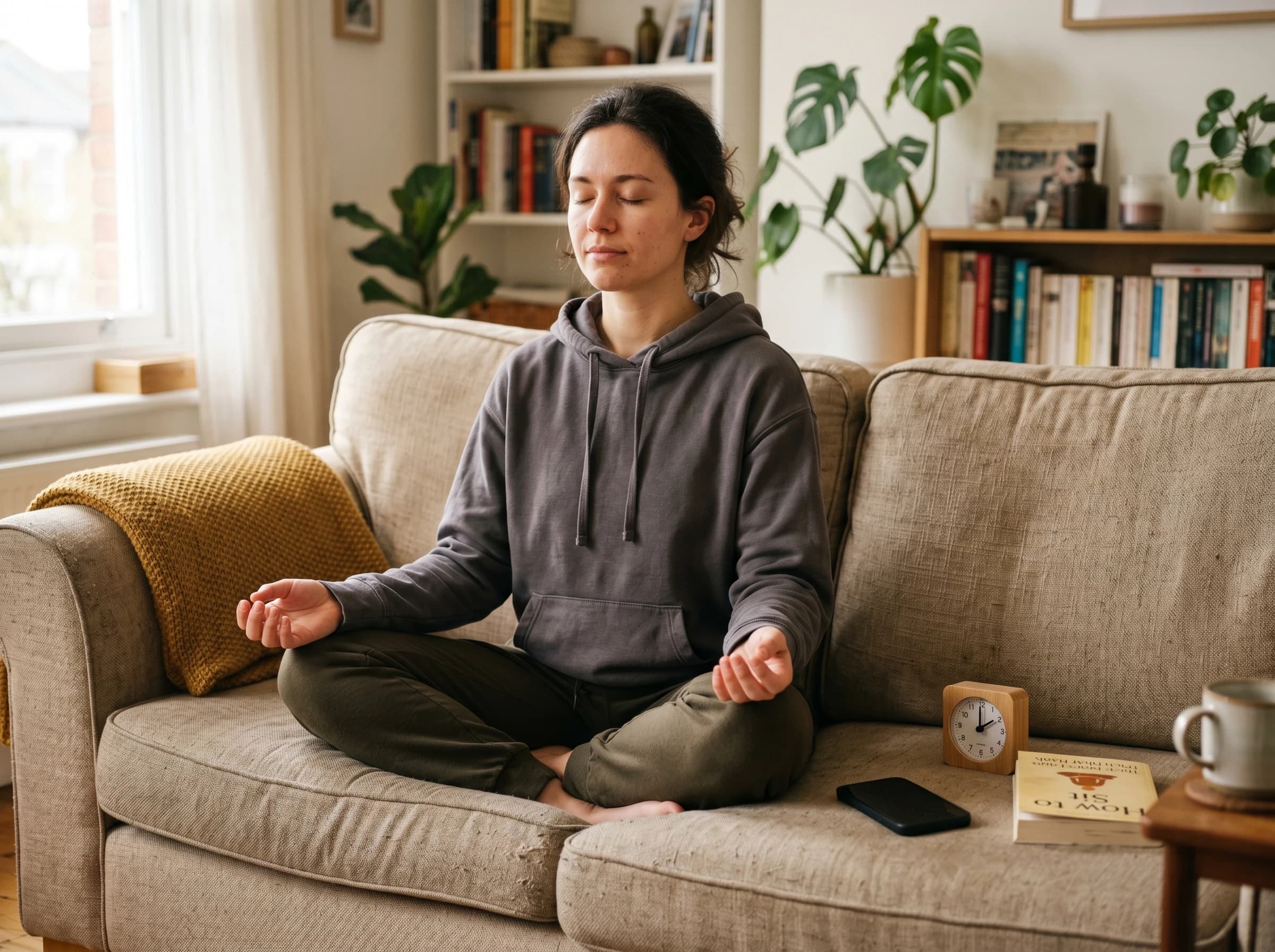
Try this for five to ten minutes a day:
- Sit upright and comfortable, eyes closed or gaze lowered.
- Rest your attention on your breath or the feeling of your feet on the floor.
- When a thought pulls you away — it will, constantly — note it ("thinking") and come back.
- Treat each return as a small success, not a correction. No frustration, no scorekeeping.
- When the timer ends, notice how your body feels before you get up.
If you're brand new to this, our mindfulness for beginners guide walks through the basics in more detail.
Common mistakes when meditating with anxiety
- Trying to force calm. Demanding relaxation creates pressure, which feeds anxiety. Aim to observe your state, not control it.
- Reading a wandering mind as failure. Returning attention is the practice. More wandering simply means more reps.
- Going too long, too soon. Long sessions can give anxious thoughts more room to escalate. Start short.
- Using meditation to avoid help. If anxiety is significant, meditation alone is the wrong tool for the whole job.
When to seek more support
Meditation is a self-care skill, not a treatment for a clinical condition. Please reach out to a qualified professional if anxiety is interfering with your work, sleep, relationships, or daily functioning; if you experience frequent panic attacks; or if worry feels constant and uncontrollable. The NCCIH notes that, while uncommon, meditation can occasionally intensify difficult emotions — so if a practice consistently leaves you more distressed, stop and seek guidance rather than pushing through (NCCIH). Asking for help is not a failure of practice; it's good judgement.
Where to go next
Meditation won't stop your mind from generating thoughts, and it isn't meant to. What it offers a tendency to overthink is space — a reliable beat between a worry and your reaction to it. Built patiently, that space is genuinely life-improving.
Keep the practice grounded in the fundamentals with our mindfulness basics guide, and for the wider emotional benefits of a steady practice, see mindfulness and emotional well-being.
Frequently Asked Questions (FAQ)
Why does meditation sometimes make my anxiety worse? Sitting quietly can briefly amplify worries you'd been outrunning, and close focus on the breath can feel uncomfortable for some. Usually it eases with shorter, body-anchored, eyes-open practice. If it consistently worsens, stop and speak to a professional.
How long until meditation helps my anxiety? The strongest evidence comes from eight-week structured programmes, so think in weeks, not days. Many people notice small shifts — a little more space before reacting — within two to three weeks of daily practice.
What type of meditation is best for overthinking? Mindfulness-based approaches, especially noting and body-anchoring, are well suited to rumination because they teach you to observe thoughts rather than engage them.
Is it better to meditate or use breathing exercises when anxious? For an acute spike, breathing exercises act faster on the body. For the longer-term habit of relating differently to anxious thoughts, meditation does more. Most people benefit from both.
How we made this guide: Researched, written, and fact-checked by The Wellness Voyage editorial team, with every health claim backed by a citable source — recognised health authorities and peer-reviewed studies are linked throughout and listed in full below. We fact-check and review this article periodically and update it as the evidence changes; the last reviewed and updated date is shown with this article. It is written to inform, not to replace personalised advice from a qualified healthcare professional.
Medical disclaimer: This article is for informational purposes only. Always consult a qualified healthcare provider before making changes to your health routine.
Sources
- Hoge EA, et al. Mindfulness-Based Stress Reduction vs Escitalopram for the Treatment of Adults With Anxiety Disorders: A Randomized Clinical Trial. JAMA Psychiatry, 2022. https://jamanetwork.com/journals/jamapsychiatry/fullarticle/2798510
- Goyal M, et al. Meditation Programs for Psychological Stress and Well-being: A Systematic Review and Meta-analysis. JAMA Internal Medicine, 2014. https://jamanetwork.com/journals/jamainternalmedicine/fullarticle/1809754
- National Center for Complementary and Integrative Health (NCCIH). Meditation and Mindfulness: Effectiveness and Safety. https://www.nccih.nih.gov/health/meditation-and-mindfulness-effectiveness-and-safety
All sources accessed 29 April 2026.

Sophia Martinez
A wellness researcher focused on what the evidence actually says.