
If a protein shake leaves you queasy, it is almost always one of a handful of specific things: the lactose in whey or casein, the sugar alcohols or artificial sweeteners used to keep it low-sugar, a big dose chugged too fast right after a hard workout, or, less commonly, a genuine allergy to milk, soy, or egg protein. None of these require you to give up shakes entirely — they just need to be matched correctly to what's actually going on in your gut.
Lactose is the most common trigger
Whey and casein, the two proteins behind nearly every mainstream powder, are both derived from milk, and unless a product is specifically an isolate or labeled lactose-free, some lactose usually comes along with them. Roughly 70% of adults worldwide have reduced lactase activity, the enzyme needed to break lactose down, according to a clinical review of lactose intolerance in Alimentary Pharmacology & Therapeutics (Lomer et al., 2008). In someone with clinically significant intolerance, undigested lactose passes into the colon, where gut bacteria ferment it and draw in water — the exact mechanism behind the bloating, gas, and nausea that review documents. If this sounds like you, a whey protein isolate (which has the lactose largely removed during processing) or a lactose-free label is worth trying before switching proteins entirely.
Casein digests slowly on purpose — that can feel heavy
Not all protein sources leave the stomach at the same speed, and that difference is well established, not incidental. A classic study comparing the two milk proteins found that whey produces a fast, sharp spike in blood amino acids, while casein clots in the stomach's acidic environment and releases amino acids slowly over several hours, largely because of that delayed gastric emptying (Boirie et al., 1997, PNAS). That means a casein-heavy shake sits in the stomach longer than a whey-only one, and on a stomach that's already unsettled, dehydrated, or empty, that slower emptying can register as heaviness or queasiness rather than simple fullness.

Sugar alcohols and sweeteners have a real, dose-dependent threshold
Many low-sugar protein powders are sweetened with sugar alcohols like sorbitol, xylitol, maltitol, or erythritol, or with sweeteners like sucralose. Sugar alcohols in particular are absorbed slowly and incompletely in the small intestine, so a meaningful share reaches the colon, where they draw in water osmotically and get fermented by bacteria — producing the gas, bloating, cramping, and nausea described in a review of sugar alcohol tolerance in the International Journal of Dentistry (Mäkinen, 2016). That review also lays out how much it typically takes to trigger symptoms in a healthy adult, and the thresholds vary a lot by sweetener:
| Sweetener | Single dose that commonly triggers GI symptoms |
|---|---|
| Sorbitol | Osmotic diarrhea often begins around 20–50 g |
| Xylitol | Most adults tolerate up to 10–30 g before diarrhea |
| Maltitol / isomalt | Symptoms become common above roughly 50 g/day |
| Erythritol | Tolerated up to about 0.7 g per kg body weight without a laxative effect |
Source: Mäkinen, 2016.
Sugar alcohols also turn up in sugar-free gum, "keto" bars, and diet drinks, so it's worth checking your day's total intake rather than just the shake in isolation if you're stacking several sugar-free products. Erythritol's much higher threshold before symptoms appear is one reason it has become a common sweetener choice in newer protein powders.
Chugging a shake right after a hard set
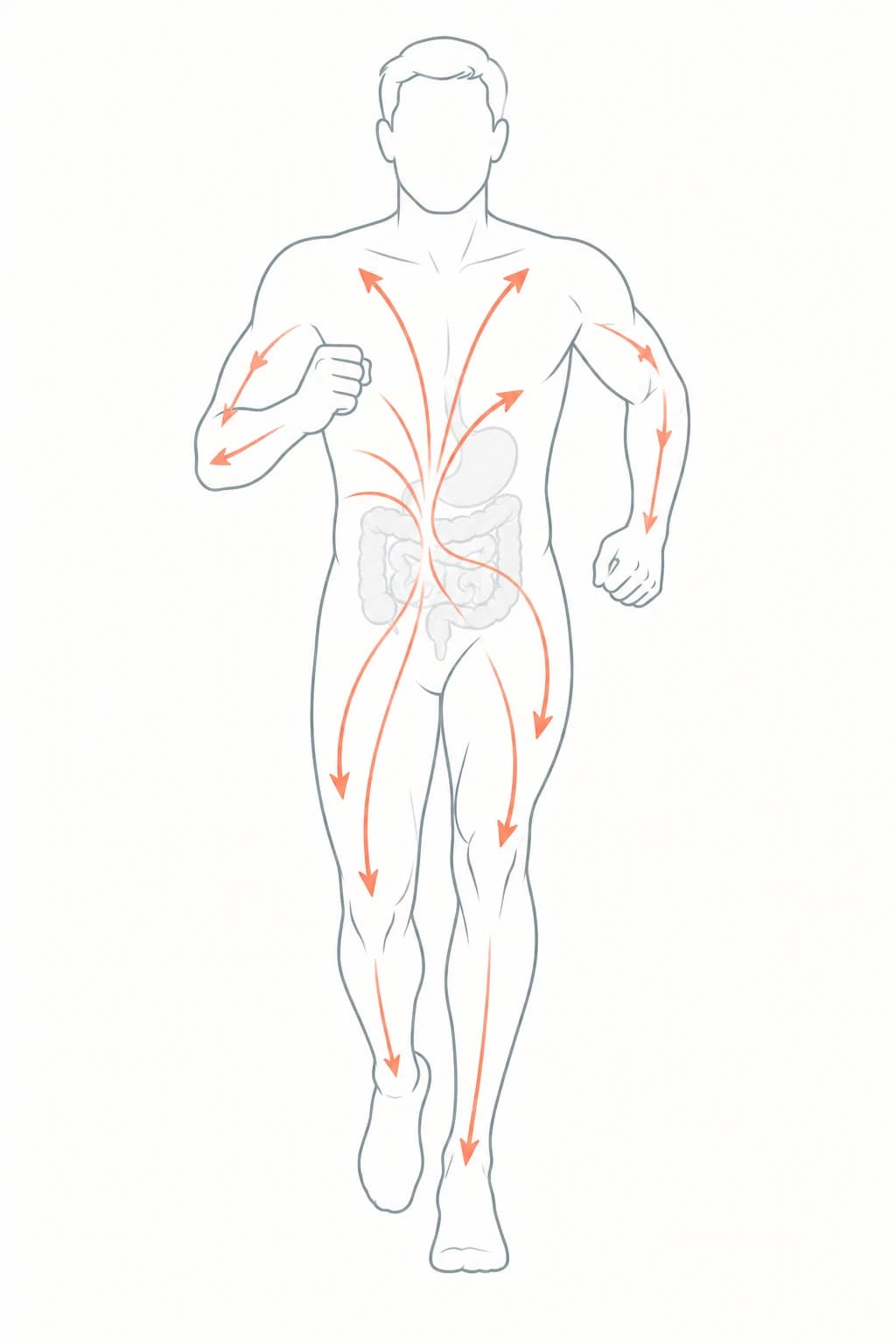
Timing matters for a reason that has nothing to do with folklore about "anabolic windows." During exercise, the sympathetic nervous system redirects blood flow away from the gut and toward working muscle, and with enough intensity or duration, splanchnic (gut) blood flow can drop substantially — a mechanism reviewed in Alimentary Pharmacology & Therapeutics as a driver of exercise-related GI symptoms, including impaired motility and nutrient absorption (ter Steege & Kolkman, 2012). Mixing a large, thick shake and drinking it fast the moment you rack the weights or step off the treadmill means asking a digestive system that's still running on reduced blood flow to process a big load immediately. Giving it a few minutes to settle, and sipping rather than gulping, gives that circulation time to normalize first.
How much is too much in one sitting
The International Society of Sports Nutrition's position stand on protein and exercise puts general daily protein needs for people training regularly at 1.4–2.0 g per kilogram of body weight per day, and notes that for maximizing muscle protein synthesis, the evidence favors spreading intake across the day in doses of roughly 20–40 g (about 0.25 g/kg) every three to four hours rather than one large serving (Jäger et al., 2017). A shake that packs two or three times a standard serving into one sitting isn't dangerous, but it is simply a bigger digestive job to handle at once than the amount the evidence associates with optimal absorption and comfort.
When it's an actual allergy, not an intolerance
True allergies to milk, soy, or egg protein are a different mechanism entirely from lactose intolerance: they're immune-mediated rather than a missing digestive enzyme, and a comprehensive review of food allergy in the Journal of Allergy and Clinical Immunology describes reactions ranging from mild nausea and cramping to hives, swelling, and in severe cases anaphylaxis (Sicherer & Sampson, 2018). If you notice hives, swelling, or breathing trouble alongside the nausea, that points toward allergy rather than intolerance, and it's worth getting evaluated rather than just switching brands.
Matching the shake to the mechanism
Most protein shake nausea traces back to one of these five things, and each has a specific fix: go lactose-free or plant-based if it's the milk sugar, don't stack sugar-free products on top of each other if it's the sweetener, let your heart rate settle and sip slowly if it's post-workout timing, split a big dose into smaller ones if it's sheer volume, and see a doctor if hives or swelling show up alongside the stomach upset. For more on how the digestive side of protein intake plays out, see our pieces on why you're still hungry after eating protein, why protein can make you sleepy, and what actually reduces bloating quickly.
Sources
- Lomer MC, Parkes GC, Sanderson JD. Review article: lactose intolerance in clinical practice—myths and realities. Alimentary Pharmacology & Therapeutics. 2008;27(2):93-103. PMID: 17956597. https://pubmed.ncbi.nlm.nih.gov/17956597/
- Boirie Y, Dangin M, Gachon P, Vasson MP, Maubois JL, Beaufrère B. Slow and fast dietary proteins differently modulate postprandial protein accretion. Proceedings of the National Academy of Sciences. 1997;94(26):14930-14935. PMID: 9405716. https://pubmed.ncbi.nlm.nih.gov/9405716/
- Mäkinen KK. Gastrointestinal Disturbances Associated with the Consumption of Sugar Alcohols with Special Consideration of Xylitol: Scientific Review and Instructions for Dentists and Other Health-Care Professionals. International Journal of Dentistry. 2016. PMC5093271. https://pmc.ncbi.nlm.nih.gov/articles/PMC5093271/
- ter Steege RWF, Kolkman JJ. Review article: the pathophysiology and management of gastrointestinal symptoms during physical exercise, and the role of splanchnic blood flow. Alimentary Pharmacology & Therapeutics. 2012;35(5):516-528. PMID: 22229513. https://pubmed.ncbi.nlm.nih.gov/22229513/
- Jäger R, Kerksick CM, Campbell BI, et al. International Society of Sports Nutrition Position Stand: protein and exercise. Journal of the International Society of Sports Nutrition. 2017;14:20. PMID: 28642676. https://pubmed.ncbi.nlm.nih.gov/28642676/
- Sicherer SH, Sampson HA. Food allergy: a review and update on epidemiology, pathogenesis, diagnosis, prevention, and management. Journal of Allergy and Clinical Immunology. 2018;141(1):41-58. PMID: 29157945. https://pubmed.ncbi.nlm.nih.gov/29157945/
All sources accessed 10 July 2026.

Olivia Smith, RDN
Registered Dietitian Nutritionist (RDN) and habit specialist, answering everyday questions about hunger, protein, and sustainable eating.