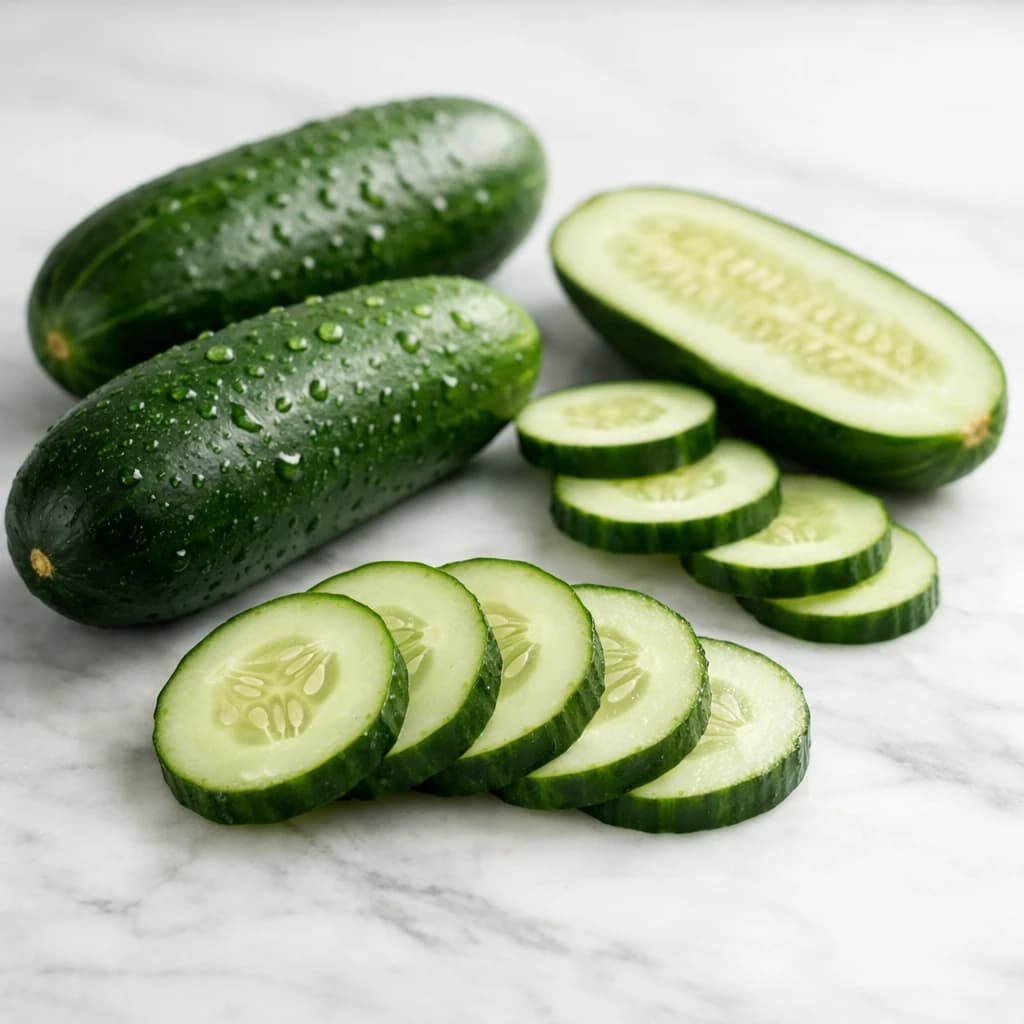
Cucumber gets talked about like a miracle food: better skin, weight loss, detox, heart health. The honest version is simpler. Cucumber is a pleasant, refreshing, very low-calorie vegetable that is mostly water. Eating one every day is a perfectly good habit, but it will not transform your health, and most of the dramatic claims oversell what a watery vegetable can do. Here is the realistic picture.
What's actually in a cucumber
Cucumbers are about 96% water, which is the single most important fact about them. A medium cucumber with the peel (roughly 300 g) provides only about 45 calories (USDA FoodData Central). Its standout nutrient is vitamin K, which it supplies a meaningful amount of, along with smaller amounts of potassium and magnesium. Fiber is low, around 2 grams for a whole cucumber, most of it in the peel.
In short: cucumber is light, hydrating, and low in calories, with one genuinely useful nutrient and a scattering of others in small amounts. That is a good thing to have in your diet. It is not a nutritional powerhouse.
What cucumber genuinely does well
It helps with hydration. Water from food counts toward your daily fluid intake, and at 96% water, cucumber is one of the more hydrating foods you can eat (Popkin et al., 2010). For people who find plain water boring, cucumber in meals or infused water is an easy way to drink a bit more.
It adds volume for very few calories. Because it is bulky and almost calorie-free, cucumber can help a meal feel more filling without adding much energy. In controlled research, starting a meal with a large, low-calorie vegetable portion reduced how much people ate overall (Rolls et al., 2004). Swapping a calorie-dense snack for cucumber sticks is a reasonable, low-effort change, though it is a small piece of the picture rather than a strategy on its own.
It adds a little fiber. Cucumber's modest fiber, mostly in the peel, contributes to regularity. Fiber as a whole helps stool frequency, though the effect of any single low-fiber food like cucumber is small (Yang et al., 2012). For real digestive benefit, the fiber across your whole diet matters far more.
Where the claims oversell
This is where honesty matters. A vegetable that is 96% water, with about 2 grams of fiber and trace plant compounds, simply cannot do most of what the internet credits cucumber with.
- Cholesterol and heart disease. You will see claims that cucumber's fiber "binds cholesterol." With roughly 2 grams of fiber, the effect is negligible. Cucumber fits nicely into a heart-healthy, potassium-rich pattern like the DASH diet, but it is a minor contributor, not a driver (Sacks et al., 2001).
- Kidney stones and "detox." The kidney benefit attributed to cucumber is really just hydration, which any fluid provides. Cucumber is not a detox agent; your liver and kidneys handle that.
- Anti-inflammatory therapy. Cucumber contains flavonoids like quercetin, but in tiny amounts. The lab studies people cite use concentrations you could never reach from eating cucumbers.
None of this means cucumber is bad. It means the honest benefit is "a hydrating, low-calorie vegetable that fits a healthy diet," not "a daily cure." And variety across many vegetables does far more for you than leaning on any single one.
A few genuine cautions
- Bitter cucumbers. Cucumbers naturally contain cucurbitacin, a bitter compound that can cause stomach upset in larger amounts. Modern varieties are bred to have little of it, but if a cucumber tastes unusually bitter, throw it out.
- Blood thinners. Because cucumber provides vitamin K, which affects blood clotting, people on warfarin or similar medication should keep their vitamin K intake steady rather than suddenly eating a lot more. If you take an anticoagulant, mention dietary changes to your doctor.
- Sensitive digestion. The skin and seeds can cause gas or bloating for some people, especially with IBS. Peeling and deseeding usually fixes it while keeping the hydration. If raw vegetables in general give you trouble rather than cucumber specifically, why salad can upset your stomach works through which ingredient is the likely cause.
The bottom line
Eating cucumber every day is a fine, healthy habit. It hydrates, adds satisfying volume for almost no calories, and brings a little vitamin K and fiber. Just keep expectations realistic: it is mostly water, and it works best as one of many vegetables rather than a daily miracle. For a related deep dive, see our gherkin and pickle guide, our look at foods that reduce bloating quickly, or browse our nutrition guides.
Frequently Asked Questions (FAQ)
How much cucumber should I eat per day? One medium cucumber is a fine amount for most adults, but there is no need to hit a daily target. A variety of vegetables gives you more than any single one, so cucumber is best as one option among many.
Is cucumber actually filling? It can be, mostly because of its water and volume. Eating it before or with a meal adds bulk for very few calories, which can take the edge off hunger, but it is not a weight-loss tool on its own.
Is it better to eat cucumber raw or cooked? Raw keeps the most water and vitamin C. Cooking reduces both. Since the appeal of cucumber is its freshness and water, raw is the usual choice.
Does cucumber have real nutritional value? Some. It is genuinely useful for hydration and is a decent source of vitamin K, with small amounts of potassium and magnesium. But it is about 96% water, so it is light on most nutrients compared with denser vegetables.
Medical disclaimer: This article is for informational purposes only. Always consult a qualified healthcare provider before making changes to your health routine.
Sources
- USDA FoodData Central. Cucumber, with peel, raw. https://fdc.nal.usda.gov/
- Popkin BM, D'Anci KE, Rosenberg IH. Water, hydration, and health. Nutrition Reviews, 2010 — PubMed. https://pubmed.ncbi.nlm.nih.gov/20646222/
- Rolls BJ, Roe LS, Meengs JS. Salad and satiety: energy density and portion size of a first-course salad affect energy intake at lunch. Journal of the American Dietetic Association, 2004 — PubMed. https://pubmed.ncbi.nlm.nih.gov/15389416/
- Yang J, et al. Effect of dietary fiber on constipation: a meta-analysis. World Journal of Gastroenterology, 2012 — PubMed. https://pubmed.ncbi.nlm.nih.gov/23326148/
- Sacks FM, et al. Effects on blood pressure of reduced dietary sodium and the DASH diet. New England Journal of Medicine, 2001 — PubMed. https://pubmed.ncbi.nlm.nih.gov/11136953/
All sources accessed 31 May 2026.

Sophia Martinez, MS, CNS
A wellness researcher focused on what the evidence actually says.