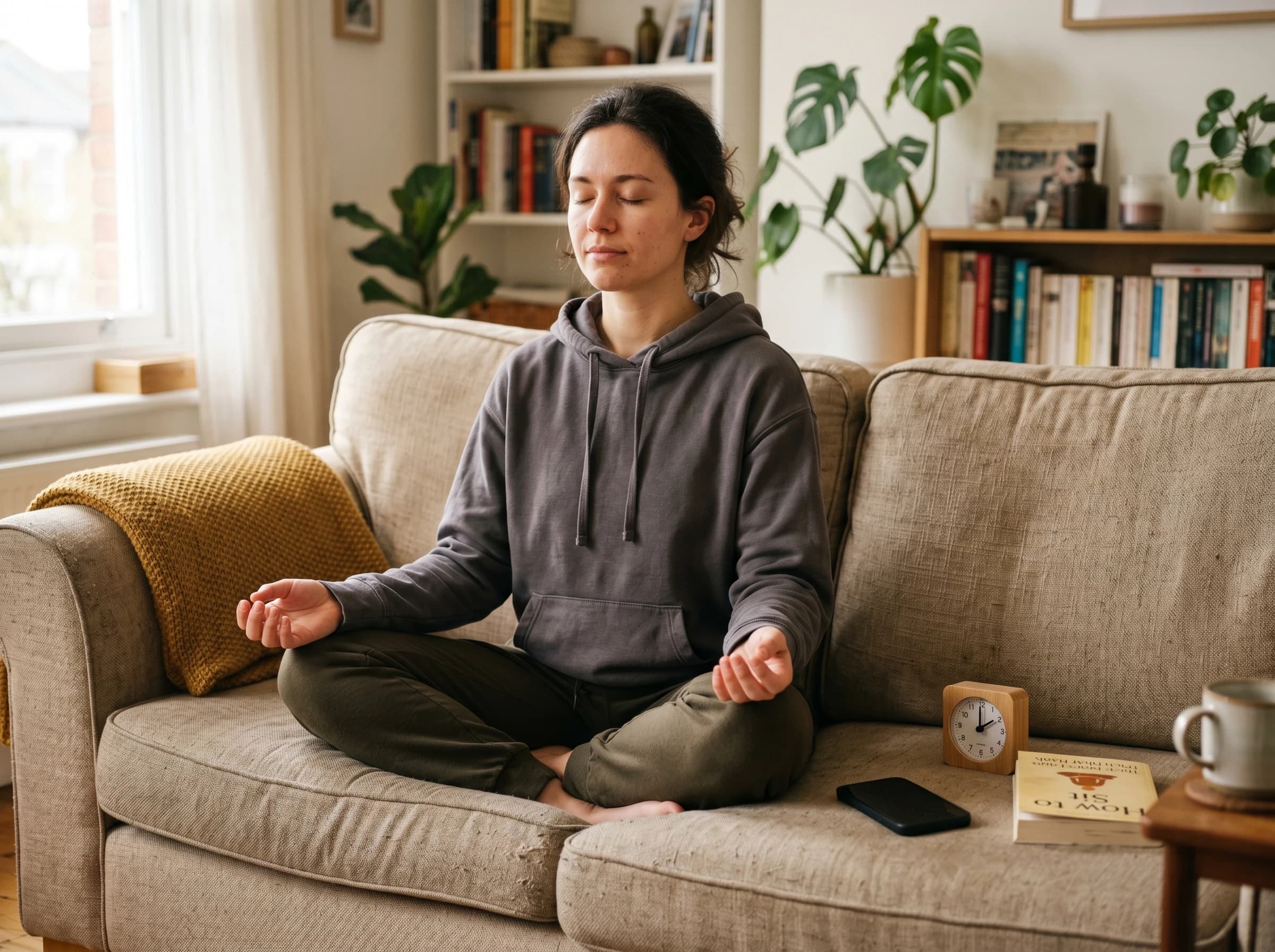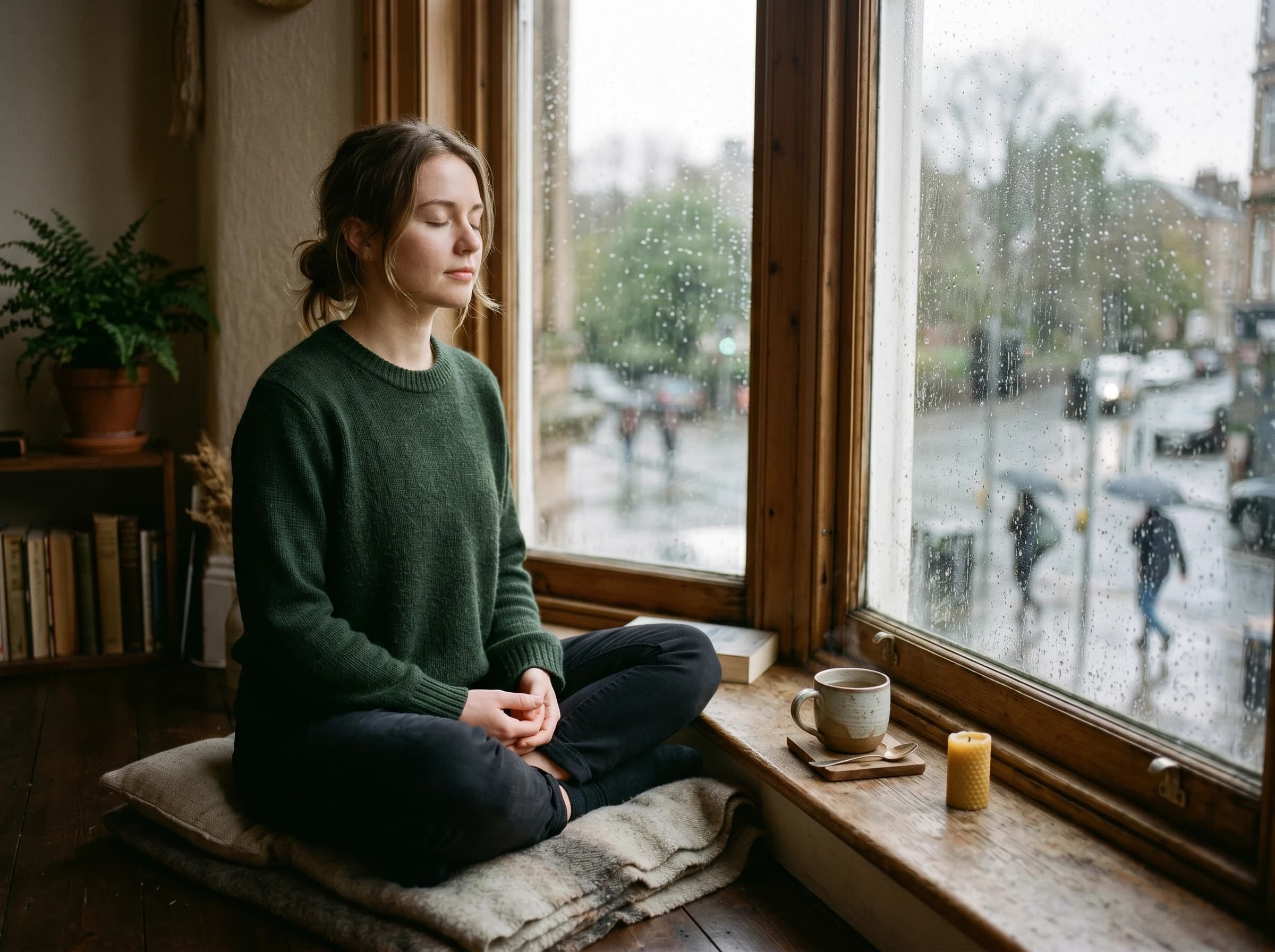
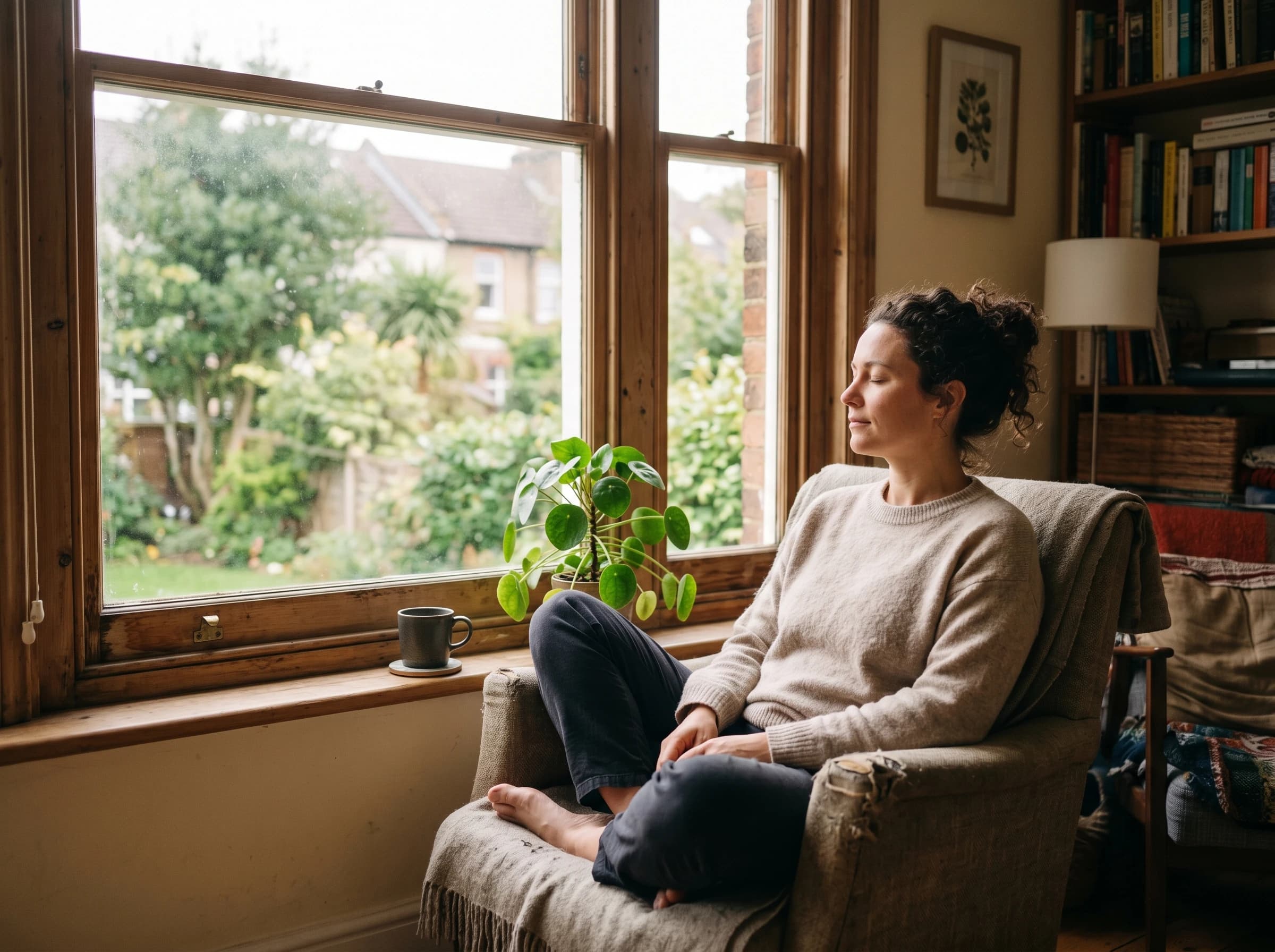
"Mindfulness means paying attention in a particular way: on purpose, in the present moment, and non-judgmentally." That is Jon Kabat-Zinn's own definition, from Wherever You Go, There You Are (1994) — the book that helped carry mindfulness out of Buddhist meditation halls and into mainstream medicine. Strip away everything added to it since — the apps, the cushions, the promises — and it holds up as the entire, unglamorous, genuinely useful skill: noticing what is happening right now, on purpose, without rushing to judge or fix it. It will not empty your mind or erase stress, but practised regularly it can change how you relate to both.
This guide covers what mindfulness actually is, what the research does and does not support, and how to fold small amounts of it into a normal, busy day.
What mindfulness actually means
Mindfulness is the act of paying attention to the present moment — your breath, your body, your surroundings, the task in front of you — while letting thoughts and feelings come and go without getting swept up in them. The modern clinical version traces back to 1979, when Jon Kabat-Zinn founded the Stress Reduction Clinic at the University of Massachusetts Medical School and built an eight-week course, Mindfulness-Based Stress Reduction (MBSR), to teach it to patients with chronic pain and stress (UMass Memorial Health).
A common misconception is that mindfulness means clearing your head. It does not. The mind produces thoughts the way the heart produces beats — constantly. The practice is not to stop thinking but to notice when your attention has wandered and gently bring it back. That returning, repeated thousands of times, is the exercise.
For a fuller look at how this fits into a broader way of living, see our companion piece on what mindful living means.
Mindfulness vs. meditation
The two words get used as if they were interchangeable, but they are not, and the difference matters for how you actually get started.
Mindfulness is the skill itself: a way of relating to whatever is happening right now, on purpose and without judgment. Meditation is one method for training that skill — a period of time set aside to practise it directly. You can be mindful without ever sitting down to meditate (while walking, eating, or washing dishes), and MBSR uses seated, breath- and body-based meditation as its main teaching tool, which is why the two get fused in most people's minds.
| Mindfulness | Meditation | |
|---|---|---|
| What it is | An attention skill — a way of relating to the present moment | A formal practice used to train that skill |
| When you do it | Any time, during any activity | A period of time set aside for it |
| What holds your attention | Whatever is happening right now | Usually one chosen anchor — breath, body, sound |
| How long it takes | Seconds to a few minutes, repeated through the day | Typically several minutes in one sitting |
| The goal | Notice, and gently return, without judging yourself for drifting | Build the attention skill through repeated practice |
If you want a structured way to build the meditation habit specifically, our mindfulness for beginners guide walks through it step by step.
Why the present moment is worth defending
If staying present sounds like a small thing, consider how rarely we manage it. In a widely cited 2010 study, researchers sampled the thoughts of more than 2,200 people at random moments during their day. People's minds were wandering — thinking about something other than what they were doing — almost half the time, and they reported being less happy when their minds wandered, regardless of what they were doing. The analysis suggested the wandering tended to cause the low mood, not the other way around (Killingsworth & Gilbert, 2010, Science).
That is the quiet case for mindfulness. Much of our stress is not about the present at all; it is rehearsal of the future and replay of the past. Learning to notice when you have drifted, and to come back, gives you a small but real lever on your own attention.
What the evidence supports — and what it doesn't
Mindfulness is well studied, which means we can be specific rather than enthusiastic.
The most careful summary remains a 2014 meta-analysis in JAMA Internal Medicine, which pooled 47 trials and found that mindfulness meditation programmes produced small-to-moderate reductions in anxiety, depression, and pain. The authors were candid that effects were modest and that meditation was not shown to outperform active treatments like medication or exercise (Goyal et al., 2014).
More recent evidence backs a stronger, head-to-head comparison. A 2023 randomized trial (the TAME trial) directly compared an eight-week MBSR course with escitalopram, a standard first-line anxiety medication, in 208 adults with a diagnosed anxiety disorder. On the primary anxiety measure, MBSR was not statistically different from the medication and met the trial's pre-set bar for noninferiority — and study-related adverse events were far less common in the MBSR group (15.4%) than in the escitalopram group (78.6%) (Hoge et al., 2023).
The U.S. National Center for Complementary and Integrative Health reaches a similar verdict: mindfulness-based approaches can help with anxiety, depression, and insomnia, with sleep effects comparable to other established methods, while the evidence for chronic pain is more mixed (NCCIH).
So the honest framing is this: mindfulness is a useful, low-cost skill that modestly helps mood, stress, and sleep for many people. It is not a cure, not a replacement for treatment of a diagnosed condition, and not equally effective for everyone. If you are dealing with significant anxiety or depression, treat it as a helpful companion to professional care, not a substitute. We go deeper into that in meditation for anxiety and overthinking.
What this looks like in an ordinary day
You do not need a free hour or a quiet room. These are illustrations of the definition above, not a full routine — they show what "paying attention on purpose" actually looks like in practice.
One conscious breath
Before you start your car, open your laptop, or answer a call, take a single slow breath and notice it fully. One breath is impossible to fail at, which is exactly why it works as a starting point.
Body scan
Lying down or seated, move your attention slowly through your body — feet, legs, torso, arms, head — noticing whatever sensation is there, without trying to change it. Three minutes before sleep is enough to feel the difference.
Walking meditation
Pick a short, ordinary walk — to the kitchen, the mailbox, between meetings — and give it your full attention: each foot making contact, the shift of weight, the air on your skin. No phone, no podcast.
Mindful eating
Choose one meal or snack and eat it without a screen. Notice the texture, the temperature, the taste — and how quickly the urge to reach for your phone shows up once there is nothing else to look at.
Any one of these, repeated daily, is enough to start noticing the shift the research above describes.
Common mistakes that make people quit
Most people who "fail" at mindfulness are simply running into predictable traps:
- Expecting a blank mind. A busy mind is not a sign you are doing it wrong. Noticing the busyness is the practice working.
- Judging the practice as good or bad. Some sessions feel calm, others feel restless. Both count. Consistency matters far more than quality.
- Going too big too soon. Twenty minutes on day one usually leads to day two never happening. Start with three.
- Treating it as a performance. There is nothing to achieve and no level to reach. The goal is the doing, not a destination.
When to be cautious
Mindfulness is safe for most people, but it is not universally gentle.
If you have a trauma history or a serious mental health condition
The NCCIH notes that adverse effects, while uncommon, can occur, and that meditation may occasionally intensify difficult emotions (NCCIH). Start with shorter, eyes-open practices and, ideally, guidance from a qualified teacher or therapist. If a practice consistently increases distress, stop and seek support rather than pushing through.
Where to go next
Mindfulness is less a thing you learn and more a habit you keep returning to. Pick one of the four practices above, attach it to something you already do daily, and let it be small enough that you cannot talk yourself out of it.
From here, the supporting guides in this cluster go deeper: calm your body quickly with breathing exercises for stress, work with a racing mind in meditation for anxiety and overthinking, and build a sustainable morning mindfulness routine. For the emotional side of the practice, our piece on mindfulness and emotional well-being is a natural next read. And once you are ready to turn any of this into an actual daily habit, our mindfulness for beginners guide (linked above) is the place to start.
Frequently Asked Questions (FAQ)
What is mindfulness in simple terms? Paying attention to what is happening right now — your breath, your body, what you are doing — without judging it or trying to change it. That is the whole skill. Everything else is just practice.
Is mindfulness the same as meditation? No. Mindfulness is the skill of present-moment attention. Meditation is one way to train it, by setting aside time to practise. You can also be mindful while walking, eating, or washing dishes.
Is it religious? The clinical forms of mindfulness used in healthcare are secular. The techniques have roots in contemplative traditions, but you can practise the attention skill without any spiritual framework at all.
How long does it take to feel the benefits? Many people notice they are a little calmer or less reactive within a few weeks of short daily practice. Clinical studies usually run programmes over eight weeks. There is no fixed timeline, and it is normal for progress to feel uneven.
Do I need an app or a teacher to start? No. Apps and teachers can help, especially early on, but everything in this guide can be done for free with nothing but your own attention. Start solo, add support if you want it.
How often should I practise? A little, often. Five minutes most days beats an hour once a week. Mindfulness behaves like a muscle: frequency builds it faster than intensity.
What if I keep forgetting to do it? That is the most common obstacle, and the fix is structural, not motivational. Anchor the practice to an existing habit — your morning coffee, your commute, brushing your teeth — so the cue is already built into your day.
How we made this guide: Researched, written, and fact-checked by The Wellness Voyage editorial team, with every health claim backed by a citable source — recognised health authorities and peer-reviewed studies are linked throughout and listed in full below. We fact-check and review this article periodically and update it as the evidence changes; the last reviewed and updated date is shown with this article. It is written to inform, not to replace personalised advice from a qualified healthcare professional.
Medical disclaimer: This article is for informational purposes only. Always consult a qualified healthcare provider before making changes to your health routine.
Sources
- Goyal M, et al. Meditation Programs for Psychological Stress and Well-being: A Systematic Review and Meta-analysis. JAMA Internal Medicine, 2014. https://jamanetwork.com/journals/jamainternalmedicine/fullarticle/1809754
- National Center for Complementary and Integrative Health (NCCIH). Meditation and Mindfulness: Effectiveness and Safety. https://www.nccih.nih.gov/health/meditation-and-mindfulness-effectiveness-and-safety
- Killingsworth MA, Gilbert DT. A Wandering Mind Is an Unhappy Mind. Science, 2010. https://www.science.org/doi/10.1126/science.1192439
- UMass Memorial Health. Mindfulness-Based Stress Reduction (MBSR). https://www.ummhealth.org/services-treatments/center-mindfulness/mindfulness-programs/mbsr
- Hoge EA, et al. Mindfulness-Based Stress Reduction vs Escitalopram for the Treatment of Adults With Anxiety Disorders: A Randomized Clinical Trial. JAMA Psychiatry, 2023. https://jamanetwork.com/journals/jamapsychiatry/fullarticle/2798510
All sources accessed 10 September 2026.

Sophia Martinez
A wellness researcher focused on what the evidence actually says.